WALTER FITZGILBERT DE HAMILTON

Boiled down for simplicity:

It would be a remarkable occurrence by the kinship system operating at the time if Walter FitzGilbert de Hamilton was not a son of Gilbert de Colville, shown in the Writs of Military Service of 1292 in Scotland as Gilbertus Coleville, a son of Walter de Colville; of a family well established in Scotland, and which were kin of the Comyns and Umframvilles. He was given the confiscated lands of the former family, and his descendants used the armorial bearings of the latter.

HAMILTON TEMPLATE

I feel it incumbant to amend the above statement:

It would be an absurdity by the kinship system operating at the time if Walter FitzGilbert de Hamilton was not a son of Gilbert de Colville; but an absurdity given breath by attempts of the living to construct events to suit their need.

m.s.

See also: https://walterfitzgilbertdehamilton.wordpress.com/2016/09/01/hamilton-fairy-tales/

Posted in Uncategorized | Leave a comment

PENNINGTON AND TYRWHITT OF VIRGINIA

In searching for Henry Pennington of Virginia, it may be prudent to concentrate on the ‘main trunk’ of this family rather than its outlying ‘yeoman’ branches, which, by deduction, was likely to have stemmed from a younger brother of William Pennington, 1517-1571, sheriff of Cumberland, as follows, and which spread to the likes of Coulton and Furness fells in the lordship of Furness.

In one sense, the identity of Henry Pennington of Virginia is as unlikely to be discovered as that of his son-in-law, George Trewitt (Tyrwhitt); yet, if families of Pennington and Tyrwhitt can be found in England to have been closely connected, then these connections almost certainly are the ones repeated in Virginia – the ‘continuation of associations’ being the 24 carat hallmark of the English kinship system.

1. Sir Alan de Pennington (d.1415) m. Katharine de Preston, dau of Sir Richard de Preston, who held land in Furness Fells. ‘Inquisition taken at Lancaster after the death of Alan de Penyngton, who held the manor of Pennington of the abbot of Furness, John de Pennington being his son and next heir’ (Annual Report by the Deputy Keeper of the Public Records, vol. 36).
1.1. Sir John Pennington (1393-1470), m. (1413) Katharine, dau of Sir Thomas de Tunstall and Isabel, dau. of Sir Nicholas Harrington (who also held land in Furness Fells), and sister of Sir William Harrington, husband of Margaret Nevill, dau. of Robert de Nevill, Sheriff of Yorkshire.
1.1.1. Ann Pennington, m. Christopher Curwen, son of ‘Sir Christopher Curwen, s. and h. of Sir William Curwen by his 1st w. Ellen. m. Elizabeth (d. aft. 1468), da. of Sir John Huddlestone of Millom castle’ (The History of Parliament: the House of Commons 1386-1421, ed. J.S. Roskell, L. Clark, C. Rawcliffe., 1993).
1.1.2. John Pennington, heir to his grandfather, by inquis. 1503, sheriff of Cumberland in 1510, m. Elizabeth, dau. of Sir Nicholas Radcliffe, of Derwentwater, sheriff, Cumberland, 1422/3, 1426/7.
1.1.2.1. Sir John Pennington of Muncaster, Sheriff of Cumberland, d. 1512, m. (1) Isabel, dau. of John Broughton, (2) Joan, dau. of Sir William Eure of Witton Castle and Maud, dau. of Lord FitzHugh of Ravenswath Castle. ‘Grant by Nicholas Radclyff, knt., John Knobilhowe, parson of the church of Lamplugh, William Farlam and Robert Roskyll, chaplain, to John son of John Penyngton, esq., and to Isabel his wife, daughter of John Broghton, esq., of a yearly rent after the death of John Penyngton, knt., in Preston in Kendale’. Dated August 12, 1452. (Hist. MSS. Com., Rep. x, app. iv., p. 225).
1.1.2.1.1. John Pennington of Muncaster (d. 1516), m. Mary dau of Sir John Hudleston, ‘on which marriage in the 23rd Edward IV. the estate was settled upon the issue male. And he having only a dau. Isabel, married to Thomas Dykes, of Warthole, Esquire, the estate came to the second brother, William Pennington, Esq., who was succeeded by Joseph Pennington, Esq., son and heir. Sir William Pennington, knight, son and heir, m. Isabel, dau. of John Farrington, of Warden, in Lancashire, Esq., with whom he had the manor of Farrington. On an inquisition of knights’ fees in Cumberland, in the 35th Henry VIII., it is found that this Sir William held the manor of Muncaster of the king as of his castle of Egremont, by the service of the sixth part of one knight’s fee (Samuel Jefferson The History and Antiquities of Allerdale Ward, Above Derwent, in the County of Cumberland, p. 229, 1842).

(1. John Nevill, Earl of Northumberland.
1.1. Lucy Nevill, m. Sir Thomas FitzWilliam, of Aldwark.
1.1.1. Thomas FitzWilliam, m. Ann, dau. of Sir Nicholas Pagenham.
1.1.1.1. Alice FitzWilliam, m. Sir James Foljambe.
1.1.1.1.1. Godfrey Foljambe, m. Troth Tyrwhit, dau of Sir William Tyrwhit, of Kettleby and Elizabeth, da. and h. of Sir Thomas Oxenbridge of Etchingham, Suss.; and sister of Tristram Tyrwhit, who m. Alice, da. of Sir William Skipwith of Ormsby, Lincs; the sister of Margaret Skipwith, who m. John Trye of Hardwicke (1540 – 1591). Tristram Tyrwhit, ‘b. c. 1530, s. of Sir William Tyrwhitt (d.1541), of Scotter, Lincs. (sheriff, Lincs. 1537) by Isabel, da. of William Girlington of Normanby, wid. of Christopher Kelke; bro. of Marmaduke and Sir Robert.
Robert Tyrwhitt, d. 1581, was the father of George Tyrwhitt, born ca. 1562. I suggest that George Truitt Sr. (Tyrwhitt) of Virginia was of this line.
1.2. Isabell Nevill, m. William Huddleston; she m. 2. Sir William Smythe, Escheator of Lancashire, Sheriff of Staffordshire, having issue : George Smith alias Harris. William Huddleston was the bro. of (1) John Huddleston and (2) Mary Pennington (wife of Sir John Pennington). John Huddleston was the father of John Huddleston, who m. (1) Joyce Prickley, by whom he had issue: Bridget Huddleston, who m. William Pennington of Muncaster, Sheriff of Cumberland (1517-1573).
1.2.1. Sir John Huddleston, m. Elizabeth, dau. of Edward Sutton, and sister of Joyce Leighton, wife of John Leighton, of Wattlesborough. (DDMC 6/11).

1.1.2.1.1.1. Isabel Pennington, b. 1485, m. Thomas Dykes.
1.1.2.1.2. Alan Pennington.
1.1.2.1.3. William Pennington of Newton (d. 1513), m. (1488) Anne, dau. of George Martindale, of Carlisle.
1.1.2.1.3.1. John Pennington, heir male to his uncle, b. 1497, d. 1522; inquis. 1527.
1.1.2.1.4. Elizabeth Pennington, m. (2., in 1491), Sir Walter Strickland.
1.1.2.1.4.1. Agnes Srickland, m. Thomas Curwen.
1.1.2.1.5. Margaret Pennington, m. (1) John Lamplugh, grandson of John Lamplugh (whose maternal uncle was Sir Alan Pennington), s. and h. of Sir John Lamplugh (exec. 8 June 1405), of Lamplugh by his w. Elizabeth, da. and coh. of Sir Richard Preston (d. by 1393) of Preston Richard and Burton, Westmld.

1.1.2.1.2. William Pennington, of Newton, Cumberland.
1.1.2.1.2.1. John Pennington, b.. 1497, heir male to hIs uncle, John; d. 1522.
1.1.2.2. William Pennington, of Hundiston, Herts., d. 1513, member of the King’s household, m. Frances, dau. of Henry Palgrave, and Ann, dau. of John Glemham, of Suffolk, and Eleanor Brandon, dau. of Sir William Brandon, Escheator for Norfolk and Suffolk, Marshall of the King’s Bench, servant of the King’s Household.
1.1.2.2.1. William Pennington, 1517-1571, sheriff of Cumberland (heir male to his cousin, John, son of William Pennington, of Newton), d. seised of the manor of Preston Richard. He m. (1) Joan, dau. of Thomas Wharton, sheriff of Cumberland, and Eleanor, dau. of Sir Brian Stapleton, of Wighill. (2, in 1563) Bridgit (dau. of John Huddleston, and his third wife, Joyce Prickley, dau. of John Prickley, of Prickley, Worcestershire), relict of Hugh Askew/Ayscough (d. 1562); of the same family (probable brother) as Sir William Askew, of Kelsey, Lincolnshire, whose son received lands from Hugh Askew. Sir William Askew was the father of Anne Askew, the Protestant martyr and poet burned in 1546. Her br. Edward Askew/Ayscough m. Margaret, dau. of Thomas Gibson of Cotham, relict of George Skipwith, son of Sir William Skipwith of South Ormsby.

Ann Askew:

“I am not she that list
My anchor to let fall
For every drizzling mist
My ship substancial”.

1.1.2.2.1.1. Joseph Pennington, 1564-1640.
1.1.2.2.1.2. John Pennington, d. 1613. On May 21, 1606, “Dame Bridget Pennington alias Askew of Seaton grants to John Pennington of Seaton, her second son, a yearly rent of £200, which was to be paid to her by her son Joseph Pennington, esquire. William Pennington his son succeeds to the Seaton estates. Dugdale’s Visitation of Cumberland shows William Pennington of Seaton to be aged 70 in 1665. His son was Miles Pennington, sheriff of Cumberland.
1.1.2.2.1.3. William Pennington.

Either John Pennington, d. 1613, or his brother, William, are the most likely fathers of Henry Pennington of Virginia. In this suggestion Henry Pennington’s grandmother would be Bridgit Huddleston, likely sister-in-law of Sir William Askew, and, thus, aunt of Anne Askew and her brother Edward Askew, who m. the relict of George Skipwith (son of Sir William Skipwith of South Ormsby), brother of the wife of Tristram Tyrwhit, whose brother was the father of George Tyrwhitt, born ca. 1562. I suggest that George Truitt Sr. (Tyrwhitt) of Virginia was of this line; perhaps grandson of his namesake.

The points of intersection are very unlikely to be coincidental, and what are unknown and unknowable in a strict sense become ‘known unknowns’, as informed by a knowledge of the English kinship system.

I give the associations of Miles Pennington to stress the central status of continuing intermarriages between the same families:

Wilfrid Lawson m. Jane, dau. of Sir Edward Musgrave, of Hayton, Cumberland. Of Sir Wilfrid’s eight daus., Elizabeth, m. John Stapleton, of Wartre; Judith m. Miles Pennington, of Seaton, Cumberland; Catherine m. Andrew Huddleston, of Hutton-John, Cumberland; Isabel, m. D’arcy Curwen, of Sells-park, Cumberland. William Lawson, Esq; eldest son, m. Milcha, dau. of Sir William Strickland, of Boynton, Yorkshire,by whom he had Sir Wilfrid, his successor, who m. Elizabeth, only dau. and heir of George Preston Esq., of Holker, Lancashire.

copyright m stanhope 2019

Posted in Uncategorized | Leave a comment

VIRGINIA HALE

A record of the ‘Demesne lands of Alderley’, made in 1666, gave a historical account of ownership: ‘copy will of Robt. Poyntz, of Alderley (1520), and of his inquisition post mortem (1521); original and copy wills of Matt. Poyntz esq., of Alderley, 1605; settlement after marriage of Matt. Rogers, gent., of Bristol, and Mary (née Flowers) of Bristol, 1618; probate will, 1618, and inquisitions post mortem, 1618, 1622, of Matt. Rogers, gent., of Alderley; original and probate wills of Matt. Rogers, gent., of Bristol, 1638, with inquisition post mortem, 1639; memoranda on title to manor, ca. 1640; and settlement before marriage of Mat. Hale, Kt., of Alderley, and Ann Bishop of Alderley’ (Glouc. Arch. D1086/T2). Mathew Rogers Jr. had two daus.: ‘Deposition in case of Mary Barker v. Eleanor Thynne et al., daughters of Matt. Rogers of Bristol, decd., over father’s estate. His widow, Mary, had re-married a member of the Barker family’. (Glouc. Arch., D1086/L7, 1639). Mary (née Flowers) of Bristol, aunt of George: Lancaster County Order Book, May 11, 1670: the estate of Margaret George, widow, to be appraised by Mr. George Flower* (a Bristol merchant), and Nicholas George, her son. George Flower died 30th November, 11 Charles I [1635]; *George Flower, junior, is his son and heir, and is now aged 8 years and 6 months. Inq. p.m., 12 Charles, p. 3, No. 119.

1. William Barker, m. Jane, dau. of William Horne, of Childs Arcoll, Salop.
1.1. Dorothy Barker, m. Francis Holland, of Burwarton, Salop.
1.2. William Barker, of Hopton Castle, Salop., m. Elizabeth, sister of William Tittely, of Salop.
1.2.1. John Barker, d. 1607, m. Edith, da. of John Blanchard.
1.2.1.1. John Barker, m. Elizabeth, da. of William Spicer.
1.2.1.1.1. John Barker, b. 1613.
1.2.1.1. John Barker, m. (2) Mary, da. of John Fownes (Fones), merchant, of Bristol.
1.2.1.1.1. Andrew Barker, b. 1631
1.2.1.1.1.1. Samuel Barker, b. 1659
1.2.1.2. Robert Barker, and Martha Barker versus Thomas Elbridge, Nathaniel Cale, Josias Clutterbuck and John Stevens. Subject: personal estate of the deceased Robert Aldworth, of Bristol, Gloucestershire, and Somerset. 1649 C 6/106/27
1.2.1.3. William Billingsley v Rogers. Plaintiffs: Henry Billingsley, Sarah Billingsley his wife, Ellen Rodway, widow and Mary Rodway, William Barker, Katherine Barker his wife and Henry Billingsley, Subject: personal estate of Robert Rogers, Bristol, Gloucestershire. 1637. C 8/76/143
1.2.1.4. Thomas Barker, m. Martha, da. of John Aldworth (br. of Richard*). This family synonomous with Baker, as given previously.

1. John Doughty, yeoman of Duddlewick, Stottesdon, Salop and Anne, da. of William Holland of Burwarton, Salop.
1.1. John Doughty, sheriff of Bristol, 1606-7 member, Bristol Merchant Venturers by 1618, master 1623-4. ‘Doughty came of a Shropshire yeoman family related to the Barkers and other local gentry. Apprenticed to Richard Cole, alderman and mercer of Bristol, he was subsequently a founder member of the Newfoundland Company, dealt in iron on behalf of the 1st earl of Cork, and became a shipowner in partnership with John Barker, whose first cousin married his brother Francis. In 1626 Doughty was returned with John Whitson, who had appointed him a trustee for his charities,
1.1.1. Mary Doughty, m. *Richard Aldworth a Bristol merchant, was a leading member of the Puritan group there
1.1.1.1. Robert Aldworth (uncle of Giles Elbridge) member, soc. of merchant venturers 1654 m. 23 Sept. 1652, Dorothy, da. of Thomas Hooke,

John Cox was seised of the manor of Southmeade, lying within the parish of Westbury on Trim, sometime belonging to the Priory of St. Mary Magdalen next to the city of Bristol, lately dissolved. So seised, the said John Cox by indenture dated 23rd August, 10 Charles I [1634], made between himself of the one part and the said John Barker, by the name of John Barker, merchant, one of the aldermen of the city of Bristol, and William Yeaman, of the said city, gent., of the other part, reciting that a marriage had been had between John Barker , jun., son and heir apparent of the said John Barker named in the writ, and Mary , then his wife and sister of the said John Cox. Inq. p.m., 15 Charles I, part 4, No. 86.

Matthew Rogers was either a br. or cousin of John Rogers, (who) ‘was seised of one messuage, 12 acres of land, 6 acres of meadow and 8 acres of pasture in the parish of Upton St. Leonards (20 miles from Alderley; purchased from John Cox). So seised, the said John made his will at Gloucester, 10th August, 11 Charles I, and thereby bequeathed to Anne , his wife, whom he made executrix, 2 third parts of all his said lands for the term of 8 years. John Rogers died 6th January last past; John Rogers , gent., is his son and next heir, and was then aged 13 years and 9 months. The said Anne still survives at Gloucester’. Inq.p.m. Charles I, p. 3, No. 18. John Rogers m. Ellen, dau.of George Hale.

1. Robert Hale, m. Alice Crewe, March 27, 1570, Alderley, Gloucestershire. ‘William Crewe died at Alderleighe 3rd October last past ; Matthew Crewe is his son and next heir, and was then aged 26 years and more. Inq. p.m., 13 Charles I, p. 1, No. 152’.
1.1. Robert Hale, m. Joan Poyntz, Sept. 13, 1599, Alderley.
1.1.1. ‘Sir Matthew Hale descended from a family of respectable clothiers in Gloucestershire, and was the only child of Robert Hale, of Alderley, in that county, by Joan, daughter of Matthew Poyntz, of the same place, a younger son of the ancient baronial family of that name. His father had been bred to the bar, and is said to have quitted it because he could not reconcile to his conscience the practice of those perversions, denials, and disguisings, of truth for which the duty of a lawyer to his client is generally thought to furnish a sufficient apology’ (Edmund Lodge, Portraits of Illustrious Personages of Great Britain, v. 8, p. 1., 1835).
1.2. Nicholas Hale.
1.2.1. John Hale, m. Margaret Jones, Nov. 4, 1622, Alderley.
1.2.1.1. Nicholas Hale, m. Mary Travers. In 1654, Nicholas Hale “suffered penalty” concerning a gun in the house of Margaret Grimes, wife of Edward Grimes (Colonial Records, vol. 1, p. 163). He owned land in York Co., before patenting (May 18, 1660), in Lancaster Co., 738 ac. on NW branch of the Corotoman River. (Colonial Abstracts of Lancaster Co., p. 219). On Feb. 8, 1668, in Lancaster Co. Nicholas Hale witnessed the Will of Margaret (Hale?) George, wife of Nicholas George, and mother of Eleonor George, wife (allegedly) of Thomas Harris, d. 1672.
Nicholas Hale had some connection to Bristol, as Thomas Gayner of Bristol, merchant, gave power of attorney to him to collect debts in Lancaster Co., Feb. 15, 1668 (Colonial Records, Lancaster Co. vol. 2, p. 72).
1.2.1.1.1. George Hale, b. 1647, m. Ellen Rogers. ‘A suite beinge commenced att this Court by Mr. Thomas Jones, Attorney of Mr. John England of Bristoll, Marriner (br. of Francis England), against George Heale, Administrator of Mrs. Mary Heale the Relicte and Administratrix of Mr. Nicholas Heale, decd.’ (Lancaster Orders, 1680-1686, p. 100). ‘Upon petition of Nicholas George and George Heale, securities for the estate of Henry King, decd, it is ordered by the court (Charles Merriman who married the widow and relict of the said King being clandestinely departed this countrey) that for the securtiy of said Nicholas George and George Heale, that an inventory of the whole estate belonging to the said Merriman in this county be forthwith taken by Robert Pritchard and Thomas Parfit and exhibited at the next court, the said Nicholas George and George Heale to the secure of the said estate’ (ibid.).
1.2.1.1.2. Mary Hale, died bef. Jan 1717, m. Henry King.

I have not dotted the i’s in this, a very simple thing to do.

copyright m stanhope 2019

Posted in Uncategorized | Leave a comment

A HARDY CROWD

1. Francis Derrick Sr., of Long Ashton, Somerset, d. 1637 – granted to Humphrey Hooke and others, parishioners of St Stephen’s, a yearly rent of 52s out of his tenement there – part owner in 1629 (with John Goninge and Humphrey Hooke), of the ships ‘The Hope’, ‘The Little Charles’, and ‘The Fortune’. John Goninge, same year, was the part owner of (1) ‘The Supply’ (with William Pitt, Richard Holworthy, Richard Long, and Humphrey Hooke); (2) ‘The George’ (with Richard Holworthy, and Capt. Charles Driver); ‘The Dragon’ (with Thomas Colston); ‘The Fortune’ (with Francis Derrick); ‘The Abraham’ (with Humphrey Hooke, and Mrs. Butcher); ‘The Hope’ (with Francis Derrick); ‘The Dilligence’ (with John Barker, and William Pitt).
1.1. Francis Derrick Jr. – purchased land of Sergeant John Harris, decd.

William Pitt was the father of Col. Robert Pitt, d. bef. Jan. 9, 1674, in IOW. He was Captain of the Thunder, a merchant ship out of Bristol and a Colonel in the Virginia Militia; father of John Pitt, who m. Olive, dau. of John Hardy and Alice Bennett. She m. (1) Giles Driver; (2) John Bromfield, and (3) Lt. Col. John Pitt. John Pitt and Olive Hardy had issue: Robert Pitt, d.v.p., who m. a. dau. of Col. Arthur Smith; her br., m. Sarah (who with his wife gave to George Hardy deeds for the land on Blackwater, in 1666, the deed reciting that Sarah and Mary (wife of George Hardy) were daus. of Richard Jackson and granddaus. of Alice Bennett; her husband being a cousin of Thomas Harris, d. 1672. Mr. George Hardy (aged 37 in 1670) appraised the estate of Edward Harris (d. 1677), with Edward Bechinoe (of Bristol), Richard Corsey, John Williams, and Richard Hansford. The Will of Francis Corsey, rec. May I, 1679, was witnessed by George Moore.

1.
1.1. John Barcroft, died in Virginia.
1.1.1. John Barcroft, noted in an assignment of interest in 1652 as John Barcroft, late of Chard, Somerset.
1.2. Charles Barcroft, d. Sept. 23, 1661. Administration on Charles Barcroft’s estate granted to his son-in-law George Moore. (Anthony Fulgham transported Charles Barcroft, Isle of Wight, 1650).
1.2.1. Ann Moore, m. Thomas White.
1.2.1.1. Avis White, m. John Harris, son of Robert Harris, son of Thomas Harris, d. 1688.
George Moore’s brother, Thomas, was an overseer of the Will of John Jennings, dated Oct. 19, 1678 (witness of the Will of Thomas Harris, d. 1672, as kin), who witnessed the Will of George Hardy, proved April 14, 1655,
A headright of Thomas Harris, d. 1672, was Giles Driver, witnessed here: Bridgman Joyner (of Dorset, and guardian of an orphan of Thomas Harris, d. 1688): Appraised by Thomas Mandew, Giles Driver, Andrew Griffin. R. Dec. 4, 1719. Signed Ann Joyner. (G.B. 23).

hardy-dorset

1. Hardy was an old Dorset name. William Hardy occurs at Charminster on a subsidy roll of 1327 and Henry Herde at Abbotsbury on a similar roll in 1332.
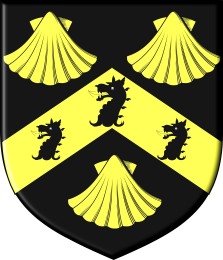
1.1. Edmond Hardy. (Sable on a chevron between thre escallops or, as many wyverns’ heads erased of the field).
1.1.1. Edmond Hardy, of Melcombe.
1.1.1.1. Robert Hardy. Hardy v Hardy. Plaintiffs: Robert Hardy. Defendants: John Hardy. Subject: manors of Melcombe Matravers, Frome St Quintin, etc, Dorset. 1651. (C 5/13/60).
1.1.1.1.1. John Hardy.

1.1.1.2. John Hardy, b. 1604.
1.1.1.2.1. Olive Hardy, m. John Pitt.
1.1.1.2.2. George Hardy, father-in-law of Edward Harris, d. 1677, in Virginia; named as “kinsman George Hardy” (nephew) in the Will of George Hardy, proved April 14, 1655; who settled on Lawne’s Creek, adj. Alice Bennett’s land. (Nugent, p. 140). He m. Mary Jackson
1.1.1.2.3. John Hardy, d. 1676, Virginia; m. (2) Alice Tucker, relict of Arthur Allen, by whom:
1.1.1.2.3.1. Joan Allen, m. (as third husband) Reuben Proctor. Alice Tucker was a probably of the family of Walter Tucker, as follows.

1.1.1.3. George Hardy, d. Virginia, 1655. Deed: Edward Bruce to George Stevens, George Hardy and John Watkins, April 15, 1646. Robert Pitt’s dau., Elizabeth, m. George Stevens.
1.1.1.4. Samuel Hardy.
1.1.2. William Hardy. Bridgman v Hardy. Plaintiffs: Anne Bridgman, widow. Defendants: William Hardy, Ralph Hunding. Subject: lease of Abbotsbury farm and parsonage, Dorset, demised to defendant Hardy by Lady Young. 1603-1625. (C 2/JasI/B41/23).
1.1.2.1. William Hardy. Hardy v Burridge. Plaintiffs: William Hardy. Defendants: Robert Burridge, George Hardy, Elizabeth Hardy his wife, Richard Waddon, Anne Waddon (John Hardy’s sister), Robert Colmer, Elizabeth Hodder and William Clapp. Subject: personal estate of John Hardy, Dorset. 1669. (C 8/222/21). Robert Burridge m. Elizabeth Cogan, sister of John Cogan, d. 1689, in Virginia, who proved the Will of Thomas Harris, d. 1688, and who m. (1) Joyce Bland, d. 1677, a dau. of Gregory Bland; hence the connection to the Bennett/Harris family of Wiveliscombe. Robert Burridge was of a family of Chard and Taunton, Somerset, and Bristol, Gloucestershire. Robert Burridge’s son, Robert, who settled in Lyme Regis, Dorset, m. Mary Tucker (see Dorset Parish Registers, vol. 3), granddau. of Walter Tucker, merchant, who settled in Lyme about 1604; he was mayor in 1607. The importance of the sons and grandsons of Robert Burridge (d. 1675) to the English south coast trade with Virginia was vast. Robert ‘King’ Carter corresponded with them
1.2. John Hardy.
1.2.1. John Hardy, d. 1669. Hardy v Tucker. Plaintiffs: Lancelot Hardy. Defendants: Honor Tucker, widow and John Hardy. Subject: estate of John Hardy, Beaminster, Dorset. 1660. (C 9/23/52).
1.2.1.1. Lancelot Hardy, b. Jan. 27, 1607.

I have not repeated the connections between the various strands of Harris, having done so repeatedly, and, more aptly, recently.

The real connection was tobacco.

copyright m stanhope 2019

Posted in Uncategorized | 1 Comment

ERCHEMBALD AS FLEMING

There are as many inconsistencies in accounts of the Norman elite as there are in human nature; Norman ‘histories’ being variously composed by monks who served the propaganda needs of their masters, and were of a religious persuasion that allowed the belief of their abbot being able to see their transgressions through stone walls. Women were generally seen as ‘Eve’, and Norman matriarchs had to be of a saintly status to warrant a mention. In all this, the one constant of society at this time (and well beyond) was that the elite married within their kinship circle, so preserving protection and wealth within it. It is this aspect that helps identify likely genealogies – that of repeated associations between the same families over successive generations. Genealogy is not made more ‘academic’ by the insertion of copious references, that is, by using a method that is now considered ‘academic’, whilst ignoring the plausibility of the source. We need to ask when considering the Normans, and all triumphant dynasties, what is really going on here?

The following suggestion of the ancestry of Erchembald the Fleming follows a plausible pattern, I suggest.

1. Charlemagne, m. Hildegard of Vinzgouw.
1.1. Louis I, ‘the Pious’, m. (1) Ermengarde of Hesbaye (in Liege, Belgium), dau. of Ingeram, Duke Of Hesbaye, and Hedwig of Bavaria.
1.1.1. Holy Roman Emperor, Lothar (“der Franken”), m. Ermengarde of Tours.
1.1.1.1. Lothar II., by his concubine, Waldrada:
1.1.1.1.1. Gisela, m. Godfrey (Ivarsson), brother of Sitric, father of Ragnall, who, like Rollo, was called princeps Nortmannorum. He was the leader of the Loire Vikings that had conquered much of Brittany, and he attended the coronation of Rollo’s son, William Longsword, “and was probably of Rollo’s family” (A. Hugo, France Historique, p. 416, 1837). Ragnall was probably the father of Sprotta (Scand. Sprottr), concubine of William Longsword, described as ‘nobilissima’ (Frodoard, 933, MGH SS III, p. 381). She was not a Breton. William Longsword held land to the east of the Loire Vikings in Brittany, and Sprotta was likely allianced with William as a peace-weaving marriage, giving William an uncontested (by Ragnall) claim to the Cotentin and Avranchin. Sprotta and William had issue: Richard I., who m. Gunnor, his former concubine. Professor Eleanor Searle (‘Facts and Patterns in heroic poetry’, 1984) wrote of the besieged colonists being reinforced by a new wave of Norsemen in the 960’s, and Richard (“dux pyratorum”) took as a wife Gunnor, the dau. of one of their leaders, in a ‘peace-weaving’ marriage. They had issue: Richard, “the Great Prince”, bur. Fécamp, who, by a concubine, had Godfrey, father of Gilbert de Brionne ( overlord of Gilbert Crispin I.), father of Baldwin FitzGilbert. Ragnall’s brother was probably Harald of Bayeux, “noted ally of Rollo’s family, who came to hold land between Bayeux and Coutances, possibly connected to the family of the Duchess Gunnor, and the person called on for assistance by Bernard the Dane when the Scandinavian colonists came under attack by Frankish forces” (Hudson, Viking Pirates, p. 65, 2005).

Sprotta, m. (2) Asperlenc, having issue: Rodolph d’Ivri, born ca. 943, father of (1) Emma d’Ivri, Abbess of St Amand. Baldwin FitzGilbert, raised by Emma d’ivri at Rouen, probably his aunt; donated to St Amand in memory of his mother. (2) Emmenie d’Ivri (she and siblings born ca. 970), who m. Richard de Beaufour. Of their daus., it is suggested, one m. Erchembald, vicecomes of Rouen, having issue: Gilbert Crispin I., father of Gilbert Crispin II. (Collavilla); his son being Robert d’ Armentieres, who held under Gilbert de Gand in 1086. A second dau. probably m. Gilbert de Brionne; a third certainly m. Hugh de Montfort-sur-Risle; their dau., Alice de Montfort-sur-Risle, m. Gilbert de Gand.
1.1.1.1.1.1. Bernard ‘the Dane’. (Beorn; ‘of the blood royal of Saxony’). The invaders of Normandy were referred to as Marchmen, describing an origin between the Elbe and Eyder, that is, of “the march”, the boundary between Germany and Denmark. The letters the invaders brought with them were expressly called Marcomannic; and it was the Marcomanni who sacked Rouen. Another term for the invaders was Nordalbingian, which, as Marchman, meant a person from beyond the Elbe. These terms point to a Marcomanni settlement in “the march”, in Saxon Holstein and Danish Sleswick; that is, the ‘Normans’ were of mixed blood.

1. Charlemagne, m. Hildegard of Vinzgouw.
1.1. Louis I., m. (2) Judith of Bavaria, dau. of Welf I, count in Swabia, and Hedwig, a member of the Saxon nobility, the dau. of Count Isambart (“Isambard the Saxon”).
1.1.1. Charles II., born in Frankfurt, 824, d. 877.
1.1.1.1. Judith, m. (1.), as his third wife, Aethelwulf, king of Wessex, son of Ecgberh (Anglo-Saxon Chronicle, 855); (2) her stepson, Aethelbald, king of Wessex (“contrary to God’s prohibition and the dignity of a Christian, contrary also to the custom of all the pagans … and drew down much infamy upon himself”; Asser, p. 8.; (3) Baldwin I. (“Iron-Arm”), count of Flanders; he of pragmatic disposition, it may be presumed.
1.1.1.1.1. Boudewijn (“von Flanderen”), count of Flanders, m. Ælfthryth, dau. of Alfred “the Great”, king of the Anglo-Saxons, and Ealhswith.
1.1.1.1.1.1. Arnulf I. (“the Great”), count of Flanders; born in 889, in Ghent, East Flanders, d. 965; m. Adele of Vermandois, dau. of Héribert II, count of Vermandois, and Adèle, dau. of Robert I, King of France, and Aélis. His southern expansion led to conflict with the Normans, who were trying to secure their northern frontier, resulting in the 942 murder of William Longsword at the hands of Arnulf’s confederates.
1.1.1.1.1.1.1. Luitgarde, m. Wichman von Hamaland, “burggraaf von Ghent”.
1.1.1.1.1.1.1.1. Adela (“von Sachsen”), m. Balderich, Graaf von Drenthe, who d. 1021.

1.1.1.1.1.1.1.2. Theodric von Ghent, m. Hildegarde.
1.1.1.1.1.1.1.2.1. Arnoul von Ghent, m. Liefgarde.
1.1.1.1.1.1.1.2.1.1. Adalbert von Ghent, m. Ermengarde.
1.1.1.1.1.1.1.2.1.1.1. Rolph (Rudolf) von Ghent: “Roelof Adelbert Arnoud van Gent” m. Giselle, sister of (1) Ogive, daus. of Gislebert of Luxemburg (“Ogivam, filiam Gisleberti comitis de Lixelemborg”), and cousins of Otgive, dau. of Gislebert’s brother, Frédéric I, count of Moselgau. They were sons of Sigefrid of Luxemburg, and brothers of the empress Cunégonde (Annales Quedlinburgenses). Giselle made a gift to St. Peter’s, ca. 1058, naming her three sons: “Balduuini filii ipsius Gislæ, item filiorum eius Rodulfi, Gisleberti”.
1.1.1.1.1.1.1.2.1.1.1.1. Gislebert von Ghent (Gilbert de Gand); brother of Rodulph de Gand, chamberlain of Flanders, and Baldwin, lord of Alost. The first record of him is that he was left conjointly in command of York with William Malet (as sheriff) and Robert FitzRichard in 1068. He was the second-cousin of Otgive, dau. of Frederick I, count of Moselgau, and wife of Boudewijn IV (“von Flanderen”), who m. (2) Eleanor of Normandy, dau. of Richard II. (“the Great Prince”) and Judith of Brittany. Gislebert von Ghent m. Alice de Montfort-sur-Risle, dau. of Hugues II. de Montfort-sur-Risle and a dau. of Richard de Beaufour, as given.
1.1.1.1.1.1.1.2.1.1.1.1.1. Hugh de Gand, m. Adeline de Beaumont, dau. of Robert de Beaumont, Count of Meulan, 1st Earl of Leicester.
1.1.1.1.1.1.1.2.1.1.1.1.1.1. Robert de Gand, m. Gunnora de Albini Brito, dau. of Ralph de Albini Brito (English Baronies’, I. J. Sanders, OUP, 2nd ed, 1963); she m. (2), Nicholas de Stuteville. A sister of Gunnora de Albini Brito, Maud, m. William de Colville (Collavilla); descendant of Gislebert Crispin I. William held one night’s fee of Robert de Gand in Lincs, his br.-in-law.
1.1.1.1.1.1.1.2.1.1.1.1.1.1.1. Gilbert de Gand, Earl of Lincoln, obit. 1241, father of Juliana de Gand, who m. Geoffrey d’Armentières, son of Henry d’Armentières.

1.1.1.1.1.1.1.2.2. Erchembald von Ghent, vicecomes (in this instance, sheriff) of Rouen, m. a dau. of Richard de Beaufour and Emmenie de ivri, sister of Emma d’Ivri, Abbess of St. Amand (wife of Osmund the dapifer); granddaus. of Sprotta and Esperlenc.
1.1.1.1.1.1.1.2.2.1. Gislebert Crispin, m. Gunnora de Conteville (born 1009), granddau. of Osmund de Conteville, and a sister of Osmund the dapifer, who Gislebert Crispin attempted to defend during the successful attempt to kill him in 1040. Gislebert made a gift to St. Amand to honour Osmund’s memory.
1.1.1.1.1.1.1.2.2.1.1. Gislebert Crispin (alias Collavilla), held the fortress of Damville as a vassal of Gilbert de Brionne’s son, Richard FitzGilbert (de Clare).
1.1.1.1.1.1.1.2.2.1.1.1. Gislebert Crispin, m. Hersende de Brezolles, and became enfeoffed in Armentières-sur-Avre
1.1.1.1.1.1.1.2.2.1.1.2. Robert Crispin (de Armentières-sur-Avre), held under his kinsman, Gislebert von Ghent, in 1086.
1.1.1.1.1.1.1.2.1.2.1.2.1. William de Whatton, m. … de Newmarch.
1.1.1.1.1.1.1.2.1.2.1.2.1.1. Robert de Watton.
1.1.1.1.1.1.1.2.1.2.1.2.1.2. Adam de Newmarch. It is claimed (CP ix. 543, citing Yorkshire Archæological Journal, vol. iv, p. 143, and Blythe cartulary, fo. 106), that Adam de Newmarch was the son of William de Watton, an unnamed son of his inheriting land from William de Newmarch, his uncle. Pipe Roll 31 Hen I (1129/30), Northumberland, p. 36., records ‘Wills de Waddona’ accounting for ‘fil suus’ having succeeded to the land of ‘Willi de Novo Mercato avunculi sui’ in Northumberland.
1.1.1.1.1.1.1.2.2.1.2. Hesilia Crispin, m. William Malet; he receiving Conteville by dower. His family held Collavilla, nr, Harfleur.

1.1.1.1.1.1.2. Baldwin (“von Flanderen”), d. 962, bur. in the Abbey of St. Bertin, Saint-Omer, France (then Flanders), m Matilda “Mechtild von Sachsen”, dau. of Hermann I, Duke of Saxony and Hildegard von Westerburg; and sister of Bernard I, Duke of Saxony. Matilda d. May 25, 1008, in Ghent.
1.1.1.1.1.1.2.1. Arnulph (“von Flanderen”), d. 987., bur. La Chapelle-Saint-Laurent, Poitou-Charentes, France, m. Rosala, dau. of Berengar II of Ivrea, king of Italy.
1.1.1.1.1.1.2.1.1. Boudewijn IV (“von Flanderen”); born 980, d. 1035, in Ghent, m. (1) Ogive of Luxembourg, dau. of Frederick I, count of Moselgau.

copyright m stanhope 2019

Posted in Uncategorized | Leave a comment

MORE SIMPLY CRISPIN

ERCHEMBALD AS FLEMING

1. Ivar.
1.1. Guthfrith Ivarsson – alias Godfried, “Duke of Frisia” and ruler in Dublin (883). , vassal of the Emperor Charles III., after that ruler sued for peace, giving Godfrey most of Frisia to rule. Charles also gave him Gisela (865-908), illegitimate dau. of King Lothair II. (839-869), as his wife. The exploits of Godfried are ‘transferred’ to Rollo by Dudo.
1.1.1. Bernard the Dane. (Beorn) ‘Of the blood royal of Saxony’. Lothair II had had one son and three daughters, all by Waldrada, and all of whom were declared illegitimate
1.2. Sitric, founder of Limerick; its historian, Ferrar, says, “According to a manuscript in the editor’s possession, the Danes got possession of Limerick in the year 855”.
1.2.1. Ragnall. The annalist Flodoard mentioned a Viking named Ragenold, like Rollo, called princeps Nortmannorum, leader of the Loire Vikings, who were regarded as a menace, especially to Brittany. He is noted as being a man of Rollo, who attended the coronation of Rollo’s son, William Longsword, in 931, and was probably of Rollo’s family” (A. Hugo, France Historique, p. 416, 1837).
1.2.1.1. Sprotta (Scand. Sprottr), concubine of William Longsword, described as ‘nobilissima‘ (Frodoard, 933, MGH SS III, p. 381). She was not a Breton. In 934 William Longsword was given Breton lands by King Ralph as a bulwark against the Vikings to the west of them. These Vikings were led by Ragnall, and Sprotta was likely allianced with William as a peace-weaving exercise, giving William an uncontested (by Ragnall) claim to the Cotentin and Avranchin.
1.2.1.1.1. Richard I., m. Gunnor, his former concubine. Gunnora, d. bef. Jan. 5, 1031. Professor Eleanor Searle (‘Facts and Patterns in heroic poetry’, 1984) wrote of the besieged colonists being reinforced by a new wave of Norsemen in the 960’s, and Richard (‘dux pyratorum’) took as a wife Gunnor, the daughter of one of their leaders, in a ‘peace-weaving’ marriage.
1.2.1.1.1. Richard, ‘the Great Prince’, bur. Fécamp.
1.2.1.1.2. Godfrey (by a concubine).
1.2.1.1.2.1. Gilbert de Brionne, overlord of Gilbert Crispin I.
1.2.1.1.2.1.1. Baldwin FitzGilbert.
1.2.2. Harald of Bayeux, “noted ally of Rollo’s family, who came to hold land between Bayeux and Coutances, possibly connected to the family of the Duchess Gunnor, and the person called on for assistance by Bernard the Dane when the Scandinavian colonists came under attack by Frankish forces” (Hudson, Viking Pirates, p. 65, 2005).

1.2.1. Sprotta, m. (2) Asperlenc.
1.2.1.1. Rodolph d’Ivri, born ca. 943.
1.2.2.2.1. Emma d’Ivri, Abbess of St Amand. Baldwin FitzGilbert, raised by Emma d’ivri at Rouen, probably his aunt; donated to St Amand in memory of his mother.
1.2.2.2.2. Emmenie d’Ivri (she and siblings born ca. 970) m. Richard de Beaufour.
1.2.2.2.2.1. … de Beaufour, m. Erchembald, vicecomes of Rouen.
1.2.2.2.2.1.1. Gilbert Crispin I.
1.2.2.2.2.1.1.1. Gilbert Crispin II. (Collavilla).
1.2.2.2.2.1.1.1.1. Robert d’ Armentieres, held under Gilbert de Gand in 1086.
1.2.1.1.3.2.1.2. William Crispin, m. Eve de Montfort L’Aumary, aunt of Isabel de Montfort, who m. Raoul III de Conches (Tosny), Lord of Flamstead. ‘At that time violent hostilities broke out between the people of Breteuil, Evreux, and others in that neighbourhood. William de Breteuil had married Adeline, the daughter of Hugh de Montfort (sur-Risle), but he had no son born in wedlock. He died at Bec on the second of the ides of January, but was buried at Lire, in the abbey which his father had founded on his own fief. His nephews William de Guader and Reynold de Grancei  disputed the succession; but the Normans chose Eustace, his son by a concubine, preferring a countryman of their own … In consequence, the parties flew to arms with great violence, and the country was still further desolated. William de Guader dying soon afterwards Reynold became stronger, and William earl of Evreux joined with many others in affording him aid. Ralph de Conches, son of Isabel, and Amauri de Montfort (brother of Isabel) collected their forces on the side of Reynold, and did much mischief to their neighbours, devastating their country by hostile inroads, but they rendered but little service to the cause they espoused. For Eustace, supported by William Alis, Ralph-the-Red‘ (Ord. Vit. xi., iv.).
1.2.2.2.2.2. … de Beaufour, m. Gilbert de Brionne.
1.2.2.2.2.3. … de Beaufour, m. Hugh de Montfort-sur-Risle. By a second wife, Hugh de Montfort-sur-Risle, was the father of Adeline de Montfort-sur-Risle, who married William of Breteuil, eldest son of William FitzOsbern*.
1.2.1.1.3.3.1. Alice de Montfort-sur-Risle (by … de Beaufour), m. Gilbert de Gand.
1.2.1.1.3.3.2. Hugh II. de Montfort-sur-Risle (by his second wife).
1.2.2.2.2.4. Robert de Beaufour. (the missing generation).
1.2.2.2.2.4.1. Robert de Beaufour, ‘sire de Belfou’, named by Wace as a companion of William Crispin (son of Gilbert Crispin I.), at Hastings, with:

(1) The ‘sire d’Alnou’ (Fulke d’Anet), whose sister was the wife of Gilbert Crispin I.; they the children of Osmund de Conteville and a sister of Osbern the dapifer (son of Herfast, br. of Gunnor). Thus, Gilbert Crispin’s wife was a cousin of *William FitzOsbern.

(2) The ‘sire d’Estotevile’, near Ivetot. Yorkshire Domesday tenants-in-chief such as William de Percy enfeoffed a large number of sub-tenants. In Wheldrake, including William de Colleville; this holding originally being held by William Malet, his uncle (V.C.H. Yorks. ii. 167, 262, 293). William de Percy also held the castle of Tadcaster, which had also originally belonged to William Malet, whose son, Robert, succeeded to only a portion of his father’s lands, very likely the result of him joining the 1088 rebellion against William Rufus. Many of the Malet estates in Yorkshire and other counties passed by ducal confiscation to Robert de Stuteville (see D.B, i, 373a-374b, 320b-321a); a descendant of his married William de Colville, of Bytham, descendant of Thomas de Colville.* A ‘wrong choice’ was made by Robert de Stuteville II., one of the rebels captured by the king at Tinchebrai, in 1106. His Yorkshire estates were given to Nigel d’Aubigny, a son of Roger d’Aubigny, of St. Martin d’Aubigny, a brother of William d’Aubigny, the royal pincerna. In addition to the Stuteville and Malet estates Nigel was granted the overlordship of former tenants-in-chief, such as William de Colville. Coxwold was granted to *Thomas de Colville shortly after 1145, a tenant of Roger de Mowbray, son of Nigel d’Aubigny.

Wace was said by Elizabeth Van Houts to not be infallible, but neither arbitrary or fictitious, and whose method of collecting written material and recording oral tradition made him a serious historian.

1.2.2.2.2.4.1. Richard de Beaufour: ‘Son fils Richard II de Beaufour figure comme témoin dans une charte du Conquérant avec Raoul de Conches* et Guillaume de Breteuil‘ (Charpillon). Beaufour: d’argent au lion de gueules, billeté de même ou d’or. *As given, he was the husband of the cousin of William Crispin II. (Collavilla).
1.2.2.2.2.4.1.1. … de Beaufour, m. Hugh II. de Montfort-sur-Risle.

1.2.1.1.3.2.1.3. Hesilia Crispin, m. William Malet, who probably gained Conteville as dower.
1.2.1.1.3.2.1.3.1. Robert Malet, held the fief of Collavilla, near Harfleur, Seine-Inf. Domesday shows “Gilbert de Colavilla” as a considerable undertenant of Robert Malet at Rendlesham; he also held under Robert Malet’s mother, Hesilia Crispin (DB/Sf 6/19-21, 29-30, 34-37, etc.).
1.2.1.1.3.2.1.3.1.1. Robert Malet. Amongst the benefactions made to the abbey of St Taurin, Evreux, in the late eleventh century were grants of land in Pinterville (arr. Louviers, Eure) given by Robert Malet, and his wife, Emmelina, with the assent of William de Breteuil, whose wife was probably a sister of Robert’s wife, daughter of Hugh de Montfort II., with whose lands and tenants, English and Norman, the Malets were often involved.
1.2.1.1.3.2.1.3.1.2. William Mallet. In 1121, Henry I. confirmed the gift of Conteville (Eure) to the abbey of Bec, ‘pro anima patris et matris sui et fratris sui Roberti’.

copyright m stanhope 2019

Posted in Uncategorized | Leave a comment

CHILDREN OF IVAR

To follow on my previous post, from which the central importance of women in the construction of the Norman State should be adduced, and to strip away from the account of the Norman chroniclers (propagandists) obvious untruth:

THE PIVOTAL ROLE OF NORMAN MATRIARCHS

1. Ivar exosus (cruel). His nickname, ‘beinlauss’, is wrongly interpreted as ‘boneless’, reflecting a misunderstanding of the written source of exosus, which was abbreviated to exos (boneless), hence stories invented to explain this strange epithet. “Exosus accords well with Adam of Bremen’s description of Ivarr as crudelissimusis” (J. de Vries, ‘Die westnordische Tradition der Sage von Ragnar Lodbrok’. Zeitschrift für deutsche Philologie 53, 257-302, 1928).
1.1. Guthfrith Ivarsson – alias Godfried, “Duke of Frisia” and ruler in Dublin (883), vassal of the Emperor Charles III., after that ruler sued for peace, giving Godfrey most of Frisia to rule. Charles also gave him Gisela (865-908), illegitimate dau. of King Lothair II. (839-869), as his wife. The exploits of Godfried are ‘transferred’ to Rollo by Dudo.
1.1.1. Bernard the Dane. (Beorn) ‘Of the blood royal of Saxony’. Lothair II had had one son and three daughters, all by Waldrada, and all of whom were declared illegitimate
1.2. Sitric, founder of Limerick; its historian, Ferrar, says, “According to a manuscript in the editor’s possession, the Danes got possession of Limerick in the year 855”.
1.2.1. Ragnall. “The identity between the Ragnall of the Irish Sea and Ragnald of northern Britain is no longer in doubt” (Downham, Viking Kings, p. 94). The annalist Flodoard mentioned a Viking named Ragenold, like Rollo, called princeps Nortmannorum, leader of the Loire Vikings, who were regarded as a menace, especially to Brittany. He is noted as being a man of Rollo, who attended the coronation of Rollo’s son, William Longsword, in 931, and was probably of Rollo’s family” (A. Hugo, France Historique, p. 416, 1837). “In 924, Ragenold, although he had accepted a grant of lands within the borders of France, laid waste the country of Duke Hugh” (Reginald Lane Poole, The English Historical Review, p. 16, 1911). I suggest that he was William Longsword’s father-in-law.
1.2.1. Sprotta (Scand. Sprottr), concubine of William Longsword, described as ‘nobilissima‘ (Frodoard, 933, MGH SS III, p. 381). She was not a Breton. Eric Christiansen’s (History of the Normans, note 234, p. 199, 1998), explains that in 934 William Longsword was given Breton lands by King Ralph as a bulwark against the Vikings to the west of them. These Vikings were led by Ragnall, and Sprotta was likely allianced with William as a peace-weaving exercise, giving William an uncontested (by Ragnall) claim to the Cotentin and Avranchin. The loire Vikings held sway in Brittany between 919 and 936.
1.2.1.1. Richard I., m. Gunnor, his former concubine. Gunnora, d. bef. Jan. 5, 1031. Professor Eleanor Searle (‘Facts and Patterns in heroic poetry’, 1984) wrote of the besieged colonists being reinforced by a new wave of Norsemen in the 960’s, and Richard (‘dux pyratorum’) took as a wife Gunnor, the daughter of one of their leaders, in a ‘peace-weaving’ marriage.
1.2.1.1.1. Richard, ‘the Great Prince’, bur. Fécamp.
1.2.1.1.2. Godfrey (by a concubine).
1.2.1.1.2.1. Gilbert de Brionne, overlord of Gilbert Crispin I.
1.2.2. Harald of Bayeux, “noted ally of Rollo’s family, who came to hold land between Bayeux and Coutances, possibly connected to the family of the Duchess Gunnor, and the person called on for assistance by Bernard the Dane when the Scandinavian colonists came under attack by Frankish forces” (Hudson, Viking Pirates, p. 65, 2005).

1.2.1. Sprotta, m. (2) Asperlenc.
1.2.1.1. Rodolph d’Ivri, born ca. 943.
1.2.1.1.1. Hugh d’Ivri. Hugh gave Celloville, that is Serlos villa (Seine-Maritime, cant. de Boos), and Sahurs (Seine-Maritime, cant. Grand-Couronne) to St Amand. (See Pierre Bauduin, ‘La première Normandie’, p. 206, 2004). The territorty of Boos was formerly held by Gosselin, vicecomes of Rouen, and likely to have been Hugh’s uncle
1.2.1.1.2. Emma d’Ivri, Abbess of St Amand.
1.2.1.1.3. Emmenie d’Ivri (she and siblings born ca. 970) m. Richard de Beaufour.
1.2.1.1.3.1. … de Beaufour, m. Gilbert de Brionne.
1.2.1.1.3.1.1. Baldwin FitzGilbert, raised by Emma d’ivri at Rouen, probably his aunt; donated to St Amand in memory of his mother.
1.2.1.1.3.2. … de Beaufour, m. Erchembald, vicecomes of Rouen. Vicecomes. Erchembald, on entering La Trinité du Mont, gave to the house his meadow in Sahurs, and all that he held by hereditary right in Celloville. (RADN, no. 82, 1030-1035). I suggest that ‘hereditary right’ related to a gift by Hugh d’Ivri to a niece, wife of Erchembald; that is, hereditary right in its wider context.
1.2.1.1.3.2.1. Gilbert Crispin I., m. Gunnor de Conteville, dau. of Osmund de Conteville and a sister of Osborn, dapifer (aunt of William FitzOsbern*). Gilbert was wounded on the night of Osbern’s murder, and he later made a gift to La Trinite du Monte in Osbern’s memory, a gift witnessed and approved of by Emma (Receuil, ed. Fauroux, no. 82).
1.2.1.1.3.2.1.1. Gilbert Crispin II.
1.2.1.1.3.2.1.1.1. Robert d’ Armentieres, held under Gilbert de Gand in 1086.
1.2.1.1.3.2.1.2. William Crispin, m. Eve de Montfort L’Aumary.
1.2.1.1.3.2.1.3. Robert Crispin, the exiled mercenary.
1.2.1.1.3.2.1.4. Hesilia Crispin, m. William Malet (Monasticon 3. 405).
1.2.1.1.3.2.1.4.1. Robert Malet, held possessions in Collavilla, near Harfleur, Seine-Inf.; from which Gilbert Crispin II. and his br. William were also titled Collavill.
1.2.1.1.3.3. … de Beaufour, m. Hugh de Montfort.
1.2.1.1.3.3.1. Alice de Montfort-sur-Risle, m. Gilbert de Gand. By a second wife, Hugh de Montfort-sur-Risle, was the father of Adeline de Montfort-sur-Risle, who married William of Breteuil, eldest son of *William FitzOsbern.
1.2. A uterine sister of Richard I., one of the ‘plures filia’, from which ‘sprang many families of noble birth’; (i.e.of the ducal clan).
1.2.1. Emmeline, m. Gosselin (vicecomes of Rouen – i.e. sheriff of that vicinity), the founder of the monasteries of the Holy Trinity of the Mount (1030), and of St. Amand, both near Rouen.
1.2.1.1. Godfrid, vicecomes d’ Arques (perhaps a br. of Gosselin), m. a dau. of Avelina (sister of Gunnor, wife of Richard I.) and Osbern de Bolbec. Richard I’s illigitimate son, Godfrey, being the father of Gilbert de Brionne, patron of Gilbert Crispin I.

What is needed is to peer into the fog with sceptisism and replace it with what might most reasonably be the case.

It is not reasonable to ignore the role of all women in Norman empire building. The term ‘concubine’ is used in Norman mythology by historians who were monks, who sought to glorify that which their church sanctioned (marriage), denigrating that which was not.

copyright m stanhope 2019

MORE SIMPLY CRISPIN

Posted in Uncategorized | Leave a comment

THE PIVOTAL ROLE OF NORMAN MATRIARCHS

ERCHEMBALD THE FLEMING

The early clan chiefs of Normandy held power through alliances with those of competing claim. It was an act of political proportion, as if attempting to ride two horses, with feet in two stirrups, as many sharp twists and turns were to be attempted.

William Longsword’s first alliance was with Sprotta, of unknown lineage; his partner through ‘Danish rite’ – one without religious ties, and a strong feature in Norman history. Of the five generations of Norman chiefs, from Rollo to William the Bastard, only the children of Richard I. were born of a marriage sanctioned by the Church, and were, thus, ‘legal’.

The looser arrangements, however, came with obligations – a legally recognised concubine could not choose to leave her husband, and was given ‘wifely’ status until he chose to seek another concubine or wife. The Church would assert the superiority of a wife married according to its rites, and children of ‘Danish rite’ were not necessarily looked upon as the legal heirs of their father, though would be if the alliance that they represented was still of importance.

It should be realised that concubines also came from families of high status; tales of chance meetings in a forrest (Richard I. and Gunnor’s sister) are simply allegorical, making mythical connections between the Norman elite and the heroes of earlier, classical dynasties. Gunnor was undoubtedly of a high status, Scandinavian family who were among the wave of successive incursions into Normandy by different factions. It is a mistake to believe that successive colonisers were entirely of a Scandinavian origin; they were a synthesis of various racial groupings, many long-since intermarried as a way of guaranteeing peace treaties.

The invaders of Normandy were referred to as Marchmen, describing an origin between the Elbe and Eyder, that is, of “the march”, the boundary between Germany and Denmark. The letters the invaders brought with them were expressly called Marcomannic; and it was the Marcomanni who sacked Rouen. Another term for the invaders was Nordalbingian, which, as Marchman, meant a person from beyond the Elbe. These terms point to a Marcomanni settlement in “the march”, in Saxon Holstein and Danish Sleswick. The Danish side of “the march” was controlled by the family of Gorm the Old, a king in southern Denmark , that is, Jutland, who also had “holdings in Norway.” He was the son of someone identified by Adam of Bremen as “Hardegon filius Suein”, that is, Harthaknutr, son of Svein.

Gunnor’s marriage to Richard I. was about building alliances to counteract those who might usurp his clan’s rule.

William Longsword found it expedient to marry Leutgard, a sister of Herbert of Vermandois. (Her sister married Arnulf, a party in William’s murder). His object was to gain the favour of the Frankish nobles, solemised by closer connexion with the Church. This would have alienated some of his allies and relations, and accounts for the bitter internecine strife of this period. It was not the case that William’s son by Sprotta, Richard I., was ‘forced’ to marry his concubine, Gunnor; it was expedient to do so in relation to the advantages of the alliance he legalised.

Sprotta’s later alliance with Asperling brought about (with a number of daughters), Rodulph d’Ivri, uterine brother of Richard 1., and of great importance in the defense of Richard’s clan. This trust did not stem from association with Asperling, but from common connection to their mother’s faction.

1. Sprotta, m. (2) Asperling.
1.1. Rodolph d’ Ivri, m. Eremberg.
1.1.1. Emma d’Ivri, later Abbess of St Amand, m. Osbern, son of Herfast, brother of Gunnor, wife of Richard I. Her kinsman, Baldwin FitzGilbert, was raised by Emma at Rouen, and he made a donation to St Amand in memory of his mother (pancarte, line 32). Emma’s brother-in-law, Richard de Beaufour (Bellofago), made donations on behalf of his daughters (filias plures), who may have joined Emma at St. Amand as nuns. Baldwin FitzGilbert was the son Gilbert de Brionne, the founder of the Abbey of Bec (the son of Godfrey, son of Richard I., by a concubine), and the patron of Gilbert Crispin 1.

Another niece was probably the mother of Gilbert de Brionne; another of Gilbert Crispin I.; another was certainly the wife of Hugh de Montfort-sur-Risle; their issue being: Alice de Montfort-sur-Risle, married to Gilbert de Gand. By a second wife, Hugh de Montfort-sur-Risle, was the father of Adeline de Montfort-sur-Risle, who married William of Breteuil, eldest son of William FitzOsbern.

Heather J. Tanner (Medieval Elite Women and the Exercise of Power, 1100–1400, p. 105), conjectured that the Gilbert who made a donation to St Amand on the occasion of his wife becoming a nun there (lines 35-39), was the son of Vicecomes Erchambald, and thus, a fidelis of Emma, and her husband, Osbern. Gilbert was wounded on the night of Osbern’s murder, and he later made a gift to La Trinite du Monte in Osbern’s memory, a gift witnessed and approved of by Emma (Receuil, ed. Fauroux, no. 82).

1.1.1.1. William FitzOsbern.’In the 1040’s, Emma’s son, William de Breteuil, made a donation to La Trinite of lands held by the vicecomites Erchembald and Turold, the chamberlain of Countess Gunnor (pancarte, no. 118). ‘These donations illustrate the importance of female family connections and hint at their associated networks of patronage‘ (ibid., p. 104). In this sense, men fought in battles when women could not hold the peace.
1.1.1.1.1. William de Breteuil confirmed the donations to the Abbey of Bec of his father, including:
(1) What he himself possessed in the suburbs of Brionne.
(2) The fiefs given to Bec by William Crispin the elder, including the tithe of the church of Blangy and its domain.
(3) The tithe of the church of Livarot, including its domain and the sixth part of its mills.
(4) The tithe of the mill and the domain of Mesnil-Foubert Le Faulq, canton of Blangy, held by William Crispin the younger.

Thus, the earliest landholdings of the Crispin family were held of their kinsfolk, the FitzOsberns. This is not to say that these landholdings originated with them, for those of closely connected kinship gifted land to each other, as in the case of Hugh d’Ivri gifting some of La Chapelle-Bayvel to his nephew, William FitzOsbern, whose mother, Hugh’s sister, held land of the patrimony of her father (with the approval of Gunnor, her mentor), of the tenantship of her brother, and of his gift. It is not the case that lineage can be adduced from tenurial associations, for such were underpinned by a variety of formats; one of which may have included a gift to Baldwin FitzGilbert from Emma d’Ivri, his guardian, and probable aunt.

1. …
1.1. Harfast. Dudo of Saint-Quentin claimed she was of noble Danish origin, without specifying whether this was a paternal association. A clue as to his place of origin is given in the orthgography of Herfast; which is a form of Haerfest (OE), Herbist (OHG); Herfst (Dutch). These are Saxon terms meaning harvest, and are seen in the statements ‘god sumer’, ‘god harfest’. They represent a distinctly Saxon form of harvest, being distinguishable from the Scandinavian forms Haust (ON), Hdst (OSw.); Host (OD).
1.1.1. Osborn, dapifer. Guillaume of Jumièges records that a sister married Osmund de Conteville, their son being Foulques d’Anet. ‘Neptes vero plures predicto Gunnor habuit quarta Osmundo de Centumvillis Vicecomiti Vernonii, ex qua natus est primus Fulco de Aneio et plures filia, quarum una mater fuit primi Baldewini de Revers’.
1.1.2. Osborn’s sister, m. Osmund de Conteville – Contevillam, Conteville-sur-Risle.
1.1.2.1. Gunnor de Centvilles, et de Livarot, m. Gilbert Crispin I.
1.1.2.1.1. Hesilia Crispin, m. William Malet (Monasticon 3. 405); he gaining Conteville as maritagium.
1.1.2.1.1.1. Robert Malet, held the fief of Collavilla, near Harfleur, Seine-Inf., from whence his cousins, William and Gilbert Crispin were endowed. Robert Malet held land of Gilbert Crispin I. in Mesnil Josselin, canton de Broglie, which was donated to Bec; a place of ironworks.
1.1.2.1.1.2. Gilbert Malet, whose son was William Malet II. (E.H. Bates, ed., Two Cartularies of the Benedictine Abbeys of Muchelney and Athelney, Somerset Rec. Soc. 14, 1899: see Subsidiary Indices i., ii).
1.1.2.1.1.2.1. William Malet: Between 1117-1121: ‘Anno ab incarnatione Domini millesimo centesimo vicesimo primo Willelmus Malet dedit Deo et Sancte Marie Becci Contevillam, ita quietam et integram sicuti eam tenuerunt ipse et antecessors ejus, et hoc pro salute anime sue et omnium parentum suorum. … ‘Guillelmus Malet monachus Becci terram sive prædium quod vocatur Mesnil Josselin dedit monasterio Beccensi’. (See Gallia Christiana, vol. xi. p. 301).
1.1.2.1.1.2. Beatrix Malet, m. William d’ Arques, as follows.

It is almost certain that Gilbert Crispin I. married a sister of Fulco d’’Anet, who donated to Bec: ‘Saint-Julienen-de-Mailloc, canton d’Orbec; le Mesnil-Simon, canton de Vernon; where Anquetil donated to Bec that which had been Osmonds, confirmed by ‘Guillaume de Vernon, tenant en chef‘ (who had possibly married a daughter of Osbern – M.S). A confirmation charter of Henry II. informs that property in Mesnil Simon was included in a grant to Bec by Emma, second wife of Baldwin FitzGilbert, aforesaid.

1.1.2. Hugh d’Ivri, Archbishop of Bayeux: Between 1042-1049, Hugh gave Celloville, that is Serlos villa (Seine-Maritime, cant. de Boos), and Sahurs (Seine-Maritime, cant. Grand-Couronne) to St Amand. (See Pierre Bauduin, ‘La première Normandie’, p. 206, 2004). The territorty of Boos was formerly held by Gosselin, vicecomes of Rouen, and likely to have been Hugh’s uncle. Vicecomes Erchembald, on entering La Trinité du Mont, gave to the house his meadow in Sahurs, and all that he held by hereditary right in Celloville. (RADN, no. 82, 1030-1035). I suggest that ‘hereditary right’ related to a gift by Hugh d’Ivri to a niece, wife of Erchembald; that is, hereditary right in its wider context. Gilbert Crispin I., by this account, may have been the great-grandson of Rodolph d’ Ivri, and great-great grandson of Sprotta.

1.1.3. Emmenie d’Ivri (see François Farin, et al., Histoire de la ville de Rouen, p. 131, 1731), m. Richard de Beaufour.
1.1.3.1. ….. de Beaufour, m. Erchembald, vicecomes of Rouen, fidelis of Richard I. (Beaufour, Calvados, cant. de Cambremer, held by Hugh d’Ivri).
1.1.3.1.1. Gilbert Crispin, nephew of Emma and Hugh d’ Ivri, fidelis of Osbern, dapifer, filius Herfasti. As stated, Gilbert was wounded on the night of Osbern’s murder, and he later made a gift (la vallée de Richer ou Riquier, et les prés de Rieux) to La Trinite in Osbern’s memory.

For him to be Gilbert Crispin I., he can not have died soon after this event, in that Gilbert is recorded in a charter of ca. 1056 in which he donates the fief of Hauville (held of William I.) to Jumieges. Hauville is situated near Montfort-sur-Risle.

Gilbert Crispin I. was noted by Milo Crispin as being ‘of renowned origin and nobility’ (Milo Crispin, How The Holy Virgin Appeared To William Crispin The Elder And On The Origin Of The Crispin Family, ed. Migne, cols. 735-744, 1856).

His descendants were of the ‘Rouennais‘: Adolphe Chéruel, Histoire de Rouen: ‘L’archevêque de Rouen, Hugues d’Amiens, les évêques de Bayeux et de Lisieux, un grand nombre de nobles, Gauthier, comte de Meulan, Robert de Neubourg, Richer de l’Aigle, Guillaume de Vernon, Baudry du Bosc, Amaury, Gislebert et Gosselin Crespin, Henri de Ferrières, Robert de Torcy, Richard de la Haye, Eugène et Alexandre de Bohun, Geoffroi de Clères, Hugues de Monfort, et plusieurs autres barons, s’étaient solennellement portés garans de la charte concédée aux Rouennais par le duc de Normandie’, ca. 1150.

1.2. A uterine sister of Richard I., one of the ‘plures filia’, from which ‘sprang many families of noble birth‘. (Of the ducal clan).
1.2.1. Emmeline, m. Gosselin (vicecomes of Rouen – i.e. sheriff of that vicinity), the founder of the monasteries of the Holy Trinity of the Mount (1030), and of St. Amand, both near Rouen.
1.2.1.1. Godfrid, vicecomes d’ Arques, m. a dau. of Avelina (sister of Gunnor, wife of Richard I.) and Osbern de Bolbec. Richard I’s illigitimate son, Godfrey, being the father of Gilbert de Brionne, patron of Gilbert Crispin I.
1.2.1.1.1. William d’ Arques, m. Beatrix Malet, dau. of Hesilia Crispin, and granddaughter of Gilbert Crispin I.

This is a traditional narrative. Jean-François Pommeraye, Histoire de l’abbaye royale de S. Ouen de Rouen, 1662, gives an alternative and no less plausible version, stating that Godfrid was the brother or nephew of Gosselin, Gosselin and his children being dead by 1058. He added: William and Osbern, sons of Osbern and Emma d’Ivri, gave to La Trinite what they possessed at Val Richer; ‘at the place called ‘Sahurs’.

copyright m stanhope 2019

Posted in Uncategorized | Leave a comment

THOMAS HARRIS – 1637-1688

(See ALBINIACO TO HARRIS).

This is an account of Thomas Harris of Cheddar, who, I suggest, died in Virginia in 1688.

I have posted the suggestions of other ‘Harris Hunters’, who believe in a much closer relationship between various members of a Harris family of Somerset than may be the case.

The hardest thing in genealogical research is one of differentiating one line of a family from another, as the advantageous associations of one were shared by the other, and they often married into the same families; thus, distant consanguineous links were ‘refreshed’ by non-consanguineous marriages, producing a dense mesh of various cousinship relationships – the basis of the English kinship system that was continued in Virginia, as a matter of enhancement and survival.

Such it was with a family of Somerset Harris. One branch of it married into the family of Governor Bennett; that of Thomas Harris, d. 1672, and Edward Harris, d. 1677, and, thus, their cousins, of the family of Thomas Harris, d. 1688, shared many connections to the Bennetts and their associations. In the account that follows it would be easy enough to detail the shared links to such families as Barham, Bland, Branch, Brantley, Fulgham, Monger, Moore, and Thorpe (as previously given, perhaps ad nauseam); but this would miss the specific, enduring, and defining link between the families of Counsell and Harris.

As I have pointed out, the level of inbreeding between such families of this time was extraordinary by modern standards, which makes DNA ‘results’ very questionable as to the closeness of proposed relationships; people being denoted as a sibling or cousin, when, in fact, a relationship as a distant cousin may be more apt.

In what follows, it is assumed that Thomas Harris, father of Thomas Harris, baptised 1637, in Cheddar, married Joan Gardner, rather than Joan Kirton, as assumed in previous notes; an almost fact, pointed out to me by fellow ‘Harris Hunters’.
This line of Harris had very prestigious and powerful connections of the ‘old money’, making it an attractive proposition for such families of the ‘new money’ (as the Bennetts) to marry into their wider family.

THOMAS HARRIS – 1637-1688
1. Thomas Harris of Mells , carpenter, b. 1494; landowner as tenant of the Dyer family of Glastonbury Abbey; they interm. with the Paulets.
1.1. John Harris, noted in a deed concerning Mells, 1555.
1.1.1. John Harris, of Blackforde, in Wedmore, bur. Jan 27, 1597, “servant” (probably estate steward) of Robert Sherwell, who m. (Oct. 6, 1578), Maria Beard/Berd/Berde (see N.A. C 3/8/108), dau. of John Beard. The Will of Maria Sherwell, widow of ‘Robert Sherwell, of Blackford, Somerset, gent.’, was proved Nov. 26, 1627: She requests burial at Wedmore, and named ‘cousin Richard Counsell’,* ‘cousin Margery Hodges’,* and ‘Mr. George Hodges, of Wedmore’ (son of Thomas Hodges, son of George Hodges Sr.).

The Hole family intermarried with the Fulghams were probably they of Wedmore (and adjacent Cheddar and Meare). Conveyance from Robert Hole, Wedmore, yeoman, son and heir of Marie Hole, sister and co-heir of Robert Sherwell, and Temperance his wife to Richard Counsell, Heathhouse, Wedmore, yeoman: ¼ part of free chapel. Reciting letters patent April 14, 1603, granting the free chapel to Michael Cole and John Rowdon who sold it to Robert Sherwell. April 15, 1625. (Bristol Arch. HA/D/357). Edwards v Hole. Plaintiffs: John Edwards and Katherine Edwards his wife. Defendants: Robert Hole, Temperance Hole his wife and Thomas Southworth. Subject: messuages and lands in Wedmore, Somerset, late of Thomas Eaton. 1603-1625. (N.A. C 2/JasI/E6/66).

At this generation, Richard Harris (of Glastonbury) established himself at Wiveliscombe (25 miles ‘as the crow flies’ from Wedmore/Cheddar/Meare), his family intermarying with the Bennets of Wiveliscombe and Virginia.

1.1.1.1. John Harris, d. 1625, m. Penelope Millard, Sept. 9, 1611, in Wedmore. He m. (2) Christiana Thurston, bapt. 28 Oct. 1591, on Oct. 8, 1618; the great-niece of Joan Thurston, who m. (2) John Counsell, on Aug. 13, 1573.
(1. John Counsell, m. (1) Margaret Browning, April 28, 1567, in Wedmore. (2). Joan Thurston, afors.
1.1. *Richard Counsell, bapt. Apr. 4, 1568. PROB 11/104/18, May 4, 1604. Held one third of the manor of Mudgley.
1.1.1. *Margery Counsell, m. John Hodges, 1610. (‘1590 Margeria f. Richardi Cownsell jun. de Muddeslei’, i.e. Mudgley, where his family held a third of that manor.
1.2. John Counsell, bapt. Dec. 25, 1569, seen here: Francis & Blanche James to John Counsell, lease. (Som. Arch., DD\GB/83/1, 1613).
1.2.1. John Counsell, bapt Nov. 28, 1601, in Wedmore, ‘f. Joannis Counsell’, m. Mary Coomer, Nov. 26, 1631; the sister of Agnes Coomer, who m. John Harris in the adj. parish of Cheddar, Feb. 4, 1635; daus. of John Coomer, and sisters of John Coomer, father of Mary Coomer, who m. John Gardner, on Oct. 24, 1664, in Cheddar (son of John Gardner, d. 1677). John Gardner was the br. of Joel Gardner, father of (1) Jane Gardner, who m. James Counsell, June 12, 1682, in Cheddar. (2) Elizabeth Gardner, who m. George Tibbits, May 1678, in Cheddar, sister of Hester Tibbits, who m. Thomas Harris (as second wife), Apr. 24, 1679, in Cheddar; Hester Harris d. 1680, probably in childbed. Thomas Harris, d. 1688 in Virginia, is not recorded there before 1681.

(John Gardner, dying intestate admin. requested by relict, Mary. Security Thomas Joyner, James Gardner, 1684, p. 56. ‘Thomas Taberer assigned a bill to John Gardner against Rebecca Izard’ (Mr. Boddie, p. 562); step-mother of Ann Izard, who m. (2) Michael Fulgham; their issue: Sara Fulgham, who m. William Raiford (a kinsman); Michael Fulgham, who m. Mary Pitt (of the Bristol Pitts); Anthony Fulgham, who m. Sara Raiford (likewise kin); Susannah Fulgham, who m. Hardy Counsell (son of Hodges Counsell Jr.); Ann Fulgham. who m. (Mr. Boddie conjectured), Robert Harris, son of Thomas Harris, d. 1688. Thomas Joyner (father of Bridgeman Joyner, as follows) was connected to the Bennett family, in ways I have previously given, thus connected to the general family of Harris. Like the Hardy and Pitt families, he was of Dorset, where many Bristol seafarers and merchants (as Mr. Seward) plied their trade).

1.2.1.1. John Counsell, m. Alice, the relict of Richard Jeffries. Richard Jeffries, dying intestate, administration requested by John Counsell, who married the relict of the said Jeffries, Aug. 9, 1666. Security, Mr. (Francis) England, and his son-in-law, George Branch (B. 2, p. 13). Deborah Joyner, wife of Bridgeman Joyner (guardian of William Harris, orphan of Thomas Harris, d. 1688), gave ‘cozin’ (cousin of sister’s husband), John Counsell, a young heifer.

(Francis England’s grandson, Francis Branch, m. Elizabeth Norwood, niece of Henry Norwood, son of Henry Norwood and Elizabeth Rodney, of Cheddar, kin of the Hodges family of adjacent Wedmore. Francis Branch was the br. of Ann Branch, who. m. Robert Hodges Jr. (undoubtedly of the Wedmore Hodges). The W&M Quarterly, p. 741, 1982, makes George Branch the brother of a Thomas Branch, who may have been he who witnessed the Will of John Bly in Virginia (proved May 16, 1664), with John Gardner, John Bly bequesting a hogshead of tobacco to Christopher Branch Sr. (‘for writing my Will’), probable father of George and Thomas. (See Lothrop Withington, Virginia Gleanings in England, p. 112, 1980). The connections are the tobacco trade. (Some connection to Thomas Bridgeman, merchant, of Bristol, is highly likely).

(1. John Rodney, m. Ann, dau. of Sir James Croft.
1.1. Maurice Rodney, of Stoke Rodney, Sheriff of Somerset, d. 1588, m. Joane Dyer, dau. of Sir Thomas Dyer, of Somerforth, landlord of the aforesaid Thomas Harris of Mells, carpenter, b. 1494.
1.1.1. Dorothy Rodney, m. Rees Davis – hence connections to Davis in Virginia; and to Bartholomew Owen.
1.2. George Rodney, m. Elizabeth, dau. of ‘Kirton, of Cheddar’.
1.2.1. Agnes Rodney, m. Captain Thomas Hodges, son of this Thomas Hodges: Oct. 1, 1576. ‘Licence for Thomas Gresham, knight, and Anne his wife to alienate lands in Wedmore, Marcke, Wookey, Meare, Stoke Gyfford, Chelton, Panboroughe, Blackeford, Allerton and Sonde and common of pasture in moors (named) there, co. Somerset, to Thomas Hodgys. For 13s. 4d. paid to the Queen’s farmer’.
1.2.2. John Rodney, m. Jane, dau. of Sir Henry Seymour (brother to Edward, Duke of Somerset, Lord Protector in the reign of King Edward VI.) and to Jane, wife to King Henry VIII. ‘He bought the farm at Cheddar, and made many other purchases, notwithstanding which, the said ancient inheritance in his time became considerably diminished by law-suits and portions settled on his daughters. He had by his said wife seventeen children, seven only of whom survived him; viz. three daughters’ (Mr. Collins), inc. Elizabeth Rodney, wife of Henry Norwood.
These were connections of great political and social weight).

1.2.2. Hodges Counsell Sr.
1.2.2.1. Hodges Counsell Jr. Daniel Boucher (of Bristol), Will rec. May 1, 1668. Leg. to my kinsman Robert Boucher; dau. Elizabeth; to Hodges Counsell the younger, … to Elizabeth Monger the dau. of John Monger. Friends John Hardy and Thomas Taberer overseers. Witnesses: Hodges Counsell, and William Bacon. John Hardy was the likely father of (1) Debora Hardy, wife of Bridgeman Joyner; (2) Lucy Hardy, wife of Hodges Counsell, Jr.
1.2.2.1.1. Hardy Counsell, d. 1750, m. Susannah Fulgham.
1.2.2.1.1.1. Mary Counsell, m. (1) Henry Applewhite, (2) Phillip Brantley.
1.2.2.1.1.1.1. Thomas Applewhite, m. Elizabeth Fulgham, dau. of Nicholas Fulgham and Martha Pitt, son of Nicholas Fulgham and Sara Davis, son of Anthony Fulgham. Anthony Fulgham’s son, Michael Fulgham, m. Anne Izzard.
1.2.2.1.1.1.1.1. Henry Applewhite, d. 1739, m. Mary Counsell, da. of Hardy Counsell and Susannah Fulgham.
1.2.2.1.2. John Counsell sold to James Counsell (witnessed by Nathan Counsell), on May 2, 1756, 174 ac. on the south side of the Blackwater Swamp adj. William Harris, (Southampton Co., B. 2, p. 97). William Harris sold to Nathan Counsell of IOW Co. (on Apr. 8, 1756), 100 ac. adj. Bridgman Joyner Jr. Wit. Jesse Jones, Sarah King, and James Kitchen. (ibid. pp. 97-98).
1.2.2.1.2.1. James Counsell.
1.2.2.1.2.1. Nathan Counsell).

1.1.1.1.1. Thomas Harris, (br. of said John Harris, husband of Agnes Comer), m. Joan Gardner, bapt Apr. 6, 1617, in Cheddar, sister of John Gardner bapt. there on Nov. 1, 1621, son of John Gardner, d. 1677, as given. Boultinge v Harris. Plaintiffs: John Boultinge. Defendants: Joan Harris, Thomas Harris and Thomas Hill. Subject: property in Blackford, Somerset. 1658. (C 10/48/20. PROB 11/372/389). Will of John Boulting, Yeoman of Wedmore, March 24, 1683. John Boulting had m. Hannah Counsell dau. of William Counsell, relict of Thomas Hardwitch, of Cheddar, d. 1646; he was the son of John Boultinge and Ann Hix, m. Jan. 27, 1619.
1.1.1.1.1.1. Thomas Harris, bapt. Dec. 31, 1637 (d. 1688, in Virginia), m. (1) unknown, (2) Hester Tibbits (1679-1680). A John Harris m. Susan Hole. in 1640, in Meare.

The following assumptions of birth dates are based on 21 being the age of majority.

1.1.1.1.1.1.1. George Harris, b. 1671 (to live with John Turner 4 years).
1.1.1.1.1.1.1.1. William Harris, d. 1765, with wife Charity, of Halifax Co., NC., to John Counsell, Oct. 11, 1764, 100 ac. on the north side of Black Creek (patent to Barnaby McInnie, who sold it to George Harris, who gave it to his son William). Sig. William Harris and Charity Harris. W. Henry Pope, Simon Harris (William’s son), and William Kitchen.
1.1.1.1.1.1.1.1.1. Simon Harris.
1.1.1.1.1.1.2. Martin Harris, b. 1672 (to live with brother Edward 5 years). Will proved, Apr. 14, 1750, bequests to ‘my cousin James Harris son of Robert Harris the plantation whereon I now live … James Harris son of Edward Harris … Mathew Harris son of Robert Harris … James Harris son of James Harris … and I do appoint John Dunkley, Joseph and William Jones Executors of this my last Will and Testament … In the Presence of us Catherine Dunkley, Joseph Monger … Memorandum It is my Desire that James Harris on my Giving him my Land to make over to his brother Mathew Harris his part of the land given him by his father Robert Harris’. (Southampton Co., W.B. 1, pp. 10-11).
1.1.1.1.1.1.3. Edward Harris, m. Mary Turner.
1.1.1.1.1.1.3.1. Edward Harris, m. Mary Thorpe, sister of Timothy Thorpe, whose dau. Mary Thorpe m. James Barham, son of Charles Barham, son of Robert Barham and Elizabeth, dau. of John Clarke and Mary Flake, probable dau. of Robert Flake and Katherine Moore (their dau., Joyce, m. Francis England), aunt of Ann Moore, who m. Thomas White; their dau., Avis, m. John Harris, son of Robert Harris, son of Thomas Harris, d. 1688.
1.1.1.1.1.1.3.1.1. James Harris.
1.1.1.1.1.1.3.1.2. Henry Harris.
1.1.1.1.1.1.3.1.2.1. Elizabeth Harris, m. Henry Monger.
1.1.1.1.1.1.3.2. James Harris, d. 1749, m. Cheary (sister of Mathew Joyner, son of Thomas Joyner, Will dated April 13, 1740; the son of Thomas Joyner (br. of Bridgeman Joyner, the guardian of an orphan of Thomas Harris, d. 1688.
1.1.1.1.1.1.3.2.1. James Harris, m. Elizabeth Norfleet, dau. of Marmaduke Norfleet, son of Thomas Norfleet, who bought adjoining land from Robert Counsell (NC. Edg. Co. D.B. 1., p. 204), and was mentioned as a neighbour of Robert Counsell and Thomas Turner (J. Bryan Grimes, Abstracts of North Carolina Wills, p. 17).

(1. John Turner, m. Antonia Boulting (May 6, 1574) in Wedmore.
1.1. William Turner, bapt. March 11, 1579 in Wedmore, m. (May 28, 1612), Jane Rodney.
1.1.1. John Turner, bapt. May 14, 1618 in Wedmore, was a headright of Richard Tye (in 1650), whose relict (Joyce Bland – the Bennett/Harris connection), m. John Cogan. Thomas Harris, d. 1688, placed his son George with John Turner and his wife, a dau. of Mathew Tomlin. John Cogan witnessed the Will of the said Thomas Harris.
1.1.1.1. Mary Turner, m. Edward Harris, son of Thomas Harris, d. 1688.
1.1.1.2. Joseph Turner.
1.1.1.2.1. Mary Turner, m. West Harris.
1.1.1.3. Thomas Turner, d. bef. September 5, 1751, m. Martha Joyner. dau. of Thomas Joyner (br. of Bridgman Joyner, guardian of an orphan of Thomas Harris, d. 1688).
(1. John Monger, his headright in Virginia in 1650 was William Hadway/Hardaway, of Bristol (a Bland connection). John Monger, 800 acs. on N. side of Rappa. Riv. in Corotoman Riv. … Due sd. Monger for trans. of 16 pers., inc. Charles Barcroft the 4th tyme, George Moore, and William Hadway, etc. George Moore was the father of Ann Moore, who m. Thomas White. They had issue: Avis White, who m. John Harris, son of Robert Harris, son of Thomas Harris, d. 1688.
1.1. Robert Monger Sr.
1.1.1. Robert Monger Jr. The progenitor of the Pittmans, Thomas Pittman, was born in Wedmore (as per deposition date). His descendant, Thomas Pittman, appointed Robert Lancaster, John Dunkley, and Robert Monger Jr., trustees to his son, Thomas PItman, 1728.

(Thomas Pittman, bapt. Dec. 24, 1613, in Wedmore, deposed to be 63 Years of age on March 5, 1677, in Surry Co.; deposed to be “about 70” on Nov. 4, 1684. He m. Lydia (“Lidie”) Gray; a da. of Thomas Gray Sr., the relict of Samuel Judkins, father of Charles Judkins. Thomas Pittman had first m. the relict of Thomas Atkinson, the father of John Atkinson, who m. Ann Holliman. Their da. Hanna Atkinson m. Reuben Cooke, who d. bef. August 1, 1751 in IOW Co., grandson of William Cooke, born March 27, 1613, in Bristol, d. bef. Nov. 10, 1679 in Surry Co. Lydia (“Lidie”) Gray was Thomas Pittman’s third wife’ he m. (1) Frances; (2) Martha Gwaltney, a widow, of Bristol. (Gwathney).

1.1.1.1. Joseph Monger.
1.1.1.1.1. Henry Monger, m. Elizabeth Harris, dau. of Henry Harris, Jan. 8, 1767, in Southampton Co.; son of Edward Harris, d. 1739 (and Mary Thorpe), son of Edward Harris, son of Thomas Harris, d. 1688).

1.1.1.1.1.1.3.1. West Harris, m. Mary Turner.
1.1.1.1.1.1.3.1.1. Turner Harris.
1.1.1.1.1.1.3.1.1.1. Nathan Harris.
1.1.1.1.1.1.4. Robert Harris.
1.1.1.1.1.1.4.1. John Harris, m. Avis White.
1.1.1.1.1.1.4.2. Mathew Harris.
1.1.1.1.1.1.4.3. James Harris.
1.1.1.1.1.1.5. James Harris.
1.1.1.1.1.1.6. John Harris, b. 1670 (to live with John Fulgham 3 years).
1.1.1.1.1.1.7. Thomas Harris.
1.1.1.1.1.1.8. Ann Harris (to live with Ann Thorpe 7 years), probable aunt of Mary Thorpe, aforesaid, dau. of Joseph Thorpe, Sr. and Dorothy Fenn, dau. of Timothy Fenn and Elizabeth Kae, dau. of Robert Kae, of Bristol (atty. of Theoderic Bland, the kinsman of the Harris through the Bennetts).
1.1.1.1.1.1.9. William Harris, b. 1674 (to live with Bridgeman Joyner 7 years).

This was a specific strand of the Harris family, I suggest.

copyright m stanhope 2019

(See ALBINIACO TO HARRIS).

Posted in Uncategorized | Leave a comment

ALBINIACO TO HARRIS

(See THOMAS HARRIS 1637 – 1688).

The earliest notice which occurs of Wanswell Manor, Gloucestershire, is a licence granted in 1256 by the abbot and convent of the monastery of St. Augustine in Bristol, to Philip de Leicester, who then possessed it in right of his wife, Isabella de Wanswell.

From A brief historical account of the Manor of Wanswell, printed by A. Strahan, 1817: ‘Robert de Stone died 27. Ed. I. seized of Wanswell, leaving a son Thomas, who died about 15 Ed. II. leaving two daughters co-hereisses, one of them married Serjeant, to whom Stone was allotted as her portion; the other, Alice, being possessed of the manor of Wanswell, married John de Swonhonger. They had a son William de Swonhonger, who inherited this manor, as did his son Elias, who died 8 Ric. II. leaving a son John, who died without issue 22 Ric. II., whereby the manor of Wanswell descended to his nephew John Thorpe, a burgess of Bristol, son of Isabella his sister, who had married John Thorpe, also a citizen of Bristol’.

Thomas de Berkeleye, lord of Berkeley, and Thomas de Berkeleye, lord of Berkeley, and John de Swonhungre. Sept. 1, 10 Edw. II. Thomas has leased to John 48 a. 45 perches of land in various fields at Wanneswelle in enclosures, 3½ a. 10 perches of meadow in enclosures and 2 a. 22 perches of pasture in enclosures, which Thomas de Stone, recently deceased, held of Thomas by knight service in Hamme; to hold until the full age of the heir or heirs of Thomas, rent 6s. 8d. a year to Thomas, 26s. 8d. a year to Thomas’s daughter Isabel and 60s. a year to Thomas’s daughter Margaret. 1316. (BCM/A/1/24/191).

1. John Thorpe, burgess of Bristol, and Isabel his wife; and Richard Richard of Hinton by Berkeley and Joan his wife. Mon. before the Annunciation, 8 Hen. IV. John and Isabel have leased to Richard and Joan the field called Courtefelde, in Waneswelle by the road called Puttebroke, a croft called Prestefeld, a pasture called Oldefisshewere, beside Courtefelde, and 3 a. of meadow in le More; for their lives, rent 40s. a year. Witnesses: Thomas Stauntone, William Gilmyn, Robert Smyth of Pedington, John atte Hurne. March 21, 1407. (BCM/A/1/24/193).

(1. Wlliam de Albiniaco or Daubeny. At the time of his death, betw. 1267 and November, 1272, it was found by Inquisition that he held two carucates of land in Kingesholme, near Gloucester, by the service of guarding the door of the department of the King’s steward. The jury further found that John de Albaniaco, aged twenty years, was his next heir.
2. John de Albaniaco, noted in his inquisition to have d. March 31, 1304. John de Aubeny was his son and heir, aged eleven years, born in Hackendean, Kent, August 1, 1294. During his minority, the guardianship of his lands had been granted to Christina, widow of John de Montacute. his mother’s name was Isabel. In September, 1332, he obtained the King’s licence to convey his manor of Kyngesholme, near to Gloucester, in fee to Elias de Godeleye (of West-Perle, in the county of Southampton), his father-in-law, to hold to the use of himsel and Cecilia his wife, and their joint issue, with remainder to his right heirs. He died at the end of the year 1333. An Inquisition was taken at Hentone-Dabeney, in the county of Southampton, on 4th February following, when it was found that he was holding in fee of the King in chief, by the service of guarding the King’s larder on the day of his coronation. Elias de Albaniaco his son, of the age of 18 years at the feast of Michaelmas last past, was his next heir, born on 29th September, 1315.
3. Elias de Albaniaco; inquis. June 16,, 1381.
4. Elizabeth Giffard.
5. John Giffard. Inq. taken at Gloucester, Tuesday before St Gregory, 16 Richard II. The said John, who lately died while a minor in the king’s wardship, held the under-mentioned manor in his demesne as of fee tail by a gift and feoffment thereof lately made to John de Albiniaco and Cecily his wife, his ancestors, by Ellis Godleye. The said John and Cecily had issue Ellis their son and heir, who had issue Elizabeth his daughter and heir, mother of the said John the king’s ward. Kyngeshome by Gloucestre. The manor so called, held of the king in chief by knight’s service. The said John son of Elizabeth died on Monday after St Peter’s Chains, in the year aforesaid, without heir of his body. His next heirs are William Mattesdon Droys, son and heir of Maud daughter of the said John de Albiniaco and Cecily and sister of Ellis aforesaid, Eva wife of Simon Cadel, daughter and heir of Christina another sister of the said Maud and Ellis, Cecily Sage, another sister of the said Maud and Ellis, and John Swonhonger, son and heir of Isabel another sister of the said Maud and Ellis. Of these, William, Eva and Cecily are 40 years of age and more, and John Swonhonger is 18 years of age. (C. Ric. II File 75).
3. Isabel Daubeney, m. Elias (Ellis) Swonhonger, son of John de Swonhonger and Alice de Stone.
4. John de Swonhonger.
5. William de Swonhonger.
6. Elias de Swonhonger, ob. 1390, m. Joan, dau. of John Bill.
7. John de Swonhonger, died without issue 22 Ric. II., 1399.
6. Isabel de Swonhonger, m. John Thorpe).

2. John Thorpe, d. 1469, m. Margaret Toyt. John Thorpp has leased to John Wyth … 11 parcels of land containing 62 selions in the field called Walmegarstone; for their lives, rent 9s. 8d. a year. Witnesses: John Oldelond, Walter Toyt, Richard Ricard. 1429. (BCM/A/1/24/179). Pardon to Walter Toyt of Bradeston of the king’s suit for the death of William Higecok of Bradeston, whereof he is indicted or appealed, and of any consequent outlawry; as the king is informed that he killed’ him in self-defence. By p.s. 1371.

3. Richard Thorpe, m. Margaret Loffe. Richard possessed Wanswell and died seized of it 6 Henry VIII. William Berkeley, knight, lord of Berkeley, William Try of Hardwick, esquire, Walter Skay of Nibley, esquire, and Richard Thorpe of Wanswell, gentleman; and Henry Cote, citizen and goldsmith of London. Whereas William, William, Walter and Richard are bound to Henry in £56 13s. 4d. payable at Michaelmas, Henry wills that if they pay, in the parish church of St. Vedast in Faryndon ward in London, as follows, viz. at Michaelmas 5 marks, at Easter 5 marks, and so from feast to feast until the sum is fully paid, the bond will be void. 1476. (BCM/A/5/8/18).

4. Thomas Thorpe, died seized of Wanswell 35 Henry VIII., m. Alice Dastin. Lease for life from Thomas Thorpe of Wanswell in the parish of Berkeley, co. Glouc., gent., to John Ricardus of Wanswell, the elder, of a weir or stage for fishing in the river Severn. 1519. (Birmingham: Archives. MS 3549/52).

5. Thomas Thorpe, d. 1561, m. Margaret Throckmorton, dau. of William Throckmorton, and sister of Thomas, who m. Margaret Whittington; their dau., Ann, m. John Tracy.

6. Nicholas Thorpe, d. 1600, who in the first year of Queen Elizabeth, having attained the age of 21 years, sued out his livery, when in the valor sive eatentust annexed to the indenture of livery, the annual value of the manor of Wanswell, with its appurtenances in Wanswell and Hame, is stated to have been 14l. 7s. 8d. and to have been holden of the king as of his manor of Berkeley, by knight service. He m. Mary Wikes (alias Mason).

7 ‘George Thorpe, bap. 1 Jan. 1576, 1st s. of Nicholas Thorpe of Wanswell Court and his 1st w. Mary, da. of Christopher Wikes alias Mason, of Abingdon, Berks. educ. Staple Inn; M. Temple 1598; m. (1) July 11, 1600, Margaret, da. of Sir Thomas Porter of Newent, Glos., s.p.; (2) Feb. 21, 1611, Margaret (d. 1629), da. and h. of David Harris of Bristol, Glos. 2s. 1da; suc. fa. 1600. d. Mar. 1622. (No relation to the Harris, as follow).

Thorpe came from an undistinguished gentry family that had held Wanswell Court since 1402. In 1609, together with Arnold Oldisworth, he leased land recovered from the river Severn at Slimbridge in Gloucestershire from Robert Sidney. … The governor (of Virginia), Sir George Yeardley, described him as ‘a most sufficient gentleman, virtuous and wise, and one upon whose shoulders the … government of this whole colony would most fitly sit’. His plans to send for his family suggest that he intended to settle permanently. Principally concerned with evangelizing the Indians, he wrote to Sir Edwin Sandys on 15 May 1621: ‘I doubt God is displeased with us that we do not do as we ought to do, take his service along with us by our serious endeavours of converting the heathen that live round about us. … Scarce any man amongst us that doth so much as afford them a good thought in his heart … in my poor understanding if there be wrong on any side it is on ours, who are not so charitable to them as Christians ought to be’ (cit. Hist. Parl., Andrew Thrush and John P. Ferris, 2010).

From Appendix of the 5th Report of the Royal Commission on Historical Manuscripts, 1876:

1616, July 14, Somer Islands. — Bryan Cave to Mr. Thorpe, one of the Adventurers for the Sommer Islands. Understanding that Thorpe was discouraged about his share and held back from supplying money until he heard the truth, Cave encourages him, and doubts not that if ho supplies plants and other necessaries, his commodities shall be greater. Their great enemies are the rats, which threaten the subversion of the plantation. The Governor, whose industry he praises, has given orders that the inhabitants shall work their confusion by poison and traps. In the margin is a snort note by Daniel Tucker to Thorpe, saying that not having leisure, he has got Cave to write; recommends Thorpe to send supplies to his land and provisions for two or three men, and says that to that effect he has written to the Countess of Bedford.
Mutual Covenants, between Sir William Throckmorton, Richard Berkeley, George Thorpe, John Smyth, and John Woodlefe; fo. 64.
The Charter party with Mr. Williams of Bristol for the hire of his shipp; fo. 94.
The Certificate of Sir George Yardley of the arrival of our ship in Virginia; fo. 97.
The particular charges in a supply sent into Virginia in March 1619, in the ship from London wherein Mr. Thorpe went; fo. 98
The quadrupartite Articles of Agreement, between Mr. Berkeley, Mr. Thorpe, Mr. Tracy, and Mr. Smyth; fo. 127.
Ferdinando Yate’s account of his voyage to Virginia in 1619. It is preceded by an address (in 2pp.) to George Thorpe, of Wanswell, Esq., and John Smith, of Nibly, Esq. The 16 day of September anno domini, 1619, he set sail in Kingrod in a bark of Bristol called the Margaret. — They made land on the 28 Nov. and landed at Keeketau in a good harbour on the 30 of Nov. The writer tells of nothing but the weather and the damages to the ship.
1620, Dec. 19. Southampton Hund. George Thorpe to John Smith, at North Nibley. Is busy examining witnesses concerning Captain Argoll. Will write more by the next [ship], against which time he hopes Captain Woodleefe’s tobacco will be ready.
1634, April 10. Inventory of the goods and estate of Capt. George Thorpe, deceased, appraised by three persons (named). They are valued at pounds of tobacco; total, 1.323J Ibs. (3 pp.)
1634, Aug. 14. Bristol. William Thorpe, son and heir of George Thorpe, to Mr. Taylor, asking him when he arrived in Virginia to enquire when George Thorpo died, what goods and servants ho had, who was then Governor, whether an inventory was taken, and what lands he had in Berkeley Town. (1 p.).

8 William Thorpe, d. 1666, m. Ursula, dau. of John Smyth, Esq. of Nibley.

7. John Thorpe m. (1) Sept. 15, 1592, in St Martin’s in the Field, Rebecca Greene.
8. Thomas Thorpe, b. ca. 1598.
9. Joseph Thorpe, Sr., m. Dorothy Fenn, dau. of Timothy Fenn and Elizabeth Kae, dau. of Robert Kae, of Bristol (atty. of Theoderic Bland, the kinsman of the wider family of Harris, through the Bennetts). (Fenn/Venn; a large family of which were settled in the vicinity of Cheddar, Somerset, almost certainly of that place was Thomas Harris, d. 1688, in Virginia. The Fenns/Venns intermarried with (a) the Day family, they with (1) the Thurstons, they with the Counsells, (2) the Pittmans (of Virginia); (b) the Tuttons; they with the Pittmans, Counsells, and Walls.
10. Ann Thorpe. Ann Harris, dau. of Thomas Harris, d. 1688, ‘to live with Ann Thorpe 7 years.
10. Timothy Thorpe Sr., d. bef. Oct. 13, 1763 in Southampton Co.
11. Timothy Thorpe Jr., m. Martha.
12. Mary Thorpe, m. James Barham, son of Charles Barham, son of Robert Barham and Elizabeth, dau. of John Clarke and Mary Flake, probable dau. of Robert Flake and Katherine Moore, aunt of Ann Moore, who m. Thomas White; their dau., Avis, m. John Harris, son of Robert Harris, son of Thomas Harris, d. 1688.
11. Mary Thorpe, descendant of Wlliam de Albiniaco, m. (1) Edward Harris, son of Edward Harris and Mary Turner, son of Thomas Harris, d. 1688.

7. John Thorpe m. (2) Margaret Ann Sherry, Sept. 16, 1605, in St Martin’s in the Field.
8. Otho Thorpe, of Virginia, bapt. Aug. 16, 1606, in St Martin’s in the Field, m. (1) Elizabeth Thorpe, relict of Richard Thorpe, kinsman. (2) Dorothy Fenn, probably Timothy Fenn’s sister. 

copyright m stanhope 2019

(See THOMAS HARRIS 1637 – 1688).


c


Posted in Uncategorized | 1 Comment

COLONIAL MINSHULLS

There is little point in repeating the tales of old that ‘attached’ by intermarriage the family of Egerton to the Earls of Chester. Neither is it safe to give undue credence to the genealogies given in such as Burke, copyest of earlier works and transmitter of their mistaken assumptions. The earlier part of the following construction of the Egerton pedigree is at least feasible, a remark that may be apt to the pedigrees of associated families. However, the general point is missed. These families were so intermarried that in one sense they were the same family, acting on behalf of its various sub-divisions; indeed, many of these families probably shared common ancestors hidden by the fog of time. In what follows, I have not detailed the many instances of step-siblings marrying; of a relict marrying her deceased husband’s cousin, etc., as the sheer complexity of such an account would overwhelm, and add little to the general sense of a deeply-intermarried kinship group that circled the premier Egerton lords, seeking furtherance by closer association.

As an aid to understanding the structure of any English kinship group, the method of seeing it through the prism of it premier family is not to be equalled – its gravity clearly attracting those in its orbit and their origins – as the Bennetts to the Harris in Virginia. Such ‘solar systems’ of association conquered the vast wilderness of early Virginia; indeed, nothing less than their combined resource could have. The myth of individual enterprise outside its framework of support is but a latter-day political invention. When Geffrey or Rachel Minshull, as follow, stood on New World soil, they did so with a sound sense of their family’s past and assistance from kin, factors that gave strength to combat the many trials facing them. In what follows, I have also omitted the many instances of marriages to a sole heiress – interbreeding had resulted in extinction of many male lines.

1. Philip, high-sheriff of Cheshire, temp. Edw. I., possessed the manor of Egerton, near Malpas, Cheshire.
2. David de Malpas, alias Egerton.
3. Philip, sheriff of Cheshire, 1308.
4. David de Malpas, alias Egerton, sheriff of Cheshire (1311 and 1333), m. Isabel, dau. of Richard Fairhurst, of Crewe, esq.
5 Philip Egerton.
6. Ellen Egerton, m. Sir William Brereton.
7. Isabel Egerton, m. Sir John Delves.

5 Urian Egerton, m. Amelia, dau. of John Warburton, of Warburton, Esq.
6. John Egerton.
7. Sir John Egerton, killed at battle of Blore-Heath, Stafford, Sept. 1459, m. Margaret, dau. of Sir John Fitton, of Cheshire.
8. Philip Egerton, m. Margaret Mainwaring, dau. of William Mainwaring and Margaret Warenne.
9. John Egerton, m. Elizabeth, dau. of Hugh Done, of Oulton, Esq.
10. Philip Egerton, of Egerton and Oulton, m. Jane, dau. of Sir Gilbert Smith, of Cuerdley.

11. Margaret Egerton, m. Hugh Starkey, d. 1500. ‘Hic jacet corpora Hugonis Starkey de Olton armi et Margaret uxoris ejus’. The tomb once bore two brass effigies, with armorial bearings. The Starkeys appear to have been persons of great influence and station at one time. They resided at a place called Darley Hall, which stood at the back of the present Oulton Hall, and which was pulled down by Mr. Egerton many years ago. Oulton Park and demesne were their property, and they held the manor of Knights Grange, the manor of Olton, one-third of the manor of Erdswick, and lands in Minshull Vernon’. (Transactions of the Historic Society of Lancashire and Cheshire, vol. 7, p. 36, 1855).
12. Hugh Starkey, by Will dated July 3, 1526, leaves ‘£5 towarde byying off bells to Budworth Church’.
12. Elizabeth Starkey, m. Thomas Brooke, of Dutton; his mon. there bes. the Warburtons.
13. Elizabeth Brooke, m. Richard Walker of Lee Green, safely assumed to be of the family of Thomas Walker, of Lee Grene (in Minshull Vernon), who m. Elizabeth Egerton; their dau. m. Thomas Minshull of Erdswick (in Minshull), as follows.
13. Christian Brooke, m. Richard Starkey of Appleton and Stretton, d. 1461, second wife.
14. Geoffrey Starkey, of of the Lower Hall in Stretton, m. Joan, dau. of Roger Derbie of Chester.
15. Richard Starkey, d. 1527, requested to be ‘buryed in the channcell of the pisshe church of Budworth where my gr’nte fadr and my fadr be buryed’, named ‘my sonnes Richard and Peyrs … my sone Thomas’.
16. Richard Starkey.
16. Thomas Starkey.
17. Richard Starkey.
17. John Starkey, m. Anne Litler (in Budworth), dau. of Christopher Litler, and sister of William Litler, bapt. Dec. 14, 1604.

18. George Starkey, bapt. 1613 (Budworth), m. Margaret Minshull, 1638, likely sister of John Minshull, father of John Minshull, bapt. Feb. 29, 1640, father of Rachel Minshall, bapt. April 30, 1679, who m (1) Thomas Taylor (1700, in Philadelphia), (2) Samuel Littler (July 31, 1707, in Maryland), (3) Thomas Oldham (1728, in Pennsylvania). John Minshull, father of Rachel, is shown has a landholder in Appleton under the Warburtons of Arley, together with Thomas Warburton, of Hillcliffe, Mary Wright, for Southerne’s Land; John Webster, of Appleton; and Joseph Watts. (See Daniel King, et al. The History of Cheshire, vol. 2. p. 663, 1778). The families of Southerne, Watts, and Webster were intermarried with the Starkeys). Thomas Oldham was likely of the Cheshire family of Jonathon Oldham, the administrator of the estate of John Oldham, merchant, of Cheshire, England, Aug. 22, 1698, Philip Andrew being security. John Oldham died intestate, and is recorded in the grant of administration as having land in Pennsylvania. (See also Boome v Cholmondeley. Plaintiffs: Ralph Boome. Defendants: Francis Cholmondeley, Thomas Minshull, Mary Brookes, Robert Hyde, Daniel Barker and Thomas Oldham and others. Subject: money matters, Cheshire. 1695. (C 10/532/7). 1. Thomas Cholmondeley m. Elizabeth Minshull, dau. of John Minshull and Frances Egerton, as follows. 2. Thomas Cholmondeley, m. Jane, dau. of Sir Lionel Tollemache, 2nd Bt. 3. Mary Cholmondeley, m. John Egerton, of Egerton and Oulton, Esq. 2. Francis Cholmondeley, 1635-1713.

17. Sibilla Starkey, Sir John Warburton, of Warburton and Arley.
18. Sir Piers Warburton, lord of above, and of Budworth and Appleton, etc.
19. Jane Warburton, m. Sir William Brereton, of Brereton.
19. Anne Warburton, m. Sir Edward Fitton, of Gawsworth.
19. Sir John Warburton, bur. at Great Budworth.
20. Peter Warburton, Esq., m. Mary, dau. of Sir John Holcroft, of Holcroft.
21. Jane Warburton, m. William Brereton, of Ashley.
21. Isabel Warburton, m. Sir Edward Stanley, of Bickerstaffe.
21. Eleanor Warburton, m. Thomas Marbury, of Marbury (a cousin of the Starkeys).

11. Sir Philip Egerton, m. Eleanor, dau. of Sir Randal Brereton, of Ipstone, chamberlain of Cheshire and Flintshire.
12. John Egerton, Esq., m. Jane, dau. of Piers Mostyn, of Talacre, co. of Flint, Esq.; that is, Piers ap Richard ap Hywel, d. 1580, third son of Richard ap Howel (d. 1539) and Catherine, dau. of Thomas Salusbury, of Lleweni, Denbighshire, and Margaret, dau. of Morys Wynn, Esq., of Gwydir. Piers was the br. of Thomas Mostyn, d. 1558, whose eldest son, William, d. 1576, was sheriff of Flintshire three times. His eldest son by his first wife (Margred, dau. of Robert Powel of Parc-y-Drewen, Whittington) was Thomas Mostyn, d. 1618. Margred was the granddau. of Thomas Powell, Sheriff of Shropshire (d. 1588) and Mary, dau. of Sir Robert Corbet of Moreton Corbet. and Elizabeth Vernon; and the sister of Blanche Powell, who m. Thomas Williams of Wollaston (Willaston).
12. Elizabeth, m. Sir William Stanley, of Hooton, co. Chester.
12. Sir John Egerton, b. 1551, d. 1614; m. Margaret, dau. of Sir Rowland Stanley, of Hooton. He was of Egerton and Oulton, Cheshire and Wrinehill, Staffs.
13. Frances Egerton, m. John Minshull, Esq., d. 1654, of Church Minshull.
14. Elizabeth, sole dau. and heir of John Minshull, Esq. He was the son of a namesake, and br. of Catherine, the second wife of John Poole (Pole), Esq. (his first being Susan, dau. of Sir John Fitton of Gawsworth), by whom he had issue: John Poole, esq., who m. Mary, dau. of Sir Rowland Stanley.

6. David de Egerton. d. 1352, m. Jane Pichard, of Almaly.
7. Ralph de Egerton.
8. William de Egerton, d. 1421, m. a dau. of John Hawkestone, and Annabella Bromley.
9. Ralph de Egerton, of Wrinehill, m. Elizabeth, dau. of Randle Mainwaring, of Over Peover, and Margery de Venables.
10. Hugh Egerton, m. (1443) Margaret Dutton, sister of Sir Thomas Dutton, the half-br. of William Mainwaring.
11. John Egerton, d. 1518. m. … Cotes. He subsequently m. Eleanor Brereton, dau. of Sir Randle Brereton and Katherine Bulkeley.
Eleanor’s sister, Elizabeth, m. Sir Randall Mainwaring, of Over Peover (d. 1557); having issue: Margaret Mainwaring, who m. Sir Arthur Mainwaring of Ightfield, Sheriff of Shropshire; their dau. Elizabeth Mainwaring, m. Peter Shakerley, of Hulme (d.1553), having issue: Eleanor Shakerley, wife of Thomas Minshull, of Erdswick, as follows.
12. Elizabeth Egerton, m. Thomas Walker, of Lee Grene (in Minshull).
13. Margaret Walker, m. Thomas Minshull of Erdswick (ob. 1556), son of William Minshull of Erdswick (d 1558) and Margaret Fitton (d. 1555), dau. of Thomas Fitton of Pownall. She was the relict of James Mainwaring, son of Charles Mainwaring of Croxton, Esq. Thomas Fitton, aet. 35 in 1476, d. 1507, had m. Cicely, dau. of Hugh Mainwaring of Croxton. Thomas Fitton was the son of John Fitton, and Ellen, dau. of Lawrence Fitton, of Gawsworth, who m. ca. 1440, per heraldic glass in Gawsworth Church. (See John Parsons Earwaker, Cheshire: Past and Present, vol. 1, p. 121, 1887). ‘Pownall, John; asks for licence to alienate the manor of Erdeswik, together with lands in Wrenbury and Minshull Vernon to Ralph Vernon, Esq., Thomas Pull, son of Sir Thomas Pull, Jordan Stafford, Robert Dokenfeld, Thomas Roode junior, and Richard Starky, son of Geoffiry Starky, to hold during the life of Thomas Fitton, of Pownall, with remainder to the heirs male of the said Thomas Fitton, and, failing them, to his daughter Margaret and her heirs by her husband, Jacob Mainwaring, son of Charles Mainwaring, of Croxton, and, failing them, to the heir and assigns of the said Margaret Licence granted on payment of fine of 20 marks, the annual value of the lands not exceeding 22/. Charles Mainwaring and Hugh Hurleton, sureties for payment of the fine’. (Hen. 7. Reports from Commissioners, vol. 27, p. 27, 1865).
Thus, a most common feature is evidenced – consanguineous links that became weaker over time, were continuosly strengthened by the intermarriage of distant cousins.

14. Thomas Minshull, of Erdswick, m. Elenor Shakerley.
15. Peter Minshull, of Erdswick (obit. 1640), m. Mary, dau. of Rowland Dutton, of Hatton, son of Sir Ralf Dutton (ob. 1587), and Ann Townshend, of Ludlow.
16. Thomas Minshull, of Erdswick, ca. 1615-1657, m. Jane, dau of Sir Edward Fitton, of Gawsworth.
16. Katherine Minshull, m. Christopher Collier, of Yarlett, son of Sir Robert Collier and 3rd wife, Agnes Venables; his second wife being (m. 1552), Agnes Mainwaring, dau. of Henry Mainwaring.
16. Geffrey Minshull, b. ca. 1620. (Vis. Cheshire, 1663, Minshull of Erdswick).
11. Ralph Egerton, d. 1522.
12. William Egerton, d. 1600, m. Jane, dau. of Sir Thomas Lacon,and Maria Corbet.

(1. John Townshend of Raynham (d. 1465).
1.1. Sir Roger Townshend (obit. 1493, judge) m. Eleanor, dau. of William Lunsford, of Battle.
1.1.1. Sir Roger Townshend, of Raynham (obit. 1551) m. Anne (obit. 1551), dau. of William de Brewse, of Wenham Hall.
1.1.1.1. John Townshend, of Brampton (dvp), m. Eleanor, dau. of Sir John Heydon, of Braconsthorpe.
1.1.1.1.1. Richard Townshend, of Brampton (obit. 1544), m. Catherine, dau. of Sir Humphrey Brown, of Ridley Hall.
1.1.1.1.1.1. Sir Roger Townshend, of Raynham, (obit. 1590), m. Jane, dau of Sir Michael Stanhope, of Shelford.

1.1.1.2. Sir Robert Townshend (obit. 1556, judge in Chester), m. (1516) Alice, dau of Robert Povye, of Twyford.
1.1.1.2.1. Sir Robert Townshend, judge, of Ludlow, m. Anna, dau. of John Machill, alderman of London.
1.1.1.2.1.1. Sir John Townshend, of Ludlow, m. Alice, dau. of Richard Fitzhughes, of Walcot, Oxon. (Fitzhugh family of Virginia).
1.1.1.2.1.1.1. Anne Townshend, m. Reginald Williams of Willaston (d. 1659).
1.1.1.2.2. Thomas Townshend, of Mergate Hall, m. Elizabeth Periante; had issue in Shropshire.
1.1.1.2.3. Ann Townshend, m. Sir Ralf Dutton.
1.1.1.2.3.1. Rowland Dutton, m. Ellena, dau. of Thomas Scriven, of Frodesley, Shropshire, and Elizabeth, dau. of John Leighton, of Wattlesborough, near Alderbury; sister of Cecilia Jenyns, wife of William Jenyns, of Wallyburn, probable aunt of Eleanor, dau. of Rowland Jenyns, wife of Richard Harris, and mother of John Harris, of Cruckton, grandfather of Rowland Harris, of Ludlow, who m. Jane Langford, they almost certainly the grandparents of William and Mary Harris (Ligon) 0f Virginia. The Scrivens were lords of Frodesley Manor as a result of John Scriven, bailiff of Salop in 1402-6, marrying, Joanna, heiress of John Henaud; whose family held Frodesley in 1230. (Eyton’s Antiq. of Shropshire, vol. xi, p. 81).
1.1.1.2.3.1.1. Mary Dutton, m. Peter Minshull, of Erdswick (in MinshullVernon, temp. Henry 4, held by Fittons ).
1.1.1.2.3.1.1.1. Geffrey Minshull (per. Vis.), b. ca. 1615-1620. Perhaps he of Northampton Co., Virginia. in 1651. When inspecting all other possibilities, to the level of monumental inscriptions, he is the only one that can not be disproven, I suggest.
1.1.1.2.3.1.1.1.1. Rowland MinshulL (perhaps named after his grandfather).

They were all taken to church as children, where their attention would have been directed to the armorials on display. They were acutely aware of which family’s arms quartered their own, and of the quarterings of those families. They had a sense of historic continuity, taken with them and propagated in the New World.

copyright m stanhope 2019

Posted in Uncategorized | Leave a comment

ALTERNATIVE HARRIS VIEW

I have been asked to present this (alternative) Harris view:

1. Richard Harris, m.Eleanor Bennett Oct. 8, 1594, in Wiveliscombe.
1.1. Thomas Harris, d. 1672, m. Judith Blake, Nov. 20, 1623, in Wivelscombe.
1.1.1. John Harris.
1.1.1.1. John Harris, m. (April 13, 1689), Elizabeth Church.
1.1.1.1.1. Isabella Harris, b. April 17, 1695, m. Nicholas Fulgham, son of Nicholas Fulgham, d. 1736, and Martha Pitt.
1.1.2. Thomas Harris, d. 1688.
1.1.2.1. Thomas Harris, m. Judith Edwards. No proof they not the parents of:
1.1.2.1.1. Thomas Harris, d. 1729/30.
1.1.2.2. Robert Harris. (Wife unknown).
1.1.2.2.1. John Harris, m. Avis White, grandau. of George Moore, of Bristol.
1.2. Richard Harris.
1.2.1. John Harris, bapt. Feb. 18, 1624; estate admin. May 1687. Signed Wm. Newsum, Wm. Newitt; grandson, John Harris, witnessed a deed (of May 20, 1710) with Wm. Newsum. John’s son and namesake m. Mary Drew.
1.3. Edward Harris of St. Dunstan in the East, London, merchant, aged 45, named in the Hubberday v. Penniston court case of 1641, which stated he received tobacco from Virginia with Captain Thomas Cornwallis, associate of Richard Bennett. Edward held land patented by his cousin, Richard Bennett, on Nov. 4, 1642. This was adj. land held by Wm. Newsome, April 6, 1653, p. 51.
1.3.1. Edward Harris, d. 1677, m. Martha Hardy.
1.3.2. Thomas Harris, d. 1677, tobacco associate of kinsman, John Bland.

Connective tissue:

George Bell – headright in 1650 of William Yarrett (the Quaker) and Francis Wittington, of Crewkerne, Somerset.
George Bell came to Virginia after birth of his son, George, bapt. Dec. 7, 1649, in Chard, Somerset.
William Wittington’s dau., Ursula, m. Edmund Scarburgh, his fam. interm. with the Bennett/Harris fam. of Wiveliscombe, Somerset.
Thomas Whittington was a headright of Thomas Greenwood, in IOW, 1652.
James Pyland, bapt. Aug. 30, 1604 in St Mary’s Le Porte, Bristol, m. the wid. of Thomas Greenwood.

Thomas Greenwood, 150 ac. July 28, 1641. Upon a branch of Seward’s Creek adj. John Seaward and John Upton.
John Upton’s headright was Christopher Lewis, Godpar. of a dau. of Bartholomew Owen; his fam. interm. with the Bennetts/Harris.
On March 27, 1672, George Bell witnessed the will of Ambrose Procter, Jr., his fam. interm. with the Owens.
In 1678, George Bell witnessed a deed of Thomas Tooke, planter, to Nicholas Cobb for 900 ac. bought from William Tooke.
On Oct. 11, 1664, George Bell requested admin. of the estate of Edward Powell, who died intestate.
On Jan. 16, 1686, Edward Cobb sold 900 ac. to Thomas Moore. The deed states that Nicholas Cobb died and the 900 ac. went to Nicholas Cobb, Jr., his oldest son and heir; Nicholas Jr. died and the land went to Edward Cobb, his brother. This deed was witnessed by Thomas Tooke and John Bell, son of George Bell Sr’s spoken will of Nov. 1, 1688 named legatees, George Bell Jr., John Harris (son of Thomas, d. 1672), Hannah Brown, dau. of George Brown.
In 1687, George Bell Sr. witnessed the Will of Francis Hobbs, br.-n-law of the said John Harris.
George Bell Jr’s Will was probated Nov. 9, 1702, naming wife Joyce Bell as executor, giving her land leased from Col. Joseph Bridger; naming son George Bell and dau. Elizabeth, estate to be equally divided. Witnessed by John Davis and Francis Floyd.
Edward Cobb m. Frances Bond, sister of Dorothy Bond, wife of John Bond (this family probably of Chard).
John Bond, Gentleman. Leg: son William; son John; dau. Francis; wife Dorothy. Capt Francis England; Lt Arthur Smith; Mr Richard Sharpe. R. May 3, 1669. Witnesses: John Bennett, William Cooke, p. 63.
1.1.1. John Bennett was the son of Thomas Bennett, bapt. Nov. 5, 1603, who m. Agnes Beard, July 17, 1623 (who was the headright of his br., Governor Richard, in 1636, as later was Edward Harris, father of Edward, d. 1677, and, some say, Thomas, d. 1688.
Dorothy Bond bequeathed the balance of her estate to be divided equally between sons William and John Bond and grandson William Watson. Nicholas West: Admin. requested by John Watson in right of his wife Sarah, who was the relict of the said West. R. Feb. 18, 1667.
Security John Davis. Appraisers: John Hardy, Arthur Smith, Richard Sharpe; the latter was possibly the br.-in-law of Thomas Harris, d. 1688.
The Will of Sarah Watson (who m. (1) John Luke, (2) Nicholas West (3) John Watson), rec. Aug. 9, 1672, named dau. Katherine Luke, to be placed in the custody of William Yarret and his wife; if said dau. dies without heirs her estate to William Yarret Jr. and my brother in England, in Solembareth, Gloucestershire. (der. Barrett).
Philip Thomas (creditor of the estate of Nicholas West in 1668; his Will prob. Feb. 9, 1702, witnessed by Judith Edwards Harris), named children John, who m. Susan, dau. of John Portis; William, who m. Sarah Hill, dau. of Sylvestra Bennett and Col. Nicholas Hill.

Thomas Harris (s.o. Thomas, d. 1672). Appraisal by Reuben Proctor, John Harrison, Philip Wheadon, James Wilson. Signed: Judith (Edwards) Harris (wife). March 23, 1712. Judith Edwards was the sister of Sara Edwards, mother of Bridgman Joyner (guardian of an orphan of Thomas, d. 1688); and uterine half-sister of Ann Griffin, wife of Thomas Drake (headright of Henry Turner). The Edwards were probably they interm. with the Pitts of Bristol, as given previously. Thomas Drake’s son, John, m. Mary Browne: 1. Samuel Brown. 1.1. Jesse Browne, d.1770, m. Elizabeth Ridley, dau. of Captain Nathaniel RIdley. 1.1.1. Samuel Browne, m. Elizabeth Pitt, dau. of John and Priscilla Pitt. 1.1.2. Mary Brown, m. John Drake. 1.1.3. Martha Brown, m. Henry King. John Pitt was the son of Lt. Colonel John Pitt and Sarah Moone; he half-br. of Prudence Driver (wife of Charles Driver, son of Giles, headright of Thomas Harris, d. 1672); and son of Robert Pitt, of Bristol. John and Priscilla Pitt’s dau., Martha, m. Joseph Bridger.

Charles Chapman, Appraisal by George Bell, John Bell, Thomas Harris, Jeremy Proctor. June 25, 1711. Charles Chapman, the county clerk, who had married Silvestra Hill’s niece.
Philip Wheadon’s wife, Sarah, formerly Sarah Luck, and sister of John Jenning Jr., whose wife was Mary Hill, dau. of Sylvestra Bennett and Col. Nicholas Hill.
Inventory of the estate of John Watson, taken Oct 14, 1673. Admin. of Capt Arthur Smith and Mr. Richard Sharpe. Recorded Dec 9, 1673.
His dau. Mary Watson m. Matthew Tomlin. Oct 1695: Mathew Tomlin and wife, Mary Tomlin, of the lower parish to william Bridgers …. 100 ac. on the Blackwater (being part of 1220 ac. granted to said Mathew Tomlin on April 27 1686), bounded by John Fulgham. Witnesss: William Kae (of Bristol) was associated with the family of Fiveash into which a dau. of John Harris (s.o. Thomas, d. 1672) married. John Fulgham was the cousin of Nicholas Fulgham (d. 1719; Arthur Smith Sr. and Jr. witnessed Will), whose son, Nicholas m. a dau. of the said John Harris.
Mathew Tomlin was the br. of Mary Turner, wife of John Turner, Sr., of IOW; parents of Mary, m. to Edward Harris., son of Thomas Harris, d. 1688, it is thought.
Arthur Smith.

Mathew Tomlin Sr. was the headright (in 1637) of Nathaniel Floyd (IOW).
Nathaniel Floyd’s widow m. Francis Hobbs, father-in-law of John Harris, son of Thomas Harris, d. 1672.
Edward Brantley, headright of John Seward (ship-master/merchant, of Bristol, with estates in Somerset.
John Seward’s fam. interm. with the Jennings (originally of Bristol), interm. with the Bennetts/Harris.
George Moore, of Bristol, aged 78 in 1710, m. Jane Barcroft, dau. of Charles Barcroft, whose family held land in Chard, alongside the Bell and Cogan families; one of the latter witnessed the Will of Thomas Harris, d. 1688.
Anthony Fulgham, of Pitminster, Somerset (tenant of Symes, who held Chard), transported Charles Barcroft, IOW, 1650.
June 21, 1665. Samuel Eldridge (of Bristol) dying intestate, adm. requested by Thomas Moore (br. of George) who m. the relict. Security George Moore and Mr Brantlie. (AP.,10).
Katherine Moore, sister of George and Thomas, m. (2) Robert Flake, tobacco factor of Bristol merchants. By her first husband, she had issue: Joyce, who m. (1) Francis England, (2) George Cripps. George Moore’s dau., Ann Moore, m. Thomas White. They had issue Thomas and John White, brothers of Avis White, who m. John Harris, son of Robert Harris, son of Thomas Harris, d. 1688.

Thomas Greenwood’s Will was witnessed by Joseph Bridger, John Davis (the estate of Edward Harris, d. 1677, owed him money); John George, and Nicholas Hill, witness to the Will of Thomas Harris, d. 1672 (with Edward Brantley). Nicholas Hill was a kinsman of the Harris family, having m. a Bennett cousin. The estate of Edward Brantley’s son, John, was appraised by James Pyland Jr., Apr. 26, 1725. (G.B, p. 180).
The Will of Thomas Moore, dated Sept. 28, 1696 (B. 2, p. 371), mentions ‘land I bought of Edward Cobb to hold to him and his heirs forever’. Wit., Phillip Brantly, John Bell (husband of Ann Bennett (probably a dau. of Richard Bennett, d. 1709, and Anne Barham, sister of Charles Barham, associated with Thomas Harris, d. 1672), John Davis.

copyright m. stanhope 2018

Posted in Uncategorized | Leave a comment

MR GREER’S HARRIS AND OWEN

Mr. Greer’s compilation of emigrants appears as an unintelligible collection of unrelated acquaintances; yet it is far from that. It is a priceless record of the working of the English kinship system, wherein kin helped kin, naturally (at least in those days). I have documented my thoughts on the connections between various members of a family of Somerset Harris on many occasions (and have included interpretations of my notes of ‘Harris Hunters’ of old), and hereinafter will not repeat the relationships between these Harris and the all-powerful Bennett family; the heart of their kinship centrifuge, to which all circling families were drawn (by way of political security and financial furtherance); they, in turn, attracting other families, the moreso the nearer to the centre they became. By such method early Virginia was colonised; Mr. Greer’s notes being a testimony to this.

Harris John 1636 Randall Holt James City.
William Harris: his Will was probated 19 April 1721. To wife Margaret. To grandson Harris Taylor. To granddau. Mary, wife of Thomas Taylor. To grandson Harris Taylor, land purchased of Robert Girly. To granddau. Mary, land at her death to her husband Thomas Taylor. At their deaths, to their son Thomas Taylor. Friends Capt. Thomas Holt and William Gray to divide property and overseers of the will. Executor, Thomas Taylor. (W.B 7, p. 325). Thomas Holt was the son of Randall Holt and Elizabeth Hansford, da. of of Colonel John Hansford. Thomas Holt’s first wife was Frances Mason, da. of Francis Mason , whose Will names Thomas Holt, “Son-in-law” (B. 2., p. 116). Elizabeth Mason, wife to Francis, and mother to Thos. Holt was the widow of Thomas Binns, Sr. As Mrs. Elizabeth Binns she patented 777 ac. on 18 Oct. 1669. (B. 6, p. 281) On May 6, 1701., as Elizabeth Mason, she deeded 388 ½ acres to grandson, Francis Holt, and 388 ½ acres to grandson, Francis Mason – “if he dies, to Grandson, Charles Binns.” (Surry W&D B. 2., p. 225) Thus, Frances Mason Holt, first wife of Thomas Holt, was ½ sister to Thomas Binns (Jr). Robert Barham lived successively with Thomas Binns, Robert Hart, and Thomas Holt. Robert Barham, son of Charles, associated with Thomas Harris, d. 1672, as previous notes.

Gillett John 1637 Nathaniel Floyd Isle of Wight.
Tomlin Mathew 1637 Nathaniel Floyd Isle of Wight. Mathew Tomlin, neighbour of Thomas Harris, d. 1688.
Alice Bechinoe, dau. of Edward, m. Robert Kae, of Bristol. She m. 2. John Goodrich. Robert Kae’s sister, Elizabeth Kae, m. Timothy Fenn; their dau. Kae Fenn, m. John Fiveash, 1709. (B. 2., p. 509), br. of Thomas Fiveash (James Pyland witnesses his Will, dated Jan. 4, 1725); uncle of Thomas Fiveash, who m. (1712), Alice Harris, da. of John Harris.* (B. 7, p. 288), son of Thomas Harris, d. 1672. “Francis Hobbs’ now wife Mary was former wife of Nathaniel Floyd deceased”. Francis Hobbs’ da. was the wife of *John Harris. Francis Hobbs Jr. left a legacy to “cousin John Davis”, and “brother John Harris”; his Will being recorded on June 9, 1688. Edward Harris, d. 1677, was in debt to John Davis. James Pyland was the son of Richard Pyland and Elinor Moore.
Floyd Arthur 1647 Elizabeth Barcroft Isle of Wight.
Floyd Nicholas 1654 Abraham Moone.

Hamlin Margaret 1653 John Gillett Lancaster.
Harris Thomas 1650 Stephen Hamlin Charles City.
Harris William 1637 John Moone Isle of Wight. The Moones were kin of the Fulghams. The only recorded Harris connection is to a granddau. of Thomas Harris, d. 1672, marrying a Fulgham.
White Peter 1635 Richard Bennett.
White Peter 1653 Nich. Meriwether Northumberland. A Bartholomew Owen connection.
White Peter 1637 George White New Norfolk.
Moone William 1637 George White New Norfolk.
George White was a merchant adventurer, and owned ships with Humphrey Hooke, whose dau. m. Apr. 30, 1635, Mr. Giles Elbridge, of Bristol, merchant. The chief organizers … among other men whose names figure on the list of pioneer colonists in Virginia are those of Robert Aldworth and Giles Elbridge”. (R. Hargreaves-Mawdsley, A Record of the First Settlers in the Colonies of North America, 1654-1685). John Fones was a merchant-partner of the following: The Queen and John Hill v. John Aldworth, John Fones, George Lane and George White v. Philip Cowper, Richard Barker, and Christopher Whitson.* Customs due on merchandise imported by the defendants. Bristol. 41 Eliz. (Bristol Arch, E 133/9/1413). A *John Whitstone withessed the Will of Edward Brantley. The will of Aldworth Elbridge, “of the city of Bristol, merchant”, Sept. 1, 1653: “Imprimis, to my cousin Thomas Moore (his executor), twenty punds of lawful English money”; meaning his br.-in-law, wife of his sister, Elizabeth, as specified in the Will. He identifies himself as son of “Giles Elbridge merchant deceased”. Thomas Moore (the executor) died in the lifetime of the testator. His son, Thomas, b. circa 1610, who “died in parts beyond the seas”, took over admin. of this estate in 1680. Thomas Moore Jr. was possibly the father of Thomas Moore and: (1) George Moore (stated to be “age 78 years” when he made his will in 1710 (Chapman, IOW Wills, p. 54), and who m. Jane Barcroft, dau. of Charles Barcroft, whose family held land in Chard, Somerset. Administration on Charles Barcroft’s estate granted to his son-in-law George Moore. (Anthony Fulgham, of Pitminster, Somerset, transported Charles Barcroft, Isle of Wight, 1650). (2) Katherine Moore, who m. (2) Robert Flake, a tobacco factor for Bristol merchants. George Moore had issue: Ann Moore, who m. Thomas White (almost certainly of the family of George White, if normal standards of kinship association are adhered to). They had issue Thomas and John White, brothers of Avis White, who m. John Harris, son of Robert Harris, son of Thomas Harris, d. 1688. George Moore’s brother, Thomas, was an overseer of the Will of John Jennings, dated Oct. 19, 1678 (witness of the Will of Thomas Harris, d. 1672, as kin), who witnessed the Will of George Hardy, proved April 14, 1655, who came to Virginia before 1636, when he is called “Shipright”. In 1644, he patented 300 ac. situated upon Lawne’s Creek and bordering upon Alice Bennett’s land, and bequested “To my kinsman George Hardy 3000 lbs. of tobacco to buy two servants”; he, aged 37 in 1670, appraised the estate of Edward Harris, d. 1677, with Edward Bechinoe (of Bristol), Richard Corsey, John Williams, and Richard Hansford. The Will of Francis Corsey, rec. May I, 1679, was witnessed by George Moore.

Bennett Sarah 1642 Stephen Hamlin York.
Harris Ann 1653 Robert Tomlin.
Harris Anne 1653 John Gillett Lancaster.
Harris Elin 1656 Thomas Harris Lancaster. There is no proof of her being Elinor George.
Thomas Harris, 650 acs. on th N. side of the head of Puscaticon Cr Lancaster Co., 23 Aug. 1656, p. 392 Adj. land of Oliver Seger, & opposit an Indian feild. Trans. of 13 pers, inc. Giles Driver, p. 319. A headright of Thomas Harris, d. 1672, was Giles Driver, witnessed here: Bridgman Joyner (guardian of an orphan of Thomas Harris, d. 1688): Appraised by Thomas Mandew, Giles Driver, Andrew Griffin. Ordered in October Last past. R. Dec. 4, 1719. Signed Ann Joyner. (G.B. 23).

Harris Thomas 1643 Peter Knight Isle of Wight. (Father of Thomas, who d. 1672).
Knight Robert 1638 John Watkins James City.
Knight Robert 1648 Thomas Hart James City. The Nusome connection.
Hart Thomas 1654 Nich. Merywether Westmoreland. A Bartholomew Owen connection.
Hart James 1653 Abraham Moone Northumberland.
Bennett Chris. 1653 Peter Knight.
Bennett Robert 1653 Peter Knight Northumberland.
On Oct. 9, 1619, in Wiveliscombe (from whence the intermarried Bennetts and Harris), Elizabeth Knight m. William Owen. He may have been the nephew of Robert Owen of Bristol (who held land in Portbury), kin of the Pitt family, and the father of Bartholomew Owen. It is highly probable that Elizabeth Knight was related to Sarah Knight of Wiveliscombe, who m. Nicholas Harwood, on May 2, 1614. Nicholas Harwood may have been he of that name who was security for Thomas Joyner in a suit against William Stone in James City in 1637, p. 122; probable grandfather of Bridgman Joyner, guardian of an orphan of Thomas Harris, d. 1688. Elizabeth Knight’s family (of Wiveliscombe) were cousins of the Bennetts of that place.
Harris William 1648 John Seward Isle of Wight. John Seward’s family were kin of the Bennetts through the Jennings.
Harris William 1643 Phillipp Bennett Upper Norfolk .

Moone Thomas 1652 Littleton Scarburg.
Tomlin Henry 1638 Edmund Scarburgh Accomack.
Tomlin William 1653 Charles Scarburg Northampton.
Holt Edward 1653 Charles Scarburg Northampton.
Knight Francis 1653 Charles Scarburg Northampton.
Knight Francis 1652 Littleton Scarburg.
Knight Robert 1638 John Watkins James City.
1. Governor Richard Bennett, bapt. Aug. 6, 1609, d. 1675, in Virginia; his Will bequesting: “To William Yearret of Pagan Creek and to the wife of *Mr. Thomas Taberer, to each of them two thousand pounds of tobacco”. *His dau., Ruth, m. John Numan, perhaps br-in-law of Thomas Harris, d. 1672. 1.1. Ann Bennett, who m. (2) Theoderick Bland: (1) the second-cousin of Frances Bland, wife of John Cogan (very likely to have been of Chard, Somerset, from whence Charles Barcroft, whose headright was claimed by Anthony Fulgham, IOW, 1650; likely to have been the parents of “John Coggins”, of Bristol, who witnessed the Will of Thomas Harris, d. 1688. 1.2. Elizabeth Bennett, m. Charles Scarburgh, son of Edmund, and br. of Littleton Scarburgh (whose headright was the Bristol merchant, John Watson), in 1652. (2) Brother of John Bland, associate of Thomas Harris, d. 1677, as previous notes.

No escaping Thomas Harris, d. 1672, as if he had the measles.

Thomas Harris, d. 1688, can not have been the patriarch of the entire tribe of Harris.

There are lost ancestors, hidden in a dark forest, awaiting rescue; and the more they are looked for, the more they may be found. That will not be achieved by clinging to familiar pathways.

copyright m stanhope 2018

Posted in Uncategorized | 1 Comment

THE EPPES CONNECTION

1. Sir Robert Townshend (d. 1556, judge in Chester), m. (1516) Alice Povye, dau. of Robert Povye, of Twyford.
1.1. Thomas Townshend, held land in Shropshire, m. Elizabeth Periante.
1.2. Sir Robert Townshend (judge in Ludlow, Shropshire), m. Anna Machill, dau. of John Machill, alderman of London.
1.2.1. Sir John Townshend of Ludlow, afterwards of Winforton (Herefordshire), m. Alice Fitzhughes, dau of Richard Fitzhughes, of Walcot.
1.2.1.1. Anne Townshend, m. Reginald Williams of Willaston, d. 1659; see previous notes for Harris/Holland connections.
1.3. Sir Henry Townshend (judge in Chester), of Cound, Shropshire, m Susanna Hayward (dau. of Sir Roland Hayward of London (who held the manor of Cound, and Walcam Wood, in Stottesdon, birth place of Richard Cocke, of Bremo; son of George Hayward, of Bridgnorth, Shropshire), by his first wife, Joan Tillesworth.

Sir Roland Hayward m. (2) Katherine Smythe (dau. of ‘Customer Smythe’), who m. (2) Sir John Scott, brother of Mary Scott, who m. Sir Anthony St. Leger, brother of Ann Digges, mother of Dudley Digges, M.P. for Tewkesbury, Gloucestershire; father of Edward, Governor of Virginia. Roland Hayward and his second wife had issue:

(1) Alice, wife of Richard Buller of Shillingham, Cornwall; their dau., Katherine, m. James Parker, of Brownsholme, they the parents of Richard Parker, of Virginia, as follows.

(2) Ann, wife of John Eppes, born in 1586, in Lydd, Kent, son of John Eppes ‘the Elder’, gent, and older brother of:

(1) Captain William Eppes, bapt. March 7, 1594, who arrived in Virginia in the ‘William and Thomas’ on Aug. 29, 1618; and was in command of Smith’s Hundred Company in 1619.
(2) Captain Francis Eppes. On Aug. 26, 1635, he patented 1700 ac. of in Charles City, on the south side of James river, bounded on the east by Bayly’s Creek. His son, Lt. Col. Francis Eppes, m. (2) Elizabeth Littleberry, relict of William Worsham, of Jordan’s Parish, father of Sarah Womack (wife of Abraham Womack, the brother of Richard Womack, neighbour of Major William Harris, as follows), mother of:

(1) Jane Pugh, wife of Henry Pugh, relict of John Price Jr.
(2) Mary Ligon, wife of Richard Ligon, son of Mary Harris, sister of Major William Harris, as follows.

Henry Pugh and Jane Price Pugh had issue, Ann, wife of:

(1) Abraham Childers Jr, of Henrico; father of Sarah, wife of Nicholas Perkins Jr., son of Nicholas Perkins Sr. and Mary, who m. (2), as his second wife, Richard Parker, whose first wife was Elizabeth, dau. of Capt. Richard Bailey.
(2) John Adkins, of Henrico.

John Price Jr. was the son of a namesake who was was almost certainly the John Price bapt. Nov. 10, 1584, at the Church of St Lawrence, in Ludlow, son of “William Preece”. Feb. 24, 1624. Muster of John Price: John aged 40. John Price m. (1) Elizabeth Matthews: ‘1613 May 30. John Prees & Elizabeth Matthews, widow‘; 2. Anne …, who m. (2) Robert Hallom. John Price settled near the Bremo land of Mr. Richard Cocke, southeast toward Turkey Island Creek, land of William Randolph.

Fellow congregants of St Lawrence were Rowland Harris and Jane Langford, who m. Sept. 14, 1595; they the parents of Richard Harris, bapt. Sep. 10, 1599, Thomas Harris, bapt. Sep. 4, 1602; John Harris, bapt. March 5, 1604; he the father of:

(1) Mary Harris, bapt. Apr. 3, 1625. In 1689, Mary (Harris) Ligon gave a deposition stating her age to be 64. (2) William Harris, bapt Jan. 13, 1627. Edward Lewis was the step-father of the Harris brothers; they being step-brothers of Thomas Lewis, aged 23 in 1623, recorded here:

Hannah Boyse, dau. and heir of Luke Boyse, late of Henrico, decd., patented in Nov., 1635, 300 ac. in Henrico adj. land of her mother Alice Edlowe; due 200 ac. for transportation of servants, viz.: ‘Thomas Lewis, Robert Hallom, Joseph Royall, Edward Holland, and Oliver Allen’ (Virginia Magazine, v., p. 97).

The Harris brothers were also first-cousins of:

(1) Mary Harris, second wife of Fleetwood Dormer, whose mother was Mary Isham, the aunt of Henry Isham, who resided at Bermuda Hundred, Henrico Co., who m. Katherine Banks, relict of Joseph Royal; their issue being: 1. Henry Isham (obit. 1678), 2. Anne Isham, who m. Col. Francis Eppes, 3. Mary Isham, who m. Col. William Randolph, named as a ‘friend’ in the Will of Major William Harris, as was a son of Richard Cocke. Fleetwood Dormer’s first wife was Katherine Ligon, second-cousin of Thomas Ligon, whose son and namesake married Mary Harris, b. 1625.

(2) Thomas Harris, Esq., of Prescot (b. 1604, St. Lawrence, Ludlow), who, in marrying into the Hollands, was kin of Richard Cocke, of Bremo (and the Williams of Willaston): Thomas Harris, Esq., of Prescot, m. (1632), Alice Holland, dau. of William Holland, bapt. (1574) at Burwarton, and buried there in 1642 (Will proved P.C.C. 94 Campbell), son of Thomas Holland, bur. (1612) at Stottesden, and Alicia, ‘fil. Thomas Cocke of Pickthorne’ (Will pr. P.C.C. 19 Capell,1613); styled ‘of Pickthorne’, great-aunt of Richard Cocke, b. 1597, in Pickthorne, Stottesdon; bapt. December 13, 1597 at Sidbury, Shropshire; obit. Bremo Bluff, Henrico, 1665.

Major William Harris held land adj. that of his sister, Mary (Harris) Ligon, on Curles Swamp, on the north side of James River, between a plantation called ‘Curles’ belonging to Col. William Randolph, and a plantation of John Woodson, containing 200 ac. left to Mary Ligon by her father Capt. Thomas Harris, dec’d.’ (B. 4, p. 4).

William Randolph’s land was not on the south of the river, as was the ‘Longfield’ land of Captain Thomas Harris, who died by 1646, when an act of the Assembly of Virginia of that year ordered a fort to be erected at the Falls of James River, to be called Fort Charles; an abstract being: “And, whereas, there Is no plantable land adjoynlng to fort Charles, and therefore no encouragement for any undertaker to maintnaine the same, lt is therefore, thought fitt and Inacted, that if any person or persons purchasing the right of Capt. Thomas Harris shall or will settle or inhabit on the south side of James River right opposite to the said fort. The Crown granted this land as an escheat in 1700, its last owner having died without issue; his boundaries being defined.

Major William Harris held land on ‘Ware Run’. The specific location of ‘Ware Run’ is give in Richard Womack’s grant: ‘Now know yee that I ye sd Sir Will Berkeley knt. give and graunt unto Richard Womack foure hundred and fivety acres, three rood eight po: of land on ye North side of Appomatock River in Henrico Cout extending as ffolloweth beginning at a small branch of ye Ashen Swampe and running along ye Swampe So: by Ea: 220 po: over a small branch to a Pokicory No: Ea: over ye same branch 26 po: then up ye branch No: Ea: by Ea: 94 po Ea: by No: along ye branch to ye head of it 102 po So: So: Ea: 22 po: to John Puckett his line (his dau. m. Richard Womack Jr.) No: Ea: b Ea 54 po: No: Ea: by No: 130 po: to ye head of ye Spring Run No: Ea: by Ea: 56 po: No: by We: 34 po: No: We: 60 po: to Mr. Baugh his line neigh ye Round Slash No: No: We: 15 po: to Major Harris his cornor We: by So: 380 po: to ye place aforementioned the sd land being due unto ye sd Richard Womack by and for ye transportacon of nine persons into this Collony’. March 15, 1672. To repeat, Richard Womack was the brother-in-law of Sarah Worsham, dau. Elizabeth Littleberry, who m. Lt. Col. Francis Eppes, brother-in-law of Ann Hayward, half-sister of Sussana Hayward, wife of Sir Henry Townshend, of Cound, Shropshire.

It is far less fanciful, than the fabrications surrounding this subject, to suggest that Mary Harris was adopted by her uncle, Thomas (bapt. in St. Lawrence, 1603); a second captain of that name, and was a step-sister of his son, Thomas, bapt. there in 1628. ‘Tho. Chamberlaine aged twenty-seven or thereabouts deposeth that he heard Mrs. Lygon say that she and her brother had made an agreement that Maj.Thomas Harris her sd. brother, should have the whole proffitts of the surveyor’s place till her sonne come of age, since her said soyne come of age this depont heard Major Harris say he had made an agreement with his kinsman (nephew, Richard Ligon), for halfe the proffitts of the said place, and all soe this deponent hath heard Mr. Ligon say the same’.

John Price’s son and namesake m. Jane Pugh, who subsequently m. Hugh Ligon, son of Mary Harris. William Randolph and Joseph Pleasants witnessed the Will/probate of John Price Jr. (1710/1711).

copyright m stanhope 2018

Posted in Uncategorized | Leave a comment

GILBERT

1. Rollo.

1.1. William, m. (more danico) Sprota. She m. (2) Esperleng, having ‘Rodulphum … et filias plures, quae posteà per Normanniam Nobilium matrimonio sunt copulatae’ (Will. Gemet, Historia). Thus, it was claimed, Rolph de Ivri’s many sisters were the bloodline of Norman families of nobility.

This is similar to the claim made for Gunnor’s “many nieces”, and is a result of the Norman chroniclers being propagandists for their masters, weaving the elite into a tapestry which had at its heart the ducal family. Justification to rule was claimed by such links, and, consequently its God-given nature – a common claim of ruling tyrannies for centuries to come. It is easier to decode the chronicler’s propaganda message than to make sense of the glaring inconsistencies within and between their accounts – moreso when compared to the Norse Sagas.

1.1.1. Richard, m. Gunnor.
1.1.1.1. Richard, Duke of Normandy, 996-1026.
1.1.1.1.1. Robert, Duke of Normandy, 1027-1035.
1.1.1.1.1.1. William, Duke of Normandy, 1035-1087, and king of England, 1066-1087.
1.1.1.2. Emma m. Cnut, king of England, 1016-1035, and Denmark, 1018-1035; son of Swein Forkbeard, king of Denmark, 986-1014, and England, 1013-1014. Cnut’s sister, Estrith, m. Jarl Ulf, son of Jarl Thorgils, and br. of (1) Gytha, the wife of Godwine, Earl of Wessex; they the parents of (1) Edith, wife of Edward the Confessor, Harold, king of England, 1066, Tostig, Gyrth, and Leofwine. Jarl Ulf and Estrith had issue, Swein, king of Denmark, 1047-1076. (2) Eilaf Thorgilsson.

Thorgils Sprakling was a Danish chieftain, around whom a great deal of myth-making, has ocurred, such as giving him as the father of Fulbert of Falaise. Knitlinga Saga gives an account of him being the son of Thyra, dau. of king Harald Gormsson, of Denmark (born ca. 935; died 986), and Styrbjorn, son of king Olaf Bjornarson, of Sweden. In this regard, he was a dynastic link; his descendants, thus, being throne-worthy.

Eilaf Thorgilsson (born ca. 980) is recorded as being in the Scandinavian army which invaded England in 1006. His father was born ca. 955. Any (Danish) relationship between his family and that of Gunnor and Herfast is unknown, though not improbable.

Returning to:

1. Rolph de Ivri, who m. Eremberg.
1.1. One of their daus, Emma, m. Osbern, son of Herfast, br. of Gunnor, wife of Richard I. A charter of Herfast points to him inheriting (or being given) land by his brother-in-law:

‘In nomine Domini. Ego Arefastus notum esse volo omnibus christianis, quia res hereditatis meae Sancto Petro concedo Carnotensi cœnobio, pro salute mea et antecessorum meorum nec non et pro salute comitis Richardi et matris sua Gonnoridis’ etc.

Herfast, ante 1028, gave to St Pere de Chartres a third of ‘Torgis Villa (farmstead of a Scandinavian chief named Thorgils, Turgis), identified as Teurteville-Hague, canton Octeville, by M. Guerard (ed., Cartulaire de I’abbaye de Saint-Pere de Chartres, ed., pp. 108-15, 1840).

1.1.1. William and Osborn. They donated land to S. Trinité de Rouen, with the consent of “matre eorum Emma”, for the soul of their father:

‘Christi fidelibus pateat quod Willelmus et frater ejus Osbernus, annuente matre eorum Emma, pro anima patris sui Osberni, cognomento Pacifici, et pro semetipsis, totam terram quam Herchembaldus vicecomes et Turoldus, comitissae Gunnoris camerarius, de illis tenebant, sanctae et individual Trinitati Rotomagensi, abbate Isemberto praesente, jure hereditario tradiderunt. Quam donationem Willelmus, dux Normannorum, laudavit, et manu propria roboravit. Sed, quia terra supradicti Erchembaldi magna ex parte in vadimonio erat, abbas predictus de ejusdem Sanctae Trinitatis pecunia redemit earn, datis scilicet pro S. Jacobi terra duodecim libris denariorum, et aliis duodecim libris pro Sanctae Trinitatis capella, et quatuor libris et uno equo pro Pissei terra, et pro terra de Pleiediz viginti quatuor libris denariorum; quosreceperunt Croco et Erchembaldus, filii ejus‘.

Signum ejusdem Willelmi , comitis. Signum Willelmi , filii Osberni. Signum Osberni, fratris ejus. Signum, matris eorum, quorum est haec donatio. Signum Croci , filli supradicti Erchembaldi. Signum Erchembaldi, fratris ejus. Signum Godeboldi. Signum Daneboldi. Signum Ansfredi, filii Osberni. Signum Gisleberti, filii Turgisi. Signum Rogerii, filii Salomonis. Signum Normanni de Pleiediz.

This charter is probably dated between 1047, when Duke William quashed a rebellion, and 1060, when his power was more fully established.

The signatories are part of the Norman elite, whose land-ownings were usually centred around kinship connections of some sort – a known of the mostly unknown.

Whoever Gilbert was is of the unknown. If he was a younger son of Jarl Thorgils (Turgis), he would have had the necessary connections to have married into the Norman elite; this probably being a prerequisite. He would also have had some connection to the Saxon elite, as did the family of Malet.

copyright m stanhope 2018

Posted in Uncategorized | Leave a comment

GREAVES AND WILLIAMS, VIRGINIA

The context to the following article can be seen here: https://tinyurl.com/y7ch9545

1. William ap David married his kinswoman, Gwenhwyvar, dau. of David Lloyd of Leighton, and sister of David Lloyd (Vaughan) of Marrington, and Humphrey Lloyd of Leighton.
1.1. Reginald Williams, of Willaston, m. Margaret Lee, dau. of Fulc Lee of Langley.
1.1.1. Thomas Williams, the eldest son of Reginald, was Sheriff of Montgomeryshire, and in 1582 Sheriff of Shropshire. He m. Blanche Powell dau. of Robert Powell of Whittington. His deputy was John Harris: “Johes Harries, gent” was of Stockton, in the parish of Chirbury, Salop. He m. Petronella, dau. of John Wynn of Broughton, near Bishop’s Castle, ap Reynold ap Sir Griffith Vaughan, Knt. Ban’t. (Lewys Dwnn, vol. i, p. 329.) He was deputy Sheriff to his br.-n-law, Randall Hamner in 1561; who m. Lucy, dau. of the said John Wynn. Gruffudd Vaughn/Vychan was the 2nd son of Gruffudd ap Ieuan ap Madoc ap Wenwys, a family which traced their ancestry (as the Williams) from Brochwel Ysgithrog. He was the brother of David Lloyd of Leighton, aforementioned
1.1.1.1. Reginald Williams, of Willaston, d. 1612, m. Margaret Gore, dau. of Gerard Gore, of London. They had 7 sons.
1.1.1.1.1. Thomas Williams, of Willaston, m. Elizabeth Price, dau. of John Price, of Gogerddan.
1.1.1.1.1.1. Reginald Williams, m. Anna Townshend, dau of John Townshend, of Ludlow. Her kinswoman, Elizabeth Townshend, m. Edward Cresset, of Upton Cressett, whose grandfather was the br. of the great grandf. of Richard Cressett of Upton Cressett; Sheriff of Shropshire in 1584. (Richard Townshend, of Virginia, may have been of this family: John Williams, in 1650, was a headright of Frances (Baldwin) Townshend, relict of Richard Townshend, Richard Jones, as second wife (by his first wife, the father of Peter Jones, who m. Margaret Cocke, d. o. Thomas Cocke, s.o. Richard Cocke of Pickthorne, Shropshire), and Robert Williams. Robert Williams was a headright of Samuel Matthewes; of obvious Welsh extract, he calling his plantation “Denbigh”. The commonly given parentages of Richard Jones and Samuel Matthewes are contentious.
1.1.1.1.1.1.1. Thomas Williams.
1.1.1.1.1.2. Bridget Williams, m. Thomas Williams, of Winnington. i assume him to be a son of John Williams of Winnington, and Jane, da. of Oliver Lloyd of Leighton, as follows.
1.1.1.1.1.3. Thomas Williams.
1.1.1.1.1.4. John Williams.

(“The Williams family, like the Eytons, were connected by marriage with the Purslowes oi Sidbury, near Bridgnorth, and John Purslowe, gentleman, of Uppington, buried at Alberbury in 1622 may have been either a Purslowe of the Sidbury or of the Hogstow branch. They were also connected with the Corbets of Halston, near Pontesbury, and thus perhaps with the Corbetts of Wilmington, who frequently occur in the Alberbury registers during the 17th century, and are styled Mr. or ” generosus”. John Williams, gentleman, was of Winnington from 1665 to 1672, and in 1674 he was of Wollaston Hall” (Shrop. Arch. Soc., vol. 3, p. 69, 1908).

1.1.2. Robert Williams of Winington, m. Margaret Jennyns, dau of Thomas Jennyns of Wallibourne, thus being close kin of the Harris of Cruckton/Ludlow.
1.1.2.1. John Williams, of Winnington, m. Jane, da. of Oliver Lloyd, of Leighton, as follows.
1.1.2.1.1. Maria Williams, m. David Lloyd, son of George churchwarden of the parish of Chirbury in 1611; son of Richard Lloyd; son of Richard Loyd , of Leighton (son of Humphrey Lloyd, and br. of (1) David Lloyd, of Moel y Garth, in Guilsfield, grandfather of Sir Charles Lloyd Bart, of Moel-y-garth, sheriff in 1670, whose son, Edward Lloyd, m. Ales, d.o. William Penrhyn of Rhysnant; her sister, Alice, m. Walter Clopton, sheriff in 1683, the possible father of William Clopton of Virginia, father of a Walter Clopton. At a meeting of the York Co Court in Feb of 1688 there was a suit pending between John Williams, plaintiff, and William Clopton, defendant. (2) Oliver Lloyd of Leighton. (3) Catherine Lloyd, who m. Edward Langford, son of Richard Langford, of Alington, and constable of Ruthyn Castle, living in 1586.
1.1.2.1.1.1. Georgius filius Davidis Lloyd de Marton. Bapt. 24° 9 bris, 1631. George Lloyd of Marton, was rated for property in Stockton, the adjoining township to Marton, and for Stockton and Marton in 1680, where his mother had resided up to the time of her death, in 1675. He was churchwarden in 1665.
1.1.2.1.1.2. Thomas filius Davidis Lloyd de Marton. Bapt. 17° die 9 bris, 1637.
1.1.2.1.1.3. Johannis filius Davidis et Mariae Lloyd. Bapt. 23° Junii 1642.
1.1.2.1.2. Thomas Williams, m. Bridget Williams, as given, kin of the Townshend family.
1.1.2.1.3. John Williams, d. bef. Jul. 2, 1620.
1.1.2.1.3.1. John Williams, bapt. July 2, 1620, Alderbury. (A parish of the Leightons). Probably he designated “gent”.

1.1.2.2. Thomas Williams.
1.1.2.2.1. Thomas Williams, “of Winnington”.
1.1.2.2.1.1. William Williams, bapt. Sept. 3, 1609, Alderbury, m. Alice …
1.1.2.2.1.1.1. Hugh Williams, bapt. ca. 1646, m. Jane.
1.1.2.2.1.1.1.1. John Williams, bapt. Nov. 6, 1670. Perhaps he of Virginia, who m. Mary …
1.1.2.2.1.2. John Williams, bapt. April 1, 1617, Alderbury.

1.1.2.2.2. Humphrey Williams.
1.1.2.2.2.1. John Williams, bapt. June 11, 1615.
1.1.2.2.3. Gilbert Williams, m. Catherine.
1.1.2.2.3.1. John Williams, bapt. Aug. 17, 1619. Either he, or his cousin and namesake, perhaps associated with William Clopton in Virginia.
1.1.2.2.3.2. Richard Williams, bapt. ca. 1630, m. Margaret Davis, July 2, 1673.
1.1.2.2.3.2.1. John Williams, bapt. July 9, 1674. Perhaps he of Virginia, who m. Mary. 
1.1.2.2.3.3. James Williams, bapt. Feb. 28, 1634. Perhaps the headright of Joseph Croshawe in Virginia.
1.1.2.2.4. Reginald Williams, m. Ann.
1.1.2.2.4.1. Mary Wiliams, bapt. June 22, 1634. Perhaps the headright of Joseph Croshawe in Virginia.

“28 Aprilis, 1632. The agreement betwixt the parishioners of Chirbury, the burgesses of Shrewsbury, and others comittees met in Salop … with the consent of Richard Hunt, Thomas Knight, and Thomas Jones, Esqrs. … and for the sayd parishioners of Chirbury, David Lloyd, Richard Harries, gentlemen, and others, parishioners” (Chirbury Records). Members of this Harris family removed to Salem, Mass., at the time of the Commonwealth.

The Hunt family of Shrewsbury were of some influence. Hunt v Studley. Plaintiffs: George Hunt. Defendants: Peter Studley and Richard Studley. Subject: marriage agreement, Shrewsbury, Shropshire. 1641. Studley v Greaves. Plaintiffs: John Studley. Defendants: Samuel Greaves. Subject: property in Shrewsbury, Shropshire. 1663-1678. (N.A. C 6/79/9). Mary Prowd (kin of the Harris/Langford family of Cruckton and Ludlow), chr. 1595, md. John Studley, draper, Bailiff of Salop 1624, Mayor 1642, as his 3rd wife, & their son John Studley was chr. 1623. Samuel Greaves (rector 1619–53) also held Pontesbury (ejected 1645). SA-IMG41: Monumental inscription, at Culmington (5 miles from Ludlow), of Ralph Greaves (d. 1631), rector of Culmington, and his wife Margaret Greaves (d. 1638), daughter of John Watts; their children were Samuel Greaves, Hierome Greaves, Tobias Greaves, John Greaves, Elias Greaves, Susanne Greaves, Sarah Greaves, Judith Greaves, Arbella Greaves, Priscilla Greaves, Barbara Greaves, Anne Greaves, Marie Greaves, and Rebecca Greaves. SA-IMG181 Monumental inscription of Catharine Greaves (d. 1620), wife of Samuel Greaves, rector of Berrington. SA-IMG180 Monumental inscription of Adah Greaves (d. 1638) wife of Samuel Greaves, rector of Berrington. Monumental inscription of Samuell Greaves (d. 1654) and his wife Jane Greaves (d. 1694). Both at Berrington. MI6133/20/3 The Rev. Ralph Greaves, who died in 1630 aged 78, was the rector of Culmimgton 53 years.

Studley v Bowers. Plaintiffs: John Studley. Defendants: John Bowers, Humphrey Tomkins, Samuel Greaves, Edward Browne and John Warter. Subject: messuage in Castle Foregate, Shrewsbury, Shropshire. 1675. ( N.A. C 6/293/44). Court of Chancery: Studley v Greaves. Plaintiffs: John Studley. Defendants: Samuel Greaves. Subject: property in Shrewsbury, Shropshire. 1663-1678. (N.A. C 6/79/9). A familial connection is suggested. Samuel, son of Samuel, son of Rector Ralph Greaves, m. Adah Churchman, on Oct. 2, 1621, in Wroxeter, Shrop. It is quite likely that Samuel Greaves was the father of Ralph Greaves of Virginia, who witnessed a deed in 1650 in York Co., and died in 1667. Ralph Greaves m. Rachel Croshawe, dau. of Major Joseph Croshawe, whose headrights in York were the cousins Mary Williams (1649), and James Williams (1651), close kin of John Williams, bapt. July 9, 1674; most likely he also of Virginia, who named his estate Studley.

Ralph Greaves was not a descendant of a “Graves” ancient planter; the Holy Grail of American pedigree-making.

What is witnessed here is a ‘Gordian Knot’ of kinship associations, which no Herculean effort can fully untie.

copyright m stanhope 2018

Posted in Uncategorized | Leave a comment

SHREDS AND PATCHES – HARRIS AND HOLLAND

fake

A Shropshire family of Harris shared kinship associations with the Hollands of that place from early times; explaining such necessitates an account of the family of Williams, of Willaston. Commencing with the first six generations, as given in the Visiation of Shropshire – 1. Griffith ap Beli, of Garth. 2. Madoc ap Griffith 3. Kadwgan ap Madoc. 4. Ryrid ap Kadgwan. 5. Madoc ap Ryrid 6. Jevan ap Madoc, m. a dau. of Giffry – it may be noted that the Welsh bardic tradition, reliant on memorising oral tradition, lends weight to claimed ancestries, made more easy by a son being named as “ap” (son of) his father.

The seventh generation brings us to ‘recorded’ history:

7. Griffith ap Jevan, m. Margaret Fairford, dau. of Richard Fairford and Margaret, dau. of Hugh de Paunton, son of Hugo de Paunton and Johanna, dau. of Hugo Gerband of Trefnant and Petronilla, dau. of Peter Pigot of Willaston. Willaston (Wollaston) had been previously held by the Pigots, under the Corbets of Caus. Mr. Eyton gives notice of Ralph FitzPikot, who, in 1180, was amerced 20s., among other feudatories of Caus, for false judgment passed against Fulke FitzWarin. Howell Pigot (dominus de Willaston), great-grandfather of Peter Pigot. was living in 1282. William Valentine Lloyd (The sheriffs of Montgomeryshire, with notices of their families, 1540 to 1639, pp. 126, 127, 1876), allows further dating: “Griffith ap Jeuan, who married Margaret Fairford, the heiress of Willaston, was born 49th Edward III, 1375, died in the 30th Henry VI, 1451, and was buried in the Austin Friars, Salop. A deed drawn out on the marriage of his son David ap Griffith ap Jeuan, with Catherine, dau. of Cadwallader ap Owen (ap David, ap Adam, ap Meyrick ap Pasgen ap Gwyn, to Brockwel Ysgythrog),* bears date the 9th Henry VI, 1430.

(*That is, par Dwnn, et al.:
1. Griffith ap Beli.
2. Gwyn ap Griffith, Lord of Guilsfield (Cegidva, abounding in hemlock), m. Annest, daughter of Einion Wychan (Vichan) ap Einion ap Ieva.
3. Griffith ap Gwyn.
4. Pasgen ap Gwyn, m. Nest, verch Llewelyn Wychan (Vichan).
5. Meuric ap Pasgen, m. Gwervyl, verch Ieuan Koch ap Rhys Gwnley, Lord of Marton.
6. Adam (Adda) ap Meuric, an Official of Powys in the 1270’s.
7. David ap Adam.
8. Owen ap David.
9. Cadwallader ap Owen.
10. Katherine, verch Cadwallader ap Owen, m. (1430) David ap Griffith.
11. William ap David, m. (ca. 1460) Gwenhever, verch David Llloyd ap Sir Griffith Vichan.
12. Matilda verch William, m. William Holland).

8. David ap Griffith, m. (1430) Katherine, verch Cadwallader ap Owen.

9. William ap David, m. (ca. 1460) Gwenhever verch David Llloyd ap Sir Griffith Vichan; a kinswoman. Archaeologia Cambrensis (vol. 1, p. 47, 1846), gives account of her ancestry: “Sir John Olcastle called by the Cambrians Sion Hendy o Went Iscoed, was a native of the Welsh part of Herefordshire. Having, A.D. 1413, escaped from the Tower of London, whither he had been committed on the charge of heresy, he lay concealed for a time with some Lollard friends at Broniarth, near the residence of Sir Griffith Vaughan, lord of Burgedin. Here, in 1417, Sir Griffith and his brother, Ieuan ab Griffith, with the assistance of others, apprehended him. They then took him to Pool Castle, and delivered him over to Edward Charlton, lord Powys … “Edward Charlton, Lord Powys, to the honour of God, and in consideration of the diligence and assiduous pains taken by Ieuan ab Gruffydd ab Ieuan ab Madoc ab Gwenwys, and Griffith Vichan, his brother, in seizing John Oldcastell an heretic, and perverter of the Catholic Faith, and an enemy to our Sovereign King that now is; at the instance of the said parties — the said Lord Powys indemnifies them of all murders and other misdemeanors by them committed on that occasion; and also to the honour of the most omnipotent God, the said Lord Powys remits unto the said Ieuan and Griffith in perpetuity all suits and services, porthiant hav, and porthiant gauar, &c., for all their lands within his lordship’s manor of Soithstrad Marchell paying in lieu thereof, of all rents and services whatsoever, which they held or owed suit for, to the said Lord Powys and his heirs, one barbed arrow yearly for ever at the feast of St. John the Baptist”.

Sa. three nags’ heads erased, ar. (Brochwel Ysgythrog for Williams).
Sa. between a chevron, ermine, three lions’ heads erased, two and one, ar. (Fairford).
Or., two bars, ermine, in the dexter chief a cross flori, or. (Paunton).
Ermine, three fusils (Pigot).

“It is on record that the manor of Willaston from 1180, and doubtless long be fore, had been in the possession of the knightly family of Pigot, or in that of their descendants, through heirs female, the “ Williams’,” for a period bordering on five centuries. The only visible mark which still recalls their ownership of Willaston is the sign of the Nag’s Heads, their arms, lately hanging from a beer-house in the neighbourhood, and giving its name to a cluster of cottages”.

This allows us reasonably conjecture (on chronological grounds) that Matilda, the wife of William Holland, as follows, was a dau. of William ap David.

10. Reginald ap William (Williams) of Willaston, m Margaret Lee, dau. of Fulc Lee of Langley and Elizabeth, dau. of John Leighton of Wattlesborough, son of Sir Thomas Leighton.*
10. Robert Williams of Winington, m. Margaret Jennyns, dau. of Thomas Jennyns of Wallyburne.

THE HARRIS CONNECTION

1. Thomas Jennings, of Wallibone, m. Elianora Jay, dau. of Rowland Jay.
1.1. Rowland Jennyns, m. Elizabeth Bromley, dau. of William Bromley.
1.1.1. Thomas Jenyns Esq., m. Katherine Oteley, dau. of William Oteley, of Pitchford.
1.1.1.1. William Jennyns.
1.1.1.2. Margaret Jenyns, m. Robert Williams of Winington, br.-in-law 0f William Holland, as follows.
1.1.2. Elianora Jenyns, m. Richard Harris of Cruckton, as immediately follows.

1. John ap Harry, m. Margaret Leighton, dau. of *Sir Thomas Leighton and Anne Baker, dau. of Roger Baker of Shrewsbury.
2. Richard Harris, m. Eleanor Jenyns, dau. of Rowland Jenyns, of Wallyburne, Salop,
3. (William Harris, yeoman of Wheathill, Condover, it is reasonable to suggest, noting the ensuing shared associations of William Harris and John Harris, of Cruckton, as follows).
4. Roger Harris, of Shrewsbury.
5. Sarah Harris, m. Richard More of Linley and Larden, d. 1643, Sheriff of Shrop.
6. Thomas Moore, m. Margaret Ligon, b. 1614, great-granddau. of Richard Ligon by his first wife. Katharine Ligon, granddau. of Richard Ligon by his second wife, m. Fleetwood Dormer, Esq. He m. (2) Mary Harris, niece of Rowland Harris, and first-cousin of Thomas Harris and John Harris. Col. Thomas Ligon, who m. Mary Harris, was the grandson of a brother of the said Richard Ligon; see anon).
3. John Harris (of Cruckton). m. Eleanor, dau. Thomas Prowde of Sutton. “The family was ancient in this neighbourhood, and has been already noticed as having been tenants of a good part of Sutton under the abbots of Shrewsbury”. (Hugh Owen, A History of Shrewsbury, vol. 1, p. 408, 1825).
4. Richard Harris, obit. 1631, m. Anna Smallman, obit. 1650, dau. of Thomas Smallman of Wilderhope.
5. Mary Harris, Lady Dormer, m. (in 1673, as second wife), Fleetwood Dormer, b. May 21, 1616, son of Sir Fleetwood Dormer (obit. February 1, 1638), and Mary Isham, aunt of Henry Isham, who resided at Bermuda Hundred, Henrico Co., who m. Katherine Banks, relict of Joseph Royal; their issue being: (1) Henry Isham (obit. 1678), (2) Anne Isham, who m. Col. Francis Eppes, (3) Mary Isham, who m. Col. William Randolph, named as a ‘friend’ in the Will of Major William Harris, as was Thomas Cocke, son of Richard Cocke of Bremo. Fleetwood Dormer’s first wife was Katherine Ligon, second-cousin of Thomas Ligon, whose son and namesake married Mary Harris.
4. Arthur Harris, m. Jane Newton, of Prescot, Shropshire.
5. Thomas Harris, Esq., of Prescot, m. (1632), Alice Holland, dau. of William Holland, bapt. (1574) at Burwarton, and buried there in 1642 (Will proved P.C.C. 94 Campbell), son of Thomas Holland, bur. (1612) at Stottesden, and Alicia, ‘fil. Thomas Cocke of Pickthorne’ (Will pr. P.C.C. 19 Capell, 1613); styled ‘of Pickthorne’, great-aunt of Richard Cocke, b. 1597, in Pickthorne, Stottesdon; bapt. December 13, 1597 at Sidbury, Shropshire; obit. Bremo Bluff, Henrico, 1665.
4. Thomas Harris, bapt. 1559.
4. Rowland Harris, of Ludlow, m. Jane Langford, dau. of Thomas Langford, gent. “Charges layd out upon the reparacons of the parish churche of Ludlow by Thomas Langford and John Taylor, wardens, from the feast of Alle Seyntes anno Domini 1559, unto the seyde feast then next ensuynge viz. for one hole yere, anno Domini 1560” (Churchwardens’ Accounts). Jane Langford, bapt. Oct. 10, 1567, m. (Sept. 14, 1595) Rowland Harris, of Ludlow, ob. 1605. Jane Langford m. (2) Edward Lewis, of Sutton Magna. Thomas Lewis, aged 23 in 1623, step-brother of John Harris, b. 1604, is most likely recorded here: Hannah Boyse, da. and heir of Luke Boyse, late of Henrico, decd., patented in Nov., 1635, 300 ac, in Henrico adj. land of her mother Alice Edlowe; due 50 acres for her personal adventure and 50 ac. for the personal adventure of her father, and 200 ac. for transportation of servants, viz.: ‘Thomas Lewis, Robert Hollum, Joseph Royall, Edward Holland, and Oliver Allen’ (Virginia Magazine, v., p. 97).
5. Thomas Harris.
5. John Harris. (Cousins of Mary Harris, born ca, 1615, whose second husband’s first wife was a kinswoman of Thomas Ligon, husband of Mary Harris.
6. William Harris.
6. Mary Harris, m. Thomas Ligon. (of these, more anon).

THE HOLLANDS

1. William Holland. July 20, 1491. William Constantyne late of London Esq. grants to John. Petits gent, all his lands and tenements within the lordship of Burwarton. Witnessed by Thomas Hord arm., Thomas Cresset arm., John Hord arm., Richard Haughton gent., William Holland,
et mult. He m. Matilda, dau. of Williams, of Willaston. His descendants bore azure, a lion rampant guardant argent. (The arms, differenced, of the FitzHamons).
1.1. Thomas Holland, m. Elizabeth Wall, of Wheathill. (From whence, n.b. a family of Harris, associated with the Ligons).
1.1.1. William Holland, m. Alice, dau. of Jno. Dedington al’s Detton, of Detton. In 1562, there was a reciprocal release as to moieties of the manor, etc., of Wheathill between William Holland, of Burwarton, and Robert Detton, of Ingwardine. William Holland was buried at Burwarton in 1590.
1.1.1.1. Thomas Holland “student of ye Middle Temple de Burwarton et de Medio Templo Lond”, “had good advancemt with his wife”, Alice, dau. of Thos. Cocke of Pickthorne in Com. Salop, a man of worth and credit”; and his wife, Agnes., whom he m. in 1573. (Grandfather of Richard Cocke, of Bremo). In 1598, he made a settlement of Pickthorne, leased under Purslowe of Sidbury, on his wife and sons Michael and John. In 1603, occurs a lease for lives from Sir Henry Wallop and Dame Elizabeth his wife to Thomas Holland, William his son, and Margaret his son’s wife, of a messuage in Burwarton, occupied by William Holland. Thomas Holland was bur, at Stottesden in 1612, and his widow in 1622. In his will (proved P.C.C. 19 Capell, 1613) he is styled “of Pickthorne”.
1.1.1.1.1. William Holland, was bapt. at Burwarton in 1574, and buried there in 1642. (Will proved P.C.C. 94 Campbell). He m. Margaret, dau. of “Thos. Smalman of Wildertop in Com. Salop Esq., who was reader of ye inner Temple and one of ye Justices of ye Council of ye Marches of Wales”.
1.1.1.1.1.1. Thomas Holland, born in 1602.
1.1.1.1.1.1.1. William Holland, “a Student in ye University & in ye Inns of Court”. He m. (in 1660) Elizabeth, sister of “Sr. Edw. Lutwich who was Chief Justice of Chester & of ye Councill in ye Marches of Wales & afterwards one of ye 12 Judges of England”.
1.1.1.1.1.2. Alice Holland, who was baptized at Burwarton in 1607, and was m. there in 1632 to Thomas Harris, of Prescott* (Baschurch).
1.1.1.2. Francis Holland. The estate of Francis Holland, at Burwarton, was inherited by Thomas, son of Robert Lutley. His sister, Anne, married (at Burwarton in 1634) William Lewis of Sutton (Diddlebury), the half-brother of Thomas Harris, b. 1603, and John Harris, b. 1604, his father, Edward Lewis of Sutton Magna having m. Jane Langford, the relict of Rowland Harris.

It is very probable that William Lewis and Anne Lutley were the parents of John Lewis, granted 400 ac. on the north side of the James River adj. to William Humphries, Nov. 7, 1673; he the br. of Edward Lewis, father of William Lewis, bapt. March 16, 1661, in Diddlebury, husband of Elizabeth Woodson, they the parents of Joseph Lewis, who m. Elizabeth Pleasants. “Robert Woodson, Sr. of Henrico Co. For good causes to my loving grandson’s, William & Joseph Lewis (children of his da., Elizabeth Woodson, and William Lewis), 450 ac. patented to me and Richard Farris, Giles Carter, (Major) William Harris, and Roger Cummings, Oct. 21, 1687, on White Oak Swamp”. R. May 1, 1707.

1.1.1.2.1. Mary Holland, m. Robert Lutley; she the niece of Thomas Holland of Burwarton, the husband of Alice Cocke, aunt of Richard Cocke of Bremo, bapt. December 13, 1597 at Sidbury, Shropshire; obit. Bremo Bluff, Henrico, 1665, whose son, Thomas, was also named as a ‘friend’ in the Will of Major William Harris. (‘Colonial Wills’, 1677-92, p. 68).
1.1.1.3. George Holland, of Bal. Coll. Oxon, in 1583, aged 20, and of Clement’s Inn in 1595. He held an estate in Purslow (Clunbury), and was bur. at Clunbury in 1645, his will being proved the following year (P. C. C. 41 Twisse). He m. (1595) Cecilia, dau. of Adam Lutley of Bromcroft, bur. at Clunbury in 1652, by his wife, Elizabeth Cresset, dau. of Robert Cressett. Adam Lutley’s sister was Joyce Lutley.* Cecilia Lutley’s br., Robert Lutley, mar. Mary, dau. of Francis Holland.
1.1.2. John Holland, b. 1535, m. *Joyce Lutley; he being John Holland Sr., enfeoffed in Lamberhurst, Kent; father of John Holland Jr., of Lamberhurst, who m. Mary Barham; having issue: David Holland, grandf. of Michael Holland of Goochland.

(Deed to declare the uses of a fine. 1. John Lutley of Bromecroft, gent. (br. of Adam – MS), Nicholas Leighton of the Cotes, gent., Henry Whitton of Lamberhurst, Kent, gent. (married to Camela Bassano, son of Thomas Whitton of Lamberhurst, and Jane Cressett, whose sister, Elizabeth Cressett, m. Adam Lutley of Bromcroft, Shropshire, bur. Oct. 7, 1590, br. of Joyce Lutley, aforesaid); Francis Holland of Burwardyne, gent. and Thomasyn his wife. 2. Francis Cressett of Upton Cressett, esq., and Edward Cressett, gent., son and heir apparent of Franciss Cressett. A fine was levied for settling the manors and property to Francis Cressett for his life, remainder to Edward Cressett and his heirs forever, i.e.:- The Manor of Upton Cressett and lands and houses, etc. and the patronages in Upton Cressett, and all rights, etc. belonging to the Manor, late the property of Richard Cressett, esq. decd. (inc.) the messuage in which … Jurden lives in Felhampton, p. of Wistanstow. Signed: John Lutley, Nicholas Leyghton, Henry Whitton, Francis Holland, mark of Thomasyn Holland. (1605. 5460/3/1tHE 11/8.

The Whittons were a Shropshire family: Inquisition post mortem: On the death of John Whitton esq. He died seized of a messuage in Feyntree late in tenure of William Wall, another late in tenure of John Wall, another late in tenure of Roger Weyll, a pasture late in tenure of Richard Fernell, a pasture late in tenure of John Wall junior. (Of this family of Wall was almost certainly the Holland ancestress). He gave these by charter to Thomas Grey, Richard Mitton, Richard Horde and William Gattacre esqres. to the use of John Whitton and Johanna Gattacre in consideration of their marriage, April 25 Henry VIII (1533). Sept. 18, 1546. Grant: (1) Alice Lane, widow. (2) John Whitton. 1 to 2 a messuage and appurtenances in Dedulbury. Witnessed by Wm. Langford and others. 1538. (Shrop. Arch. 20/6/70).

HARRIS cont.

*Thomas Harris, of Prescott, as given, was the cousin of:

(A) John Harris (son of Rowland Harris and Jane Langford), bapt. March. 16, 1604, St Lawrence, Ludlow; his issue being (1) Major William Harris, bapt. Jan. 13, 1627. (2) Mary Harris, bapt. April 3, 1625. In 1689, Mary (Harris) Ligon gave a deposition stating her age to be 64. Major William Harris held land adj. that of his sister, Mary (Harris) Ligon, on Curles Swamp. John Harris was the br. of Thomas Harris, bapt. Sept. 4, 1603. (B) Mary Harris, associated with Col. William Randolph, who purchased, from the colonial government, the escheated lands of Nathaniel Bacon north of the James River: “The condition is that there is a parcel of land on north side of James River, between plantation called ‘Curles’ belonging to Col. William Randolph, and plantation of John Woodson where he lives, containing 200 ac. left to Mary Ligon by her father Capt. Thomas Harris, dec’d.’ (B. 4, p. 4). This land, on Curles Swamp, was adj. to that of Major William Harris, p. 386: ‘John Woodson, Sr. of Henrico Co to Edward Lester, land next to Richard Cocke, next to land formerly William Harris’s on Curles Swamp, next to land given by Thomas Harris to his da. Mary Lygon’.

The Ligon connection to Shropshire pre-dated Mary Harris marrying Fleetwood Dormer; it was earler associations that brought about latter ones: 1. … 1.1. Richard Ligon, m. (1) Mary, dau. of Sir Thomas Russell. 1.1.1. William Ligon, m. Elizabeth Harwell, dau. of Edward Harwell of Besford. 1.1.1.1. William Ligon, the younger, of Madresfield, m. Elizabeth, da. and coheiress of John Pleydell, Esq. 1.1.1.1.1. Margaret Ligon, b. 1614, m. Thomas Moore, son of Richard More, of Linley and Larden, d. 1643, Sheriff Shrop. 1619, and Sarah, da. of Roger Harris of Shrewsbury, Salop, son of William Harris, yeoman, of Wheathill. 1.1. Richard Ligon, m. (2) Margaret, da. of Sir John Talbot, of Grafton. 1.1.1. John Ligon, of Arle, co. Gloucester, b. 1581, d. Sept. 21, 1644, m. his cous., Elizabeth Ligon, dau. of Arnold Lygon. 1.1.1.1. Katharine Ligon, m. Fleetwood Dormer, Esq. He m. (2) Mary Harris, niece of Rowland Harris, and first-cousin of Thomas Harris and John Harris. 1.2. Thomas Ligon, m. Frances Dennys (cousin). 1.2.1. Thomas Ligon, m. Oct. 10, 1602, Elizabeth Pratt. 1.2.1.1. Col. Thomas Ligon, m. Mary Harris.

William Langford (second-cousin of Major William Harris), m. Jane Jordan, of Stone Acton, Shropshire. (See Deed declaring the use of a fine levied by Edward Lutwyche: (1) Edward Lutwyche Esq. (as given, his dau. m. George Holland, br.-in-law of Alice, dau. of Thos. Cocke of Pickthorne), (2) William Jurden of Felhampton, Thomas Langford of Stone Acton. (3) Edward Jurden of Wooston. To hold to William Jurden for 99 years if Richard Jurden and Edward Jurden, sons of William Jurden and Jane, dau. of William, so long live at the yearly rent of £4. Whereas Edward Lutwyche, by deed of July 10, 1623, demised to Thomas Langford, Alice his wife and William their son a house in Stone Acton. December 27, 1632. (Shrop. Arch. 5001/4/1). William Langford was a neighbour of Henry and John Fleming (Nat. Arch. C 5/482/9), benefactors of Diddlesbury Church. Henry Fleming was born in 1624. His Will was proved in 1656 (P.C.C. 124 Wootton), which mentioned his “brother Fleming” and “brother (in-law) Bassett”. The salient point is that Henry Fleming’s brother was probably the John Fleming who died in New Kent county, April 27, 1686, whose son, Charles Fleming, owned land land next to his cousin, William Basset, whose Will was proved May 14, 1724.

Samuel Jordan was likely to be of the family Stone Acton: Will of Samuel Jordan of New Kent Co., probated June 11, 1719: ‘being weak of body … It is my will that my beloved friend (br.-in-law) John Fleming have the plantation of Thomas Langford dec’d, & the management of his estate & the bringing up of his son *Thomas Langford as wholely to himself … executors wife Elizabeth (Fleming) Jordan, friends Charles Fleming, John Fleming, Tarlton Woodson, and Thomas Pleasants’ (son of John Pleasants and Dorothy Jordan, relict of Robert Jordan, son of Thomas Jordan, the Quaker. John Pleasants was the br. of Elizabeth Pleasants, who m. James Cocke, grandson of Richard Cocke, of Bremo. James Cocke owned the estate of “Curies,” north of the James River. He was clerk of Henrico from 1692 to 1707, in which office he was succeeded a few years after by William Randolph. Tarleton Woodson made a deed in 1721 in Henrico county to William Randolph for land conveyed by Nathaniel Bacon to his grandfather, Robert Woodson, in 1674; this Robert being the br. of John Woodson, whose son and namesake was a neighbour of Mary (Harris) Ligon and Major William Harris on Curles Swamp; whose da., to repeat, m. William Lewis, close kinsman of (it is strongly suggested) of Major William Harris. *The lands of Thomas Langford, deceased, were determined in a report dated February 26, 1731 – ‘the line between Wm Bird esq. & Alex Cock cannot be found, Edward Hundley present for Wm Bird, present Henry Hix for Mr. Sam’l Welden, Daniel Patrick, William Harris, Jr., son of Major William Harris.

William Randolph’s land was not on the south of the river, as was the ‘Longfield’ land of Captain Thomas Harris, who died by 1646, when an act of the Assembly of Virginia of that year ordered a fort to be erected at the Falls of James River, to be called Fort Charles; an abstract being: “And, whereas, there Is no plantable land adjoynlng to fort Charles, and therefore no encouragement for any undertaker to maintnaine the same, lt is therefore, thought fitt and Inacted, that if any person or persons purchasing the right of Capt. Thomas Harris shall or will settle or inhabit on the south side of James River right opposite to the said fort, soe it be done this or the ensueing yeare. That hee or they underttkeing as aforesaid shall have and enjoy the houseing belonging to the said fort for the use of timber, or by burning them for the nailes or otherwise, as also shall be exempted from the publique taxes for the term of three years, provided that the number exceed not tenn, as also shall have and enjoy the boats and ammunition belonging to the said fort”. The Crown granted this land as an escheat, its last owner having died without issue. In Virginia, in the absence of heirs, land escheated to the Crown, which was determined by a Jury of Escheat, and it is certain that the judgement of 1700 referred to an escheat jury verdict. William Broadnax’s boundaries were given as those pertaining in 1638: ‘Thomas Harris, 820 acs. comonly known by the name of the Longfeild, Henrico Co., Feb. 25, 1638, p. 615.

Major William Harris did not inherit the Longfield estate of Captain Thomas Harris – he owned land adjacent to Mary (Harris) Ligon on Curles Swamp. A Colonial record purported to be housed in the British archives naming William Harris as the only son of Captain Thomas Harris is a fiction. The purported record of Major Harris selling Longfield is a fiction. It is far less fanciful to suggest that Mary Harris was adopted by her uncle, Thomas, a second captain of that name; or, following a well-trodden path of deception, yet another Harris fabrication.

(In passing, it can be noted that the date of the Will of Major William Harris was altered. This is nothing to do with interpretations of contrasting callendar dates; it is about the ability of anyone to amend a document (now in the Library of Virginia) as to their interpretation, a crimal offence in England, but seemingly of a de rigeur nature in Harris circles).

The Captain Thomas Harris of the 1624 Virginia Muster (died before 1646, without proof of him being an “ancient planter“), descended from a John Harryes (and thus had no connections with associates of the Cocke family of Shropshire), who is recorded as of Walton, near Aylesbury, in 1431. His descendant, John Harris, in 1535, was paying a rent of £7 6s. 8d. to the manor of Maids Moreton with the mill there called ‘Brent Myll.’ The Woodliffe family also held tenements in Maids Moreton. His son was Robert Harris, Rector of Bechampton, which is situate 6 miles east of Maids Moreton. Robert Harris succeeded as Rector of Bechampton on June 11, 1526. His son, John Harris is recorded in a legal case of circa 1560, in which he is a defendant against the executor of John Finch, son of Sir Moyle Finch, and cousin of Erasmus Finch, who sponsored Margaret Bourdman in Virginia, habitee of the Captain Thomas Harris household of the 1624 Muster. John’s sister married William Piggot, brother of Matthew Pigott, who succeeded as Rector of Bechampton. William Piggot’s sister, Ursula Pigott, married her kinsman, Christopher Pigott, of Doddershall, near Aylesbury, Bucks. Christopher Pigott’s brother, Thomas, represented Aylesbury in the 1589 Parliament before serving as county sheriff in 1593-4. Sir John Gibson married Anne, daughter of Sir John Allott, Fishmonger of Wood Street, London, and Mayor in 1590, widow of the aforesaid Thomas Pigott. Margaret Berman (Bourdman), recorded as being in the household of Captain Thomas Harris in the 1624 Muster, was a niece of Sir John Gibson on her mother’s side.

Like it, like it not.

copyright m stanhope 2018


Posted in Uncategorized | Leave a comment

BIRD – ANOTHER MODERN PROMETHEUS

1… 1.1. Thomas Forte. 1.1.1. Thomas Forte. 1.1.2. Elenor Forte, m. Christopher Stevens, Oct. 19, 1581. 1.1.3. John Forte, bapt. Feb. 2, 1567.
1.1.4. Alice Forte, m. Thomas Knight, Jan. 18, 1593.

(1. 1.1. Thomas Knight, m. Alice Berde, May 13, 1563. 1.1.1. Thomas Knight, m. Alice Forte Jan. 18, 1593. 1.1.2. William Knight, bapt. Oct. 27, 1570. 1.1.2.1. Elizabeth Knight, m. William Owen, Nov. 17, 1619. 1.1.2.1.1. Bartholomew Owen, of Virginia. 1.1.2.2. Mary Knight. 1.1.2.2.1. Sara Knight, m. Nicholas Harwood, May 2, 1614. Will of Nicholas Harwood (tobacco planter), dated April 1, 1639, mentionedd debt to John Stringer (“for my phisicke”), who witnessed his Will. Deposition of John Stringer (p. 183) states that he was at Mr. Burdett’s house, where he witnessed Thomas Joyner (as given hereinafter, attorney of Edward Robins) calling Mrs. Robins (wife of Obedience Robins, br. of the said Edward Robins) “dishonest”, she calling him a “knave”. Thomas Joyner was ordered to ask forgiveness by the court. (Beverley Fleet, Virginia Colonial Abstracts, vol. 2, p. 85, 1988). Edward Robin’s dau., Rachel, m. Richard Bearde. Thomas Joyner was the father of a gurdian of an orphan of Thomas Harris, d. 1688. 1.2. … Knight. 1.2.1. Philip Knight, m. Elizabeth Coleman, Oct. 8, 1584).

(1. Roger Berde, d. 1594. 1.1. John Berde. 1.1.1. John Berde, bapt. Aug. 19, 1588. A contemporary of his was Samuel Bird, of Wiveliscombe, who, as a London draper, bequeathed (in 1647) the large sum of £200 “for the support of honest but indigent persons of the community” (of Wiveliscombe). 1.1.1.1. Agnes Berde, b. 1605, m. Thomas Bennett, June 17, 1623. Given that everyone herein mentioned were ‘attached’ to the ‘Bennett thread’, it deserves consideration that the William Bird who purchased from Thomas Busby “a grist mill and appurtenances at the head of Upper Chipoakes Creek”, was of this family. John Barker Jr. m. Grace Busby, dau. of Thomas; her prob. Aug. 18, 1725: Leg. dau. Sarah Lanier, 5 shilling. John Barker was the son of his namesake, who patented 600 ac. on Chippokee Creek, Oct. 5, 1657. Rec’d of Mr. Jno Barker in acct of what he oweth to Mr. John Bland & Company for the plantation of Chippoades I sould him the some of 5000 pounds of tobacco with caske, this 13 Jany 1653, signed Theoderick Blande, Wit: Frances Blande. Rec’d 26 Ober 1658. The Blands were (Bennett) cousins of the Harris; Thomas Harris, d. 1677, traded with Mr. John Bland & Company. Jethro Barker, br. of John Jr., was security for Mary Harris “due faithfull admon. on the estate of John Harris her late father deced” (1687). As previous notes, the relationship between these Harris has been given. 1.2. Giles Berde, m. Joan Chapman, April 26, 1564. 1.3. Alice Berde, m. Thomas Knight, May 13, 1563).

Regarding the Birds: another Modern Prometheus bestrode Virginia. There is a need for a ‘scalpel of disambiguation’; as with the Dukes, the key is Barham/Bennett/Harris.

Forte cont.

1.2. John Forte.
1.2.1. William Forte, bapt. May 24, 1576.
1.2.1.1. Richard Forte July 20, 1597, m. Marie Tolmer, 25 Nov. 1622.
1.2.1.2. Hugh Forte Dec. 5 1600.
1.2.1.3. George Forte, bapt. Feb 19, 1604.
1.2.1.3.1. Elias Forte, of Virginia; witnessed the Will of William Groves, with John Harris, son of Thomas, d. 1672.
1.2.1.3.1.1. Alice Forte, m. Christopher Foster, son of Christopher and Elizabeth (Barker) Foster.
1.2.1.3.1.1.1. Amy Foster, m. John Westbrooke Jr. (comment not being required).
1.2.1.3.1.2. George Forte.
1.2.1.3.1.2.1. Phyllis Forte, m. John Fiveash, br. of Peter Fiveash (appraisal April 28, 1702 by William Thomas, John Brantley (son of Edward), and Richard Hardy. Thomas Harris, Will recorded Nov. 13, 1672, security given by the said Edward Brantley), father of Thomas Fiveash, who m. (1712) Alice Harris, da. of John Harris. (B. 7, p. 288), the son of Thomas Harris, d. 1672.
1.2.1.4. Henry Forte, bapt. May 21, 1614.
1.2.2. Robert Forte, m. Alice Lovell,* Aug. 8, 1605.
1.3. William Forte.
1.3.1. Agnes Forte, bapt. May 7, 1563, m. John Hill, April 26, 1585.
1.3.2. William Forte, m. Lucy Burt, Aug. 2, 1585.

*Her sister, Gertrude Lovell, m. George Webber, June 25, 1608, whose sister, Mary Webber, m. Richard Vincent,* Sept. 11, 1611. The Lovells were intermar. with the Clowters (Agnes Lovell/ John Clowter, Feb. 7, 1568; the Clowters with the Westbrookes (Joan Westbrooke/John Clowter, Sept. 23, 1559); she the sister of the Harris matriarch: William Harris, m. Dorothy Westbrooke, Aug. 51, 1562, having issue: Richard Harris, who m. (Oct. 8, 1594), Eleanor Bennett – everyone was the cousin of everyone.

*Richard Vincent/Vinson would have been closely related to George Vincent, who m. Elenor Edney, May 13, 1563, dau. of Robert Edney and sister of Robert Edney and Elizabeth Edney, wife of Robert Bennett, having issue Elenor Bennett, who m. Richard Harris, etc., as given. she the sister of Edward Bennett, business partner of Edward Robins (whose attorney was Thomas Joyner, whose son, as given, was the guardian of an orphan of Thomas Harris, d. 1688), and father of Silvestra Bennett, who m. Nicholas Hill, who (with Edward Brantley) witnessed the Will of Thomas Harris, d. 1672. Elenor Bennett was the aunt of (1) the aforesaid Thomas Bennett, who m. Agnes Bearde; (2) Richard Bennett, Governor of Virginia, whose dau., Ann Bennett, m. Theoderick Bland, br. of Elizabeth Bland, wife of William Bearde; and John Bland, trading partner (in tobacco) of Thomas Harris, d. 1677 in Virginia. (3) Richard Bennett, whose first wife was (most pertinently) Ann Barham, as given hereinafter. According to some Harris researchers, Elenor Bennett was the mother of (1) Thomas Harris, d. 1672, the father of Thomas Harris, d. 1677, and Edward Harris, the father of Edward Harris, d. 1677, and Thomas Harris, d. 1688.

In a Darwinian sense, Virginia was colonised by competing flocks; each flock comprising of co-operating individuals.

copyright m stanhope 2018

Posted in Uncategorized | Leave a comment

ANET AND CRISPIN

1. Harfast. Brother of Gonnor, Duke Richard’s wife.
1.1. … m. Osmund de Centville (not the tutor of Richard 1). She received (assumed as dower) the fiefs of Livarot (where Gilbert Crispin I. held land), and Saint-Julien-sur-Vie, par Le Prévost.
1.1.1. Foulques d’Anet. To paraphrase D’Anisy (1842) – “We must note that, as a result of a false interpretation of the text of Orderic Vitalis and Guillaume de Jumièges, Foulques d’Aunou, son of Baudry the Teuton, was often confused with Foulques d’Anet, son of ‘Osmond de Centville, who are two different characters”. He points to the latin ‘primus Fulco de Aneio’, being wrongly translated, as shown by entries in the Norman Exchequer accounts of Simon d’Aneio being synonomous with Simon d’Aneto, descendant of Foulques d’Anet, citing Ducarel, pp. 229,230. A similar error made Gilbert Crispin I. being synonomous with his liege lord, Gilbert de Brionne.

Foulques d’Anet and his sister Albreda were among the early benefactors to the abbey of Bec-Hellouin “Ex dono Fulconis de Aneto et homimim suorum manerium de Mesnillo Simonis cum ecclesia et omnibus ecclesiae et manerii pertinentiis. Ex dono Albredae sororis ejusdem Fulconis assensu et voluntate ipsius terram de A.d. 1047. Groselers quae est juxta landam sita cum omnibus pertinentis suis’. (MSAN, vol. 16, p. 287).

Mr. Stapleton made a case for Albreda being the mother of (1) Roger de Ivry, the ‘Conqueror’s’ butler, and the founder of a monastery in honour of the Virgin Mary, in the vicinity of his castle of Ivry. His wife was Adelina, daughter of Hugh de Grandmesnil. (2) Hugh de Ivry, butler of the ‘Conqueror’. ‘Alberada Hugonis et Rogerii mater, dedit, annuentibus ipsis, hoc quod habebat in ecclesia et decima de Hainolvilla (Henouville-en-Caux) et unam acram terrae in eadem villa pro anima sua. Hugo Pincerna supradictae’ (Charter of confirmation for the Abbey of the Holy Trinity of Caen).

A close relation was probably Robert d’Ivry. “Robert d’lvry ended his days in the abbey of Bec, leaving three sons, Ascelin Goel, and William, “milites insignes”, and Robert, in holy orders. The eldest of these succeeded to his father’s patrimony, and built thereon the castle of Bréval ; his wife, Isabella; was dau. of William of Breteuil, who had the Honour of Ivry, which he claimed in right of his descent from Count Ralph. After the death of William, King Henry I retained the castle of Ivry, but about the year 1119 he restored the wardship to Robert Goél, son of Ascelin Goel and Isabel de Breteuil. Of this marriage there was issue, seven sons and a daughter, the wife of Ralph Le Roux, who was sent 1119 by Henry I. to the aid of Ralph de Guader (Ord. Vit. 857), and 1120 was one of the nobles who perished with Prince Henry in the Blanche Nef. His nephew Simon le Roux was living 1137 (Ord. Vit. 197).

1.1.1.1. Robert d’Anet, who held the fiefs of d’Anet, Château-Neuf, Brézolles, and Sorel, etc., as tenant of Albert, as follows. (L’arrondissement de Dreux est composé de 7 cantons: Anet, Brezolles, Châteauneuf, Dreux, La Ferté-Vidame, Nogent-le-Roi, Senonches). He married, ca. 1045-1050, Adeline, daughter of Ingulphe. This Robert retired to the monastery of Saint-Père, and died ca. 1080, when Adeline gave to Saint-Père, for the salvation of her husband and of her ancestors all the rights she had over the church, mills and the land of Anet. Robert’s son was Simon d’Anet, the crusader (1096); his was a namesake, donator to Bec-Hellouin.

The charters of Saint-Père are not often subject to translation, let alone analysis. There are references of a vague nature to a Hersendis making a donation to Saint-Père. She is a tenant of Albert, son of Ribald. The only sense I make of various charters allows for the following construction, however accurate it may be.

(1. Ribald.
1.1. Albert, witnessed the act in which Gautier of Dreux gave the church of Armentières to Saint-Père.
1.1.1. Hugh (“heres”).
1.1.1.1. Hersendis de Brezolles, m. Gilbert Crispin III. Gislebertus de Tileriis; Hersendis, uxor ejus; Gislebertus et Ribaldus, filii ejus. I take Gilbert Crispin III. to be the brother of Robert de Armentières, who held under Gilbert de Gand, Domesday. The relationship was one of kinship. Gilbert de Gand was the cousin of Baldwin V., Count of Flanders: (1. Baldwin IV count of Flanders. Gilbert de Gand’s mother was probably the Gisele who was a sister of Otgiva, wife of Baldwin IV count of Flanders. 1.1. Baldwin V., Count of Flanders, succeeded father in 1055; cousin of Gilbert de Gand. 1.1.1. Baldwin VI., Count of Flanders, succeeded father in 1067; m. Richilde, who m. (3) William FitzOsbrn, cousin of the Crispin family).
1.1.1.1.1. Gilbert Crispin.
1.1.1.1.2. Ribald Crispin.
1.1.2. Guazo (“frater ejus”).
1.1.3. Hersendis. She retired to Saint-Père.
1.2. Jean (named in Adeline’s charter as grandfather).
1.2.1. Ingenulf.
1.2.1.1. Adeline, m. Robert d’Anet, vassal of Albert and his son, Hugh.
1.2.1.2. Albertus, “filius Ingenulf”).

1.1.1.2. Gunnora d’Anet, m. Gilbert Crispin 1. (This places Foulques and Gunnora as being born ca. 1000). This marriage answers M. Le Prevost’s statement that there was an apparent association between the Crispin and FitzOsborn family, without the basis of that association being known. ‘Nous ignorons à quel titre Gislebert Crespin etait appele à ratifier cette donation; mais nous supposons que ce pouvait être à raison de quelque alliance avec la famille d’Ivri, dont le souvenir est perdu (‘Ordericus Vitalis’, ed. le Prevost et. al., p. 398, 1840).
1.1.1.2.1. Robert Crispin, the exiled mercenary.
1.1.1.2.2. Hesilia Crispin m. William Malet; he acquiring Conteville (Centville).
1.1.1.2.3. William Crispin I.
1.1.1.2.4. Gilbert Crispin II., held the fortress of Damville as a vassal of Gilbert de Brionne’s son, Richard FitzGilbert (de Clare).
1.1.1.2.4.1. Gilbert Crispin III., m. Hersende de Brezolles, and became enfeoffed in Armentières-sur-Avre. By 1188, Gilbert, his descendant, had ceased to possess Damville. He had probably sold it to Simon Anet (Simon II. d’Anet) before leaving for the Holy Land, where he died in 1190, at the siege of Acre (‘Isti obierunt eodem anno [1190] in obsidione Acrae: vicecomes of Turonia, Gilibertus of Tillers’).

1.2. Osborn de Crépon, m. Emma, dau. of Raoul d’Ivri (Count Rodolph), uterine brother of Duke Richard I.
1.2.1. William FitzOsborn. In a charter concerning land at Guernanville, ‘Foulques the elder, tainted by corruption, lifted his heart (toward God) and withdrew to Ouche, where he assumed monk’s robes, and gave to St. Evroult the church of Guernanville and its tithes’. This donation was confirmed by Guillaume de Breteuil (William FitzOsborn’s son), Gilbert Crispin I. and his sons (Gibert Crispin II. and William Crispin I), in the presence of Roger de Clare; son of Richard FitzGilbert, son of Gilbert de Brionne, son of Godfrey, born c. 953), illigitimate son of Duke Richard. William FitzOsborn m. Richilde, relict of a second-cousin of Gilbert de Gand, who did not hold land in Flanders, and had no connection to Armentières of that region.

copyright m stanhope 2028

Posted in Uncategorized | Leave a comment

UNDERSTANDING THE METHOD

DARWINBartholomew Owen was as connected in a familial sense to the Bennett family as the Harris and Vinsons (also Vincent in registers) of Wiveliscombe. His father was almost certainly William Owen (nephew of Robert Owen, merchant of Bristol, as follows), who m. Elizabeth Knight, on Nov. 19, 1619, in Wiveliscombe, granddau. of Alice Bearde, sister of John Bearde, great-grandfather of Agnes Bearde, who m. Thomas Bennett, July 17, 1623, in Wiveliscombe, as also follows. A contemporay of Alice and John Bearde was George Vincent (also Vinson per register), who m. Elenor Edney, May 13, 1563, dau. of Robert Edney and sister of Robert Edney and Elizabeth Edney, wife of Robert Bennett, having issue Elenor Bennett, who m. Richard Harris; she the sister of Edward Bennett, business partner of Edward Robins (whose attorney was Thomas Joyner, whose son was the guardian of an orphan of Thomas Harris, d. 1688), and father of Silvestra Bennett, who m. Nicholas Hill, who (with Edward Brantley) witnessed the Will of Thomas Harris, d. 1672. Elenor Bennett was the aunt of (1) the aforesaid Thomas Bennett, who m. Agnes Bearde; (2) Richard Bennett, Governor of Virginia, whose dau., Ann Bennett, m. Theoderick Bland, br. of Elizabeth Bland, wife of William Bearde; and John Bland, trading partner (in tobacco) of Thomas Harris, d. 1677 in Virginia. (3) Richard Bennett, whose first wife was (most pertinently) Ann Barham, as given hereinafter. According to some Harris researchers, Elenor Bennett was the mother of (1) Thomas Harris, d. 1672, the father of Thomas Harris, d. 1677, and Edward Harris, the father of Edward Harris, d. 1677, and Thomas Harris, d. 1688. However the case may be, the Vincent/Vinson family of Wiveliscombe were their kin.

ROBERT OWEN’S LINK TO A FAMILY OF ROSE

Rice (Rees) Davis, of Carmarthenshire, Wales, and Tickenham, Somerset, an eminent lawyer of the Middle Temple, m. the relict of Robert Owen, merchant of Bristol (also of Abergwili, Carmarthenshire); the sister of William Pitt, the father of Robert Pitt of Virginia. Thus, he was the stepfather of Robert Owen, Esquire, of Tickenham, and the step-grandfather of his son, Robert Owen, who was admitted to St John’s College, Oxford (as his father), on June 30, 1626, aged 19. He was admitted to the Middle Temple on November 10, 1628, and was buried in the Temple Church on January 3, 1636. His Will leaves a single bequest to an unmarried sister. The Will of Robert Owen, merchant of Bristol, named two brothers, George and Griffith; a son of either, William, was party to the disputes between the claimants to his estate. Through his previous marriage to Dorothy Rodney, Rice Davis held land in Wedmore, Somerset, the estate of the Hodges family, who were also intermarried with Rodneys, and a family of Rosse (Rose).

1. George Rodney.
1.1. Maurice Rodney, Esq., m. Joan, dau. of Sir Thomas Dyer of Somerford, Co., Wilts.
1.1.1. Dorothy Rodney, m. Rice Davis of the Middle Temple, and of Tickenham, Esq. He m. (2) Isabel, da. of Henry Lygon of Colne, Gloucestershire, widow of Edward Basset. (3) Mary Pitt, sister of William Pitt, and widow of Robert Owen of Bristol, merchant, by whom a da. who married Nicholas Poyntz.
1.2. Agatha Rodney, m. Captain Thomas Hodges, d. 1583, of Wedmore; from which family Hodges Council, of Virginia.
1.2.1. Thomas Hodges, m. Eleanor, da. of John Rosse (Rose) of Shepton Beauchamp, Somerset.

THE (VARIOUS) VINSON CONNECTIONS

(The registers are not complete, and the first John Vinson, of Virginia, may have descended from such as Peter Vincent, bapt. April 14, 1562).

1.
1.1. John Vincent.
1.1.1. Richard Vincent, bapt. Aug 15 1559.
1.1.2. Mary Vincent, bapt. Feb. 19, 1562, m. George Dyer, Feb. 1, 1588. (The early Harris family were tenants of a family of Dyers).
1.1.3. Henry Vincent, bapt. March 30, 1568.
1.1.3.1. Joan Vincent, bapt. April 11, 1599.

1.2. George Vincent, m. Elenor Edney, May 13, 1563, dau. of Robert Edney and sister of Robert Edney and Elizabeth Edney, wife of Robert Bennett, having issue Elenor Bennett, who m. Richard Harris, etc., as given.
1.2.1. Peter Vincent, bapt. April 14, 1562.
1.2.2. Daniel Vincent, bapt. Oct. 10, 1568, m. Elizabeth White, Sept. 25, 1596.
1.2.3. Joan Vincent, m. Roger Hole, May 31, 1584. (The Fulghams were intermarried with a family of Hole).

1.3. David Vincent.
1.3.1. David Vincent, bapt April 20, 1578.
1.3.1.1. John Vincent, bapt. Feb. 15, 1602, d. 1638.
1.3.2. John Vincent.
1.3.2.1. William Vincent, m. Dorothy Benson, Oct. 9, 1634
1.3.2.1.1. Elenor Vinson, m. John Thorne, May 4, 1667 (baptised Dec. 25, 1636; son of Gilbert Thorne and Mary Bearde, m. Nov. 28, 1607, she bapt. May 12, 1585, dau. of John Bearde; great-grandfather of Agnes Bearde, who m. Thomas Bennett, as given.
1.3.2.2. John Vincent, bapt. Jan. 25, 1611.
1.3.2.3. George Vincent, bapt. June 9, 1613; m. Fortune Richards, Nov. 30, 1639.
1.3.2.4. Dorothy Vincent.
1.3.2.4.1. John Vincent (out of wedlock), bapt. Sept. 13, 1638.

John Vinson’s Will, dated Oct. 20, 1698 and probated July 7, 1699, leaves all his property to his wife Katherine, relict of Francis Sowerby (p. 171), whose estate he was surety for (1680). Her Will was probated Nov. 6, 1705 (p. 339). It makes bequests to Thomas Rose son of Richard Rose, to her dau. Elizabeth Rose, her granddau. Ann Rose, wife of John Watkins. The said Thomas Rose m. Elizabeth Seward (of a family with strong Bennett connections). John Vinson deposed to be about 40 years of age on Jan. 25, 1675 during the probate of William Tooke’s Will, witnessed by Joseph Vinson, p. 104. William Tooke’s son, John, d. 1720; the executor of his estate being William Ezell, p. 308. William Tooke’s dau., Elizabeth, m. Michael Ezell, father of William, and son of Timothy Ezell. Elizabeth Tooke and Michael Ezell had issue, Elizabeth Ezell, who m. John Atkinson Jr., son of a namesake and Ann Holman. Their son, Amos Atkinson, m. a dau. of Charles Judkins Jr., son of a namesake, whose Will (1709) was witnessed by Michael Harris (son of Robert Harris, son of Thomas Harris, d. 1688), nephew of Jane Harris/Jones/Judkins. William Tooke was the br. of Thomas Tooke: A Bennett/Harris cousin was Richard Bennett, d. 1709, whose first wife was (circumstantially) Anne, who was Charles Barham’s sister (see Douglas Richardson, ‘Plantagenet Ancestry’). Mr. Charles Barham Ex., Thomas Harris (d. 1672) and Thomas Tooke overseers, were officers of the Will of William Ridley, who was probably the br. of Elizabeth Ridley, Charles Barham’s wife.
1.3.2.4.1.1. John Vinson, of Prince George Co.
1.3.2.4.2. Thomas Vinson, Surry Co., Jan. 21, 1716: “action of debt between John Allen, plt., and Sarah Vincent, executrix of the Last Will & Testament of Thomas Vincent, decd.”, p. 75.
1.3.2.4.2.1. Thomas Vinson’s, m. Isabel. His Will (probated 1764 Northampton Co., p. 15) – my daughter Charity Vinson Carter 6 ac. on the south side of Bear swamp, my daus. Susannah Vinson Morgan, Sarah Vinson Fuller, and Isabel Vinson Duke 5 pounds VA money each.
1.3.2.4.2.1.1. Isabel Vinson, m. Robert Duke. His will of 1766 names sons Robert, William, Samuel, Benjamin, Joseph, and James, and daus. Rachel and Lucrese. The real connection between Robert Duke and the William Duke, the father of Thamar Duke (her name taken from the river which rises 4 miles from the Bristol Channel, before its westward flow between Devon and Cornwall), wife of Peter Green, was the Bennetts; as Peter Green was the great-grandson of Elizabeth Filmer, niece of Katherine (Filmer) Barham, mother of Charles Barham, who arrived on the “John and Ambrose” in 1653, and who married Elizabeth Ridley in Virginia, as heretofore given. Charles Barham was the cousin of Mary, wife of Thomas Duke. (Charles’ father was Robert Barham, whose father was Robert Barham, br. of Thomas Barham, father of Mary Duke. Ergo, within the framework of the English kinship system, Robert and William Duke were descendants of either Thomas Duke or a very close relation of his.
I suggest that it is not feasible to plot this path, as there are evidently different families of Duke involved in the usual plotting, and a family, as the Harris, split into cousinships. Thomas Duke may have swam in the Tamar as a member of the Dukes of Poer-Hayes (Duke’s-Hayes), but only as a junior one, for the children of their first-sons are accounted for.

THE COOKE CONNECTION

1. Charles Judkins was the son of Samuel Judkins, who m. Lydia (“Lidie”) Gray; a da. of Thomas Gray Sr.
2. Lydia m. Thomas Pitman, the relict of Samuel Judkins, bef. Sept. 10, 1672.
3. Thomas Pitman had first m. the relict of Thomas Atkinson.
4. Thomas Atkinson was the father of John Atkinson, who m. Ann Holman.
5. Their da. Hanna Atkinson m. Reuben Cooke, who d. bef. August 1, 1751 in IOW Co., grandson of William Cooke, born March 27, 1613 in Bristol, d. bef. Nov. 10, 1679 in Surry Co. Hannah’s br. was James Atkinson, as follows.
6. Reuben Cooke was the father of John Cooke, who d. bef. January 2, 1777. Will of John Cooke, Leg: nephew Dempsey Cooke: nephew Mathews Harris, son of Michael and Sarah (Matthewes) Harris. Executor brother Nathan Cooke, dated April 18, 1762. Witnesses: Peter Woodward, Benjamin Lancaster (son of Elizabeth Harris, of the Harris family under discussion, and Samuel Lancaster); William Harris, and Benjamin Bailey (who witnessed the Will of John Matthewes, 1762; p. 432). R. Jan. 2, 1777. Benjamin Bailey also (1) appraised the estate of James Kitchen (of a Bristol family), 1765, p. 140; (2) witnessed the Will of Elenor Calthorpe, 1775, p. 118; (3) witnessed the Will of John Smith, with Micajah Holman, 1780, p. 296. He was a son of Anselme Bailey, and half-brother of Martha Hargrave. Matthew(s) Harris, witnessed the Will of John Jones (1770, p. 38), with Benjamin Bailey, the executor. If William Harris was not the William, br. of Mathewes, then, perhaps a cousin.

1. William Cooke Sr. (b. 1613), of St. Augustine The Less Parish, Bristol, m. (1632) Mary Blackborne, of Bristol.
1.1. William Cooke Jr., d. 1698, m. Joan Roper, dau. of Hugh Roper, of Burnham, Somerset (20 miles from Wiveliscombe), witnessed here: Sir John Thorowgood, knight, Wm. Steele, Recorder of the City of London, and others, viz., Henry Danvers, Richd. Read, Richd. Young, John Brown, Wm. Skinner, John Pocock, Geo. Cooper. v. Richd. Moore, John Moore, Henry Moore, Hugh Roper, William Roper, Thos. Mulford, Thos. Wride, Thos. Syme (held land in Pitminster, landlord of the Fulghams), John Petheram, Wm. Petheram, Nichs. Adams: Parsonage of Burneham, in the county of Somerset, 1654-55 (E 134/1654-55/H). William Cooke Jr. pat. 360 ac. in IOW in 1664, selling this to Thomas Woodward in 1665. His Will was witnessed by Peter Vasser and James Atkinson, aforesaid. Peter Vasser was the husband of Mildred Cripps, dau. of George Cripps. To borrow from a previous note: “Thomas Moore Jr. (of Bristol) was possibly the father of (1) Thomas Moore (great-uncle of Avis White. who m. John Harris), (2) George Moore, grandfather of Avis, stated to be “age 78 years” when he made his will in 1710 (Chapman, IOW Wills, p. 54), and who m. Jane Barcroft, dau. of Charles Barcroft, whose family held land in Chard, Somerset. Administration on Charles Barcroft’s estate granted to his son-in-law George Moore. (Anthony Fulgham, of Pitminster, Somerset, transported Charles Barcroft, IOW, 1650). (3) Katherine Moore, who m. (2) Robert Flake, a tobacco factor for Bristol merchants. By her first husband, she had issue: Joyce, who m. (1) Francis England, (2) George Cripps”.
1.1.1. William Cooke, d. 1740, m. Rebecca Jones, dau. of James Jones, of Surry Co; his Will pr. May 12, 1719. William Cooke’s Will left bequests to his daus., Mary, wife of William Briggs, and Amy, wife of John Maclin. It was witnessed by Thomas Lanier (who m. Amy’s sister, Ann Maclin); br. of Sampson Lanier Jr., whose dau., Rebecca, m. Walton Harris; great-grandson, it is believed, of Thomas Harris, d. 1688. Sampson Lanier Jr. was the br. of James Lanier, who m. Mary Cooke, dau. of Henry Cooke, who was certainly of this family of Cooke.

William Cooke held land in 1693 in the Upper Parish of IOW, adj. Thomas Moore (to repeat, grandfather of Avis White, who m. John Harris, son of Robert Harris, son of Thomas Harris, d. 1688); and Edward Boykin, which had previously been owned by John Proctor. In 1727, he patented 190 ac. on the south of Blackwater Swamp, next to Josiah Barker (connected to the family of Elizabeth Harris, wife of Samuel Lancaster). His son was probably the William Cooke who m. Elizabeth Rives, dau. of William Rives and Elizabeth Foster.

1.1.1.1. William Cooke, patented land in Brunswick, south of the Meherrin River, adj. John Vinson. (B. 13, pp. 55, 138).

1.1.2. John Cooke, d. 1711, m. (1) Hannah Jones, dau. of James Jones, (2) Avis Killingworth, widow of William Killingsworth. John Cook was a tenant of John Watkins; who was perhaps descended from the John Watkins (of Bristol), whose widow, Elizabeth. is mentioned in Surry records as making a marriage contract (April, 1655) with Sackeford Brewster. License signed by Nicholas Meriwether, Cl. C., and Rev. Mr. Lake married them in the presence of John Corker, who ‘gave her away’ (W. & M. Quarterly, iv., 42.). Sackeford Brewster and Richard Bland made a voyage in 1650 on the Appomattox River.
1.1.3. Reuben Cooke, d. ca. 1750, m. Hannah Atkinson.
1.1.4. Thomas Cooke, d. 1736, m. Mary Jones, dau. of Arthur Jones (headright of William Cooke Sr.), and Susanna King, dau. of Henry King. Thomas Cooke’s Will was witnessed by John Brantley, who m. the widow of Thomas Harris, d. 1730. (The Brantleys circled the Harris. kin of the Bennetts).
1.1.5. Elizabeth Cooke, m. John Weaver.
1.1.6. Sarah Cooke, m. Samuel Cornwall Jr, his br.-in-law, Samuel Hargrave, being mentioned in his Will, probated Aug. 20, 1718. In 1683, William Foreman was ordered to pay Samuel Cornwall Jr. a part of his father’s estate. In October 1674, Bartholomew Owen and Joanna, his wife, sold 150 acres to William Foreman, a neighbor, who was to pay Quit Rents.
1.1.7. … Cooke, m. Samuel Hargrave.

Albemarle Parish Records:
Children of Francis Sowerby and Katherine:
(1) Francis Sowerby, d. 1717, m. Mary Jordan.
(2) John Sowerby, m. Lydia Norwood, dau. of William Norwood and Lydia Jordan, having issue: Jane Sowerby, who m. John Deberry.
(3) Elizabeth Sowerby, m. Richard Rose, having issue:
(a) Richard Rose, who m. Ann Horton, dau. of Thomas Horton, p. 91, having issue:
(1) Sarah Rose, who m. Thomas Harris; she was a Godparent of William Ezell (b. 1749), son of Thomas Ezell, Jr. and Anne, with William Harris, and William Rowland, whose dau., Lucy, b. June 25, 1763, was the Godchild of Anne Ezell, David Owen, and Sarah Rowland. Thomas Ezell’s son, William Ezell, b. May 21, 1749, had Godparents Sarah Rose, William Rowland, and William Harris. William Rowland m. Elizabeth Proctor, dau. of Joshua Proctor and Katherine Owen, dau. of Bartholomew Owen, and sister of Robert Owen (d. 1717); William Owen (d. 1752); and Thomas Owen (d. 1744).
(2) Faith Rose, m. Michael Withers. (interesting family).
(3) William Rose, d. 1792, Sussex, m. Mary Ezell, bef. 1754, Surry.

These Harris must be of interest, unless upsetting the delicate Harris applecart, that is.

The central dynamic of what appears to be a never-ending merry-go-round of associations was the Bennett family, around which families orbited, plotting intermarriage – the lesser to the stronger so as to become ‘less lesser’; the centuries old imperative of the English kinship system. This dynamic was not static, for, as other families of influence joined the kinship group, they gradually became the sun, around which others danced; a game of thrones.

None proven in a politically correct way, but compliant with the rigid dictates of the English kinship system, as certain as can be.

Somerset, Gloucestershire/Bristol/Tobacco.
copyright m stanhope 2018

Posted in Uncategorized | 1 Comment