
These notes on the Wormley family are an amendment and extension of previous ones. They are a tribute to the great research efforts of Nick and Kevin Wormley, who over the years have explored their family history, creating a path for others to follow; they following in the path of previous Wormley researchers of centuries past.
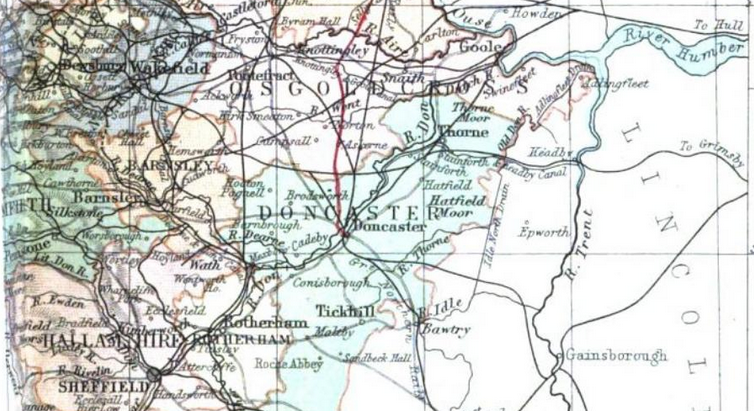
The family pf Wormley were almost certainly a branch of the Newmarch family of Womersley, in the West Riding of Yorkshire; a parish that comprised of the townships of Little Smeaton, Stubbs. Walden, Womersley, and part of Cridling Stubbs. In the time of the Domesday Survey it was granted to Ilbert de Lacy, one of the most powerful of Norman barons. The Wormleys were to be be granted land by the Earl Warren in the Hatfield area of Osgoldcross wapentake.
The Newmarch family, in post-Conquest England, descended from Henry de Newmarch and Dyonisia de Tilly, dau. of Otho de Tilly (probably of Calvados, Tilly-sur-Seules, Normandy, a tenant of the Honour of Warenne, and Mabel FitzRaven, daughter of William FitzRaven, Sheriff of Wakefield, and a daughter of Hugh de Boseville, from Beuzeville-la-Giffard,
Normandy. These associations were repeated over succeeding centuries, and the family of Wormley affords a perfect example of a vastly intermarried network of English colonists of early Virginia; those of the class that held land of their superior lord, such as the Lacys. An example of such “continuation” is that of John Bosvile, and his wife, Isabel Cresacre, being the ancestors of Gervase Bosvile, who m. Susan Wormley. Isabel Cresacre’s 2nd husband was Henry Langton, whose family bore for arms: three lions rampant, as those of the Wormleys.
The following notes contain much detail, which some may consider superfluous, yet those being described – of the vastly intermarried network – cannot be fully understood as single entities. They were defined by their peripheral relationships, of all manner of cousinship, and it is these that need to be also recorded.
THE PAYNEL AND LACY ASSOCIATION
1. Ralph Paynel. In 1088, Paynel was sheriff of Yorkshire, and seized the lands of William of St. Calais, the bishop of Durham, at the command of William II, whose cause he defended at the meeting at Salisbury, in Nov. 1088. In 1089, he refounded the priory of Holy Trinity, York, and made it a cell to Marmoutier Abbey; to it he gave Drax, his chief Yorkshire vill. (Dictionary of National Biography, vol. 43, 1885). He may have m. (1), a dau. or sister ilbert de Lacy*. (Clay,114). He m. (2) Matilda, dau. of Richard de Sourdeval, whose Domesday lands passed to Ralph’s descendants . (Keats-Rohan (K-R), 342, 1999). The Paynels took their name from Haye-Paganelli, situated 10 miles from Avranches. The “Haye” signifying a circular mound, topped with wooden spikes – a Scandinavian fort – which were common throughout France.
LACY
1. *Ilbert de Lacy, d. 1093, “occurs in the survey as mesne-tenant of many of the manors in Lincolnshire, of Odo, bishop of Bayeux, probably already the superior lord of the fief of Lassi, in whose contingent at Hastings he might therefore have fought, with his half-brother, Walter, as vassals of the see. It is probable, though as yet no circumstance has come to light which affords sufficient proof of the absolute identity of the persons, that Ilbert and Hawise (his wife) were the owners of Bois l’Evêque, not far from Darnetal, near Rouen, the capital city of Normandy, and that an Emma de Lacy, who was a nun at St. Amand, of Rouen, in the year 1069 (and had given to that Abbey twenty-two acres of land in Bois and Mount Maimart, which the Abbess sold to a Monk of La Trinité du Mont) was Ilbert’s sister“. (Richard H. H. Holmes, Pontefract: Its Name, Its Lords, and Its Castle, p. 59, 1878)
WOMERSLEY AS PART OF THE LACY FEE
In 1086, Domesday Book sets forth that, “In Tateshall there are sixteen carucates of arable land without tax, where there can be nine ploughs. This Manor the King used to hold. Now Ilbert has there 4 carucates and 60 lesser burgesses, and 16 cotters, and 16 villains, and 8 bordmen, having 18 ploughs. Tateshall included what we now call Pontefract, Monkhill, Tanshelf, East Hardwick, and perhaps Carleton. In Tateshall was the Church, in Tateshall were three mills, in Tateshall were the alms lands, no trace of either of which exists in the present township of Tanshelf. The disproportion of value of Tateshall was excessive. Compare its value (£20) with those of Elmsall (£3), the two Kellingtons (40s), Roal and Eggborough (60s), Beal (60s), Knottingley (£4), Ferrybridge (50s). Wheldale and Frystone (£4), Houghton (100s), Hessle (5s), Ackworth (£4), Darrington (£8), Stapleton (£4), Womersley (£6), Smeaton (£6), Kirk Smeaton (£4), Thorp Audlin (£4), Badsworth, Upton and Rogerthorp (£3), Stubbs (40s), &c., and it will be evident that in the peaceful time of the Confessor, the manor of Tateshall was worth the united values of three, four, six, ten or even twenty neighbouring manors, (ibid.).
1.1. Enguarrand de Lacy. “Later on, in 1080, an Enguerrard, son of Hilbert (probably Ilbert de Lacy – as there was at the time no other Ilbert who would have been spoken of by his Baptismal name alone – gave to the same Trinité du Mont two-thirds of the tithes of Bois l’Evêque; and when we have mentioned that this Enguerrard was apparently a great person, as his signature precedes that of the Count of Morton, and that he was Governor of Caen, but expelled by the townspeople just before the battle of Tinchebrai, in 1106, we have mentioned all that is known of those relatives, or suspected relatives, of Ilbert de Lacy, who did not succeed in gaining a settlement in England, but remained in their native Normandy” (ibid.).
Hilbert de Lacy, received extensive lands from William the Conqueror. “Hilbertus de Lacy”. “Hilbertus de Laceio”. “Be it known unto all Christians as well living as future, that I Hilbert de Laci together with Hadrude* my wife do give the mansion of Tuisuicz unto the Holy Trinity of Mont Rouen; the land to wit, with water and meadows and woods and all things to the same mansion belonging, for my soul and (the soul) of my lord king William, and the souls of my parents and friends, as also of my wife and of my son Hugh, for that also that he my son above-named resteth in that place; and the tithe of Freteval”. Freteval, the tithe of which is granted, was probably the small town of that name in France, situated in La Beauce, upon the river Loir. (The Archaeological Journal, p. 250, 1857). *Haduidis/Hawuidis probably a latinisation of Hawise.
Beauce is situated 1 mile from Lessay. It is very probable that the ancestor of Ilbert de Lacy was a military associate of William de Belleme, and in some way of familial connection, as in 1005, William a made several grants to local churches including the church of Beauce, which his father had founded. (Geoffrey H. White, ‘The First House of Bellême’, Transactions of the Royal Historical Society, Fourth Series, vol. 22, p. 76, 1940). It was an almost invariable medieval requirement that those making a donation to a religious foundation were in some way related to the founder.
A not improbable conjecture:
1. …
1.1. Roger de Montgommery, named in a grant to the abbey of Jumiéges, witnessed by “Hugonis filii ejus”.* (William de Jumiéges, op. cit. bk. I., ch. lxxij. and lxxiij).
1.1.1. Roger de Montgomery, m. Mabel, dau. of William de Bellême.
1.1.1.1. Robert de Montgommery “de Bellême”, m. Agnes, dau. of Guy, Comte de Ponthieu.
1.2. *Hugh Montgomery.
1.2.1. Ilbert de Lacy.
LACIACUS. LACEIUM ; LASSAYUM; LASSEIUM. – LASSAI.
“Petite ville et paroisse de l’archidiaconé de Passais, chef-lieu d’un doyenné, sur la rive droite du ruisseau de Chastenai, dans le pays des Diablintes. L’église paroissiale, située au hameau de S.-Fraimbault, distant d’un kilomètre de la ville, fut établie, suivant la tradition, par l’anachorète S. Fraimbault, dans le VI° siècle. La chapelle de Lassai en était la succursale”.
“Le canton de Passais, arrondissement de Domfront. On sait que Richard Ier, troisième duc de Normandie, donna à Yves de Creil, comte de Bellême et d’Alençon, ou à son fils Guillaume, une partie du Passais, à charge de défendre cette frontière de la Normandie contre les incursions des Manceaux et des Bretons. Guillaume de Bellême fit bâtir, vers 1020, le château de Domfront, dont subsistent encore quelques vestiges”. (Léon de La Sicotière, Le département de l’Orne, p. 118, 1845).
That is, was Ilbert de Lacy a cousin of Roger de Montgomery, son-in-law of William de Bellême, enabling Ilbert to donate to William de Bellême’s religious foundation in a familial capacity?
HUGH DE LACY
1.2. Hugh de Lacy,* the probable father of William, father of Robert de Stapleton:
Robert de Stapelton gave the vill of Osmundethorp to the Templars of Templehurst. (Osmundthorp near Leeds; “regione quæ vocatur Loidis”). Robert de Stapelton was one of the West Riding family who had property at Cudworth and Thorpe Stapleton. It may have been to enable him to make this grant that, about 1172, he gave the monks of Pontefract two tofts in that town, in exchange for three bovates at Osmundthorp, which he had formerly bestowed upon the same monks in exchange for land at Armesby. The witnesses to this charter were Alan clericus de Derfeld, Willus fil. Hervei, Petrus de Tolleston, et Ricardus et Alanus fratres sui, Herbertus de Archis, Willus fil. Morker, Walterus de Tolose, Ricus de Stapelton et Hugo frater ejus, Walterus fil. Hugonis, Ricardus de Archis, Jordanus de Ledestun, et Roger. de Ledestun. The witnesses enable us to fix the date to about 1172.
In a Stapelton charter witnessed by Henry de Lacy, who died before 1190, and others, Robert styles himself “Robertus fil. Willi, fil. *Hugonis.” He was one of the knights of Yorkshire in 1166, holding two fees of Henry de Lacy, and was of full age as early as 1154, for he was one of the witnesses when Lacy confirmed the charter of Pontefract Priory at his brother’s death in that year. The witnesses to this deed are Wills. Grammaticus, Jordan de Insula, Wills. le Peytevin milites,* Elias capellanus, tunc vicarius de Whitechirch, and William Grammary, who was probably he of that name, of Bickerton, near Ribston, living in 1202 (Yorkshire Arch. and Top. Journal, viii., p. 274). *William le Poictevin, of Headingley, near Leeds, living in 1207.
Carta Henrici de Laci,* de Fundatione Abbatiæ de Kirkestal. (Carta A. 1. E. III. n. 37).
Concedo etiam eis, et hac carta confirmo donationem quam Willielmus de Reinavilla, et uxor ejus fecerunt eis, per conventionem, et per divisas, et metas, quas ipse eis statuerit, et carta sua confirmavit. Concedo insuper eis, et hac eadem carta confirmo illam donationem terræ quam fecit eis Willielmus de Hedigleia, et uxor ejus, et filius ejus, per conventionem, et per divisas, et metas quas idem Willielmus eis fecit, et statuit, et sicut ipse, et Robertus filius suus, per cartas suas confirmavit; sub eadem quoque confirmatione, eis concedo donationem quam fecit eis Samson de Alretuna, per conventionem, et per divisas, et metas quas idem Samson eis statuit, et carta sua confirmavit. Precor autem et præcipio omnibus hominibus meis, quatenus hunc locum, et hujus loci habitatores, et omnia eis pertinentia diligant, et honorificent, et manuteneant. Testes dominus Henricus archiepiscopus Eboraci, Otto de Tilli, Richardus grammaticus, Jordanus frater ejus, Richardus filius Gubaldi, Radulphus filius Nicholai, Willielmus de Mungei, Robertus Pictaviensis, Willielmus de Hedingleia.
As an aside, there is no particular reason to suppose that “Richardus grammaticus” was related to the above mentioned “Wills. Grammaticus”, or “Rannulf, a vassal of Ilbert de Laci, who held Knottingley of him in 1086, is afterwards mentioned as ‘Ranulfus Grammaticus,’ and as having held lands there, given by Ilbert de Laci towards the endowment of St. Clement’s chapel in Pontefract Castle. (Old Mon. i. 659). (The Duchess of Cleveland, The Battle Abbey Roll. vol. II.). Knottingly, Tenant-in-chief in 1086: Ilbert of Lacy. Lord in 1086: Ranulf (the Latinist), who also held of Ilbert in Shippen (House), Skyrack, Yorkshire. Lords in 1066: Ernwy; Godric. Sturton (Grange), Skyrack, Yorkshire. Lords in 1066: Ernwy; Godric. The sobriquets “grammaticus”, “latinist”, referred to someone who could interpret charters written in latin concerning their lord, a necessary requirement, who often witnessed such charters in that capacity.
1.3. Robert de Lacy, founder of Pontefract Castle, d. bef. 1130. (VCH Lancaster 1, pp. 312-319).
1.3.1. *Henry de Lacy (d. 1177, ibid.), 4th Baron of Pontefract, builder of Kirkstall Abbey.
PAYNEL cont.
1.1. William Paynel, inherited his father’s lands in Yorkshire, including those at Drax. Between 1126 and 1135, he confirmed his father’s benefactions to Selby Abbey, and founded the Priory at Drax, and also gave gifts to Holy Trinity Priory in York. He died ca. 1145 to 1147. (K-R., pp. 1057–1058). He m. (1) a dau. of William fitzWimund, of Avranches. Domesday records FitzWimund as holding land in Exeter as a tenant of Baldwin FitzGilbert, a dau. of whom he married. (K.R., p. 490). Their son, Robert d’Avranches, m. Hadvise, dau. of Gelduin of Dol. A dau. married William Paynel, but her name is not known, ibid., p. 263, pp. 1057–1058.
1.1.1. Fulk Paynel, m. Lesceline, dau. of Hasculf de Soligny, having five sons: William, Fulk, Hasculf, John, and William. He died ca. 1182, and his heir was his eldest son, William. (Dalton “Paynel family” Oxford Dictionary of National Biography).
PAYNEL AND NEWMARCH
1.1.2. Frethesant Paynel, m. Henry de Newmarche. ‘Henry de Novomercato, son of Sir Adam,* confirmed to that Abbey, all their lands and possessions they had in his fee in this Parish of Whatton’. He d. bef. 1239. *Adam de Newmarch, born ca. 1146, benefactor of Roche Abbey, 1180, son of Adam de Newmarch. (CP ix. 543, citing Yorkshire Archæological Journal, vol. iv, p. 143, and Blythe cartulary, fo. 106); son of William de Whatton, who m. … de Newmarch; son of Robert d’ Armentières,* held land in Whatton of Gilbert de Gand,* who held half a carucate as a member of Whatton. Ilbert de Lacy* held a manor of Whatton. In 1270, Adam Newmarch held there 2 fees under Gilbert de Gand, descendant of the first so named. From which family: Roger de Newmarch, (d. by March 1352), cousin of John de Mowbray, 2nd Baron Mowbray. He held land in Womersley and Askern in 1318. (Rot. Chart. Dugdale’s Baronage. Inquisitiones post mortem). *Gilbert Crispin II.,* m. Hersende de Brezolles, and became enfeoffed in Armentières-sur-Avre. He donated a moiety of Brezolles to the Abbey of Bec. He was the likely father of Robert d’ Armentières.
See: https://tinyurl.com/mr4cxtbn
Roll of Fines, Yorkshire. The fourth year of Henry the Third, under the heading, “Of seisin of land. The king to the sheriff of York, greeting. We enjoin you that you cause without delay Frethesent, the daughter and heir of William Paynel, to have full seisin of the lands with the appurtenances, which had been those of the same William, father of the same Frethesant, in Hooton and in Shilton, and which belongs to the same Frethesant by hereditary right, 29th day of October, in the fourth year of our reign, through the same and the bishop of Winchester.”
In the Testa de Nevill, under the heading, Verdicts of the county of York: in the third year of the reign of King Henry, son of King John, are these entries. Frethesantha, who had been the wife of Geoffrey Luterel, and daughter of William Paynell, is of the donation of the lord the king. Henry de Newmarch has her. It is not known through whom. Her land of Barony is worth seven pounds yearly. The daughter of Isabella, sister of the aforesaid Frethesanta, is of the donation of the lord the king. Eustace de Greinville has her. Her land is worth seven pounds. Birdforth. Land of the aforesaid ladies in that wapentake is worth ten marks, namely, in Silton. The land of Frethesaunt Paynel, wife of Henry de Newmarch, is worth ten pounds.
This second husband of Frethesant Paynel was lord of Bentley in the parish of Arksey, and was also tenant of the manor of Etherthorpe in the parish of Darfield; but he died without issue, as we learn from a convention made between the prior and convent of Bretton of the one part, and Sir John de Newmarch of the other part, in the year of grace 1239, on the morrow of the translation of St. Thomas the martyr (8th July), at York, as to the manor of Alwardethuait, (Alverley Grange, in the parish of Wadworth, liberty of Tickhill), in which there is a stipulation for the finding of a priest, who was to celebrate the divine office for the soul of Henry de Newmarch, his uncle. This Sir John de Newmarch of Bentley and Womersley was the son of Adam de Newmarch,* brother of Henry de Newmarch, one of the mainpernors of Henry, son of the earl of Cornwall, or Fitz-Count, in 1205. (Royal Archaeological Institute of Great Britain and Ireland, p. 125, 1848). *Adam de Newmarch of Womersley, Campsall, Thorp, Bentley, and Arksey.
CAMPSALL CHURCH
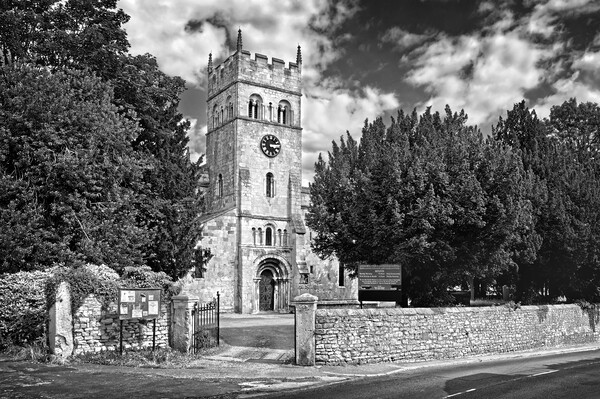
Campsall Church. Henry de Lascy E. of Lincolne p’sents Robert Sahm to the church of Campsall June 4, 1288.
East window in the Quire: Lacy, Or a lion rampant purpure. This is frequently, if not generally, said to be the Lacy arms, but erroneously. They were the arms of the earldom of Lincoln which John de Lacy bore in right of his wife.* His son and successor in the Honour of Pontefract, Edmund de Lacy, did not bear them, as he died before his mother, and even Henry de Lacy bore them only after her death. The arms in Campsall church were doubtless the arms of this Henry de Lacy, which may help to fix the time of the window at cir. 1300. *Margaret, dau. of Robert de Quincey, son of Saher de Quincey II).
Newmarch, Gules, five fussils in fesse or. The early Newmarch family were vassals of the Percys, and assumed their coat of arms.”Perhaps the best known English example is that afforded by the coat of Percy, Earls of Northumberland: Azure, five fusils conjoined in fess or”. (John Woodward, A Treatise on Heraldry, vol. 1, p. 195, 1896).
William Percy granted to Sallay Abbey all of Stockdale and Wivesdale, and confirmed the gifts of Richard de Moravilla, grants confirmed by Henry de Puteaco, ca. 1162, witnessed by Adam de Novo Mercato. This Henry de Puteaco claimed to be the son of Hugh Pudsey, the chancellor, and Alice, dau. of William Percy. “He gave the church to Finchale Abbey; he gave his estate of Osmundal to Robert de Perci; Settle fell back to the main line of Percy on his childless death, and his manor of “Wichton Cumptin,’ “derived from his father, was subject to the dower of Dionisia (daughter of Oto de Tilli), very strangely divided in 1211 or 1212 between Peter FitzHerbert his kinsman on the father’s side, (they were both great nephews of King Stephen), and Robert de Ros the grandson of William de Percy’s second wife Sibilla”. (George Tate, The History of the Borough, Castle, and Barony of Alnwick, vol. i., p. 399, 1866).
Window on the South Side: Or a lion rampant purpure – Orate pro Animabus Johannis Cresacre et Elizabethæ uxoris eius qui istam fenestram fieri fecerunt. (Yorkshire Archaeological and Topographical Journal, vol. x., p. 363, 1889).
The Cresacres initially adopted the armorial of the Lacys. Plita de banco Ter. Mich., 4° 6 Ed. 2, rot. 88 (1312). John son of Adam de Youkflete (Dodsworth, vol. 153), complaines agt John de Cresacre 90 acres of Land &c. in Camsale, & the deft calleth to warrant Roger de Novo Mercato. fo. 107. That is, Sir Roger Newmarch, of Womersley. William de Warren granted Yokefleet to his son, Adam, between 1180-1189, which he held from Hugh du Puiset (whose seneschal was Philip de Colvillel), in feudo et hereditate.
The family of Newmarch descended from this Dionisia Otho de Tilly, who m. (2) Henry de Puteaco/Puiset, see as follows.
THE CRISPINS
1. Gilbert Crispin II., m. Hersende de Brezolles, and became enfeoffed in Armentières-sur-Avre.
1.1. Robert d’ Armentieres (Domesday tenant of Gilbert de Gand in Whatton), alias Robert de Whatton. (Thoroton, i., 267, 1797). ). In 1166, David d’Armentières held ten knights’ fees of Earl Simon of Northampton, to whom most of the Domesday fief of Gilbert de Gand had descended. (L. F. Salzman, ed., A History of the Co. of Oxford: vol. 1,, pp. 373-395,1939). A manor of Whatton, noted by Mr. Thoroton, was Aslacton. “After the Conquest Uluric* held it of Ilbert de Lacy, whose fee it became”, ibid., 260. *Probably Ailric, who, as his son, “Suuen Filius Ailric” was a tenant of Ilbert de Lacy in Yorkshire. (K.R., 429).
“After the Conquest, this manor (Whatton) was of the fee of Gilbert de Gand. It was long held by the Whattons, Newmarches, and Gascoignes, the latter of whom sold it to the father of the first Earl of Chesterfield” (Philip Stanhope). (William White, History, gazetteer, and directory of Nottinghamshire, p. 514, 1832).
1.1.1. William de Whatton, ibid.
NOVO FORO
1. …
1.1. Ralph de Novo Foro, witnessed the foundation charter of Roger de Busli of Blythe Priory in 1088, and was presumably a tenant of the fee which was to become the Honour of Tickhill, in which his descendants held 4 knights’ fees. (Complete Peerage, ix, 543; EYC, viii., pp. 42, 48).
1.1.1. William de Novo Foro.
1.1.2. … de Novo Foro, m. William de Whatton.
1.1.2.1. Adam de Whatton (Adam de Novo Foro), granted land in Thurnscoe to Nostell Priory (Cartulary of Nostell, fo. 28), as Paine de Novo Foro had done to Blyth.
1.2. Paine de Novio Foro, benefactor of Blythe Priory, withe the consent of his nephew, William, ibid.; that is, William de Novo Mercato, named as the uncle of the son of of William de Whatton, who rendered account of 25L in 1130 for his son’s succession to the lands of William de Novo Mercato, ibid. This is presumably, Adam de Novo Foro, who took his mother’s name, and witnessed the foundation of Roche Abbey in 1147. (EYC, viii, 42).
NEWMARCH cont.
1.1.2.1.1. Henry de Newmarch, m. Dyonisia (dau. of Otes de Tilli and Mabel, dau of William FitzRaven of Hatfield, who m. (2) Henry Puiset.
The traditional account: “About the middle of the twelfth century we meet with a certain Hugh de Tilly who had three sons Otho, Ralph, and Roger. Otho was a considerable man in South Yorkshire: he was steward of the Earl of Warenne at Conisbro’, and seems to have held property in Doncaster, where he erected the original Otho de Tilly cross. He, or possibly his father, had obtained a considerable estate in the Lacy fee during the reign of Henry I, and in 1166 he was returned as holding three knight’s fees under Henry de Lacy. He was the second witness (preceded only by the Archbishop of York) to the so-called foundation charter of Kirkstall Abbey by Henry de Lacy. But he left no male issue, and at his death his estates passed with his daughter and heiress to the Newmarch family”. (The Publications of the Thoresby Society, vol. 26, part 1, p. 16, 1919).
Corrections given by Mr. John Wainwright, “Yorkshire”, p. 64, 1829: “Otone de Tylly de Conigbroc seneschallo comitis;” In addition to what they held in England, they were considerable proprietors of land, &c. in Normandy … Otho married Mabilla, daughter of . . who gave to the monks of Roche, out of her own patrimony at Bramley, two oxgangs of land, with a toft and croft. She also confirmed a previous donation of three oxgangs. In the 9th Henry III., A. D. 1225, Mabilla de Tilli claimed to have right of presentation to the rectory of Hatfield, then in litigation; and on the case being heard in London, it was deemed her right, and awarded accordingly. From a deed without date, noticed in Dodsworth’s collections, it would appear, that William le Vavasour, by his charter, gave and confirmed, to Otto de Tilli and his heirs, the village of Thorpe-in-Baln, with its appurtenances, rendering for all services, ten shillings per annum. Witness, Radulph de Tilli, his elder brother.
This grant was ratified by the paramount lord, Henry de Lacy; of whom, in the ” Liber Niger Scaccarii,” Otho de Tilli is said to have held two knight’s fees … The issue of this match was an only daughter, named Dionesia, whose hand was bestowed in marriage upon Henry de Newmarsh; but whether she was his first or second wife, we are not certain. That he was twice married, is manifest; and that the aforesaid Dionesia was his second wife, is extremely probable. Amongst the fines of the 24 Henry III., we find that Henry de Newmarsh gave to our lord the King sixty marks, that he might have to wife the widow of Geoffrey Lutterell, if she pleased; and William Bustard made a fine of the same sum, that he might take to wife the sister of the wife of the said Geoffrey, with her inheritance …
On this account it was, that the village of Thorpe-in-Baln became the property of the Newmarshes, from whom it passed to the Nevils. Hitherto, we presume, we have been consistent with ourselves; but a difficulty must now be contended with. Amongst the fines levied by King Henry II., there was one of £33. odd, made by Otho de Tilli, that his daughter might be disposed of in marriage at the King’s will; and Henry del Puasac was fined seven pounds, that he might have to wife the daughter of the said Otho. This circumstance, we conceive, cannot have reference to Dionesia, the second wife of Henry de Newmarsh before mentioned; for we never find Henry del Puasac, on any occasion, exercising the rights of ownership over any part of the Tillies’ property; hence it is reasonable to suppose, that there were two of that name, father and son, and that Henry del Puasac married the daughter of the elder Otto de Tilli, whose property would, of course, descend to his son. But to which we may with justice ascribe the erection of the cross at Doncaster, we are wholly ignorant”.
FITZRAVEN
Son of Hrafn: “Well might he be taken as the symbol and companion of Sea-rovers, whose sable flag was the terror of nations, whose Raven ensign seldom drooped before the banner of a foe”. (John Horace Round, Archeological Notes, p.7, 1883).
William FitzRaven,* Sheriff of Wakefield (under William de Warrene), from 1148-59), married a daughter of Hugh de Boseville, from Beuzeville-la-Giffard, Normandy, who held land in Harthill, Yorks. Their daughter, Mabel FitzRaven (born at Hatfield, circa 1120) married Otho de Tilly, probably of Calvados, Tilly-sur-Seules, Normandy, a tenant of the Honour of Warenne in Barnbrough, Bilham, and elsewhere. Their daughter, Dyonesia de Tilly, married Henry de Novo Mercato (Neufmarche/Newmarche). Their son, Henry came of age in 1172 and died in 1178. He is recorded a holding an interest in Barnburgh (Farrar, E.Y.C., Honour of Warrene, extra series, vol. 6, p. 154, 1949). His son of the same name was a donator of land in Barnburgh to Southwell Cathedral chantry.
*He was probably of Danish extraction, and gave his name to Ravensthorpe. Raven, from Hraefn, D., a raven, the Danish standard, and probably an indication of the abode of a Dane. Thorpe, O.E. and D., a farmhouse; hence, the raven’s farm-house. (Old Yorkshire, p. 201, 1881). Ravensthorpe is ca. 20 miles from Womersley, and ca. 7 miles from Wakefield.
Notification by Elias de Bosville to Roger, archbishop of York, of his gift, for the souls of Fulk his brother and William (third) Earl de Warenne, to Nostell Priory of his mill at Harlington, a bovate of land with a toft in Barnborough, and 6 acres of land and a toft there, and of William the miller and his wife and children. 1148 – June 1152. (Farrer, Clay, E.Y.C., cit. Nostell Cart., Cotton MS, Vesp. E xix., fol. 57v.). Elias and Fulk de Bosville were sons of Hugh de Bosville, aforementioned, and thus were uncles of Mabel FitzRaven, who married Otho de Tilly; their daughter, Dyonesia de Tilly, married, as said, Henry de Novo Mercato (Newmarche).
“Elias de Boseville appears to have been a person much connected with the Newmarches, to which connection the Bosviles owed the five fusils in fesse they bore on their shield, afterwards distinguished by three bears’ heads, or some other figure in chief. Sir John Bosvile, living 1252 and ’54, married the heiress of Darfield. They were afterwards seated at Ardsley and Newhall, Chevet, and Peniston-Coningsburgh, Warmsworth, Braithwell, and Ravenfield, Yorkshire, and Belhouse Grange, Notts”. (Duchess of Cleveland (Catherine Lucy Wilhelmina Stanhope), Battle Abbey Roll, p. 151, 1889).
1.1.2.1.1.1. Thomas de Newmarch (b. ca. 1225).
1.1.2.1.1.1.1. Thomas de Newmarch* (b. ca. 1260), m. Lora (not is father), d. & h. of Sir Geoffrey Gumbaud. Lora’s sister, Margaret, m. Laurence de Holebeche; their dau., Margaret, m. (in 1321), Sir Robert Deiville, son of Sir John Deiville (d. 1326); the son of Sir John Deiville, Constable of York Castle (d. 1291), and Maud,* dau. of Sir Roger de Mowbray. Sir John Deiville, ‘Constable’, was the son of Sir Robert Deiville of Egmanton and Adlingfleet, and Dionisia, dau. of Sir Thomas FitzWilliam, of Sprotborough. Lora, late the wife of Thomas de Novo Mercato (Newmarket), the elder, knight: Yorkshire. 11 Edward III 1338). (C 135/52/4).
NEWMARCH AND BELLA AQUA
1.1.2.1.1.1.1.1. Hugh de Newmarch, m. Olive, d. & coh. of John de Bellew (Bella Aqua). whose family were sub-feudaries of the Newmarch family in Barnburgh, as the Cresacres.
1.1.2.1.1.1.1.1.1. Elizabeth de Newmarch, m. Ralph de Newmarch.
1.1.2.1.1.1.1.1.2. Thomas de Newmarch. The Arms of Newmarch, of Whatton, were, Argent, five fusils in fesse, gules; those of Newmarch, of Bentley, Gules, five fusils in fesse, or. (Thoroton’s Notts. Harleian M.S.S.).
NEWMARCH AND PAYNEL
1.1.2.1.1.2. Henry de Newmarche (kinsman of Henry Puiset, grandson of William Percy), m. Frethesant Paynel. The Testa de Nevill includes a list of landholdings in Yorkshire, dated 1219, which includes “Frethesanth que fuit uxor Willelmi Paynel”, adding that “Henricus de Novo Mercato eam habet”, holding land in “Rydal” as well as “filia Isabelle sororis Frethesanth predicte … Eustachius de Greinvill eam habet”. Frethesant’s sister, Alice, m. Robert de Gand. Henry de Newmarche had a son and namesake: In 1210, the Curia Regis Roll, vol. 6, p.114, shows Henrici de Novo Mercato agreeing to the appointment by his sub-tenant Robert Mallet of Thomas de Wimerele as the vicar at Bolton-Upon Dearne. The right to choose the vicar was important in medieval society, giving someone the advowson or ‘living’ of a church gave him money, a house, and control in the local community, and suggests Thomas was someone familially connected to the donator’s family
1.1.2.1.1.2.1. *Adam de Newmarche. Feb. 15, 1219: Institution of Robert de Gray, clerk, to the mediety of the church of Cameshal (Campsall), which belonged to Hugh de Hetfeld, at the presentation ‘nobilis viri, A. de Novo Mercato’ (The Register or Rolls of Walter Gray, Lord Archbishop of York).
1.1.2.1.1.2.1.1. Margery de Newmarch, m. Jordan Foliot, son of Richard Foliot and Margery de Stutteville. C.C.R., April 20, 1264: The king has committed to Richard Folyot the manors of Adam de Novo Mercato of Womersley (‘son of Adam’) Campsall, Thorp’, Bentley and Archsey in Yorkshire, which the king took into his hand because he (Richard) captured him (Adam) while Adam was resisting the king in hostile manner in the conflict that recently took place at Northampton, to keep for as long as it pleases the king. Richard Foliot’s Yorkshire properties included Norton, near Campsall and Walden Stubbs (‘Stubbs’). The early manor house lay a little to the north of the vill of Walden Stubbs, in the parish of Womersley.
1.1.2.1.1.2.1.1.1. Richard Foliot, of Gressenhall, Norfolk, b. Dec. 25, 1283, died on the King’s service in Scotland between April 18 and July 23, 1317 (Rot. Pat. 10 Edward II., p.2, m. 20). He m. (1310) Joan, relict of James de Bohun, daughter of Sir William de Brewose, Lord of Bramber and Gower.
1.1.2.1.1.2.1.1.1.1. Margery Foliot, in 1330, had livery of her purparty of the lands of her grandmother, Margery de Newmarch. (Inq. p.m. deceased brother, Richard Foliot, Edward II. file 93, no. 6).
His Whatton estate, which his grandfather had held, “comprised 4 fees of the Honour of Tickhill, 2 held of Earl Warenne, and 3 of the Earl of Lincoln in Yorks, 3 fees in Whatton, Hawksworth and Aslacton, Notts, of the Barony of Gand, and the manor of Carlton Scroop, Lincs, and Ketton, Suffolk. He was summoned for military service in Wales in 1241, and in Scotland 1244. . Chancery inquis. Adam de Novo Mercato (Newmarket): Bentley. 31 Henry III (1247). (C 132/6/21). A charter of 1228 records that Adam de Newmarch donated St Nicholas’ chapel at Cobcroft, a hamlet in Womersley parish, to be used as a chantry, and money to pay a monk or priest to pray for his soul and the soul of his wife Joanna (Pontefract Chartulary, vol. ii.).
THE JOHN DE NEWMARCH LINEAGE
1.1.2.1.1.3. John de Newmarch, d. 1247. June 29, 1233: “setting out for Scotland with the king … John de Novo Mercato, earl of Lincoln”. (Rot. Scot.).
1.1.2.1.1.3.1. Adam de Newmarch II. The Charter of Adam, the son of Lord John of Newmarket (To Hirst). “To all the sons of holy Mother Church to whom the present writing shall come, Adam, the son of Lord John of Newmarket, giveth greeting for ever in the Lord. Be it known unto all of you that we for the health of our soul, and of the souls of our ancestors and descendants, have given and granted (and by this present writing declared quit of us and our descendants for ever) to God and Blessed Mary and to the Master and Brethren of the Order of the Temple of Solomon of Jerusalem”. The witnesses being Peter de Gypton, probably a member of the Priory of Pontefract (Y. A. J., vol. xi., p. 29); William de Normanton; William de Wadworth’ (Dodsworth MSS.). “The grantor of this charter is said (Baine, Yorkshire Past and Present) to have held three knights’ fees under de Laci, Earl of Lincoln, and also two knights’ fees of the honour of the Earl of Warren. His father, Lord John of Newmarket, and his sons, Adam and John, are in the list of those buried in the churchyard of the Blackfriars of Pontefract. But only the heart of Adam de Newmarket himself seems to have been deposited there”. (Holmes,The Blackfriars of Pontefract).
Memorandum of an agreement between John de Warenn and Adam de Newmarch (Novo Mercato), son of John, viz. that the water stopped up in the Balne (Balnea) should be carried off by a ditch 8 ft. wide and 4 ft. deep within the tilth (culturam) called ‘Wehtwonge’ to the ditch called ‘Smalehacchedich’ and thence into the ditch called ‘Holdepersonedich,’ and so to the water called ‘Dich,’ the west side to be kept in repair by Adam’s men and the east side by John’s men, etc. Yorkshire. Endorsed: inter maneria sua de Wilmarsley, Thorp, Campshall, Bentley et Archesey, Ebor.’ Yorkshire, West Riding. 1253-1254. (E 40/10762).
Agreement. First party: Walter de Ludham Second party: Adam de Novo Mercato: It is agreed between Walter de Ludham, Edmund de Lasci [Lacy], steward, and Adam de Novo Mercato, son of John, that Walter is to grant to Adam one piece of land in Camesale (Campsall) below Adam’s yard in perpetual exchange, if Edmund wishes, when he comes to full age, which same piece contains in length 22 perches by a perch of 20 feet and in width in total, by addition in one place and subtraction in another, 10 feet, for twice as much land to the use of Edmund from the cultivated land of Adam towards the north, which lies at the windmill. Additional people: (witnesses) Robert the parson of Camesale (Campsall). Stephen de Sudkirkeby (South Kirkby). Henry, his son. Geoffrey le Vinur. William and Henry, brothers of the parson of Camesale (Campsall). (DL 25/2155).
1.1.2.1.1.3.1.1. Adam de Newmarch III (b. ca. 1225), of Womersley, d. 1283. He succeeded to his grandfather’s estates on September 25, 1247. To the Malcolm de Harle, escheator Grantham beyond Trent. Order to cause all the lands that Adam de Novo Mercato held of the king in chief as of the inheritance of Cecily, his wife, in Redburn, near Hilbaldestowe, which the escheator took into the king’s hands upon Adam’s death, to be replevied to Cecily until the next parliament, so that there may then be done what ought of right to be done”. (CCR 19 Edw I, p. 177, mem. 4). Cecilia de Neville was the wife of Adam de Newmarch, and mother of Sir Adam de Newmarch, husband of Elizabeth de Mowbray.
Adam de Newmarch, his lands were escheated in 1264, m. Cecily de Neville, desc. of Walter de Neville
Adam Newmarch III. was the brother of Robert de Newmarche., b. ca. 1235. Demise by Philip de Vermel, with the consent of lady Joan his mother, to Sir Robert de Novo Mercato, for thirteen years, of his capital messuage with a close and toft in Brampton (Bierlow), with land in Brampton, Alkele, and Cantele, and the advowson of the church of Brampton and Cantele etc: Whitsunday, 1260. (E 40/5475). Within Brampton was Newhall, which was held by Adam, son of Swain,* from the family of Fleming. (Monk Bretton Cart, fol. 210d.). The Newmarch and Fleming families jointly held in Wentworth: “Adam de Novo Mercato et Willelmus le Flemmyng tenent eandem villam; et pars dicti Willelmi tenetur de feodo de Skypton, et pars dicti Adæ de honore de Tikehull”. (Kirbey’s Inquest). “Sir Henry de Vernoil, temp. Ed. I. held of Robert Lutterell in Yorkshire, and married Agnes, one of the co-heiresses of *Swain de Houghton” (juxta Hickleton). (S. Yorks., ii., 128). The Vernoil family were tenants of the Lacys, and donated to their foundations of Kirstall and Hirst, as did the Newmarch family. (John Napper Worsfold, History of Haddlesey, p. 12, 1894).
Robert’s son was Adam de Newmarch, b. ca. 1270. Grant by Adam son of Robert de Novo Marcato to Adam de Pontefracto, of 1 1/2 acre in Halhe, adjoining le Quarel flat on the north; 1 acre abbutting on the croft held by John Cokewald; 1/2 acre at ye Crownest; and 1 plot of land in Hepton, between Longrode and le Welclosys, late held by Michael de Deneby of Cecilia de Novo Mercato (Adam’s aunt); at a rent of 12d. for the land within the bounds of Mirfield, and 2s. for the land within the bounds of Hepton. At Mirfeld, the Assumption, 1307. Witnesses: Sir John de Sothyll, Sir Wm. de Beston, Knts., John de Lacy. (Yorkshire Archaeological Journal, 12, p. 260, 1893).
CONNECTIONS TO NEVILLE
Sanders’ English Baronies, p. 74, names the sisters and co-heirs of Alexander de Neville* (d. 1249), of Redbourne, Lincs, cit. C.I.P.M. i, nos. 154, 270; C.P.R.1247-1258, p. 46; C.R. 1251-3, p. 166; C.R. 1253-4, p. 3; C.C.R. 1288-96, p. 177, and Quo Warr., p. 426.
Joan, m. John de Eton.
Margery/Margaret, m. Nicholas de Neville*.
Elena, m. Henry le Tyeys. (1307. C241/67. Debtor: Richard Tyas (lord of Farnley Tyas, Agbrigg Wapentake, W.R.Yorks). Creditor: Francis Tyas, Thomas de Heaton, and John de Cresacre, executors of Francis Tyas, knight, deceased (of Farnley Tyas, Agbrigg Wapentake, W.R.Yorks). Amount: £29 10s. Before whom: Nicholas de Langton; Edward de York, Clerk; at York).
Juliana, m. Ingram Folenfaunt (having issue a son of the same name, recorded in the grants as follows).
Cecily, m. Adam Newmarket (Newmarche).
Grant. (1) Ingelram s. of Ingelram Folenfaunt of Addewyk. (2) John de Bosevill of Tykehill. John his s., of Waddeworth. Rich. Cok and wife Agnes. (1) to (2) and heirs manor of Addewyk. Witn.: Sit Thos. de Mounteny, Roger Curzoun, Wm. le Loverd, Geoffrey de Hyrst, etc. At Doncaster, Sat. Eve of Epiphany 18 Edw. II. 1325. (Notts. Arch., DD/FJ/1/194/8).
Release. (1) Juliana wid. of Ingeram Folenfaunt. (2) Rob. de Rayneberg. (1) to (2) all lands he had of Roger de Leycester in Addewick. Witn.: Wm. de Loverid, Rob. Typion of Boulton, Rich. Bastard. At Addewick, Palm Sunday, 27 Edw. I. April 12, 1299. (Notts. Arch., DD/FJ/1/194/4).
Release. (1) Wm. Fitzwilliam, kt. (2) Rob. de Raynebergh and wife Alice. (1) to (2) all lands in Addewyk (1) inherited after death of aunt Agnes, d. of Thos. Fitzwilliam. Witn.: John de Donecastre, Rob. Tilly, John de Eland, Ingelram Folenfaunt, etc. At Doncaster, Sun. after St. John of Beverley, 31 Edw.I. May 12, 1303. (Notts. Arch., DD/FJ/1/194/20).
Portion of a Will, apparently of Hen. de Lacy, Earl of Lincoln (1257-1312). Dated at Bordeaux, on or about Conversion of St. Paul, 1287. Apparently revoked; many bequests cancelled by a stroke through names, as likewise 1st., 2nd. and 4th. executors. Executors: John le Romain, Archbishop of York (1286-1296); Rob. Burnel, Bishop of Bath & Wells (1275-Oct.1292); John de Lacy, Chancellor of Chichester; Sir Rob. de Saham, and Wm. de Nony. Among bequests are: To Engeram Folenfaunt, £10 (100s); etc. (Notts. Arch., DD/FJ/4/25/1).
Release. (1) Ingram s. of Ingram Folemfaunt. (2) Sir Nich. de Leycestre. (1) to (2) all premises as above. Witn.: Stephen de Bella aqua. John de Cresacre, John le Vavasur, Rob. Tilly, etc. At Addewick, Sat. after Hilary, 23 Edw. I. Jan. 15, 1294/5. (Notts. Arch., DD/FJ/1/194/2).
(One constant of medieval life was that those who witnessed deeds were often related. Take, for instance, Stephen de Bella aqua and John le Vavasour, who witnessed Ingeram Folemfaunt’s deed, with John de Cresacre, above given. In the year of grace Mccc. … it was agreed, on Sunday, the morrow of All Saints, between the lady Isabella de Bella Aqua, on the one hand, and William, son and heir of the lord John de Bella Aqua, on the other; that the said lady had bought of the lord William le Vavasur (father of *John) for two hundred marks sterling (William’s right to marry a dau. of William le Vavasur). For which concession the same William granted to the said lady Isabella all the right and claim that she had or may have in all the lands and tenements, rents and services that descended to her by right of inheritance after the death of Lord John de Bella Aqua, his father, in Kyrtlington, Hokerton, Rohagh, Midelthorp, and Herleshag in the county of Nottingham, and in Swynton, Routhemers’, and Wylthorp in the county of Ebor., with all their appurtenances. To be held and held by the said lady Isabella for her whole life. And the said William binds himself and his heirs to warrant all the said tenements, as aforesaid, for the whole life of the said lady Isabella. In witness whereof the seal of the said Lady Isabella and the seal of the aforesaid William were alternately affixed to the present indented writings. (Trans. and précis, Reg. archiep. Greenfield, pars ii., inter ff. 221, 222). In the 31st Edward I. *Stephen de Bella Aqua held in Swinton and Rawmarsh, and the heir of John de Bella Aqua in Wildthorpe.
The Bella Aqua from Belleau, or Bella Aqua, in Normandy. In 1165 this family held knight’s fees in Kent, Berks, and York. Gilbert de Bella Aqua witnessed a charter of the Archbishop of York, ca. 1140 (Mon. i. 476). They also held Warmsworth and Barnborough of the Newmarches. That is, they held the Conisborough moiety, and the Cresacres held the Tickhill moiety in 1316. ‘In 23 Edward I. (1305) John de Bella Aqua or Bellew married Laderina, youngest of the four sisters and coheirs of Peter, the last Lord Brus of Skelton; and in her right, upon the partition of that inheritance, had the lordships of Carleton in Balne, Ramlesforth, Thorpe-Arches, Tibthorpe, and certain lands in Sethbarne — all in the county of York).
Rev. Joseph Hunter’s South Yorkshire: family of Neville of Redbourne, Lincs. and Mirfield, Yorks; with additional notices.
1. Alexander de Crevequer, m. Amabil, dau. of Adam fitz Swein. “With Adam FitzSwayne, the son of Swayne, the male line of this great Saxon family became extinct. He left two daughters, co-heiresses: the family of one of them, Matilda, married to Adam de Montbegon, Lord of Hornby, became settled at Brierley, in possession of what we may call, speaking generally, the eastward portion of her father’s estate. Their son Roger de Montebegon died without issue 12 Henry III. By Matilda’s second husband, John de Malherb, she had two daughters, co-heiresses Clementia, married to Eudo de Longvillers, and Matilda, married to Geoffrey de Neville, de Novavilla”. (C.T. Pratt, A History of Cawthorne, pp. 15-18, 1882).
Transactions of the Lancashire and Cheshire Antiquarian Society, vol. 15, p. 132, 1898, cit. The “Castle of Pomfret,” by G. F. Clarke, F.S.A.: “Adam-Fitz-Sweine had two daughters, one of whom married Alex. de Crevequer, and the other married Adam de Montbegon”.
1.1. Cecilia de Crevequer, m. Walter de Neville. (The Genealogist, vol. 26, p. 2).
1.1.1. Alexander de Nevil* (b. ca. 1200), m. Margaret, a widow, 11 Henry III (1227).
1.1.1.1. Alexander de Nevil, d. 33 Henry III. (1249).
1.1.1.2. Margery de Nevil, m. *Nicholas de Neville.
1.1.1.3. Juliana de Nevil, m. Ingram Folenfaunt.
1.1.1.4. Cecilia de Nevil (b. ca. 1230), m. Adam Newmarket. (Newmarche).
1.1.2. Roger de Nevil.
1.1.2.1. Nicholas de Nevil.
1.1.3. Robert de Nevil.
19 Coram Rege Roll. Mich. 9 H. III. (1225). Redburne. Deed enrolled by which Alexander de Nevill grants and confirms to Robert de Nevill, son of Robert de Nevill, p’ homag’ and servicio suo all the lands which the said Robert holds “de dono Amabil de Nevill sororis mei in Redburne. 3 acres arable of land and half ex one part of the town of Redburne, and 33 acres of arable land and half ex the other part of the said town, and afterwards 16 bovates of arable land in said town, and one water mill near the messuage of John de Cauz. “tota servic Alex cl’ci and Hamon de Redburn libr’ tene’tum sine ullo retenemento cum omnibus alliis rebus,” appertaining to the said tenements and “molendum infra villa and extra villa &c., at the yearly rent of 6m sterling at the feast of the nativity of our Lord for all services &c.
12 Coram Rege Roll. Mich. 5 H. III. Radburne. Deed enrolled by which Alex de Neville confirms to Roger de Neville (father of Nicholas) all the lands which he holds by the gift of Robert de Neville his brother, in Radburn – the same lands. Witnesses. John Bonet, Jordan de Esseby, Robert de Amundeville, Nicholas de Neville, Robert fil Gauf’, Robert Cossin, Michael Cossin, Roger Marshall, Richard Basset, and Simon de Neville, etc.
The Paynels were established near Redburne:
18 Coram Rege Roll. Mich. 8 H. III. West Rasene. Hugh Paganell versus Prior of St. Trinity de Ebor, the advowson of the church of West Rasene*. The deft. said that Hugh Paganell grandfather of the said Hugh gave the said advowson to his church, &c., which gift was confirmed by Fulco Paganell brother of Hugh the grandfather-false claim. (Lincolnshire Notes and Queries, vol. 4, p. 77, 1896). *8 miles S. of Redburne.
ADAM DE NEWMARCH AND ELIZABETH DE MOWBRAY
1.1.2.1.1.3.1.1.1. Adam de Newmarch, m. Elizabeth de Mowbray. A suit of 1279 states: “Ralph FitzGalien brought a writ of aiel against Robert Bouchard. Robert answered that he only claimed the free tenement and could not answer without Isabel daughter of Roger de Mowbray in whom the fee and right lay and her husband Adam de Neumarche”. Adam took the side of the barons in the civil war, and, consequently: “The King granted to Richard Folyot the mann’rs of Adam de Newmarket (Newmarch) of Wilmersley (Womersley), Champsall (Campsall), Thorp, Bentley, Archesey, in the County of York”. (Holmes, Wapentake of Osgoldcross, YAJ X: 363). Debtor: Elizabeth, who was the wife of Sir Adam de Newmarche (Adam held) land in Bilham and elsewhere in Strafforth Wapentake, W.R. Yorks). Creditor: John de Spain (de Ispannia). Nov. 23, 1293. (C 241/24/39).
Adam de Newmarch was a tenant of the Lacys: Henry de Lascy, Earl of Lincoln to Adam Newmarch (de Novo Mercato), knight, and Elizabeth his wife: Grant, indented, in tail, of land and rents in Saltfleetby: (Lincs). 1272. (DL 25/2565). Demise by Adam de Newmarch (Novo Mercato) to the executors of Sir Henry de Newmarch of the easement of the grange, the granary, fruit of the garden and customary works, to make what profit shall seem good to them, viz. till Midsummer A.D. 1280; also grant that John the reeve (prepositus) shall be in all ways assistant to them. 1280. (E 40/8594). Bond by Sir Jordan Folyot to Adam de Novo Mercato, son of Sir Adam de Novo Mercato, for 20 marks to be paid within six years at the manor of the said Sir Adam in the form specified, commencing at Whitsuntide, 1273. Witnesses: Sir Richard de Barnoby, Ralph de Schifeud, Hugh de Lindric, and others. (E 40/7223).
Agreement, among Sir Walter de Ludham, Edmund de Lasci, steward,* and Adam de Newmarch (novo mercato) for the grant of a piece of land in Campsall in perpetual exchange, if approved by the said Edmund on coming of age: (Yorks, W.R. May 26, 1284). (DL 25/2155).
MOWBRAY AND WESTENAYS
1. Roger de Mowbray.
1.1. Elizabeth de Mowbray, m. Adam de Newmarch.
1.1.1. Roger de Newmarch, of Womersley, d. March 11, 1351/1352.
1.1.1.1. John de Wormley.
1.2. John de Mowbray, 2nd Baron Mowbray.
1.2.1. John de Mowbray. In the first year of the reign of Edward III. (1327) John de Mowbray held the manor of Thorne. John de Warren possessed it in 1348.
1.3. Maud de Mowbray, m. Sir John Deiville.
1.3.1. Sir John Deiville (d. 1326), m. Margaret, dau. of Margaret Gumbaud (and Laurence de Holebeche), sister of:
(1) Lora Gumbaud, m. Thomas de Newmarch (supra).
(2) Christiana Gumbald, who m. Edmund de Wasteneys, uncle of Alice de Wasteneys, who m. John Cresacre.
The Inq. p. m. of William Gumbaud, alias Gobaude, was taken in the 33rd Edward I. The jurors say that “Lora, uxor David de Fletwyth, Margareta, uxor Laurentii de Hollebek, Johanna Gumbaud, quæ est monialis apud Swyne in comitatu Ebor., et Christiana Gumbaud, quæ est monialis apud Stykeswald in comitatu Lincoln., sunt sorores prædicti Willelmi defuncti, et hæredes ejus propinquiores, et omnes sunt plenæ ætatis”. (Cal. Gen., ii., 604). Lora de Fletewik re-married Thomas de Newmarch (Poulson’s Holderness, ii., 494), who was certified joint lord of “Thorngombaud,” with Laurence de Holbek and Edmund Wasteneys. (Surt. Soc., p. 204, 1866).
(1. Edmund de Wasteneys. Grant: John de Mowbray, 2nd Baron Mowbray,* to Richard Hackelute of £20 of annual rent in Melton Mowbray to be held for the term of his life. Wit. Edmund de Wasteney. 1316. (SC 8/50/2478). *John de Mowbray, 2nd Baron Mowbray, d. March 23, 1322, was hanged at York for joining in Lancaster’s rebellion against Edward II., father of John de Mowbray. In the first year of the reign of Edward III. (1327) John de Mowbray held the manor of Thorne. John de Warren possessed it in 1348.
1.1. Edmund de Wasteneys, m. Christiana Gumbald, whose sisters, Lora, m. *Thomas de Newmarch.
1.2. Robert de Westneys.
1.2.1. Alice de Wasteneys, m. John Cresacre.
1.2.1.1. James Cresacre).
JOHN DE NEWMARCH
1.1.2.1.1.3.1.1.1.1. John de Newmarch, d. bef. May 10, 1310. (Cal. Patent Rolls, 1307-13, p. 46 and Cal. Close Rolls, 1307-13, p. 211); s. and h. (of Adam de Newmarch), was under age at his father’s death, and in ward to Alice de Lacy.
Grant for frankalmoign by Henry de Lascy Earl of Lincoln. Parties: (1) Henry de Lascy, Earl of Lincoln (2) the prior, prioress and canons of (Gilbertine Priory of) the Blessed Mary of Ormesby Property: 18 perches in breadth of land and moor in Inkelmor in the manor and soke of Snayth, near the town of Swyneflet in a place called le Westmore near the bank of the water of Ouse. And the same moor in another place where there is a right of digging for turves, containing 70 perches in breadth. 14 perches in breadth of land and moor in place called Loune in Swyneflet [Swinefleet]. 20 perches in breadth of land, moor and marsh in another place in Inkelmor in the manor and soke of Snayth … For which they undertake that a mass shall be celebrated daily for the next 15 years at the altar of the B.V.M. (Blessed Mary) at Ormesby for the souls of the Earl, his ancestors and heirs, and all faithful departed; and that yearly on the anniversary of his death, a further mass will be celebrated and 7d distributed to 7 poor people at the door of the priory. Rendering 6d yearly for all secular services and demands. The Earl to be received into all spiritual benefits of the priory. Witnesses: Sir William Vavasour, Sir William de Stopham, Sir Robert de Talbott, William de Nunny, Thomas de Fissheburn, Alexander de Ledes, John Mauleverer, Thomas de Smetheton, and John de Novo Mercato. Given at Altoft near Pontem Fractum, Nov. 6, 1304. (East Riding of Yorks Arch. (ERYA), DDX152/3).
De Banco Roll 199, Trin. 6-7 Edw. II, rot. 32. February 17, 1307: Eltham. Mandate to John son of Adam de Novo Mercato to render homage and fealty to Henry de Bello Monte, to whom the king has granted the manors of Folkyngham, Edenham and Barton, co. Lincoln, late in the tenure of Gilbert de Gaunt. (H. C. Maxwell Lyte, ed., Calendar of the Patent Rolls, Edward II, A.D. 1307-1313).
In the chancel wall of Womersley church is the figure of a Crusader, supposed to be a portion of a monument of one of the Vavasour family, formerly of Woodhall. (James Joseph Sheahan, T. Whellan, History and Topography of the City of York, the East Riding of Yorkshire, vol. p. 756, 1857).
Fines A° 19 Ed. 1 (1290). Between William le Vavasour & Nichola his wife, complt, & William de Cestrehunt (Dodsworth) & Elizabeth his wife disturber, of the manns of Womersley & Routhcliffe (Rawcliff). (The Yorkshire Archaeological Journal, vol. xiii., p. 146, 1895).
On the 25th September, 11 Edw. II. 1317, the King granted to ‘Amicie que fuit uxor Johannis de Novo Mercato et dilecto nobis Galfrido le Scrop, quod predicta Arnica ad totam vitam suam habeat liberam warennam in omnibus dominicis suis in Karleton &c. quas tenet ad terminum vite sue et que post mortem suam ad prefatum Galfridum et heredes suos reverti debent, etquod post mortem ejusdem Amicie predictus Galfridus et heredes sui imperpetuum habeant liberam warennam &c. Test, apud Ebor. xxv die Sept’. (Rot. Cart. No. 62. 61, 60). About the same time, the King granted to “Elizabeth que fuit uxor Ade de Novo Mercato et dilecto nobis Galfrido le Scrop, quod predicta Elizabeth ad totam vitam suam habeat liberam warennam &c. in Carleton quas tenet ad terminum vite sue et que post mortem suam ad prefatum Galfridum et heredes suos reverti debent”, Ibid.
Gloucester. June 23, 1330: To John de Bolinghrok, escheator beyond Trent. Order not to inter meddle further with the manors specified below, and to restore the issues thereof, as the king learns by inquisition taken by the escheator that Amice, late the wife of John de Novo Mercato, held no lands at her death of the king in her demesne as of fee, but that she held on that day the manors of Wodhale in the park of Wilmersle and Thorpe in Balne as of the purchase of her and John, to them and to the heirs of their bodies, with remainder, in default of such heirs, to the right heirs of John, and that the manor of Le Wodhale is held of Queen Philippa as of the honour of Pontefract by the service of a twentieth of a knight’s fee, and that the manor of Thorp is held of Henry le Vavasour by certain services, and that John and Amice died without an heir of their bodies, and that Roger de Novo Mercato, brother of John, is John’s next heir and is of full age’ (Calendar of the Close Rolls, Edward III, vol. II, 1330-1333).
To the justices of the Bench. Order to send one of their number who Kennington, can most conveniently be spared to Amice, late the wife of John de Novo Mercato, who holds for life the manor of Kedynton, co. Suffolk, of the inheritance of Roger de Novo Mercato, which Amice is sojourning in Yorkshire, and is unable owing to infirmity to come into the Bench, to receive from her a recognisance of what right she claims in the said manor, Margery de Wyluby and John her son having brought a writ of covenant before the king against the said Roger de Novo Mercato concerning the aforesaid manor in order to levy a fine between them of the same; so that the said Amice after such recognisance has been made shall attorn herself before the justice so sent of her fealty to the said Margery and John, and that the said justice shall certify the said justices of the Bench of the premises at a certain day to be assigned by them. The king wills that they shall, when they have before them the record of the said justices of the recognisance and fealty aforesaid, permit a fine to be levied before them in the Beuch according to law and custom. May 20, 1310. (Calendar of the Close Rolls).
“Adam de Barnardiston, in the reign of Richard I, had two sons, William and Simon. The latter was the father of Walter de Barnardiston, who left two sons, one is called “Alexander de Walpole, son and heir of Walter de Barnardiston,” and the other “Roger”. William, son and heir of the first mentioned, was contemporary to King Henry III, and left a son named Geoffrey, who lived in the reign of Edward I, and appears to have married the heiress of the family of Novo Mercato or Newmarch, probably the daughter of Roger de Novo Mercato, but for a considerable time, Amicia, the widow of John de Novo Mercato, his brother, continued to be tenant for life of the Ketton Manor estate and advowson. (Proceedings, vol 4, Suffolk Institute of Arch. and Hist. Soc., p. 126, 1848).
Grant. First party: Smyth. Second Party: Alan de Smytheton. Place or Subject: The earl grants Alan for his homage and service one messuage, 80 acres of arable land, 5 acres of meadow, 10 acres of wood and pasture and 12d of rent with appurtenances in Haghe (Hague) in the parish of Southkirkeby (South Kirkby). Witnesses: William de Stopham; Robert de Berlay; Robert de Balliol, knights; William de Nunny; Thomas de Fissheburne; John de Novo Marcato; and Edmund Talbot. Dated at Wilmerslay. March 19, 1302. (ERYA, DL 42/1/77/16).
First party: Edmund, son of Robert le Boteler. Second Party: Henry de Lacy, earl of Lincoln: Whereas Edmund, several times before the completion of this deed, has been distrained by the bailiffs of Henry de Lascy, earl of Lincoln, for doing a certain suit by the heirs of Richard son of John, tenants of the earl, at the court of Pontefract from three weeks to three weeks, which heirs are the intermediate tenants between Edmund and the earl … Witnesses: Robert de Ros; Richard de Sotton; Giles de Trumpington, knights; William de Nonni; Thomas de Fisseburne; William de Kyme; John de Novo Marcato; Alan de Smiyeton; Alexander de Ledes; and Oliver de Stanesfelde. Dated at Altofts, May 15, 1304. (ERYA, DL 42/1/77/4). Evidently, John de Newmarch was a tenant of Henry de Lacy, earl of Lincoln.
LACY BARONS OF PONTEFRACT
1. Richard fitzRanulf, and nephew of Waleran fitzRanulf, whose father Ranulf ‘the Moneyer’ had bought the mill at Vains, Normandy in 1035. (Cokayne, Complete Peerage, new ed., vol. 12, part 2, pp. 268-269).
1.1. John FitzRichard.
1.1.1. Eustace fitzJohn (died 1157), hereditary Constable of Chester, by his second wife Agnes, daughter and eventual heiress of William FitzNigel (died 1134), of Halton Castle, hereditary Constable of Chester and feudal Baron of Halton, ibid.
1.1.1.1.Richard FitzEustace (d. 1163), hereditary Constable of Chester, by his wife, Albreda de Lisours (d. 1194), daughter of Robert de Lissours and Albreda de Lacy, daughter and heiress of Robert de Lacy (d. 1193), Baron of Pontefract, son of Henry de Lacy, son of Robert de Lacy, son of Ilbert de Lacy, and nephew of Hugh de Lacy.
1.1.1.1.1. John FitzRichard, Baron of Halton.
1.1.1.1.1.1. Roger FitzJohn (adopted the name of Lacy), Baron of Pontefract.
1.1.1.1.1.1.1. John de Lacy, Earl of Lincoln.
1.1.1.1.1.1.1.1. Edmund de Lacy, Baron of Pontefract, m. Margaret de Quincy, suo jure Countess of Lincoln (ca. 1206–1266). (Loveday Lewes Gee. Women, Art and Patronage from Henry III to Edward III: 1216-1377, 2002). Margaret de Quincey was the dau. of Robert de Quincy (son of Saher de Quincey II), and Hawise of Chester, co-heiress of her uncle Ranulf, 6th Earl of Chester. Hawise became suo jure Countess of Chester in April 1231 when her brother resigned the title in her favour. As given heretofore, the Lacys adopted the armorial bearings of the Quinceys.
1.1.1.1.1.1.1.1.1. Henry de Lacy, Earl of Lincoln (b. ca. 1250, d. Feb. 1311), Baron of Pontefract.
1.1.1.1.1.1.1.1.1.1. Edmund de Lacy.
1.1.1.1.1.1.1.1.1.2. John de Lacy.
1.1.1.1.1.1.1.1.2. *Edmund de Lacy, steward of his brother.
1.1.2. Pain FitzJohn, m. Sybil, dau. of *Hugh de Lacy. (K.R., 919). (Dalton “Eustace Fitz John” Speculum p. 360). (Judith Green. “Henry I”, p. 133).
ROGER DE NEWMARCH
1.1.2.1.1.3.1.1.1.2. Roger de Newmarch, of Womersley, d. March 1351/1352. Roger de Newmarch. His Christian name suggests him to be a grandson of Roger de Mowbray. He took part in the Scottish wars, 7 Edward II., a.d. 1314, and was summoned in the following year to be at Newcastle-upon-Tyne, to march again into Scotland (Rot. Scot.). In 11 Edward II., he had a grant of Freewarren in all his lands in Womersley or Wymersley, Bishingthorp, Askern, and Scothorpe in Co. York (Rot. Chart. Dugdale’s Baronage. Inquisitiones post mortem). He seems also to have held Bolton, one of the antient fees which the last mentiond Adam held, for in 12 Edward II. he granted a moiety of the advowson to the Monks of Bretton, witnessed by Stephan de Bella Aqua, Godfrey de Stainton, etc. (N.A. C143/139/16).
His debt is recorded: ‘Debtor: Roger de Neumarche, of Yorks (held fees in Womersley and Askern, Osgoldcross Wapentake, W.R.Yorks.). Creditor: Margery de Wilby. 1310. (C 241/69/278).
In 1322, his lands were seized as a partisan of John de Mowbray, who was executed at York; Newmarch was pardoned. Under Edward III. He served on numerous commissions, and was chief commissioner for widening the River Don. He supposedly served in France in 1346 or 1347, see as follows.
He held land in Womersley and Askern in 1318. (Rot. Chart. Dugdale’s Baronage). Inquisitiones post mortem. July 13, 1322. To Thomas Deyvill, keeper of the castle and honour of Pontefract, and York. of certain lands in the king’s hands beyond the water of Ouse, co. York. Order not to intermeddle further with the lands of Roger de Novo Mercato in Wilmersley, and to restore the issues thereof and Roger’s goods and chattels found there, as it appears by certificates of the said keeper that the lands were taken into the king’s hands by Simon de Dryby, by whom they were delivered to Thomas, and that they were thus taken because Roger wore the robes of John de Moubray, a late rebel, and that Roger did not stay in John’s company many days, and did not bear arms against the king, and that he was not consenting or aiding to the said John in anywise, and the said Simon has said before the king’s council that he took the lands into the king’s hands for the above cause only.
His name occurs in the Rotuli Scotiae as in command of the fighting men of the West Riding, Co. York.
In 20 Edward III., A.d. 1347, he had granted to him a charter for a weekly market, and a fair on St. Martin’s Eve in his manor of Womersley; and in 26 Edward III. He held the manors of Thorpe and Balne, Heselwood, and Owston, Co. York, with a free fishing in the river Don
Inquis. post mortem:
10 Edward III. Westminster. Close Rolls. Membrane 36. 1336: “To the treasurer and barons of the exchequer. Roger de Novo Mercato has besought the king that — whereas Adam de Novo Mercato Roger’s grandfather, whose heir he is, was bound to the king’s progenitors in divers debts, and although divers lands which belonged to Adam, after he became thus indebted, came into the hands of divers men, yet the treasurer and barons, passing over the other tenants, cause those debts to be exacted from Roger and distrain him therefor, as if he held all the lands which belonged to Adam — the king will be pleased to cause the said debts to be apportioned between the tenants of the lands which belonged to Adam, and to order the exaction of the debts from Roger to be superseded in the meantime; the king therefore orders the treasurer and barons to hear Roger’s plaint, calling before them the said tenants, holding lands which ought of right to be charged with the said debts, and to cause those debts to be apportioned according to the portion of the said lands which each one holds and to cause those debts to be levied from them according to that apportionment, superseding the demand made upon Roger for the said debts while apportionment is being diligently pursued at the exchequer”.
Roger de Newmarch died in March 1351/2. He and his wife, Maud, left two sons, Adam and John. (This ia a contention made by Mr. Richardson, Magna Carta Ancestry, p. 247, 2011, which reflected the view of the antiquarian, Dodsworth). It is strongly suggested that another son, Roger (decessit vita patris), was he who served in France in 1346 or 1347, rather than an aged father.
1.1.2.1.1.3.1.1.1.2.1. Adam de Neumarche, m. Agnes, dau. of William FitzWilliam, knt., of Sprotborough. (Flower, Vis. Yorks., 1563/4).
1.1.2.1.1.3.1.1.1.2.1.1. Robert de Newmarch, m. Emma Rolston. (G.F. Newmarch, ibid.).
1.1.2.1.1.3.1.1.1.2.1.1.1. “Ralph de Newmarch, son of Robert, succeeded his father. This Ralph was engaged in the battle of Shrewsbury in 4 Henry IV., A.D. 1403, and was there slain. He married Elizabeth the daughter and heiress of Hugh de Newmarch, and of her brother Thomas, Lord of Whatton, the lineal descendant and heir of that Adam, the son of Adam the 2nd in the Bentley and Whatton line, who succeeded to the Whatton estates on the death of Adam the 2nd, and by that marriage re-united the two families in the person of Robert de Newmarch, their son. The figures of Ralph and Elizabeth his wife, as well as those of his four children, Robert, Hugh, Thomas, and Elizabeth, whose names are given in Stonehouse’s History of the Isle of Axholme, were once to be seen in the windows of Wymersley Church,” (ibid).
1.1.2.1.1.3.1.1.1.2.1.1.1.1. Robert de Newmarch.
1.1.2.1.1.3.1.1.1.2.1.1.1.1.1. Elizabeth de Newmarch, dau. of Robert Newmarch of Womersley and Askern, m. John Neville, Sheriff of Staffordshire (b. ca. 1420, d. March 17, 1481/2), son of Ralph Neville and Mary de Ferrers.
1.1.2.1.1.3.1.1.1.2.1.1.1.1.1.1. Joan/Jane Neville, m. Sir William Gascoigne,* of Gawthorpe, who thus became possessed of the estates of Womersley (Yorks) and Whatton (Notts.) (NEHGR 104 (1950) 270).
Elizabeth de Newmarch, the daughter of Robert, married John Nevill, of Raby, son and heir of Sir Ralph Nevill (son of Ralph, Earl of Westmorland), by Mary, daughter and heiress of Robert de Ferrers of Wem and Oversley, ca.1425. The Inquisition of Whatton, taken in 4 Henry VII., A.D. 1489, found William Gascoigne, the grandson of Joanna, the daughter of John and Elizabeth Nevill, to have been above nineteen years old at that time, so that his parents must have been married in 1469; and, if we allow an interval of only twenty-two years between the marriage of each preceding parent, that of John and Elizabeth Nevill must have been at least as early as 1425. In right of his wife Sir John Nevill became possessed of Wymersley, Scothorp, and Askrigg in Co. York, Whatton and other manors in Co. Notts, and Althorp in Co. Lincoln, at which latter place he built the church, completed circ. 1483, upon the tower of which the arms of Nevill and those of Newmarch, with Mowbray quartered, still appear. (G.F. Newmarch).
1.1.1.1.1.3.1.1.1.2.2. Roger de Newmarch. It would be be sensible to assume that it was a son of the same name who is recorded performing military service in 1346/7.
WOMERSLEY, ST MARTIN
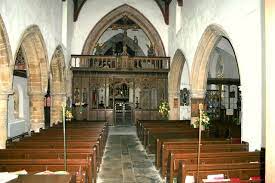
JOHN DE WORMELEY
1.1.2.1.1.3.1.1.1.2.3. John de Newmarch, b. ca. 1310, alias John de Wormeley.The Calender of Inquisitions Post Mortem in the 21st Year of Edward III (1348) shows John de Warenne to have rented land to John de Wormele of Hatfield: 1335 – ‘R. confirmavit donac’o’em quam Joh’es de Warenna, Com. Surr. fecit de uno tofto et triginta acris et unarodti terre de vastis ipsius comitis in Hatfield Joh’i de Wormele tenend. eidem Joh’e et he’dibus suis, redd’o inde per ann. viginti et tres solidos et septem denar (Acceptance of grants in fee by John de Warenna, earl of Surrey, by virtue of the licence noted above, to John de Wormele of a toft and 30 acres 1 rood of land on the waste in Haytfeld etc.).
In the same year the Fine Rolls record that, on October 15, the king made a grant to John de Wormele, at the request of John de Warenne, Earl of Surrey, and for his good service in Scotland, 60 acres of land and meadow in Staunford (see James Wormley, as follows), which the earl by his writing granted to him for the earl’s life, by the service of a pair of gilt spurs to be rendered yearly at the Exchequer at Easter. On January 27th, 1333, he witnessed a grant of 20 acres by John de Warren to his serjeant, Henry de Kelsterne, in the earl’s manor of Hatfield. John de Wormele, obit. 1350. His family’s coat of arms being recorded as gules, on a chief indented argent with three lions rampant azure.
Land in Thorne and Hatfield were often granted conjointly, it being contiguous, as this example shows: ‘In the tenth year of the reign of Edward III, the king hath granted and confirmed to Richard of Thorne, three tenements, with ten acres, thirteen and eight acres of meadow, and four and a half acres of moor, and forty acres of corn land in Hatfield and Thorne, in the county of York, which John of Warren, count of Surrey, hath granted, &c. to be held by the said Richard and his heirs, for the sum of twenty eight shillings, nine pence, and one farthing. (The history and antiquities of Thorne).
There is every probability that this John de Newmarch was granted land in Thorne by his kinsman, John Mowbray, and that this land was Wormley Hill. This is situate immediately due N. of Thorne. Thorne is due N. of the W. side of Hatfield Chase, where the Wormleys held a manor. The distance between Wormley Hill and the Wormleys manor is ca. 3 miles. It is reasonable to suggest that John de Mowbray, lord of Thorne, granted contiguous land to his kinsfolk in Thorne and Hatfield and that John de Warren later confirmed these grants.
1.1.2.1.1.3.1.1.1.2.3.1. William de Wormeley, of Brampton (5 mls. from Hatfield), who with his wife Ellen sold land and properties at Beverley for 200 silver marks in 1380 (Yorkshire Feet of Fines). This Brampton is now called Branton, next to Cantley, on the outskirts of Doncaster. On Sept. 2, 1386, Katherine, widow of Richard de Wormelay of Hatfield, granted to John Vavasur of Denyngby, William de Swinton and William Wayt, chaplain, for 4 marks per annum, from the manor of Richard de Wormelay in Hetefeld, Staynforth and Thorne, for Katherine’s lifetime. Witnessed by William Wormlay, chaplain, Thomas Fornes, John le Qwythfeld etc at Hetefeld, Sunday of Decollation St John the Baptist.
1.1.1.1.1.3.1.1.1.2.3.2. John de Wormeley, b. ca. 1345, esquire of Hatfield, d. bef. Sept. 2, 1386, m. Eleanor Foliot, presumably from the following family:
FOLIOT
1. Richard Foliot of Norton, m. (ca. 1180) … Bardolf, sister of Robert Bardolf of Great Carlton and Hoo; another sister m. … Paynel.
1.1. Jordan Foliot.
1.1.1. Richard Foliot, of Norton, Fenwick, etc. (d. March, 1299), m. Margery, dau. of William de Stuteville, of Gressenhall.
1.1.1.1. Sir Jordan Foliot, of Gressenhall (d. bef. May 2, 1299), m. Margery (d. April 18, 1330), dau. of Sir Adam de Newmarche, of Womersley, who d. bef. Jan. 20, 1302/3.
A chronological perspective: Margery de Newmarche was a. dau. of Elizabeth de Mowbray, who was born between 1238-1248. From this it may be assumed that her dau., Margery, was born ca. 1260-1270. Her husband. Sir Jordan Foliot, was born no later than 1249, thus, Elizabeth de Mowbray and Jordan Foliot were of the same generation. It was commonplace at this time for a man to be 20 years older than his wife. Margery’s father, Adam de Newmarch, was b. ca. 1225; thus he would have been ca. 40 years of age when Margery was born.
1.1.1.1.1. Sir Richard Foliot, of Gressenhall (b. Dec. 25, 1283,* d. bef. May 30, 1306), m. Joan (d. bef. June 23, 1324), dau. of Sir William de Breouse, Lord of Bramber & Gower, by his 1st wife. *(Yorks. Inqs. III:102-3).
1.1.1.1.1.1. Sir Richard Foliot, of Gressenhall (d. sans issue, May 29, 1325).
PAYNEL
1. …
1.1. Fulk Paynel.
1.1.1. Ralph Paynel.
1.1.1.1. Gervase Paynel.
1.1.1.2. William Paynel, m. Julian, dau. and heir of Robert de Bahuntune, and so acquired the lordship of Bahuntune, in the county of Devon; d. bef. 1180.
1.1.1.2.1. Adam Paynel. “The next of this name noticed is Adam Paynel (also presumed another son of William Paynel and Julian Bahuntune); which Adam, the 6th of Richard I. paid twenty millings scutage upon the king’s redemption, and married the widow of William FitzWilliam, sister and coheir of Robert Bardolf, lord of Hoo, in Kent, and of castle Carleton, in com. Lincs”. (Banks). Adam m. “a daughter of Hugh Bardolf’ of Great Carlton and Hoo. Hugh Bardolf had five daughters who became co-heirs of their brother, Robert Bardolf, described as the uncle (avunculus) of Jordan Foliot, and Ralph Paynel” (Excerpta e Rotulis Finium, p. 129), sons of Richard Foliot and Adam Paynel.
1.1.1.2.1.1. Ralph Paynel.
WORMLEY cont.
1.1.2.1.1.3.1.1.1.2.3.3.3. Richard de Wormley, of “Hetefeld, Staynforth and Thorne“, b. ca. 1350. In 1372, Richard’s coat of arms showed an amulet for difference, indicative of him being a fifth son. He witnessed various documents at Hatfield in 1373, 1375, 1376, and was named in the Subsidy Roll of 1379. A Katherine Wormley was recorded as his widow in 1386. (Flower’s Visitation of Yorkshire, 1585: “Cartae Rici. Wormeley de Hattefeld, dat. ao 46 E. III. S. Ricdi de Wormeley – Gules on a chief indented argent, three lions rampant azure, an annulet for difference”.
1348. Edmund, Duke of York. 1348. Haitfeld. He alienated 28a. of the demesne lands of the manor and 10a. land, which came sometime into the hands of King Edward II as escheat after the death of Katherine Valour because she was a bastard and died without heir of herself, to John de Donecastre, who now holds it and renders 12d. yearly per acre; to Sir Richard de Thorne, chaplain, ….. pasture, rendering 6d. yearly per acre, who now holds the same; 40a. land to John de Wormelay, who now holds them and renders 6d. yearly per acre; 60a. land to John de Donecastre of Haitfeld, who now holds them and renders 6d. yearly per acre; 14a. land to John Trulove, who now holds them and renders 6d. yearly per acre; 40a. land and moor in the park of Haitfeld to Sir Richard de Thorne, who now holds them and renders for every acre 4d. yearly; 18a. 2r. in the same park to John de Wormelay, who now holds them and renders 4d. yearly per acre
Edmund, Duke of York.* (Inquisitions post mortem (Chancery, Henry IV, file 32.) Inquisition taken at Doncastre, 3 Sept., 3 Hen. IV (1402), before William Hungate, the Escheator, by the oath of Goselin Dayvell, John Ardren, Robert Munnesdere, John Palmer of Haitefeld, Richard de Wormeley, and his son Richard all of the same place, Richard Baytte of Wakefeld, Robert Dowbyggyng, Simon Flemyng and of Wakefeld, Robert Hynkeshill and Robert Assebery of Conyngesburgh, and Robert Bosevyll.
The Duke died seised in his demesne as of fee tail, to him and the heirs male of his body, of the castles, manors, vills, and lordships of Conyngesburgh, Sandhale, Haitefeld, Wakefeld, Thorne, Fysshelake, Holmefrith and Sourby … by grant of King Edw. Ill, father of the Duke. They are all held of the King in chief by the service of two knights’ fees.
*Fifth son of Edward III and Philippa of Hainault, bom June 3,, 1341, at King’s Langley,Duke of York on Aug. 6, 1385. He died Aug.1, 1402, and was buried in the church of the Dominicans, but after removed to King’s Langley. Will 25 Nov., 1400, proved 6 Oct., 1402. He married ist, Isabel of Castile, by whom he had Edward, Earl of Rutland, 2nd Duke of York, also Richard, Earl of Cambridge. He married 2ndly, Joan, daughter of Thomas Holland, second Earl of Kent.
CRESACRE
1. John Cresacre, of Barnborough. Grant: (1) Ingeram Folemfaunt of Addewyck and wife Juliena. (2) Sir Nich. de Leicester. For £7 13s 4d p.a. for life of I.F., (1) to (2) manor of (Adwick) and 11 bovates land and meadow, — wood and 60s. rent in Addewyck, Mekesburg, Swynton, Tankerlay, Schelmarthorp, and Raddeburn. Witn: Rob. Tilly, John de Cresacre, Stephen de Bella Aqua, John le Vavasour, John de Wynteworte, Alan Bachin of Wath, Adam de Mekesburg, clerk, etc. At Addewick, Dec. 19, 1294. (Notts. Arch., DD/FJ/1/194/1). John de Cresacre was a vassal of Henry de Lacy, E. of Lincoln: South Elmsall: “Johannes de Cresacre tenet eandem villam de feodo comitis Lincolniæ, et nihil certum facit regi”. (Kirbey, The Survey of the County of York, p. 5, 1867).
1.1. Thomas Cresacre, of Barnborough.
1.1.1. John Cresacre, succeeded to his family’s estate of Barnborough, m. Alice, dau. of Robert Wasteneys of Headon. Plita de banco Ter. Mich., 4° 6 Ed. 2, rot. 88 (1312) – John son of Adam de Youkflete (Dodsworth, vol. 153), complaines agt John de Cresacre 90 acres of Land &c. in Camsale, & the deft calleth to warrant Roger de Novo Mercato. fo. 107. That is, Sir Roger Newmarch, of Womersley, probably the father of John de Wormele. The original arms of the Cresacres, as given heretofore, were recorded in Campsall Church: Window on the South Side: Or a lion rampant purpure* – Orate pro Animabus Johannis Cresacre et Elizabethæ uxoris eius qui istam fenestram fieri fecerunt. (Yorkshire Archaeological and Topographical Journal, vol. x., p. 363, 1889). These were the arms of the Lacys, which were those of the de Quinceys.
1.1.1.1. John Cresacre, of Barnborough, m. Sibil, dau. of — Cranbull. The first recorded Will of any member of the Cresacre family is that of John Cresacre which was made on the Wednesday after the feast of St. Matthew the Apostle, in 1408. He directs himself to be buried at Barnborough, and mentions Sibil his wife and James his son.
1.1.1.1.1. James Cresacre, of Barnborough, m. Elizabeth, dau. of John Woodrove. An inscription, formerly in a window in the church, requested the prayers of the worshippers for the souls of John Cresacre and Elizabeth, his wife, who had piously erected the window which contained the request.
1.1.1.1.1.1. Percival Cresacre, of Barnborough, b. ca. 1385, m. Alice (dau. of Thomas Mounteney, who died in 1450, and was buried at Barnborough. Percival Cresacre was living as late as 1455, when he was a feoffee of his dau., Isabel Langton, for the foundation of the Bosvile chantry in the church of Cawthorne.
1.1.1.1.1.1.1. Isabel Cresacre, b. ca. 1412, m. (1) John Bosvile, Esq., of Ardsley (d. Aug. 15, 1442), whose 1st wife was Mary Barley, dau. of Thomas Barley and Isabel FitzWilliam; (2) Henry Langton, who bore f0r arms: three lions rampant.
BOSVILE
1. John Bosvile, Esq., of Ardsley (d. Aug. 15, 1442), m. (1) Mary Barley, coheir of Woodhall in Darfield, co. Yorks., dau. of Thomas Barley and Isabel FitzWilliam; (2) Isabel, dau. of Percival Cresacre of Barnborough, Yorks., and Alice Mounteney. Isabel m. (2) Henry Langton. The Will of John Bosvile of Ardsley, proved Aug. 23, 1442, requested burial in the church of All Saints, Darfield. He names his wife Isabel, and sons, Thomas and Edmund. His execs. were Isabel and James Cresacre; supervisors, Maud countess of Cambridge, and Percival Cresacre.
Settlement of lands on Isabel and Henry Langton, dated Aug, 20, 1462: William Norton of Bilbrough, W.Yk., to Nicholas Wortlay, Robert Nevill, John Wodrove, Thomas Everingam, Esqs., and John Nevill of Liversedge, W.Yk., of his manor of Newhall (in Darfield) with all his lands in Darfield, Wombwell), Edderthorpe, Millhouses, and Middlewood, formerly the property of John Bosewell father of William Bosewell, with a piece of land called Elyntreflatt in Ardsley, for the lives of Henry Langton and Isabella his wife, and after their deaths, the manor etc. to go to Edward FitzWilliam, Robert Roclyff, John Dawnay, and John Bosewell, clerk, in fee simple. Witnesses; John Sotell, esq., Adamer Burdhed, Thomas Ann, Richard Syms, William Taillor, etc.
1.1. William Bosvile, eldest son by his father’s 1st wife, inherited his father’s lands at Ardsley.
1.1.1. Sir Thomas Bosvile of Ardsley (d. after June 3, 1484, but bef. June 10, 1490); grandson and heir, John Bosvile.
1.2. Thomas Bosvile, b. bef. May 4, 1416; of age when directed to give seisin under a letter of attorney dated May 4, 1437. At a court of the manor of Newhall (Ardsley), 15 Edward IV it was found that Thomas Bosvile of Ederthorpe was dead (by March 3, 1474/5), holding lands of the manor, and that Margaret the wife of William Symmes, and Hellen the wife of Robert Pilley, his daughters and coheirs, were of full age. Given this chronology, it is probable that Thomas was a son of Isabel’s by John Bosvile. The following records dentify a Thomas Bosvile as a son of John Bosvile of Ardsley and Isabel Cresacre. First is a letter of attorney: “John Bossvyll of Newhall, Esq., and Isabella his wife, to Thomas Bossvyll their son, and William Burden their servant; to deliver seisin to John Barnby and Margaret his wife, of a tenement in Barnbe, in Calthorne. Witnesses: Thomas Dodeworth, John Champnay, William his son, Adam Chedyll, John Addy, and others. dated May 4, 1437. (SpSt/4/11/9/32).
1.3. Richard Bosvile, of Ardsley & Gunthwaite, a younger son of John Bosvile and Isabel Cresace; d. 1501. A study in Colonial and Medieval Families, Richardson, Douglas, (Kimball G. Everingham, editor. 2nd edition, 2011), vol. 1 p. 262. He m. Joan, dau. of Sir Thomas de Nevillle, Knight and Alice, d. May 24, 1481, dau. of Richard Gascoigne.
1.3.1. John Bosvile, Esq., of Gunthwaite, d. aft. 1516, m. Ann, dau. of Thomas Clapham,of Beamsley, descendant of William Clapham, Esq. of Bethmesley (Beamsley), and Cecily Langton, ibid.
1.3.1.1. John Bosvile, of Gunthwaite, 1482 – February 12, 1542. He m. Muriel, dau. of Charles Barneby, and Dyonisa Hildyard.
HILDYARD
1. Robert Hildyard, 2nd Lord of Winestead, Humberside, b. ca. 1440, d. 1492, m. Elizabeth, dau. of John Hastings, of Fenwick, and Ann Morley.
1.1. Dyonisa Hildyard, m. Charles Barneby.
1.1.1. Muriel Barneby, m. John Bosvile.
1.2. Peter Hildyard, d. 1502.
1.2.1. Sir Christopher Hildyard of Winestead, d. 1538, m. Margaret, dau. of Hugh Conningsby, Judge.
1.2.1. Martin Hildyard, m. Emma Rudston, granddau. of John Rudston, Lord Mayor of London.
1.2.1.1. Richard Hilyard, m. Jane, dau. of Marmaduke Thweng.
1.2.1.1.1. Christopher Hildyard, m. Elizabeth Welby. He was the brother of Frances Hildyard.
1.2.1.1.1.1. Sir Robert Hildyard., m. Jane, dau. of Christopher Constable, of Hatfield, East Hull, and the said Frances Hildyard. The said Jane was the relict of Sir John Lister, d. 1651, who was the son of John Lister, bap. June 7, 1587, o.s. of John Lister, alderman of Hull, and Anne, dau. of Robert Gayton, alderman of Hull. He m., by 1607, Elizabeth (bur. Dec. 5, 1656), dau. and h. of Hugh Armyn, alderman of Hull. Sir John Lister, d. 1651, is recoded here: Matthew Elwood, Papist, farmeth 50l. a-yeer of these lands. William Wartinge, of Neesham, Papist, is seised of lands there. Rob. Wormeley, of Hurworth, Gent. a Papist, holds 3 oxgangs of land in Hurworth, whereof part is mortgaged to Sr. Jn. Lister, in Yorkshire. (See as follows).
BOSVILLE cont.
1.3.1.1.1. Thomas Bosvile, of Warmsworth.
1.3.1.1.1.1. Gervase Bosville, m. Susan Wormley. Susan Wormley, who was baptized at Thorne, 9th October, 1586, and was buried at Conisborough, 8th December, 1652. She married first, Gervase Bosvile, Esq., of Warmesworth, (South Yorkshire, Vol. II., p. 127,) and had issue. Mrs. Bosvile married secondly, at Warmesworth, 19th December, 1622, Thomas Vincent, Esq., of Barnborough, (South Yorkshire, vol. I., p. 377).
1.3.1.1.1.1.1. Thomas Bosvile, 1607-1659, bur, St. Peter’s, Conisbrough; held land at Airmyn.
1.3.1.1.1.2. Gertrude Bosvile, m. Philip Adams, of Owston.
CRESACRE cont.
1.1.1.1.1.2. Thomas Cresacre (b. ca. 1390), of High Melton, an adjoining parish to Barnborough and Cadeby, witness an exchange of lands by Katherine de Harum, widow of Walter de Harum, to William de Methram and his wife Margaret. All her lands in Cadeby for her lifetime in exchange for all lands and rents of William and Margaret in Scawsby, Cusworth, Bentley, Arksey and Doncaster. Witnesses: Richard son of Alexander, Thomas de Cresacre, Robert de Pikburne, Alexander de Pikburne, John de Arksay clerk et al. Given at Cadeby. Nov. 6, 1435. (Doncaster Arch., CD/377).
1.1.1.1.1.3. Margaret Cresacre, b. ca. 1390, m. Richard de Wormeley.
Thus, it may reasonably be inferred that the Cresacres adopted the arms of the Langtons, which the family of Richard Wormley also adopted; or, it may have been the case that the Langtons and Wormleys intermarried at an earlier time.
LANGTON
1. John Langton, m. Joan, dau. of Robert de Neville and Margaret Pole.
1.1. John Langton m. Euphemia Aske, on March 1, 1408. He d. Feb. 25, 1459, in Leeds. She was a dau. of Roger Aske and Elizabeth Pert, son of Conan Aske and Alianore Widdrington.
1.1.1. Joan Langton, m. Henry Vavasour.
1.1.1.1. Sir Henry Vavasour, m. Jane, dau. of William Gascoigne and Margaret Clarell, son of William Gascoigne and Joan Wyman, son of William Gascoigne and Elizabeth Mowbray.
1.1.2. John Langton, b. ca. 1410, d. Sept. 17, 1467, in Gargrave, Yorkshire.
1.1.3. Henry Langton, b. ca. 1412, m. Isabel Cresacre, as her second husband.
ASKE
1. Hugh Aske.
1.1. Conan Aske, b ca. 1360, m Alienore, dau. of Roger de Widdrington.
1.1.1. Conan Aske, m. Katherine Conyers, half-sister of Margaret Conyers, who. m. Henry Pudsey.
1.1.1.1. Margaret Aske, m. … TaIlboys of Horwood.
1.1.2. Roger Aske, m. Elizabeth Pert.
1.1.2.1. Euphemia Aske, m. John Langton, on March 1, 1408.
1.1.2.1.1. Joan Langton, m. Henry Vavasour.
1.1.2.1.1.1. Sir Henry Vavasour, m. Jane, dau. of William Gascoigne and Margaret Clarell, son of William Gascoigne and Joan Wyman, son of William Gascoigne and Elizabeth Mowbray*.
1.1.2.1.2. John Langton, b. ca. 1410, d. Sept. 17, 1467, in Gargrave, Yorkshire.
1.1.2.1.3. Henry Langton, b. ca. 1412, m. Isabel Cresacre, as her second husband.
1.1.2.2. Roger Aske, m Isabella Conyers.
1.2. John Aske, b. ca. 1370, m Joan, dau of John Shelford.
1.2.1. John Aske, m Elizabeth Gascoigne (sister of Sir William Gascoigne, Chief Justice, and aunt of Elizabeth Gascoyne, who m. Sir George Tailbois, Sheriff of Northumberland in 1495, having four sons, of whom John and Walter died s. p. William became a priest, and Gilbert was summoned to parliament as Lord Tailbois of Kyme in 1529. The name continued in co. Durham, where a younger branch of Tailbois of Hurworth is said to have held Thornton from marriage with its heiress.
GASCOIGNE
1. Sir William Gascoigne, Chief Justice, b. ca. 1350, d. Dec. 16, 1419 (68-69) Harewood, Yorkshire, m. Elizabeth Mowbray.
1. Roger de Mowbray.
1.1. Elizabeth de Mowbray, m. Adam de Newmarch.
1.1.1. Roger de Newmarch, of Womersley, d. March 11, 1351/1352.
1.1.1.1. John de Wormley, held land in Hatfield from John de Warrene*.
1.2. John de Mowbray, 2nd Baron Mowbray.
1.2.1. John de Mowbray. In the first year of the reign of Edward III. (1327), John de Mowbray held the manor of Thorne. *John de Warren possessed it in 1348.
1.1. Sir William Gascoigne “of Gawthorpe”, d. March 28, 1422, m. Jane, dau. of Sir Henry Wyman, Alderman of York.
1.1.1. Sir William Gascoigne, “High Sheriff York & Knight of the Garter”; d. ca. 1466; m. Margaret, dau. of Thomas Clarell, of Aldwarke,
1.1.1.1. Jane Gascoigne, m. Sir Henry Vavasour.
1.1.1.2. Sir William Gascoigne, m. Joan, dau. of John Neville, b. ca. 1415, d. March 17, 1482, in Althorpe, Lincolnshire, and Elizabeth, dau. of Sir Robert Newmarch, son of Ralph de Newmarch, who d. in 1403, in the Battle of Shrewsbury.
WORMLEY cont.
1.1.2.1.1.3.1.1.1.2.3.2.1.1. Richard de Wormely, b. ca. 1380, recorded in 1402 (Duke of York’s IPM), 1416 and 1422. He m. Margaret, sister, not daughter, of Thomas Cresacre.
1.1.2.1.1.3.1.1.1.2.3.2.1.1.1. John Wormley, b. ca. 1405, of Hatfield, m. Cecilia, dau. of Thomas Kellam, of Rotherham. (Archaeologia Aeliana, p. 146, 1822).
LETTER OF FRATERNITY GRANTED BY THE FRIARS MINOR.
Numerous letters of fraternity granted by the Benedictine monks of Durham have been printed by the Surtees Society, and an interesting list of the recipients is given by Dr. Raine in the Durham Obituary Rolls published by the same body. A letter from the Friars Minor of Hartlepool under special circumstances is printed in 1 Sur., ii, 27.
The document has been submitted to the Society by Monsignor Eyre, and came from Sheffield. The Wormley family were of Hatfield, near Doncaster. (See Hunter’s Doncaster, i. 175). Archaeologia Aeliana …
In Christ, greetings to John Wormlay and to Cecilia his wife, from his dearest brother, Thomas Wormlay, minister and servant of the Friars Minor in England, and by the offering of prayers the kingdom of heaven may be won. I have received your offering to our order for the sake of Christ, and the salvation of souls, as far as God allows, and accept it with affection. For this reason I grant you a perpetual inclusion in all the masses, prayers, fasts, vigils, sermons, etc. both in life and after death, through the mercy of the Savior, which the brothers appointed under my care will perform. When the memory of your death has been recited in our provincial chapter, let the same be done for you as is customary for the brothers and friends of our order who have passed away. Rejoice happily under the banner of the poor king crucified and his mother’s sweet virginal cloak. Dated in our provincial chapter, celebrated on the feast of the Assumption of the Virgin in the glorious year of the Lord, 1000 cccc.lx. (1460).
John and Cecilia Wormley were the parents of Robert Wormley whose inquisition of July 1495, taken at Doncaster in the county of Ebor seized of the lands of his father John Wormley in Gatefield near Fishlake as his heir records that he died on the previous February (1494/5), as correctly recorded in Dugdale’s Visitation, with “Additions”, by J W Clay, 1899.
1.1.2.1.1.3.1.1.1.2.3.2.1.1.1.1. Robert Wormley, b. ca, 1430. of Hatfield, d. Feb. 20, 1494/5.
1.1.2.1.1.3.1.1.1.2.3.2.1.1.1.1.1. Robert Wormley, b. ca. 1455, d. Feb. 20, 1526.
1.1.2.1.1.3.1.1.1.2.3.2.1.1.1.1.1.1. Charles Wormley, of Hatfield, b. ca. 1485.
THE SERVICE OF OURE LADYE IN THE CHAPPELL OF STANFORD WYTHYN THE SAYD PARYSSHE. (Stainforth, Doncaster).
“James Ebden, incumbent. There is certen copyeholde lande by the well dysposed parochians there, gyven to th’entente the sayd incumbent shulde saye masse and other dyvyne service in the sayd chappell, and to pray for the state of the parochians lyvyng, and for the soules departyd. The necessityis to say masse and do dyvyne service in the same chappell for aged and impotent people. There is no landes, tenementes solde ne alyenatyd sithe the statute. Firste, certen landes and ten. lyeng and beyng in dyvers places in the tenure of dyvers persons, viz.:-one messuage lyeng in Wodhowse, iij a. medowe, and iij r. of lande, ij a. of medowe in one close called Medylherst, one roode medowe in Pyghell, iiij a. medowe in Trulove Crofte, xixs.; j closse, called Bouthom, containing xiij a. iij r., one a. and iij r. of lande in the tenure of William Smythe, xxvs.; William Fysshe, ij a. lande in the Dam Crofte, ijs.; Jenet Hyll, one acre in Twaytes, xvjd.; ix a. of medowe and one r. lyeng severall in the Est Inges, betwyx Waters and the Westynges, in the tenure of dyvers persons, xxiiijs. vjd.; one cotage in Staynfurth in tholdyng of John Parkyn, iijs. iiijd.; j cotage in Staynfurth in tholdyng of James Shappull, iijs. iiijd., James Hobson for a cotage in Staynfurth, vs.; xvij a. of lande and iij r. in Inglysmore in the tenure of dyvers persons, xxiiijs. In all, cvijs. vjd. Wherof: Paiable yerely to the Kynges Majestie for a tenthe, vjs. xd. q.; to the grave of Staynforth for the Kynges rente, xiijs. xd.; to the grave of Haytfelde for the Kynges rente, ijs. vd.; to the grave of Fychlake for the Kynges rent, vijs. iiijd.; to Frauncis Frobysher for fre ferme, xijd.; to the college of Rotherham for fre rent, vd.; to John Parke for fre ferme, vijd. ob.; to Thomas Estoft for fre ferme, iiijd.; to Charles Wormeley for fre ferme, iijd. In all, xxxiiijs. ob. q.”. (William Page, Great Britain. Ecclesiastical Commission, 1546. The Certificates of the Commissioners Appointed to Survey the Chantries, Guilds, Hospitals, Etc., in the County of York, vol. 91, p. 151, 1892).
1.1.2.1.1.3.1.1.1.2.3.2.1.1.1.1.1.1.1. John Wormley (b. ca. 1520), of Hatfield, bur. March 30, 1567. In 1558, he gave evidence confirming the boundaries of Hatfield Chase. In 1561, he was a supervisor of a Will of Thomas Bradford of Arksey and Fishlake. He he m. Margery (dau. of Thomas Hutchins), bur. in Arksey on April 5, 1556.
(1.1.2.1.1.3.1.1.1.2.3.2.1.1.1.1.1.1.2.). William Wormley , of Hurworth, as follows.
1.1.2.1.1.3.1.1.1.2.3.2.1.1.1.1.1.1.1.1.1. Simon Wormley (b. ca. 1550), of Hatfield, d. 1591, m. Ann Claxton, of Burnhall).
“Simon Wormeley, gent., and Ann his wife: Meadow land in Hatfeild”. (Yorkshire Fines: 1578, in Feet of Fines of the Tudor Period (Yorks): Pt. 2, 1571-83, ed. Francis Collins, 1888).
1.1.2.1.1.3.1.1.1.2.3.2.1.1.1.1.1.1.1.1. Christopher Wormley (b. ca. 1550), of Kingston-Upon-Hull, bur. July 27, 1588. Valuation by Christopher Wormley and others, of Hull, merchants, of 20 quarters of corrupt wheat seized by the collector of the port: (Yorkshire East Riding), 22 Eliz., Nov. 17, 1579 – Nov. 16, 1580. (E 210/1536).
1.1.2.1.1.3.1.1.1.2.3.2.1.1.1.1.1.1.1.1.1. Christopher Wormeley, of Adwick, bapt. March 15, 1588/9, at st. Mary’s, Hull. He m. Mary, dau. of Philip Adams, of Austin, York. Bargain and sale for £575 of lands in Hatfield. Parties: (1) Edward, Henry and Christopher (sons of Christopher Wormeley of York). (2) Thomas Wormeley of Thorne, gentlemen. Property: Manor of Westhall (or ‘Mr Wormeley’s manor’) in Hatefield, Stainforth, Fishlake, Thorn, Sikehouse or Bramwith, sometime the inheritance of ‘Adam de Novo Marcat barron and Sir Roger de London’. Manor called Stockshold in Hatefield, Fishlake and Stainforth. And all other property in those places of Symon deceased brother of Thomas Wormeley Witnesses: John Mosley, Willm Martyn, George Jefferson, John Lomley, Gervaise Bossevile, and Thomas Mosley. Feb. 18, 1608. (ERYA, DDHV/58/1). ‘Adam de Novo Marcat barron’ was referring to Adam de Newmarch, d 1247, who witnessed a deed with Roger de London concerning land in Fishlake.
“He lived near Adwick-le-Street; married Mary, daughter of Philip Adams by his wife Gertrude Bosvile* of Owston, and left two sons and two daughters. The daughters, Jane and Anne, married their cousins, Edward and John Wormeley, sons of Henry of Riccall”. (Recollections of Ralph Randolph Wormeley). *Daughter of Thomas Bosvile of Warmsworth, and sister of Gervase Bosvile, wife of Susan Wormley.
CHRISTOPHER WORMLEY OF ADWICK WAS NOT THE COLONIAL ADVENTURER
It is pertinent to now record the comments of Nick Wormley, a modern day Wormley researcher, and expert on the subject of the Wormley family:
“Disappointingly, however, there are several grounds for concluding that the old books misidentified Christopher Wormeley of Adwick as being the colonial adventurer captain Christopher Wormeley. We think that he and his brother or son Ralph Wormeley were in fact cousins of the Riccall Wormeley family, who probably came from Hurworth-Upon-Tees, near Darlington.
Firstly, although both Christophers’ wives were named Mary, this does just appear to be a coincidence, as Mary Wormeley of Adwick was buried there in 1640. So she cannot have been the Mary Wormeley who was still living in Virginia some years later and was shown as the executrix of her husband’s estate there in the William and Mary College of Williamsburg, Virginia, Quarterly Historical Papers (1892).
Secondly, there is no record of Christopher and Mary at Adwick having a daughter called Elisabeth, but the couple who lived in Virginia did and she has to have been born earlier than their arrival in the colony in 1635. Neither is there any record of the Adwick Christopher having a son or close relative named Ralph in Yorkshire, but the couple in Virginia did and his son became the colony’s Secretary-of-State.
Our ancestor Christopher made a will in Yorkshire in December 1642, leaving bequests to all of his children who were born at Adwick-le-Street. He requested his brothers Edward and Henry Wormley, of Riccall, to educate and bring up all of the children, so they were obviously living in England, not in Virginia. It seems unthinkable that their parents would have moved abroad and left them behind.
This will made no mention of Christopher’s wife, Mary Adams (deceased two years earlier), or of any affairs or relatives in Virginia.
Christopher Wormeley of Adwick was described as a gentleman but never called Captain in any 17th century legal documents.
And in May 1640, when Captain Christopher Wormeley was the Commander-in-Chief of Elisabeth City and Charles River (York) Counties in Virginia, a House of Lords record states that in England, Richard Washington and Christopher Wormely Esquires acted as arbitrators in a dispute about a right of way between the villages of Carcrofte and Ouston. Again, unless Captain Christopher had briefly popped home to Yorkshire for a visit, this must have been two different men. (We wonder if this Richard Washington might possibly be of more interest to American readers?).
Anyway, even though we are sad to conclude that Christopher Wormeley of the Americas was not after all our direct ancestor, it does seem sure that he was descended from the same early Wormleys as us who lived in Hatfield. He might have been a third or fourth cousin to the Riccall Wormley family, as pretty certainly hSoon after Christopher Wormeley’s Tortuga Island adventure he became one of the most important land-owners in Virginia, where he and another relative, Ralph Wormeley, founded the American branch of the family. They owned many thousands of acres of tobacco plantations and were important landed gentry in what was still an English colony only a few decades old.
Ralph built or at least started the finest mansion in Virginia at the time, called Rosegill, and this became the family seat for nearly two centuries. A coastal inlet near Rosegill was named Wormley Creek after the family.
Christopher was a justice of York County in Virginia from 1636 to April 1642. He was appointed to Charles I’s Council of Virginia in January 1637, and the Calendar of State Papers for that year show Colonel (sic) Christopher Wormeley as being the military head of Middlesex County, Virginia. He was in command of Point Comfort Fort, near Jamestown, from 1637 to 1639. Subsequently in 1639 and 1640 he was Commander-in-Chief of Elizabeth City and Charles River (York) Counties.
Christopher and Mary Wormeley had a daughter, Elizabeth, who was married three times: firstly to the Secretary of State and Governor of Virginia Richard Kemp, secondly to the notorious Sir Thomas Lunsford, a member of the Virginia Council accused of cannibalism!, and lastly to Major General Robert Smith. These marriages made her a Dame and one of the most important women then living in North America.
Some people have thought that Elizabeth was in fact a daughter of Henry Wormeley of Riccall, but this is a mistake. Henry’s daughter Elizabeth married Yorkshire neighbour John Acclom of Moorby Hall, so she could not have been the same woman as the Elizabeth in Virginia.e belonged to a branch that moved 50 or so miles north to the border of Yorkshire and County Durham maybe about a century earlier.
It is unclear who Ralph Wormeley was. Several old sources said he was Christopher’s brother, but all we can say is that they were closely related and they probably both came from Hurworth-Upon-Tees.
No evidence has so far been found of either of them being born or living in England as a boy, although they must have done. Many parish registers from that long ago are lost. Ralph first appears in official records as a justice (of the peace, ie magistrate) in the Virginia court in 1637. He got married in 1645, but he was not mentioned in any Yorkshire wills.
However, we have found one historical reference to somebody named Ralph Wormeley in England.
In 1666, a Ralph Wormeley witnessed a document for the Pudsay family of Bolton-by-Bowland, on the north-western edge of Yorkshire. (See page 284 of the Yorkshire Archeological and Historical Society Series,Volume 56: The Pudsay Deeds).
In past times, witnesses to legal deeds were almost always relatives or trusted associates of the legal parties.
In addition to this manor of Bolton, the Pudsays also held the manor of Barforth-on-Tees after 1341, which is about 8 to 10 miles up river from Hurworth-on-Tees and Croft-on-Tees where the Wormley family of the Yorkshire-Durham border lived in the 1500s and 1600s. In 1585 they bought Stapleton-on-Tees, only two miles from Hurworth and Croft, making them next-door-neighbours to the northern branch of the Wormleys.
This seems clear evidence that the Ralph Wormeley named at Bolton-by-Bowland in 1666 was a member of the Hurworth-Croft Wormeley family. Presumably they were related to the Pudseys by marriage.
The Hurworth Wormeleys additionally owned a remote manor house near Shap, on the edge of the Lake District, called Rosgill or Rosegill Hall – the same spelling as the home Ralph built in America. These things couldn’t be a coincidence.
Rosegill Manor came into the possession of William Wormley of Hurworth when he married Dorothy Salkeld of Rosegill, although strictly speaking the property belonged to her through having inherited it. This Rosegill was temporarily confiscated from them in the 1640s as a punishment for their Catholicism. Ralph Wormley could not have lived there as a child, as he was a little too old to have been William and Dorothy’s son. Perhaps he was a brother of William. At any rate, he is likely to have visited their Westmorland home and presumably liked it enough to give the same name to his later mansion in Virginia.
Ralph’s first son born in Virginia was named William (died young), which might be connected with the fact that both Robert of Hurworth/Rosegill and Robert of Barnby-Upon-Don were the sons of William Wormeleys. Apparently William was a family name”. (Nick Wormley).
INGLEBY’S MANOR
1.1.2.1.1.3.1.1.1.2.3.2.1.1.1.1.1.1.2. William Wormeley, Gent., b. ca. 1530, d. 1603. “10 Feb. 1596, William Wormeley, Gent. purchased of John Syme, Gent. and Joane his wife, two messuages, tofts, gardens, and orchards, 70 acres of arable, 60 of meadow, 100 of pasture, and two acres of woodland, held of the crown in chief, 1634. Pardon to Sir John Lister, Knt. for acquiring by fine 4 Aug. 10 Car. lands in Hurworth-on-Tease, from Robert Wormeley and Margaret his wife, and William Wormley and Dorothy”.
Wormeley, William. Portf. 182. No. 3.
Inq. p.m. taken 20 April (1604) at Durham. Robert, aged 40, is his son and next heir.
(Hurworth on Teese, lands and tenements in; part thereof held of the bishop and part of the lords of the manor of Hurworth Report of the Deputy Keeper of the Records, 536, 1883).
1.1.2.1.1.3.1.1.1.2.3.2.1.1.1.1.1.1.2.1. Robert Wormley, b. 1564, who in 1628 and 1634, with Margaret his wife and William Wormeley his son and heir, mortgaged a part of their estate to Thomas Thompson, rector of Hurworth, and to Sir John Lister* respectively. Robert Wormley was a son and heir, who may have had a younger brother, or brothers, father/fathers of Christopher and Ralph Wormley of Virginia; the latter’s family naming their estate in Virginia, Rosegill. By this conjecture, Robert Wormley was the cousin of Christopher Wormley, of Kingston-Upon-Hull, the father of Christopher Wormley, of Adwick.
“Matthew Elwood, Papist, farmeth 50l. a-yeer of these lands. William Wartinge, of Neesham, Papist, is seised of lands there. Rob. Wormeley, of Hurworth, Gent. a Papist, holds 3 oxgangs of land in Hurworth, whereof part is mortgaged to Sr. Jn. Litster, in Yorkshire, and part to Mr. Thompson, Rector of Hurworth. Laurence Sayer, of Worsall, Esq. is seised of xxl. a-year land in Nesham. Richd Gresham, Francis Anderson, Chr. Thompson, John Sympson, of Hurworth; Anthony Steavenson, Edmund Preston, Edm. Chappyloe, of Neesham; are named
Sequestrators of the estates and goods of Philip Doleman, Mrs. Braithwaite, Lawr. Sayer, Esq. Sir Francis Howard, Knt. delinquents; and of Math. Elwood, William Wartinge, Robert Wormley, Gent. Papists, in Hurworth, Neesham, or elsewhere.
Another part of the land attached to the Ingleby Manor was acquired by William Wormeley, who in 1603 died seised of 4½ oxgangs ‘late of Ingleby’. (Dur. Rec. cl. 3, file 182, no. 9) He had also bought from Ralph Tailbois in 1567 an estate of 14½ oxgangs, (ibid.; cl. 12, no. 1), probably including the 13 oxgangs of which Henry son of Henry Tailbois had died seised in 1444, leaving a son John. This junior branch of the Tailbois family held of the lords of Hurworth. William Wormeley left a son Robert, who in 1628 and 1634, with Margaret his wife and William Wormeley his son and heir, mortgaged his estate to Thomas Thompson, rector of Hurworth, and to Sir John Lister respectively. Robert being a papist, his lands were sequestered in 1644″. (Dur. Rec. cl. 12, no. 4). (Robert Surtees,The History and Antiquities of the County Palatine of Durham, 1823).
1.1.2.1.1.3.1.1.1.2.3.2.1.1.1.1.1.1.2.1.1. William Wormley, b. 1600, m. Dorothy Salkeld, of Rosegill.
1.1.2.1.1.3.1.1.1.2.3.2.1.1.1.1.1.1.2.2. . … Wormley. (It was normal for i.p.m.’s to only record eldest sons, and any number of younger ones may have existed).
1.1.2.1.1.3.1.1.1.2.3.2.1.1.1.1.1.1.2.2.1. Ralph Wormley?, b. 1600-1605.
1.1.2.1.1.3.1.1.1.2.3.2.1.1.1.1.1.1.2.2.2. Christoper Wormley? (or a cousin; perhaps a second-cousin?).
LISTER
*Sir John Lister, d. 1651, was the son of John Lister, bap. 7 June 1587, o.s. of John Lister, alderman of Hull, and Anne, da. of Robert Gayton, alderman of Hull. He m. by 1607, Elizabeth (bur. 5 Dec. 1656), da. and h. of Hugh Armyn, alderman of Hull. By far the wealthiest merchant in Hull, Lister’s business had a turnover in excess of £10,000 in 1623. Lister’s championship of the Hull merchants’ interests undoubtedly explains why he was elected to Parliament for the city on Christmas day 1620 His son William became recorder of Hull, and represented the borough in the Commons in 1654 and 1656″. (The History of Parliament: the House of Commons 1604-1629, ed. Andrew Thrush and John P. Ferris, 2010).
Hull Minster: Slate figurative incised slab commemorating Hugh Arminge or Airmyn (d. 1606), draper and former Mayor (1600). Within a border inscription, he and his wife Elizabeth (née Bennington; d. 1631) are depicted full-length – Hugh in merchant’s or mayor’s gown, Elizabeth with fashionable hairstyle and lace ruff. However, Hugh’s head has worn off. A small brass or composition shield between them is lost (probably Airmyn arms: ermine, a saltire engrailed gules, on a chief gules a lion passant or: a red wavy-edged saltire on an ermine background, below a red band with a gold/yellow lion. Below the figures there may be faint traces of memento mori symbols: skulls and crossbones and winged cherub heads.
Hugh was from the Airmyn of Osgodby family. He and Elizabeth m. in Jan. 1582 and had one surviving dau., Elizabeth (1588-1656; later Lady Lister), who is in the Choir, with a heraldic ledger stone. Elizabeth snr married twice after Hugh’s death: to Samuel Saltonstall (adjacent monument) and in 1615 to Walter Rudston at North Newbald. She died in December 1631 and was buried at Holy Trinity on 29 December 1631, but it is unclear where or whether with a previous husband or with her daughter’s family.
Airmyn – 5 miles N.E. of Snaith, 7 Miles S.E. of Osgodby, 2 miles N. of Goole.
Sir John Lister, d. 1651, m. Jane Constable.
To repeat:
1. John Bosvile, of Gunthwaite, 1482 – February 12, 1542, m. Muriel, dau. of Charles Barneby, and Dyonisa Hildyard, who was the sister of Peter Hildyard, d. 1502, ancestor of Sir Robert Hildyard, who m. Jane Constable, relict of Sir John Lister.
1. 1. Thomas Bosvile, of Warmsworth.
1.1.1. Gervase Bosvile, m. Susan Wormley. Susan Wormley, who was baptized at Thorne, 9th October, 1586, and was buried at Conisborough, 8th December, 1652. She married first, Gervase Bosvile, Esq., of Warmesworth, (South Yorkshire, Vol. II., p. 127,) and had issue. Mrs. Bosvile married secondly, at Warmesworth, 19th December, 1622, Thomas Vincent, Esq., of Barnborough, (South Yorkshire, vol. I., p. 377).
1.1.1. Thomas Bosvile, 1607-1659, bur, St. Peter’s, Conisbrough; held land at Airmyn. Bargain and sale for lands at Airmyn. Parties: 1. Johh and Thomas Eastofte, 2. Thomas Vincent of his wife Susan and son and heir John Vincent. Property: capital messuage called Potter Closes with closes called Potter Closes, Lowe Grounds and Spear Close; messuage, 2 closes, 2 Wayringe Closes, Chapman Close, Westobye Close and Bushbye Close in Armyn. Consideration: £1840 Witnesess: Thomas Bossevyle, William West, Richard Horne. Nov. 17, 1629. East Riding Arch., DDBE/2/5).
(See heretofore, LANGTON and ASKE)
WORMLEY cont.
1.1.2.1.1.3.1.1.1.2.3.2.1.1.1.1.1.1.1.1.1.1. Edward Wormley, of Hatfield, d. sans issue, in 1662. Grant relating to the wardship and marriage of Edward Wormeley: Parties: (1) Queen Elizabeth (2) Michaell Besbye of Kingeston upon Hull gentleman Regarding the wardship and marriage of Edward Wormeley (age six) son and heir of Christopher Wormeley gentleman deceased Attached is a Valor and Extant of the lands of Christopher Wormeley descending to Edward Wormeley. Property: one common in le Somergaines (Summergangs), house and garth and the gross of three acres common in East and West Fields in Sudcoates [Southcoates] Annual value 17s Mentions Elizabeth Besbye widow of Christopher Wormeley Endorsement of transfer of the wardship and marriage of Edward Wormeley to his grandfather Richard Hogge. Nov. 17, 1592. (ERYA., DDSC/139).
1.1.2.1.1.3.1.1.1.2.3.2.1.1.1.1.1.1.1.1.1.2. Henry Wormley, of Riccall, bapt. Dec. 27, 1584, d. aft. Oct. 21, 1657. m. Margaret, dau. of Christopher Consett, Lord Mayor of York.
Marrige settlement relating to Henry Wormeley of York and Margaret Consett. Parties: (1) Christopher Consett of York, alderman (2) Thomas Moseley of York, alderman, Timothy, draper of Newcastle on Tyne esquire, Willaim Consett of Riccall, gentleman, and John Moseley of Gray’s Inn Property: as described in DDHV/29/27 Witnesses: Richard Scott, Christopher Wormeley, Robart Wilkinson, Thomas Harrison, George Sawers. April 23, 1612. (EYRA, DDHV/29/29). Special licence granted by Matthew Archbishop of York. For the marriage of John Preistley of the Inner Temple and Francis, daughter of Christopher Consett, alderman of York Endorsement of its solemnisation, 22 Oct 1602. (ERYA, DDSC/60). Bond for £50 relating to lands at Riccall. Parties: (1) William Towrie of Dunnington, gentleman and William West of Buttercram, yeoman (2) Christopher Consett, alderman of York and Timothy Draper of Newcastle-on-Tyne, esquire For performance of covenants of indenture of same date Witnesses: Leonard Grensburye, Symon Byar, Thomas Consett, James Jackson. July 21, 1609. (ERYA, DDHV/29/13). Assignment relating to property as described in DDHV/29/2. Parties: (1) Timothy Draper and William Consett John Moseley of Ulleakelf and Edward Wormeley of York, gentleman (2) Henry Wormeley of Riccall Witnesses: Thomas Consett Richard Newson, Robart Corney, Ralph Lomax, F Wright, John Lovell, John Agar, Barnard Gay, Reverend John Newlove, John Rowthe, Conand Cloke, George Holtbye, George Pawers, Richard Newson attorney. Oct. 10, 1616. (ERYA, DDHV/29/32). Assignment relating to property as described in DDHV/29/27. Parties: (1) Henry Wormeley (2) Thomas Moseley, alderman of York, his son John, William Consett,* Edward Wormeley; and Christopher Wormeley of Ullaskelf To trusts of marriage, as described in DDHV/29/29 Witnesses: Reverend John Newlove, John Smith, William Adams, Thomas Corney, Nicholas Maskall March 22, 1678. (ERYA, DDHV/29/33. Assigment relating to lands at Riccall. Parties: (1) Roberte Lee of Hatefelde, esquire, Peter Tyndle of Pontefracte and William Hammonde of South Milforthe, gentlemen (2) Christofor Consett of Riccall, gentleman Property: prebend and manor of Rickall, Newbaude and Cawthorpe Recites lease of the premises for 40 years at £40 rent from Reverend William Palmer prebendary, to William Hamonde of Skarthingwell, esquire and Richard Hamonde of (Balholme) (1 Jul 1570) Witnesses: Wilfride Brande, Thomas and Francis Killingbeck, Christofer Limlaye, Robart Pannet, Rychard Hamond, William Anbie, Edmond Bender, Wyliam Legh, Edmond Bere. Jan. 9, 1589. (ERYA, DDHV/29/27).
Christopher Consitt,* merchant and apothecary, was free in 1571, and chamberlain in 1578. On 21st September, 1582, being then “inhabitinge wth his familie at Sutton-under-Whitstonclif, in the countie of Yorke, he was chosen one of the sheriffes, and after he was so chosen did make his repaire and came to this cittie” (Corp. Min., xxviii., 64 b). In 1599 and 1609 he occupied the civic chair, and was governor of the Merchants’ Company in 1604. Shortly afterwards he removed to Riccall, where he “did cause a new pullpitt to be maid and sett up in the parish church, and also one new chest, wth three locks and kees unto yt, for the saffe keepinge of the Regester booke and other evedences belonginge unto the aforesaid parish, of his owne costes and charges” (Par. Reg.) In his will, dated 20th September, 1615 (Pro. 21st December, seq.), alderman Consitt desires” to be buried by my wief in Bickall quire” (Reg. Test., xxxiii., 720). (The Register of the Guild of Corpus Christi in the City of York, p. 317, 1871). “Chrofer Consett”, bapt. April, 4 1574, York, St Michael le Belfrey (Minster Yard), son of *”Chrofer”. He was a brother of *William Consett, bapt. June 9, 1576, and George Consett, bapt. June 19, 1581. The Consetts were associated with Goole, where they owned Consett Farm.
The name Consett puzzled Surtees, as it has puzzled others since his time. Seven hundred years ago it was Conekesheved.
“It is by no means clear when the old designation gave place to Consett. Certain it is, however, that the latter name had been in constant use for more than 300 years before railway guides were thought of. The earliest mention of the name occurs in Boldon Buke, p. 31, where “Arnaldus pistor habet Conekesheued in escambium de Trillesdena, et reddit Canon Greenwell, in his translation of Boldon Buke, renders the former Consett, and gives the translation thus:-“Arnald, the baker, has Consett in exchange for Tursdale, and renders 24s.” He adds, In a charter granted by him (Arnold) to the Almoner of the Convent of Durham, he calls himself Arnaldus de Concheshuet filius Jocelini” (Arnold of Consett, son of Joceline). We have found innumerable variations in the spelling; so that, with so much confusion existing both in the prefix and affix, it is exceedingly difficult to arrive at a satisfactory interpretation of the name. “Head” is clearly meant by “heved.” We have an instance of this in Gatesheved (Gateshead). This, the famous narrow street leading to Newcastle,” was not long ago known as Gateside, which leads us to think that “side” is equivalent to “head” following “s”-hence the corruption from Conshead to Conside. With regard to this latter name and Consett, both occur in old deeds from the time of Henry VIII. In many documents, where the text is in Latin, the name is given Conside, while the usual endorsement in English at he back is Consett, from which it may be inferred that the former was the ancient and the latter the popular or common name in later years”. (George Neasham, North-country Sketches, p. 142, 1893). ·
“In 1657 Henry Wormeley, by his marriage with Margaret Consett, daughter of the Lord Mayor of York, acquired the manor of Riccall, on the borders of the East and West Ridings, not far from the town of Selby; the manors of Hatfield and Fishlake were in the West Riding, to the northeast of Doncaster. At Riccall the eldest branch of the family remained until the year 1800”. (Recollections of Ralph Randolph Wormeley).
1.1.2.1.1.3.1.1.1.2.3.2.1.1.1.1.1.1.1.1.2.3.1. Edward Wormley, of Ricccal, bapt. Aug. 25, 1613, m. Ann, dau. of Christopher Wormley, of Adwick.
RICCALL
“The parish of Riccall lies about 8 miles south of York, on the east bank of the river Ouse. Its name suggests that the village was an Anglian settlement, established on a ridge near a nook of land around which the river flowed. (P.N.E.R. Yorks. (E.P.N.S.), 265). The site of the village, more than 25 ft. above sea-level, is certainly surrounded on three sides by low-lying ground, and the Ouse at Riccall has one of the most prominent bends in its sinuous course. It was at Riccall that Earl Tostig and Harold Hardrada landed in 1066 before marching to battle at Fulford, (V.C.H. Yorks. iii. 396) ,and about 50 skeletons found near the river, close to Riccall landing, in 1956–7 may be connected with the events of that year. (Y.A.J. xl. 301–7).
Riccall lies on the road from York to Selby. At the northern boundary the road crosses Dam dike by Scorce bridge, perhaps ‘skew bridge’, a name recorded as ‘Scalewisbrigg’ as early as 1227. (P.N.E.R. Yorks. 265–6). From 1612 almost continuously until the 19th century the lessees of the manor of Riccall under the prebendary were the Wormley family. (E.R.R.O., DDHV/29/29, 31, 39; Minster Libr., D. & C. Archives, L 2 (3) e, f. 15; S 1 (1) d).
The manor was sold by the parliamentary commissioners to William Consett in 1650 and he conveyed it to Henry Wormley the following year. ( E.R.R.O., DDSC/84; DDHV/29/36–7) .
A holding in Riccall belonging to the Beckwith family was mentioned in 1538–9 and later. (C 142/403 no. 93; Yorks. Fines, i. 84, 148, 204, 206; Yorks. Fines, 1614–23, 90). It was conveyed by Newark and Leonard Beckwith to Edward Wormley in 1654, (E.R.R.O., DDSC/85), and the chief house upon it apparently became the seat of the Wormleys. The house was said in 1776 to have formerly been called Beckwith’s Hall and to have been rebuilt by Edward Wormley (d. 1787). (Ex inf. Mr. D. R. J. Neave, Beverley, 1973).
1.1.2.1.1.3.1.1.1.2.3.2.1.1.1.1.1.1.1.1.1.2.1. Christopher Wormley, bapt. Oct. 18, 1614, d. Oct. 18, 1659; m. (1642). Margaret, dau. of Richard Newsome, of Fishlake.
1.1.2.1.1.3.1.1.1.2.3.2.1.1.1.1.1.1.1.1.1.1.2.1. Edward Wormley, bapt. April 4, 1643, d. 1678, m. Elizabeth Wilson, of Croft.
1.1.2.1.1.3.1.1.1.2.3.2.1.1.1.1.1.1.1.1.1.1.2.1.1. Christopher Wormley, of Riccall, m. Jane, dau. of Col. Robert Hume.
1.1.2.1.1.3.1.1.1.2.3.2.1.1.1.1.1.1.1.1.1.1.2.1.1.1. Robert Wormley, of Riccall, d. 1712, m. Elizabeth, dau. of Robert Ash of Cottingham.
1.1.2.1.1.3.1.1.1.2.3.2.1.1.1.1.1.1.1.1.1.1.2.1.1.1.1. Edward Wormley, of Riccall, bapt. June 30, 1708, d. Dec. 7, 1787, m. Mary, dau. of Thomas Pulleyn, of Burley, and Ann, dau. of Capt. John Fairfax.
1.1.2.1.1.3.1.1.1.2.3.2.1.1.1.1.1.1.1.1.1.1.2.2. Christopher Wormley, of Selby, bapt. March 14, 1709, m. Margaret …
1.1.2.1.1.3.1.1.1.2.3.2.1.1.1.1.1.1.1.1.1.1.2.2.1. Christopher Wormley, of Riccall, d. March 17, 1800, m. Jane Farrow, d. 1843.
1.1.2.1.1.3.1.1.1.2.3.2.1.1.1.1.1.1.1.1.1.1.2.3. John Wormley, of Riccall, clerk, b. 1622, d. aft. Dec. 21, 1668, m. Jane, dau. of Christopher Wormley, of Adwick.
1.1.2.1.1.3.1.1.1.2.3.2.1.1.1.1.1.1.2.2. Thomas Wormley, of Thorne, gent., b. ca. 1555, obit. 1627, m. (1) Thomasine Waller; (2) Margaret, widow of Christopher Wray, son of Leonard Wray, of Adwick, widow of Gilbert Rayney
Charles Best Norcliffe, History of the priory and peculiar of Snaith, 1861; précis of pages 41-52:
1. Mr. Nicholas Waller, of Sykehouse, in the parish of Fishlake, senior, appears as proprietor, 14th February, 1608-9, and 18th January, 1624-5. By deed of the 3rd December, 1617, enrolled at Pontefract, the 14th and 15th of April, 1618, this “worthy benefactor, did for the glorie of God, and the maintenance of the minister of Snaith, who should discharge the cure there, convey and assure feoffees the small tythes of Snaith, Cowick, &c., for payment of fortie pounds per annum for ever, to the incumbent.”-(Par. Reg.) He gave also an ancient enclosure in Snaith, called Priory-garth, which, as well as the tithe, was parcel of the late priory of Snaith, and sometime parcel of the late dissolved monastery of Selby.
He bore for arms: “a bend engrailed sable, cotised Gules”.
He is styled Warren alias Waller,” in the Calendar of Pleadings. I think the inscription which formerly existed in a window at Campsall (South Yorkshire, II. p. 469), inviting prayer for the souls of Nicholas Waller and Margaret his wife, must have commemorated his father or grandfather. Margaret was the name of his own wife, who was buried at Fishlake, 8th April, 1572; and by her he had Thomasine and Nicholas*. His second wife Isabell, was buried there 23rd August, 1623. *He had a grant of lands in Athelingfleet; and is carefully distinguished as “junior,” in the various bonds and deeds in which he appears. He lived at Balne Hall, while his father continued to reside at Sykehouse; and seems to have co-operated heartily in his father’s works of mercy. He was buried in the church of Snaith, 16th August, 1621, without issue, and his father desired to be buried near him.
The “Warrens alias Wallers” were descendants of the earls Warrene, of whom the Wormleys were tenants, as given heretofore.
1.1. Thomasine Waller, baptized at Fishlake, 23rd January, 1563-4, m. Thomas Wormley, gent on 8th September, 1584, at Fishlake. She was buried at Hatfield, 29th January, 1612/13.
1.1.1. Nicholas Wormley, baptized at Thorne, 10th June; buried there 31st July, 1585.
1.1.2. Joseph Wormley, baptized 9th November, 1591, who died young.
1.1.3. Sarah Wormley, wife of Edmund Yarburgh.
1.1.4. *Susan Wormley, who was baptized at Thorne, 9th October, 1586, and was buried at Conisborough, 8th December, 1652. She married first, Gervase Bosvile, Esq., of Warmesworth, (South Yorkshire, Vol. II., p. 127,) and had issue.
Mrs. Bosvile married secondly, at Warmesworth, 19th December, 1622, Thomas Vincent, Esq., of Barnborough, (South Yorkshire, Vol. I., p. 377,) and had issue. The marriage articles bear date the day previous; Nicholas Waller, Thomas Wormley, Edmund Atkinson, and Edward Atkinson, of Barton-on-Humber, in the county of Lincoln, gent., being trustees. Bond of obligation: (1) Mr Thomas Wormley of Cusworth, gent. (2) John Vincent, son of Thomas Vincent of Warmsworth, gent. The administrators, heirs or executors of (1) are to pay (2) 100 marks within a year of the death of (1). Amount of bond: 200 marks. 1626. (Doncaster Arch., DZ MZ 62/D/119). Papers of the Cooke-Yarborough family of Campsmount.
Thomas Wormley, of Hatfield, after the death of his wife Thomasine, which he mentions with great affection in his will, (South Yorkshire, Vol. I., p. 190,) and beside whom he was eventually buried, 24th February, 1627-8, married 6th July, 1614, Margaret, daughter of Leonard Wray, of Cusworth, who survived him. His will is dated 18th February, and was proved 10th March, 1627-8. He confirms a rent-charge made by indenture of 1st January, 1625, 3rd Charles, of £10. a year for the support of a grammar school at Hatfield, out of lands at Kirkhouse-green, in the parish of Bramwith, and Moss, in the parish of Campsall. His lands in Hatfield, which did belong to his brother Symon Wormley, and bought of Edward Wormley, and his manor house of Thorpe in Balne, purchased of Sir Thomas Wentworth, of Wentworth Woodhouse, Kt., he divides between his two daughters. To his nephews Edward, Henry, and Christopher Wormley, and their sister Mary Newsome, he gave £50. (South Yorkshire, vol. I., p. 175.) To Richard Ramsden, clerk, and preacher at Hatfield, he gave his best cloak; and appointed Mr. Richard Winter, parson of Sprotborough, Mr. James Watt, minister of Snathe, and his grandchildren, Thomas Bosvile, Nicholas Yarburgh, and John Vincent, supervisors. To his sister Moseley, late wife of alderman Moseley, of York, he gave an angell of gold, and desired 7s. 6d. to be bestowed in three prayerbooks, to be given to her two daughters, and to Herbert Thorndike, one of the sons of his said sister’s daughter Mary, deceased.
What is seen in medieval and post-medieval families of a certain status is a continuous strengthening of bonds between them. Their intermrriages formed the basis of “channels of association” though which they conducted business – the buying/renting of land, as an example. The history of this Wormley family was built on this foundation.
The efforts of Nick and Kevin Wormley in challenging the perceptions of old, and pointing the way to further research, are praisworthy.
By m stanhope, copyright Nick and Kevin Wormley 2024


 Walter FitzGilbert de Hamilton
Dear Michael,
Thank you ever so much for doing this tremendous amount of detailed and professional research into our family history and other historical families within their kinship background. You have been a great help to us over many years and we will always be grateful. I must particularly praise your work on the branch of the Wormley family that lived at Hurworth-on-Tees, on the Yorkshire-Durham border. This finally shows the origins of the 17th Century Wormeley family in Virginia, which previously had been wrongly attributed as stemming from Christopher and Mary Wormeley of Adwick-le-Street, near Doncaster. It is pleasing to have this old error corrected.
Keep up the good work Michael for all of the people you assist and guide.
Nick Wormley.
LikeLike