
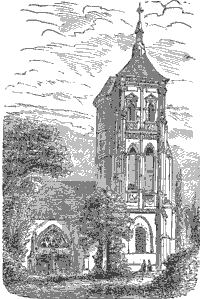
 L’ EGLISE DAMVILLE
The Bec/Crispin composite was popularised in the imaginative works of Mr. Grimaldi in 1832. He proposed that Ralf/Rollo/Rou de Bec was a brother of Gilbert Crispin I. It might be assumed that he based his supposition on Rodolf de Bec gifting tithes of Amfreville-la-Mie-Voie to Holy Trinity, Rouen, the gift being witnessed by Gilbert Crispin II.
The significance of this may be the connection of the Crispins to Ivri, given as follows. So, although Mr. Grimaldi’s construction will be shown to be not without merit, the relationship between Rodolf de Bec and Gilbert Crispin may have been that of brothers-in-law; or any such connection not of blood, but one probably connecting to the ducal family. The 19th century was full of works that offered genealogical certainties, which are still desperately sought.
1. (Possibly) Gilbert de Brionne, by a concubine. There is a continuation of association between the Crispins and the family of Bienfaite (de Clare), which can be noted in the gift (in 1070) of a moiety of Damville, to Bec, by Gilbert Crispin 11., being witnessed by his overlord, Richard de Bienfaite, son of Gilbert de Brionne, who also ratified the gift of Raoul de la Cunelle (‘Rodulfus de Cunella‘), vassal of the Crispins, of land at Tillieres, and 30 acres at Damville. (La Cunelle, Eure, cant. de Damville, comm. de Buis-sur-Damville). Raoul de la Cunelle was the son of Gilbert de la Cunelle, who held Grandvilliers. The ancestry of Cunelle commences with Raoul, son of Albert de Cravant and Aubree, da. of Hugh, Archbishop of Bayeux, son of Rodolf d’Ivri. (See Astrid Lemoine-Descourtieux, La Frontière normande de l’Avre: De la fondation de la Normandie, p. 100, 2011).
‘William Fitz-Osborn was the son of Osborn de Crepon by a daughter of Rodolph, Count, or Earl, of Jureium in that distrićt of the dutchy of Normandy which is called Calcinum territorium, or Le pais de Caux. He was related to the dukes, or earls, of Normandy by a descent from Sprota, the widow of William Longa Spatae, or Longuespée, or Long-Sword, the second duke of Normandy, and mother of Richard the 1st, the third duke of Normandy.
This Sprota, after the death of her husband, duke William Long-Sword, married a rich Norman whose name was Asperling, and by him had a son named Rodolph, and several daughters, who afterwards were married to eminent noblemen in Normandy. … This earl Rodolph married Eremberga, a beautiful woman born at a place called Caville in the Pais de Caux; by whom he had two sons, who both took to the church and became bishops in Normandy, namely, Hugh, who was bishop of Bayeux, and John, who was, first, bishop of Avranches, and afterwards archbishop of Rouen. And he likewise had two daughters, of whom one married Osbern de Crepon … This account is taken from the history of Willelmus Gemmeticensi, Lib. 7, cap. 38. It appears thtrefore that this William Fitz-Osbern was the grand-son of Rodolph, earl of Jureium, and great grandfon of Sprota, the widow of William Long-Sword, the 2nd duke of Normandy. And Robert, Duke of Normandy, the father of William the Conqueror, was the grandson of Richard the 1st, duke of Normandy, and great grandson of the same Sprota, widow of duke William Long-Sword. Therefore William Fitz-Osbern and Robert, duke of Normandy, the father of William the Conqueror, being, both of them great-grand-sons of the same woman, Sprota, were second cousins to each other’ (Anglorum Reginæ Richardi I. Ducis Normannorum, 1783).
One of the most erroneus and repeated myths of Norman genealogy makes Gilbert Crispin I. synonomous with Gilbert, Count of Brionne. Prévost, in his commentaries on Rom. de Rou, t. ii., in MSAN, 1828-1829, gives the source of this misconception, which should not be necessary if the slightest attention is given to the unlikely event of a governor of the castle of Tillières being also the elderly Count of Brionne.
1.1. Gilbert Crispin, m. a sister of Fulk d’Anet, I strongly suggest, not d’Anou – one of his ‘plures filia’. Thus, in marrying a niece of Osbern de Crepon, the answer to M. le Prevost’s statement that there was an apparent association between the Crispin and FitzOsborn families, without the basis of that association being known, is found. ‘Nous ignorons à quel titre Gislebert Crespin etait appele à ratifier cette donation; mais nous supposons que ce pouvait être à raison de quelque alliance avec la famille d’Ivri, dont le souvenir est perdu (‘Ordericus Vitalis’, ed. le Prevost et. al., p. 398, 1840).
1… 1.1. Harfast, brother of Gonnor, Duke Richard’s wife. 1.1.1. Osborn de Crepon, m. Emma, da. of Rodolf, Raoul d’Ivri, born c. 950, obit. 1015, uterine brother of Duke Richard I. 1.1.1.1. William FitzOsborn. 1.1.1.1.1. William de Breteuil. (Rodolf de Ivri’s son, Bishop Hugh, gave lands centred around Guernanville to William FitzOsborn, his nephew, and Gilbert Crespin the elder; their subtenant being Foulques de Guernanville, whose gift of his enfeoffment was confirmed by Foulque’s son, with the permission of Guillaume de Breteuil, William FitzOsborn’s son, Gilbert Crespin I., and his sons, Gibert Crespin II. and William Crespin; and Roger de Bienfaite).
The same grouping of Crespin, FitzOsborn, and Bienfaite (Clare) is seen in a legal dispute between them and Robert, Count of Meulan, who had been granted the castle of Brionne by Robert Curthose, and tried to claim the Abbey of Bec as part of this domesne. William Crespin, son of Gilbert Crespin I., William de Britolio, son of William FitzOsborn, and Roger de Bienfaite (Clare) son of Robert de Bienfaite, were vehemently opposed to this: ‘Tunc forte supervenerunt Willelmus Crispinus, et Willelmus de Britolio, et Rogerius de Benefacta, qui cum causam scissent, magna indignatione commoti, magnis vocibus et terribilibus juramentis protestati sunt, quicquid sui parentes ecclesiie Becci dederant, se auferre, si Comes Mellenti cenobium Beccense in suo dominio quoquo modo haberet …’ (Notitia de Liberate Beccensis Monasterii, 1088-1090). I would suggest that they spoke as a familial group.
1.1.2. … de Crepon. Guillaume of Jumièges records that a sister married Osmund de Conteville. 1.1.2.1. Foulques d’Anet. 1.1.2.2. Albreda d’Anet, m. … Foulkes d’Anet and his sister Albreda were among the early benefactors to the abbey of Bec-Hellouin: ‘Ex dono Fulconis de Aneto et homimim suorum manerium de Mesnillo Simonis cum ecclesia et omnibus ecclesiae et manerii pertinentiis. Ex dono Albredae sororis ejusdem Fulconis assensu et voluntate ipsius terram de A.d. 1047. 1.1.2.3. … d’Anet, married Gilbert Crispin I..
1.1.1. Gilbert and William Crispin (alias de Colville). Gilbert Crispin is one of a few that can authentically be said to have fought at the Battle of Hastings, leading a charge with Henry de Ferrers.
Given as per Mr. Grimaldi’s hypothesis:
1.2. Ralph, Rou, Rollo de Bec-aux-Cauchois. Ralph’s family held two lordships: Bec-aux-Cauchois and Bec-de-Mortagne, both fiefs of the ducal domain of Fecamp, held by the bailiff of Caux, which was a Giffard prerogative. Walter II Giffard was the leading magnate in the pays de Caux (his grandmother was a sister of the Duchess Gunnora), and Ralph’s family held under him. (Med. Pros. v. 24-5, p. 176, 2003).
1.2.1. William de Bec, held Bec-aux-Cauchois of Walter Giffard II.
1.2.1.1. Robert de Bec-Mortagne (‘Rotbertus de Moritania filius Willelmi de Becco’) ordered the building of La Vieille-Tour, the fortress of Bec-Mortagne, in 1088; his vil was Vieux-Chatel (Bul. de la Soc. des Ant. de Norm., tome iii. p. 75). Robert de Bec-Mortagne was still living in 1131.
1.2.2. Ralph, Rodolf de Bec. ‘In 1091, Rodulf restored to Holy Trinity, Rouen, the tithes of Amfreville-la-Mie-Voie which he had appropriated, in a charter witnessed among others by his brother Roger, Ralph de Blosseville (Blovilla), and Gilbert Crispin; through Amfreville (Amfreville-la-mi-Voie, Rouen; M.S) and Blosseville he can be linked to Walter; they were probably brothers’ (ibid., p. 192). ‘Rodolf’s father Esperleng was a wealthy man from Pitres, which lays just 5 miles from Amfreville-la-Mie-Voie. Osborn was the father of William Fitz Osborn … If Turstin son of Rolf was the great grandson of Rodolf de Ivri, then he and William Fitz Osborn would have been cousins‘ (ibid. p. 189, 2003). This proposition, also pertaining to Gilbert and William Crispin, would, again, perfectly explain the Crispin/Ivri connection.
1.2.3. Walter de Bec. Walter de Bec aux-Cauchois and Turstin de Bec aux-Cauchois (Turstin Filius Rolf Norman, from Le Bec-aux-Cauchois, Seine-Maritime, cant. Valmont, standard bearer of the Normans at the battle of Hastings (Ord. Vit. iii 172-3), were (joint) benefactors (of lands in Amfreville-Gueuteville; Yvetot) to Ralph de Tancarville’s foundation of St. Georges de Boscherville. (R.A.D.N. 197). It can be noted that this charter lists gifts by numerous people, and that the gifts of Walter and Turstin de Bec are recorded toward the latter end of the charter, strongly suggestive of them not having any familial ties to the Tancarvilles. Walter de Bec was a tenant of Walter Giffard II.(Domesday).
In Domesday People p. 210, Keats-Rohan suggests that Gilbert de Colville II. was from Colleville, Seine Maritime, arr. Yvetot, cant. Valmont. Coleville, of Suffolk. Colleville: Seine-Inf., arr. Yvetot, cant. Valmont. In 1086, Gilbert de Colavilla was an under-tenant of Robert Malet, his br.-in-law, in Suffolk.
1.2.3.1.Robert de Bec. Bardeville is 5 miles from Bec-aux-Cauchois, and was in possession of Robert de Bec, the brother of Walter 11., from 1087-1097. It is highly probable that the Robert of Domesday was synonomous with the Robert who was Domesday tenant of Henry de Ferrers of the manor of Hilton (Appletree Wapentake), which was afterwards in the family of de Bec (Dugdale’s Monasticon, vol. ii. p. 622): Ernald de Bec was enfeoffed of half a knight’s fee by Robert de Ferrers, Ist. Earl Derbys between 1135-1139 (RB 338). Ernald was still living in 1177 (P.R. 23, Henry II. 61). He donated two parts of his tithe in Hilton to Tutbury (D.M O. Ed. i. 354, 33a), founded by Henry de Ferrers. His son, Geoffrey de Bec gave notice to his lord, William de Ferrers, Earl of Derby, that he has given one carucate of land in Hatton (adjoining Hilton) in Marston upon Dove, Derbys., to William Calchon, date 1177-1195 (The Publications of the Northamptonshire Record Society, volume 15, p. 144, 1950).
It can be noted that the following Robert de Herils is not necessarily synonomous with the holder of Hilton: Folio 287v, Nottinghamshire. In Stapleford Wulfsi the noble, Staplewin of Mapperley, Godwin and Gladwin of Wysall had 2 carucates of land and 6 bovates taxable. Land for 3 ploughs. William has in lordship, and Robert of Hérils holds from him. Gaufr. de Heriz held it at the foundation of Lenton Priory, in the time of King Henry the first, by William Pevrel, who gave two parts of the tythe of his demesne here to that Monastery, as in the rest of Lands. (Reg. de Lentone p. 1.) King Stephen confirmed that which Gaufr. de Heriz by the consent of his mother, gave to that Church. Folio 276, Derbyshire In South Wingfield Alnoth had 2 carucates of land taxable. Land for 3 ploughs. Robert of Hérils holds from Count Alan under William Peverel. In Tibshelf Ligulf had 3 carucates of land taxable. Land for 3 ploughs. William Peverel has charge of it through the King. Now in lordship 1/2 plough. Robert of Hérils holds it.
To facilitate the continuity between the ‘Robert of Domesday’ and the family of Heriz, Herils is transmuted to Heriz, although the orthography of Heriz is much more certain.
1.2.3.1.1. Robert de Heriz, ob. ante. 1128, who held Stapleford, Tibshelf, Wingfield, and Oxcroft, was mesne tenant of William Peverel. Robert was Sheriff of Nottingham, 1110-1122 (Judith A. Green, The Government of England under Henry I., p. 221, 1989). He was a King’s Commissioner who witnessed charters of Robert de Ferrers, 1st. Earl Derbys. He was ‘probably son of the Domesday tenant’ (‘Robert’), who held Tibshelf and Stapleford (Notts.) under William Peverel (G. Turbutt, A history of Ogston, p. 226, 1975).
1.2.3.1.2. Geoffrey (Gaufrid) de Heriz. When William Peverel I. founded the Priory of Lenton, in the first decade of the twelfth-century, donators to it were his feudatories in Avranches; “les hommes de Guillaume Peverel sont du diocèse d’Avranches”, being “Le premier était Avenel, Raoul Malherbe, Norman de Saint Patrice, Geoffroy de Heriz, Adelelme ou Adelée, Robert de Mortain (Société d’archéologie et d’histoire de la Manche, 1992, Identification des notables de l’Avranchin et du Cotentin cités dans le livre noir de l’abbaye de la Lucerne, 1143-1309, p. 56). Geoffroy de Heriz donated to Lenton two-thirds of his tithes in Stapleford (Mon. Anglic. v. 111b).
The Heriz family held the fief of La Hérissiere in La Rochelle, situated six miles from Avranches, in the canton of Haye-Pesnel, from whence also came the Paynels, Beauchamps, Earls of Warwick and Worcester, and the family of Subligny, founders of the Abbey of Lucerne. La Hérissiere was a ‘fief de Haubert’, that is, held of the ducal family (D.N. V. XI. P. 379, 1776). It was also called La Rochelle-le-Hericiere (ibid.).
Heriz or Heris is the natural contraction of Hérissiere, the name for a fort with a pallisade of angled stakes that resembled the spines of a hedgehog, hence the Heriz armorial.
1.2.4. Turstin de Bec, Turstin FitzRolf. Turstin Filius Rolf Norman, from Le Bec-aux-Cauchois, Seine-Maritime, cant. Valmont, standard bearer of the Normans.
Geoffrey de Bec (alias Normannus). He is stated to be ‘probably of the same family’ as Walter de Bec-aux-Cauchois by the authors of ‘Medieval Prosopography’ (p. 192). As under-tenant, he had lands in Berks, Somersetshire, Devonshire, Leicestershire, Yorkshire, Suffolk, Cambridgeshire, Bedfordshire, Northamptonshire, and Shropshire; and was tenant in capite in Yorkshire. He was father of Ralph de Montalt. ‘Ralph the Dapifer’ (of Hugh Lupus) was living 1093 and 1119, and was brother of Hugh Fitz-Norman, or de Mara.
We look for ropes when there are but threads.
copyright m stanhope 2016


 Walter FitzGilbert de Hamilton