
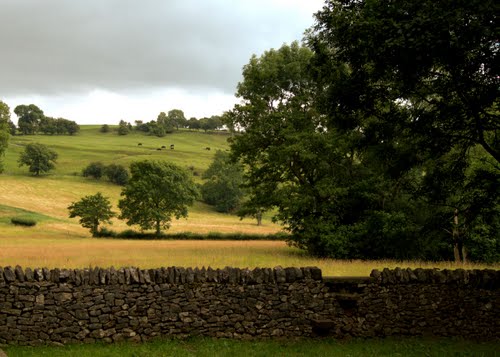
FOOTPATH TO GRINDON, STAFFORDSHIRE
Sherton is also called Shenton in old texts (see Gregory King’s ‘Staffordshire Pedigrees’ – based on Dugdale’s ‘Visitation’, 1663/4), and was home to a family of Grindon/Grendon. Colonel Thomas Grendon’s will was probated in London, December 15, 1678, in which he described himself as ‘of St. James Duke Place, London, citizen and draper’, and gave his son Thomas Grendon, ‘now in Virginia’ lands in Sherton Co., Stafford and to his daughter Hannah (Grendon) Duke, ‘now in Virginia’ property there. (See Colonial Surry, John B. Boddie, 1959). This is a wholly typical scenario – the wealthy yeoman class educating their sons and finding them a position in the London ‘trades’. A family’s place of origin was often of less importance than their connection to London, and its lucrative trade links to America.
The Grendons of Virginia almost certainly took their name from Grindon: ‘Grindon is an ancient manor, which was possessed by Robert de Stafford, in the 20th year of the reign of William the Conqueror. In the reign of Henry the Third, it was held, with Blore, by William Audley, of the Baron of Stafford. In the 9th of Edward the Third, Joanna le Strange was lady of this manor; she was afterwards married to Sir Henry Brailiford, whose daughter and heir, Joan, married Sir John Bassett, descended from the Bassetts, of Cheadle. In this family it continued till the close of the seventeenth century, when it devolved to Christopher, Duke of Albemarle’ (William Pitt, A Topographical History of Staffordshire, p. 239, 1817).
The legal documents which follow almost certainly record the family of Grendon of Virginia. I can not determine the origins of John Harris or Richard Bird, nos. 8,9.
- Roland Frith v. John Silvester, Wm. Grindon, senr.: Manor of Shenston. How long was plaintiff bailiff there? Touching value of the heriots during the time he was bailiff, during the time the manor was in the hands of the late Earl or Countess of Warwick.Election of thirdboroughts for town of Footherley. Waste of timber. Trees in part of the demesnes called Sandalles, used by defendant to enclose Ogley Common. Survey. Customs of manor.: Stafford. E 134/5Jas1/Trin6.
5 Jas 1 1607.
2. Grindon v Lloyd. Plaintiffs: Thomas Grindon. Defendants: Priamus Lloyd and another. Subject: property in Burton, Staffordshire. C 3/352/37. 1621-1625.
3. Grindon v Burton. Plaintiffs: Thomas Grindon. Defendants: William Burton and another. Place or subject: property in Warslow, Staffordshire. C 7/145/43. 1649.
4. Will of Marye Grindon, Widow of Saint Martin in the Fields, Middlesex. PROB 11/217/704. 25 July 1651.
5. Will of Thomas Grindon, Yeoman of Shenstone, Staffordshire. PROB 11/266/367. 28 July 1657.
6. Rogers v Grindon. Plaintiffs: Edward Rogers. Defendants: Thomas Grindon, William Tilden, Rebecca Tilden his wife and John Parker. Subject: messuage in the Great Sanctuary, Westminster, Middlesex. C 6/288/53. C 6/288/53. 1672.
7. Thornton v Collyer. Plaintiffs: William Thornton, James Silvester, Thomas Grindon, Thomas Cotterill, John Browne, George Silvester, James Silvester, William Smith, Nicholas Allen, James Fletcher, Roger Adams, Ann Priest, Thomas Kennall and John Birch and others. Defendants: John Collyer [Collier] and others. Place or subject: property in Shenstone and Little Aston, Staffordshire etc. C 7/345/140. 1661.
8. Harris v Panter (possibly Payntor). Plaintiffs: John Harris and others. Defendants: Roger Panter. Place or subject: property in Grindon, Staffordshire. C 7/578/78. 1679.
9. Panter v Stubbs. Plaintiffs: Panter. Defendants: Stubbs, Smith and Stubbs. Documents: depositions concerning Grindon, Staffordshire. DL 4/124/1687/6. 1687.
10. Bird v James. Plaintiffs: Richard Bird. Defendants: Joseph James and John Harrison. Subject: lands and personal estate of the deceased Ruth Stubbs, in Butterton, Grindon, Alstonefield, Wetton, and Hope, Staffordshire. C 6/329/67. 1696.
The connection to a Harris family is adduced from the following:
Robert Harrys. Edward Burton of Carshalton held that manor in 1507, and his son conveyed it to John Scott. John Scott died in 1558, seised of two-thirds of the manor of Woodmansterne. “Robert Harrys, or Harris, had an interest in this manorial estate” (Brayley et al., A topographical history of Surrey, Volume 4, p. 47, 1850). From him descended Robert Herys, esq. master in chancery (ob. 1653). His dau., Katherine Harris, mar. William Paynter, who conveyed the manor of Woodmansterne, the site of the manor, and lands here, to Sir Edmund Bowyer of Camberwell. Their son,Thomas Paynter, mar. sister of Nowell Bassano. Nowell Bassano. ‘After noe little trouble we have at last disposed of my Brother Painter’s untoward sonn — (Nowell Bassano was Thomas Poynter’s brother-law) —- he is consigned to a verry Eminent Merchant (Thomas Grendon) in Virginia’ (D-X464/3/9 8 Aug. 1682).
‘The advowson of Woodmanstone was given to the priory of St. Mary Overy, in Southwark, by Nigel de Mowbray, early in the twelfth century; but it appears from the Valor of the 20th of Edward the First, that the monks of Bec, in Normandy, derived a pension of 30*. from its revenues. It was then valued at 13 marks; and in the King’s books, at 11/ 7 s. 6d.; paying 8s. 9d. for procurations and synodals. It is a rectory in the deanery of Ewell. The Registers commence in 1566, but are not complete’ (Brayley, ibid.).
copyright m stanhope 2016


 Walter FitzGilbert de Hamilton
EDWARD GRENDON
The Surname Grendon: Anglo Saxon in origin, and means ‘green hill near a wood’, .
Jamestown Society Register A3208: Grendon, Edward [Jamestowne Island: d. 1628,
A3209: Grendon, Thomas, Sr. [London, England: d. 1680, (Burgess).] Members: 6
Edward Grendon – Order of Descendants of Ancient Planters
Edward Grendon, designated an ancient planter, immigrated from England to Virginia ahead of his family, circa 1611 and 1616 while Sir Thomas Dale was deputy governor. A colonist in Virginia by the year 1616 was entitled to 100 acres of land provided he paid his own passage and had dwelt in the Colony for three years when application for land was made. In accordance with a predetermined policy of the Virginia Company, no individual assignments of land were made during the first seven years of the Colony’s existence. The policy of granting patents for acreage to settlers was inaugurated during the latter part of the time of Sir Thomas Dale, Governor from 1611 until 1616. Those entitled to this land were designated as Ancient Planters.
“The Grendon family in Virginia starts with Edward Grendon, arriving before 1613. The heir of his Virginia property
Col. Thomas Grendon was an English business man interested in the newly emerging English Colony Jamestown. In England he was a successful business man, a member of the Draper’s Guild, a member of Hustings, with a business on Duke Street, London where he sold fine cloths and tobacco.
He invested in land in America, grew tobacco which he shipped to London.
He also inherited land from a family member, Edward Grendon, who appears to have preceded Thomas to settle the new enterprise of the Virginia Company.
Edward would bring his later wife and young children to Jamestown in 1622 after he had established a home for them.
Edward Grendon returned to England to collect some of his family. He set sail for Virginia on the “James” on July 31, 1622 accompanied by his wife, baby son Edward, and daughter Temperance (20) Although he was in the List of the Living, 16 Feb. 1623/4, alone, Mistress Grendon is mentioned 7 Feb. 1627/8 . On Feb 6 1628 Edward Grendon quoted a statement Elizabeth had made on January 14 about something one of his servants had done She was also listed as an heir when he died in 1628
It has been hard to find a generational continuation of the Grendons who continued to live in Shenstone where Col. Thomas Grendon lived., working in London and Virginia. Marriage, Birth or baptismal records have not been found for Edward and his families. I believe Edward Grendon was married twice, and his heir, Thomas Grendon of , Draper’s Guild was related to him maybe through a brother or Uncle.. I believe the wife Elizabeth and children Edward and Temperance Edward brought to America were of a second marriage due to his estimated birthdate.
I have only found one record for an Edward Grendon later that could have been Edward’s son: I found an entry in 1678, page 37. for an Edward Grendon, who is probably the son of Edward Grendon, Ancient Planter. This is the only reference for him I have found so far. He shipped 5,700 # of tobacco to England on the John Rudd Ship Masters vessel the same one used often by Thomas Grendon, probably Thomas Grendon’s grandson)
Col. Thomas Grendon my immigrant ancestor shipped goods to Jamestown Colony aboard the”True Love”
To help Edward and to help prepare for his arrival there as well.
Both men owned land in England and Virginia.
It is recorded in the Draper’s Guild for Col. Thomas Grendon that he and a son, Thomas, paid quarterage from 1647-57 as Drapers. This son Thomas was the father of Col. Thomas Grendon’s grandson Lt. Col. Thomas Grendon born about 1643/1685, of England and Virginia.
All three of these Grendon men were in the house of Burgess of the Colony Virginia.
Hannah Grendon, daughter of Col. Thomas Grendon was described by Lt. Col. Thomas Grendon of England and Va.
In his will as his “Aunt. Hannah ” and described as the daughter of Col. Thomas Grendon in his will. Col. Thomas Grendon is supposed to be Lt. Col. Grendon’s grandfather according to the will’s language.
In October 1628 his will,now lost, was presented to the Gen. Court. And proved 9 December 1628. Edward Grendon was survived by his wife Elizabeth who was then living in Virginia, and his adult heir, Thomas Grendon, was left 650 A of land..
My Research at Virginia Archives October 2017 I located the McIlwaine record for Edward’s will being recorded.. Some surprising information revealed that a Martin Peale presented his will for recording in 1628. This raises the question of where his wife might have been. And was Martin Peale somehow connected to the family.
New information discovered re Edward was the person recording his will. Martin Peale.
“P 179: 9 December 1628 At this Court was brought in the Will of Mr. Edward Grindon deceased and was proved to bee his last will and testament by the oath of MARTIN PEALE, and that he was in perfect sense and memory at the making thereof.”
Edward had had vouched for Martin in court.
“p 177 The ,,November 1628; A court at James Citty the…November 1628; C Francis West, Esqr Governor etc: Smyth. Mr. Secretary.
At this court was made the peticon of MARTIN PEALE offerred against Mr. Thomas Mayhew Concerning his wages due unto him in the good shipp the Guist, it is ordered that the said Mr. Mayhew shall paie unto the said MARTIN PEALE all his wages due unto him for the terme and tyme of his servie in the said Shipp; The reasons are for that Mr. Mayhew in his answers to the said peticon confessed he consented to dischardge him and yielded thereunto (?) and beause Governor testified that Mr. Grindon did often offer to take his oath that Mayhew was content to pay him his wages when hee did dischadge him.
I have checked for family connections. Found no immediate connections.. Have found Peales settled in America later. Some very famous artists, writers and family men. A Peale painted George Washington. Norman Vincent Peal, famous minister and writer.
A Martin Peale was in Southhampton England witnessing a Parker will in 1638, ten years later.
Martin Peale d. 1656, England, will filed in Cantebury
Martin Peale was back in England in 1638 from James City and contact with Edward Grendon in 1628
He was acquainted with the Parkers of England and Virginia
LikeLike