
This article will differentiate between the English kinship groups to which Captain Thomas Harris (of Buckinghamshire), and Major William Harris (of Shropshire), belonged, and will show that the myth of the latter being the son of the former was the product of false assumptions which were based on dubious/fraudulent records, and perpetuated in order to compose a story that made Major William Harris a continuator of an Essex line of Harris; the much-loved belief of early Harris researchers and their successors.
At the center of the narrative attempting to link Captain Thomas Harris, of the 1624 Muster, to Major William Harris, was the claim that Captain Thomas Harris obtained, through grants and inheritance, a tract of land called “Longfield”, which Major William Harris supposedly “fell heir to” (a fine poetical phrase, indeed). As will be shown hereinafter, this claim was based on records which the Henrico court regarded in the seventeenth century as unverified. In fact, the “Longfield” tract in question was in the possession of the Davis family from 1637 until 1700.
Concerning early Henrico records, the database and digital images held by the Library of Virginia have been extensively examined and used in the compilation of these notes. Concerning their context, these notes give an insight into the widespread extent of land frauds in early Henrico County, and for the first time in a full length study, place the genesis of the “Harris story” within its proper historical context.
These notes may not change the beliefs of those who firmly grasp long-held traditions, but they seek to give a realistic alternative to those willing to reassess old hand-me-down stories.
The colonisation of early Virginia by English settlers can only be understood in the actual social, economic, and political context of that period. These factors were, of course, intertwined. The social norm of intermarriages between members of the same kinship network was based on ensuing economic advantages, and activities to further its members’ assets were, in turn, supported by connections to the prevailing political elite.
THE SOCIAL CONTEXT OF COLONISATION
Basic to genealogical research of early English settlers of Virginia is that they were part of a kinship system that aided such settlement. In one sense, Virginia was not predominantly colonised by individuals, but by English kinship groups. Such groups protected and enhanced their members’ interests by promoting marriages within them. Marriages between close degrees of cousins were frequent, but it was a very intricate and many layered web, with closely related families often intermarrying within the families of each other’s in-laws; blood-ties being strengthened by non-consanguineous ones. Such kinship groups dominated the colonisation of large areas of seventeenth-century Virginia. “The Kentish gentry had begun to recreate their relationships in the area of the James River” (Peter Laslett, “The Gentry of Kent in 1640”, Cambridge Historical Journal, ix. (1948), 150. 66), is a comment equally applicable to kinship groups from Buckinghamshire and Shropshire. They recreated English parishes in Virginia, the difference being that they wished to be seated in the front pew, which, in England, was the jealously guarded domain of heredity.
The English “middling order” were subject to a State religion that proclaimed social rank as a design of God – a system of strict boundary delineation. “There were wide boundaries between socio-economic groups. These boundaries were rarely crossed. Marriages almost invariably took place between members of the same common interest group. These networks crossed geographical boundaries but not social borders” (Charles Pythian-Adams, ed., Societies, Cultures and Kinship 1580-1850: Cultural Provinces and English, p. 162, 2010).
As will be shown, as in the case of Captain Thomas Harris, when the most immediate family did not provide a route to economic and social advancement, alliances with more extended kin might be sought. Recorded within the household of Thomas Harris in the 1624 Muster, was Margaret Bourdman – whose uncle had married the widow of a kinsman. Thomas Harris would have been paid to provide such protection.
The vital importance of kinship support in England and colonial America is well documented. “Marriage is not simply the union of two persons; rather, it binds together two kin groups. It reunites human society, which time and the divergence of family lines relentlessly pull asunder” (David Herlihy, “The Making of the Medieval Family,” Medieval Families, Perspectives on Marriage, Household, and Children, ed. Carol Neel, 2004, p. 200), a point elucidated by Pounds: “Even the state in medieval England required people to be linked in small groups or tithings, so that each could vouch for the others’ good behaviour … Almost everyone is, by the accident of birth, a member of a family, of a more extended kinship group” (N. J. G. Pounds, The Culture of the English People, Cambridge University Press, 1994, p. 255).
Such social-dependency arrangements were repeated by American settler families, as examplified by the migrations of Southern author William Faulker’s ancestors and their kin: “The listing of people, their names and birthplaces in the census rolls, shows clusters of fellow North or South Carolinians, Virginians, and Tennesseans living next to one another … The family names listed in the census suggest that kinship groups were being transplanted, either at once or in stages … letters and diaries reveal brief glimpses of the vast undergrowth of siblings, cousins and in-laws that existed beneath the moving population … These kinship networks among the elite were only the more visible of a much larger complex of relations that pulled kin and family across vast American distances to be with one another”. (Don Harrison Doyle, Faulkner’s County, University of North Carolina Press, 1994, pp. 107-108, 255).
LAND ACQUISITION AND THE ECONOMIC/POLITICAL CONTEXT OF COLONISATION
The English custom of claiming land on the basis of fraudulent deeds was an ancient and well-perfected one, enabled by the economic/political power of an entrenched hierarchical class structure which continued to dominate in early Virginia. Researchers of early Virginia land ownership should be aware that certain practices common at that time may affect the reliability of genuinely early records, as follows:
“Headright claims could be sold to someone else. In this case the original recipient’s name appears in the headright list as the basis of the claim of the other person … these headright lists were notoriously fraudulent and were sold and re-sold, and sometimes completely fabricated”. (Loretto Dennis Szucs, Sandra Hargreaves Luebking, eds., The Source, A Guidebook to American Genealogy, 2006, p. 486).
“In addition to obtaining tracts using fraudulent or duplicate headrights, later-seventeenth-century elite planters devised a number of ways of engrossing land, including … bribing county clerks and provincial office clerks and surveyors to certify fake headright claims and false boundaries”. (Lorena S. Walsh, Motives of Honor, Pleasure, and Profit, University of North Carolina Press, 2012, p. 369).
The planters then bribed land office officials into accepting their fraudulent claims and generously expanding the fifty acre allotments. (Richard Lee Morton, Colonial Virginia, University of North Carolina Press, 1960, v. 1, p. 420).
The planters bribed land office officials into accepting their fraudulent claims and generously expanding their 50 acre allotments. (William Butler Scott, Every Man Under His Own Vine and Fig Tree: American Conceptions of Property from the Puritans to Henry George. Doctoral Dissertation, University of Wisconsin, 1973, p. 45).
Anthony S. Parent, Jr., in Foul Means: The Formation of a Slave Society in Virginia, 1660-1740 (Omohundro Institute of Early American History and Culture and the University of North Carolina Press, 2012, pp. 34-37), comments on this context at more length:
“The emerging elite secured hundreds of thousands of acres by using their official posts to bend the rules. False claims and malfeasance combined to form an enormity of abuse. Boundaries were exaggerated; false certificates were submitted; office clerks were bribed.” Edward Chilton, the attorney general, identified this corruption in 1697, responding to the queries of the newly established Lords Commissioners of Trade and Plantations. He reported that surveyors through “ignorance and knavery” exaggerated boundaries “so that the persons for whom they surveyed might enjoy larger tracts of land than they were to pay quitrents for.” Court justices were “lavish” in honoring headright certificates based on uncorroborated oaths. The purchasers would then present the certificates at a different court, duplicating the headrights. County Clerks … exercised “great libertty” in distributing certificates “at very easy rates” of one to five shillings for each headright. Edward Randolph, commissioner of customs, would confirm this pattern of malfeance in 1696. He observed that the simplest method of securing land had been to bribe land-office clerks for selling fifty acre headrights for as little as half a crown.
“A holder of a headright was required by law to ‘seat such land’ within three years by building a house … and by planting the land with tobacco or some other crop. Randolph observed that the planters patent so much land that they desert it within three years. They abuse the intent of the law by cutting down twenty or thirty trees, by building a bark covered hut, by turning two or three hogs into the woods, and by clearing an acre of ground where they plant corn … but they take no care of their crop, nor make any further use of their land.” The recipients were to pay the Crown one shilling for every fifty acres, but “they never payed one penny Quit-rent for it”.
“Class ties inhibited enforcement of land-use laws. Bound by common interests to their fellow planters, sheriffs were slow to enforce payments of quitrents … More often than not they had previous experience in the House of Burgesses, where they returned after their one year term of service expired. They understood that the aquisition and retention of even their own family estates resulted in the use, or, better, abuse of their offices”.
Mr. Parent continues to elucidate that the encroachment of land checked the expansion of the smaller planter-class after the 1660’s; ownership by poor whites had become problematic as wages decreased in line with decreasing prices of tobacco due to over-production, and land prices rose by 135% between 1663 and 1700 because of land monopoly by the elite. A decline of servants from Europe in the 1680s and 1690 meant that there was no exploitable class of labour for the small planter who could not afford slave labour at two to three times the cost of endentured labour.
“The monopolisation of land made folly of the belief that Virginia was the land of opportunity for English servants who had paid their passage to Virginia with their labor” (ibid., p. 37).
Forged land records were rife, culminating in: An act against Forgery. An act concerning the lost deeds, wills, records, and other writings of the county of Henrico (passed the 25th of November, 1789). “Sect. 1. Whereas by an act of the General Assembly intitled “An act for the relief of persons who have been or may be injured by the destruction of the records of county courts,” and made among other purposes for perpetuating the testimony of witnesses in relation to any deed, will, inventory or other writing recorded in the county courts, where the original is lost, and no attested copy thereof can be produced, it was enacted, that it should be lawful for the governor, with the advice of council, to issue one or more commissions as the case might require, under the seal of the Commonwealth, to nine able and discreet persons directed, giving them or any three or more of them full power and authority to meet at some convenient place by them to be appointed, and to adjourn from time to time as they shall think fit, and to summon, hear and examine all witnesses at the instance of any person whatsoever touching the premises, and to take their depositions in writing, and to return the same with such commission or commissions to the executive; which depositions were by them to be laid before the General Assembly at the next session; to the end, that such effectual relief might be given to the sufferers by the loss of the said records as should seem just and reasonable.” (Donald W. Smith, “Debtors to Our Profession?” American Congress on Surveying and Mapping, vol. 37, 1977, Cornell University, pp. 316-317).
In 1666, the General Assembly decreed that surveyors could double their fee from 20 pounds to 40 pounds of tobacco per 100 acres surveyed in the hopes of attracting “more competent, scrupulous, and trustworthy” men to the profession of surveying. The Virginia legislation began, “Whereas many contentious suites do arise about titles to land, occasioned much through the fraudulent and underhand dealing of surveighors ”. (Laws of Virginia, March 1658-9, 10th of Commonwealth, Act V).
“Thus, despite efforts by some to foster professionalism among colonial surveyors, evidence indicates that the activities of less diligent surveyors did much to destroy public respect for the early American surveyor. In addition, work conditions forced upon the early American surveyor were, to say the least, not conducive to professional development”.
“Instruments and techniques with which the early colonial surveyors were familiar were developed for use in the open fields of England. They were not suited to the forested terrain encountered in America … considerable difficulties (were) brought about by relying on unreliable magnetic bearings determined with the circumferentor (the predecessor of the surveyor’s compass) to describe land boundaries.”
“There was little, if any, educational assistance prior to the founding of the College of William and Mary to train surveyors to cope with the new conditions found in America” and “Virginia surveyors were forced by law to work in a quasi-social or captive atmosphere. They could not refuse to survey for anyone bearing a land warrant and requesting a patent survey.
“Fraudulent practices (included claiming) excess acreage beyond that cited in the corresponding warrant and encroaching on previously marked patents. The surveyor was generally blamed for these inconsistencies, but … he was surveying in accord with the wishes of his employer, the claimant” (Smith, pp. 315-316).
Inerests in common based on familial associations :
POLITICAL HEGEMONY
From The Virginia Magazine of History and Biography, vol. 1, 1893, p. 366; bold type added, additional information in brackets.
Henrico County. Acres of Land – 146,650. Tithables.- 863.
Burgesses – Tho. Cocke, Wm. Farrar.
(Thomas Cocke was named a “friend” in the will of Major William Harris. William Farrar m. Mary Tanner, relict of William Ligon, son of Thomas Ligon and Mary Harris, sister of Major William Harris.)
Sheriff – Giles Webb.
Justices of the Peace – Rich. Cocke, Wm. Randolph, Peter Feild, Francis Eppes, Wm. Farrar, Jno. Worsham, Tho. Cocke, Giles Webb, Jos. Royall,*****, Jn. Bolling.
(Richard Cocke was the brother of *Thomas Cocke, aforesaid. William Randolph* was another “friend” of Major William Harris. Francis Eppes purchased “Longfield” from John Davis. He m. Ann Isham; nephew of John Eppes Sr., who witnessed the land transaction between Major William Harris (of 140 acres) to Abraham Childers Sr. Ann Isham was the dau. of Henry Isham, cousin of Sir Fleetwood Dormer, husband of Mary Harris, daughter of Richard Harris of Cruckton, Shropshire, and, it will be argued, second-cousin of the Mary Harris who m. Thomas Ligon. John Worsham was the son of William Worsham and Jane, relict of Francis Eppes, the father by his first wife of the purchaser of “Longfield”, half-brother of Mary Worsham, wife of Richard Ligon, son of Thomas Ligon and Mary Harris, who deposed on 2 December 1684 that she was aged about 64 years, matching the April 3, 1625 baptism date of Mary Harris of Ludlow, second-cousin of the wife of Sir Fleetwood Dormer, cousin of Henry Isham).
Escheator – *Wm. Randolph.
Coroners – Wm. Randolph, Wm. Cocke, Peter Feild, Seth Ward.
(William Cocke was the br. of Thomas and Richard Cocke. Peter Feild m. Judith, dau. of Henry Soane and the relict of Henry Randolph, who by a first wife was the father of the aforesaid William Randolph).
County Clerk – James Cocke (son of *Thomas Cocke).
Surveyor – Richard Ligon (son of Thomas Ligon and Mary Harris, aforesaid).
A CASE STUDY
Any consideration of genealogies that makes use of land grants in Henrico County prior to 1677 should include an awareness that these are almost invariably based on the memories of neighbours, being “able and antient freeholders”, which were recorded in later court cases, as “statements evidence” on which claims were based. Such statements have to be placed within the context of fake headright claims and false boundaries as given heretofore, widespread bribery of officials; and, it can be added, memories of very old neighbours, whose accounts of 50 years previous or so could not be challenged, they being the only survivors of their neighbourhoods. They were also usually related in some way to the land claimant. That is, the validity of the evidence of land claims in early Virginia is open to serious question, and would not be admissable in any modern court of law. Genealogical studies should take into account the following history of Henrico Co. records:
“Henrico. Recognized in 1634 as an original shire. All county court records prior to 1655 and almost all prior to 1677 are missing. Many records were destroyed by British troops during the Revolutionary War. Post-Revolutionary War county court records exist. Almost all circuit superior court of law and chancery and circuit court records were destroyed by fire during the evacuation of Richmond on April 3, 1865, during the Civil War”. (Library of Virginia, Research Notes, number 30).
Thus, when considering land deeds prior to 1677, many from then onward have to be placed in the context that they are copies of patents which themselves may have been copies from sources which, as given heretofore, are open to a question of them being inventions. They are not copies of verified originals in the modern sense.
An example of such “evidence”, given in a court case of 1692/3, is that of Richard Cocke (son of John Cocke, of Stottesdon, Shropshire, 10 miles distant from Ludlow, the abode of the Harris family of this account), complaining that his neighbour, John Woodson, trespassed on his land on Curles Swamp, Curles Neck, Henrico Co. Woodson’s defence was that his lands were part of an old patent granted to Captain Thomas Harris in 1638. He produced what he claimed was copy of this patent, which the court designated as alleged, and to be examined by “neighbors”, of an “antient” variety:
“John Woodson, Jr., Deft. vs. Mr. Richd. Cocke, Pltf. Trespass. The Pltf. complaining for that sd. Deft, on or about ye 15 Octr. last, as well as sundry other times, both before & since, wth force & armes into & upon a certain piece or parcell of land belonging to him the sd. Pltf. Situate & being in this County of Henrico & known by ye name of Curies Swamp, did enter & wth in the limitts thereof wthout leave of him the proprietor just obtained, did hunt or shoot contrary to ye LXXI Act of Assembly in ye printed book. Deft. pleads not guilty, and saith that above tract of land calle’d & known by the name of Curles Swamp, doth not belong to the Pltf. nor hath he right thereto, but that same is a parcell of the land in possession of Nathl. Bacon Jr., and in Court produces copy of a patent (by e for ye land afsd.) granted to Capt. Thos. Harris, under whom by several mean conveyances ye sd. Bacon claimed; upon wch. plea Edwd. Chilton, Esq. their Maties Attorney Genl. (being presnt) informs the Court that by order of Councell Mr. Auditor Byrd & himself are impowered & commanded to look after their Matie land”. Feb. 1, 1692.
On October 20, 1688, Thomas Cocke, friend of Major William Harris, was granted “1650 acres in the parish of Varina, on the south side of Chickahominy Main Swamp, adjoing the land of John Woodson”, p. 668 (Reel 7). Sept. 28, 1681: Robert Woodson, brother of John, was granted “531 acres 1r. 4po. on the south side of the White Oak Swamp, in the Parish of Verina and runeth vizt. from a corner black oak of Mr. Thomas Cocke”, ibid., p. 102. Oct. 23, 1690: John Woodson was granted “385 acres in the Parish of Varina, on the north side of James River, begg. &c. belongg. to the land of Henry Price”, p. 83 (Reel 8). Oct. 21, 1687: “Woodson, Robt., senr.; Woodson, John, senr.; Lewis, Wm.*; and Charles, Thomas” were granted 470 acres in Henrico Co., p. 602 (Reel 7). June 16, 1714: “Woodson, John and Fleming, Charles”* were granted 1278 acres in Henrico Co., p. 166 (Reel 10). October 21, 1687: “Woodson, Robert; Ferres, Richard; Carter, Giles; Ferris, Wm.; and Cumins, Roger” were granted 1780 acres in Henrico Co., p. 601 (Reel 7).
A SHROPSHIRE KINSHIP GROUP – HARRIS AND LANGFORD
1. Thomas Langford, gent., b. ca. 1535, bur. April 1, 1610, in Ludlow.
1.1. Jane Langford, m. Rowland Harris. Her second husband, Edward Lewis, was by a first wife the ancestor of *William Lewis, who held land with his father-in-law, Robert Woodson.
1.1.1. John Harris, bapt. Mar 5, 1603/04, in Ludlow.
1.1.1.1. Mary Harris, bapt. 1625, in Ludlow. (Mary (Harris) Ligon).
1.1.1.2. William Harris, bapt. 1627/8, in Ludlow. (Major William Harris).
1.1.1.2.1. William Harris, was involved in the determination of the lands of Thomas Langford,* Feb. 26, 1731. (Magazine of Virginia Genealogy, vol. 36, no. 3, pp. 214-215), descended from his great-grandmother’s brother.
1.2. Thomas Langford.
1.2.1. William Langford, m. Jane Jordan, of Stone Acton; a neighbour of Henry and John Fleming (S.A., C 5/482/9). Henry Fleming’s Will was proved in 1656 (P.C.C. Wootton 124, 294), mentioning his “brother” (in-law) Bassett. John Fleming was probably he who died in New Kent Co., on April 27, 1686, whose son, *Charles Fleming, owned land land next to his cousin, William Basset, whose Will was proved May 14, 1724. Samuel Jordan of New Kent Co. (Will probated June 11, 1719) was likely to be of the family Stone Acton. He bequeathed to his “beloved friend (br.-in-law) John Fleming “the plantation of Thomas Langford dec’d , & the management of his estate & the bringing up of his son Thomas Langford as wholely to himself”. His Will was witnessed by Tarleton Woodson, grandson of Robert Woodson, supra, and nephew of John Woodson.
1.2.1.1. Thomas Langford, of New Kent Co., who appears in this land grant: “Robinson, John. September 22, 1682. New Kent Co., granted 1,252 ac. on the Dragon Swamp and branches thereof. Beginning &c. belonging to the land of Thomas Langford; thence &c. over certain branches of Arracxicoe to a Corner Red Oak by the Mill Path”.
1.2.1.1.1. Thomas Langford.
1.2.1.1.1.1. *Thomas Langford, orphan.
Mary (Harris) Ligon was involved in claiming her land lay beyond the “alleged” ancient patent. She was a part of a political hegemony which would support her claims:
In 1691, she divided her 200 acre portion of “Curles” (Swamp) on which she was living between her two surviving sons, Richard and Hugh Ligon, although she could continue to live on the property until her death, collect rents from the tenants, and fell trees for fencing and firewood. The deed transferring ownership to her sons was presumably designed to keep her land from the heirs of her son William, who had died two years earlier. Henrico Co. Deeds & Wills 1688-97, p. 231: Mary Ligon Sr. for love and affection to sons Richard Ligon and Hugh Ligon, 200 acres at Curls, being part of a grant to Capt. Thomas Harris, decd. and given by his Will to said Mary Ligon, his daughter, to be equally divided between Richard and Hugh, Richard taking the part next to Richard Cocke and Hugh the other half. Wit. Wm Soane, Thomas Cock, James Morris.
* The Court could not examine the said Will, it being lost.
* The Court was not presented with a copy of the said Will.
* The Court was not presented with witnesses to any copy.
* The Court was not presented with witnesses who could vouch for Mary Harris being the daughter of Captain Thomas Harris. Those old enough to vouch for this would include the sons of Richard Cocke Sr., Richard Cocke, and Thomas Cocke.
* The Court was not presented with any witness stating that his/her parent had told them of this alleged connection. Members of the Court, as given heretofore, were part of the same hegemony/kinfolk group to which Mary (Harris) Ligon belonged, and would have known her very well; indirectly worded supports of her claim such as: “as is commonly known by members of this Court” may indicate a reluctance to perjure themselves.
* The Court, or any other court, did not request William Harris or Edward Harris, sons of Major William Harris, to give oath as to the identity their grandfather.
* The Court, or any other court, did not request any children of Mary Harris and Thomas Ligon to give oath as to the identity their grandfather.
The unsubstantiated nature of the claim of Mary Harris Ligon, and all claims relating to the supposed 820 acres of Captain Thomas Harris, lay in an all too convenient mist; they would be summarily dismissed by any modern court not administered by closely connected kin.
All such claims were designed to, as phrased by 1984 author George Orwell, “give an appearance of solidity to pure wind”.
(As an aside, Nathaniel Bacon arrived in Virginia in 1674 after being implicated in a fraudulent scheme, and his new wife was stripped of her inhertance by her father for marrying him. (Mary Beth Norton, Separated by Their Sex. Women in Public and Private in the Colonial Atlantic World, 2011, p. 13).
“Whereas in Octr. Court last at ye pticon of Mrs. Mary Ligon an order was obtained for ye survey of Curles (Swamp) patent pr. Mr. Theod. Blande wch. being prformed at ye presentation thereof. It was objected that ye course there run did vary much from ye antient (allegedly) known bound of ye sd. land wtt in reasons ye sd. survey was not confirmed but it was in Court concluded & agreed upon (ye 2nd day of Feby. last) by the owners of ye adjacent land that they would endeavor to find out and ascertain ye antient bounds thereof, wch. was pr. ye. Court conceivd ye justest and most convenient and legal way”.
The surveying of Curles Swamp found “severall old marked and processioned trees”, which the parties concerned agreed to accept as boundaries, which were not attributed to an ancient patent held by Capt. Thomas Harris. The Court merely recorded that Mary Harris Ligon claimed that her portion of Curles Swamp had been willed to her by her father.
(Many of the Bacon’s Rebellion adherents had their lands escheated: “One such tract of 1,230 acres known as “Curles”* was on the James River one bend up-river from William’s (William Randolph’s) Turkey Island property. It had been owned by Nathaniel Bacon himself and escheated to the Crown. Berkeley appointed William Randolph to appraise the tract, which he bought for the price he set on it – £150. The patent was not issued until 1700, after the purchase price had been paid, but the transaction had been completed in 1677” (Robert M. Randolph, Peyton Randolph and Revolutionary Virginia, 2019).
*That is, his plantation on Curles Neck. Nathaniel Bacon purchased this tract from Thomas Ballard. (The separate 330 acre home where he had resided was in Middle Plantation (now Williamsburg), which was sold by his son, Thomas, to found the College of William and Mary). The said Thomas and his brother, William, acted in Court in 1691 on behalf of their step-mother, Alice (Thomas Leigh) Ballard, to attempt to recoup a debt from the estate of Nathaniel Bacon, who, thus, may not have paid/fully paid for his purchase from Ballard. Mary (Harris) Ligon claimed that her land lay on “ye upper side of ye sd. Patent”*.
She was claiming that her estate was not subject to any recovery of debt owed to the estate of Nathaniel Bacon Jr. The Bacon tract was not the legendary “820 acres” attributed to Captain Thomas Harris.
“In order whereunto the sd. parties concerned vizt: Mr. Richd. Cocke, Sr. Mr. Richd. Ligon for and in behalf of Mrs. Mary Ligon, his mother, and John Woodson, carpenter, having been round the sd. land belonging to Curles (Swamp) Patent do find severall old marked and processioned trees; wch. in a scheme or platt of ye sd. land they have laid down and presented to ye Court and did agree and conclude in open Court for themselves their heirs & assigns: That a line or lines run from each of ye sd. mark’d and processioned trees shall from hence forth forever bound and conclude the claims of any of ye sd. partys, excepting and with this proviso: That where as in one place it is conceived severall trees may be missing and that it is found a straight line run as is before express’d doth cutt off and take away an angle of land belonging to ye above named John Woodson, carpenter, and give ye same or ye like quantity to Mr. Richard Cocke wch. angle Mr. Ligon, being a surveyor in open Court affirms, doth not contain above two acres; sd. Woodson for himself and heirs, doth agree as above provided ye sd. angle taken away doth contain no more land, otherways not; and sd. Cocke wth ye sd. angle doth hold himself contented for ye losse of wtever land ye before specified bounds doth take from him. Mrs. Ligon being to have her full quantity of two hund’d acres (being a certain quantity) given by her father out of ye whole patent laid out according to ye will of her sd. father on *ye upper side of ye sd. patent for Curles and wt. quantity it wants in length to have in breadth: Ligon to make & return a particular survey to next Court: to be entered among the records.” April 1, 1691 (ibid, p. 360).
Will of Mary Ligon, March 18, 1702/3. In the name of God, Amen – I, Mary Ligon, Senr. of Henrico County, of Virginia, being weak of body but of perfect memory, praise to God, do Will, make and ordain this my last Will and Testament, in manner and form, as will follows: Imprimis:- First I give and bequeath my soul to God, my Creator and Redeemer, my body to be buried at discretion of my daughter, Johanah Hancock, in sure and certain hope of a joyful resurrection, at ye last day, Item I:- I give and bequeath to my son, Hugh Ligon, my household goods, and all my hogs he now hath in his possession. Item II:- I give and bequeath to my son, Hugh Ligon, to him and his heirs forever, 100 acres of land, lying and being in the county aforesaid, known as the name of Curles, and adjoining the river, and the aforesaid land given to my son, Richard Ligon. Item III:- I give and bequeath to my grandson, Thomas Farrar, my own bed and furniture belonging to it, two pair of sheets, four pewter dishes, half dozen plates, one chamber pot, one pewter tanker, two pewter porringers, one pewter basin, and my wedding ring, to be delivered to him on the day of his marriage, or at his beginning to keep house, or else when he shall arrive at the age of 21 years. But, if Thomas Farrar depart this life before he comes to the age of 21 years, then the same is to remain into possession of my daughter, Johanah Hancock, in whose hands they are now. Item IV:- I give and bequeath to my son-in-law, Thomas Farrar, my Indian boy, Robin, being in lieu of an Indian boy given to his wife, Mary Ligon, by her father, which Indian I desire that Thomas Farrar would be so pleased to give unto my grandson, Thomas Farrar Jr., to enjoy after me. Item V:- I give and bequeath to my son, Richard Ligon, and my daughter, Johanah Hancock, my mare known by the name of Tiny. Item VI:- I give and bequeath to my son, Hugh Ligon and to my daughter Johanah Hancock, all my sheep, to be equally divided between them. Item VII:- My will is that whatever I have given or have bequeathed to any person that they may quickly and may peacefully possess and enjoy same without molestation or trouble. Item VIII:- I do hereby will and constitute and ordain my son-in-law, Robert Hancock, and my daughter Johanah Hancock, full, whole, and sole executor and Executrix, of this my last Will and Testament. Witness my hand and seal, this 18th. Day of March 1702/3. Mary Ligon (Seal).
Codicil: “There should be no dispute over the 200 acres mentioned above. It should not go to a deceased son, William’s heirs. It reverted back to me and is mine to leave”. She is claiming that her land was dower.
“Known as the name of Curles” is not equivalent to “Curles Plantation”; it merely describes that she had land near the James River, on Curles Swamp. Nathaniel Bacon’s promissory note to landowner Thomas Ballard (October 27, 1674) was for 500 pounds sterling over the course of two years in return for a plantation on Curles Neck in Henrico County.
She does not name her father in her Will.
RECOVERY OF CROWN DEBT IN EARLY HENRICO
The Crown began a concerted effort to recover debts in Virginia.
Thompson, William John, The Early Auditors of Virginia, 1680-1716 (1969). Dissertations, Theses, and Masters Projects. Paper 1539624675. College of William & Mary – Arts & Sciences:
The great unrest in Virginia which culminated in Bacon’s Rebellion, and which had originated at least partly in financial grievances, shocked the crown into taking action. William] Blathwayt’s appointment was a direct consequence of the rebellion, and was the first step not only in an attempt to assert fiscal control, but complete administrative hegemony.
There was only one way in which the auditor could keep a check upon the quit rents, and this was the rent roll. The acquisition of a perfect rent roll became a major objective of the colonial government after 1680. The sheriff was, naturally, the vehicle used in the attempt to draw up a roll, and by 1682 it had become his duty to return a rent roll for his county to the auditor along with his account of the rents he had collected The sheriff was rewarded for his diligence in discovering lands for which payment was being evaded, and was held personally accountable for the balance between rents due and rent paid.
Auditor Byrd proposed that the sheriffs should take copies of all land grants issued, and send them to the auditor, and that all settlers should enter the acreage they claimed with the sheriff or clerk of the county court, who would return a list of claims to the auditor. This scheme failed to take into account the possibility of false claims by the colonists and the bribing of county officials.
Escheats were another royal revenue with which the auditor became intimately connected after 1686. When a person died without heirs, and failed to leave a will (as was frequently the case), his or her land was regarded as forfeit to the crown. Escheated land was informally advertised by the process of inquisition, whereby the district escheater summoned a jury of twenty-four men to inquire as to whether the land in question was truly escheated or not. Anyone who wished to obtain escheated land could petition the governor, who decided which petitioner was to be the lucky person.
The regranting of escheated land involved the stiff fee of two pounds of tobacco per acre, and this naturally involved the auditor. As receiver general he received the composition tobacco, and he accounted for all such payments to the crown. By 1700 the auditor was even more closely involved in the process of escheat, for petitions for escheated land were being referred to him by this date.
The younger Nathaniel Bacon’s estate, for example, was declared forfeit to the crown by his attainder for treason, and in 1700 three tracts formerly belonging to the rebel of 1676 were ordered to be viewed and valued by the auditor and attorney general for the purpose of fixing a sale price”.
Returning to the case of “John Woodson, Jr., Deft. vs. Mr. Richd. Cocke, Pltf.”.
One of John Woodson’s neighbors, of an “antient” variety, was John Pleasants Sr., who was born ca. 1640, and whose sister, Mary, was the wife of John Woodson, father of “Jno Woodson Jun. defendt”. The Will of John Pleasants Sr., probated in 1698, bequested to his son, John, “the plantation I now dwell cald Curles, containing by estimation three hundred acres, which said plantation was by me purchased of Wm. Cookson;* and his tract of land lately taken up between John Woodson, Henry Rowing and myselfe, the whole tract being about seven hundred acres”. *William Cookson was a supporter of Nathaniel Bacon Jr, and was hanged for his part in the “rebellion”; his land being likewise escheated, then re-granted
He bequested to his daughter, Elizabeth Pleasants, part of his plantation “purchased of Abraham Childers, bounding upon Curles Swamp containing by estimation seventy acres”. Elizabeth Pleasants m. James Cocke (Jan. 11, 1691), son of Thomas Cocke Sr., “friend” of Major William Harris (and brother of “Mr Richd Cocke senr plt”).
On Nov. 26, 1680, Abraham Childers Jr. exchanged lands with John Pleasants Sr. The latter was to receive 548 acres on Four Mile Creek, and 900 lb. of tobacco.
In return, he conveyed to Pleasants 140 acres: “being the whole dividend purchased of my father, Abra. Childers of Major William Harris, of Curles” (Swamp). It was not the case that Major William Harris conveyed 548 acres to Abraham Childers, as is often falsely claimed.
Abraham’s part of this plantation (70 acres) was to “be surrended by him now and the remainder after my mother’s decease”.
The land Major Harris conveyed was on Curles Neck, on the side of Morgan’s landing:
Wm. Harris to Abraham Childers …. “the parcel of land he now lives on-beginning at a pine tree a little above the houses of the said Childers & standing by the river, & on the lower side of Morgan’s Landing , and soe running down the river to the swamp at the old garden, & thence into Morgane’s along the main side to the nutt trees, & thence along the side of the swamp & ye meadow side to an oake tree as one goes into the meadow close by the cart path, from thence on a straight line into the pasture to a parcel of oakes standing in a ridge. Feb. 28, 1656. Wit. John Eppes, Thomas Ligon, (pp. 269-70).
This land was neither “Curles” nor “Longfield”, nor “Longfield which later became Curles”, as mythgen disguised as genealogy claims. In this transaction there is no mention of a father of Major William Harris. This land had no association with Captain Thomas Harris, whose only authentically recorded land was S. of Fort Charles, Richmond.
AN ACCOUNT OF THE AUTHENTICALLY RECORDED LAND OF CAPTAIN THOMAS HARRIS
Granting of land was again used on a large scale for the establishment of forts after the Indian massacre of 1644. By order of the Assembly in 1645 blockhouses or forts were established at strategic points: Fort Charles at the falls of the James River, Fort Royal at Pamunkey, Fort James on the ridge of Chickahominy on the north side of the James, and in the next year Fort Henry at the falls of the Appomattox River. The maintenance of these forts involved considerable expense, more than the officials of the colony wished to drain from the public treasury. Therefore, they decided to grant the forts with adjoining lands to individuals who would accept the responsibility of their upkeep as well as the maintenance of an adequate force for defense. Fort Henry, located at present-day Petersburg, was granted to Captain Abraham Wood with 600 acres plus all houses, edifices, boats, and ammunition belonging to the fort. Wood was required to maintain and keep ten persons continuously at the fort for three years. During this time he was exempted from all public taxes for himself and the ten persons. Upon similar terms Lieutenant Thomas Rolfe, son of Pocahontas and John Rolfe, received Fort James and 400 acres of land; Captain Roger Marshall, Fort Royal and 600 acres. Since there was no arable land adjoining Fort Charles at present-day Richmond, other inducements were made for its maintenance. (W. Stitt Robinson, Jr., Mother Earth: Land grants in Viginia 1607-1699, 1957, p. 32).
“Fort Royal to Capt. Roger Marshall, Fort Charles to Capt. Thomas Harris, Fort James to Lieut. Thomas Rolfe, and Fort Henry to Capt. Abraham Wood”. (William and Mary College Quarterly Historical Magazine, 1966, p. 127).
In 1646 an act was passed: “Whereas there is no plantable land adjoining to fort Charles and no encouragement for any undertaker to miaintaine the same, it is enacted that if any person purchasing the right of Captain Thomas Harris shall seat on the south side of the river, opposite the fforte this or the ensuing yeare, he shall have the houseing belonging to the ffort for the use of timber or by burning them for the nailes, shall be exempted from the publique taxes for three years, the number not to exceed ten persons as shall also have the boats and ammunition belonging to the ffort”. (Hening’s Statutes at Large, v. 1, October 1646). “The statute suggests that Captain Thomas Harris was either commander of Fort Charles or held rights to the land on the south side of the falls of the James river. (Elizabeth A. Morgan To “fix the People on the Soyle”: An Ecological Study of Family, Land, and Settlement in Colonial Henrico County, Virginia, 1611-1675, vol. 2, 1995, p. 296).
Captain Thomas Harris was either deceased (land escheated), or had abandoned this land (land escheated).
Considering the heterogeneous nature of Henrico County records bearing dates before 1677, the social and legal contexts within which they were submitted and recorded, and that the court to which they were presented regarded these particular claimed grants as needing verification, as outlined above, these possibilities should be considered:
The land grants claimed for Captain Thomas Harris were fraudulent.
These lands attributed to Captain Thomas Harris, commonly given as 820 acres, including “Longfield”, were an invention contained in the alleged patent produced by John Woodson in 1692/3, supra:
* Two of the alleged patents claimed a 50 acre headright for importing the same thirteen named people.
* In both cases he supposedly claimed an additional 100 acres for himself as an “Ancient planter” (not proven).
* In the second alleged patent, given a date of February 25, 1639/40, he is also represented as claiming an additional 100 acres in right of his wife, Adria, also claimed to have been an “ancient planter”. This has already been exposed as a fraudulent claim.
An earlier alleged patent, given the date of Nov. 11, 1635, claimed land extending toward that which had been held by Edward Gurgayney, in Digges Hundred, Henrico Co., i.e. “Longfield”, which he is supposed to have re-patented in 1638. as given in this account. However, the “Longfield” of Woodson v. Cocke (concerning which Mary Ligon testified) had a different location, and had been in the possession of the Davis family since Aug. 15, 1637, comprising 300 ac. north of the river, ext. N.W. toward lands of Cornelius de Hull,* due for transp. of his wife, Mary Davis, and three servs. *On Cornelius Creek. Captain Thomas Harris never held “Longfield”, and had no son who ever “fell heir to it”.
HARRIS, GREEN, AND BROADNAX
The allegations that, on March 17, 1664/5, there was a “conveyance from William Harris “the son of Capt. Thomas Harris” to Roger Green for 820 acres (“known by ye name of Curles”), which Roger Green purportedly conveyed to Thomas Ballard on Sept. 5, 1668, are without factual basis.
Thomas Ballard, as given heretofore, sold a tract of 1,230 acres to Nathaniel Bacon; this was an unrelated transaction. These allegations were added to a narrative constructed on the records discussed above, an attempt to map a direct link between Captain Thomas Harris (to whom the counterfeit grants give the status of an “Ancient Planter”, and who Harris “chroniclers of old” claimed to have been of a landed gentry family of Crixe, in Essex, England), and the genuine ancestor, Major William Harris.
Much research of a Harris family of Crixe was undertaken, and as a baton passed on, it has been stenuously clung to by some. That Captain Thomas Harris was from the Aylesbury district of Buckinghamshire, England, as given herein, is accepted by many others.
The accounts of the link between Captain Thomas Harris and Nathaniel Bacon also varied: he sold his land directly to Ballard; or directly to Bacon, etc., etc. There is no recorded letter of William Randolph to Major William Harris mentioning Roger Green. This claim is a story based on the need to support a myth. Accounts by some “chroniclers of old” state that Captain Thomas Harris deceased in 1649, without giving supporting information, a claim repeated in latter-day publications, which consequentially state that Mary Harris would have married Thomas Ligon by this time, which is far from certain.
“At a court held in Varina for ye county of Henrico the first day of October A.D. 1700. Present his Majesty’s Justices. To whitt: Richard Cocke, William Randolph, Peter Field, William Farrar, John Worsham … In the ejection form brought by John Brodnax against William Soane* for a certain tract of land containing two hundred and twenty acres more or less in the possession of Mr. Richard Cocke … situated, lying, and being in ye Parish and County aforesaid on which is one plantation … which William Randolph devised to John Brodnax for a term not yet expired. The aforesaid Richard Cocke sayeth that the devisee planter doth not appear to prosecute and that therefore he prays that ye suit may be dismissed. To which William Randolph, gent, the aforesaid devisor for replication saith that he is the plaintiff and that ye right of the land in controversy did really rest in him being part of a patent of 820 acres granted to him by a patent now in Court produced dated May 17, 1700* which said patent is grounded upon a former patent granted to Thomas Harris bearing date 25 February 1638 … the said land now being called Curles, formerly Longfield. And the aforesaid plt. doth further say that by order of this Court bearing date the first day of August last** he conceives that the deft. ought not to plead in abatement but ought to go on trial of ye meer right, etc., which being considered the Court doth order the deft. to plead over and whereupon the aforesaid deft pleads not guilty and thereof puts himself on his county and the plt. likewise”.
This claim to a connection to Captain Thomas Harris was merely a repetition of that found in the earlier noticed John Woodson vs. Mr. Richd. Cocke case.
There is no extant record of this Court in the Library of Virginia, Henrico Co., Court records, 1697-1714, film 31764.
This void was the perfect “place in the fog” to “mythgen,” to implant, a hybrid construction in which a particular Virginia family of Harris derive from an “Ancient Planter” who arrived in Virginia in 1611.
There is no authentic record of the Brodnax against Soane case that includes a claim that Major William Harris was the son of Captain Thomas Harris.
As in the earlier case, the Court did not accept the link to the supposed patent of 1638, but again ordered a survey, with a jury requested to have “due regard to all evidences”, which, as given heretofore, were often the product of bribery.
To repeat; all such claims were designed to “give an appearance of solidity to pure wind”.
Wherefore command is given to the Sheriff to summon twelve honest and discreet men to come upon the land in controversy on the 11th of this instant October who upon their oaths with the assistance of any able, qualified surveyor, except Mr. Richard Ligon who is presumed have interest in a parcel of land included in the aforesaid patent, and ordered to survey and lay out the aforesaid patent according to the said patent and his charts of known bounds thereof having due regard to all evidences and to make report of their proceedings therein and damages accordingly to ye next Court. And Mr. John Worsham and Capt. Joseph Royall are hereby requested to swear the Jury. (B. 3, 286).
This Court case of 1700 had an antecedant:
Xber 1st 1696. Richard Ligon plt. brings suit against William Soane defd, and by his declaration siteth forth that the defd stands justly indebted to hIm 400 lb of tobacco for a survey made. To which the aforesaid defd. appears and acknowledeth the survey but for plea sayeth that the plt. hath delivered noe plot of the land surveyed according to law thereof put himself on the County, and the plt. likewise. Whereupon it is ordered that a jury be impannelled and sworne to try the issue. (To whitt: Abraham Womack, Thomas Branch, William Burton, Edward Skerme, et al.). The Jury returns this verdict: We find the survey made, but the plot not delivered, which verdict is recorded by this Court, and it being the Courts opinion that the tob. sued for is not due before the plott be delivered, the sd. suit is dismissed with costs. (B. 3, 127).
In the regard of misdemeanor, Richard Ligon was suspended from his post as County Surveyor, restored by the May Court of 1704.
These people were not paragons of virtue in any “politically correct” sense. Their heavy betting on horse racing and other pursuits frequently led to litigation over alleged cheating*. They drank (alcohol) heavily, and often engaged in drunken brawling, often over disputed outcomes of their gambling. They were open to bribery. This is not to confer any latter-day judgement on them; they were people competing in a very harsh environment, not characters from a Hollywood movie.
One such dispute involved horse owners Richard Ligon and Abram Womack, jockeys Thomas Cocke (Jr.) and Joseph Tanner, and race starter Abraham Childers (Henrico County Minute Book, 1682-1701, p. 38, Va. St. Libr.; several others mentioned herein were involved in similar litigation: “W. G. S.”, “Racing in Colonial Virginia”, The Virginia Magazine of History and Biography, v. 2, no. 3, Jan. 1895, pp. 293-298).
THE REAL AND ONLY LONGFIELD
On March 22, 1665, John Burton Jr., was granted 700 acs. in Henrico Co. beside Cornelius Creek, in Lily Valley, about 7 miles from Richmond; which included a 100 acre tract, “Level Lands”, at the head of “Longfield” (PB 5: 585). According to the early patents, both “Longfield” and the “Annex” were 300 acre tracts, though possibly “Longfield” was smaller since the 1696 deed of Jno Davis to Fra. Eppes recorded an area of 240 acres. By the Will of Fra Eppes, “Longfield” passed to son Wm Eppes. On its N. side, “Longfield” was bounded by the Davis-Turpin tract. At its head, “The Annex” was bounded by Burton’s “Level Lands”, the northwest corner of which was “at the extent of the dividing line parting Jno Burton and Jno Davis” (i.e., the dividing line between “Longfield” and the “Annex”). (Thomas T. Bannister, Mapping 17th Century Patents on the North Side of the James River, 2002)
Thus, there was only one “Longfield”. The land Captain Thomas Harris held of the Crown below Fort James was not called “Longfield”. He was falsely associated with the “Longfield” of John Davis. This “Longfield” was distinct from the “plantation cald Curles” of John Pleasants. It was an Olympian feat of mental gymnastics to transmute the one to the other, so as to support an old myth which, it is hoped, can be discarded, leaving room for open-minded inquiry.
EARLY SETTLEMENTS IN HENRICO COUNTY
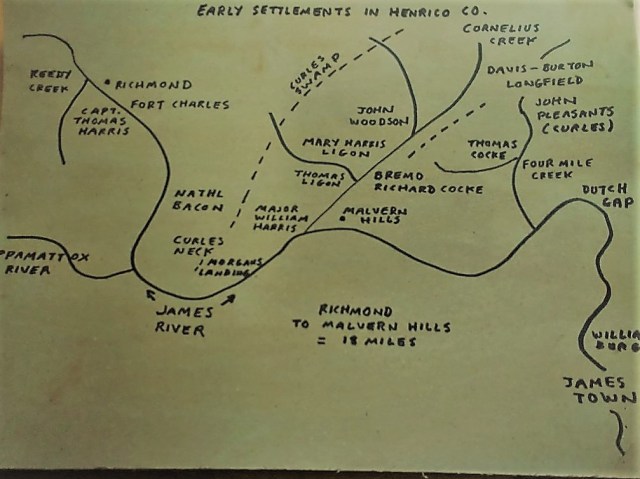 Copyright © B. T. Shannon 2023
DISAMBIGUATION: TWO HARRIS of HENRICO AND THE KINSHIP CIRCLE OF EACH
MARY (HARRIS) LIGON AND MAJOR WILLIAM HARRIS
COCKE, HARRIS, AND ISHAM
1. Euseby Isham, m. Anne Borlase.
1.1. Mary Isham, m. Sir Fleetwood Dormer, d. Feb. 1, 1638 (son of Peter Dormer and Margaret, dau. of Thomas Fleetwood, and sister of Sir William Fleetwood*).
1.1.1. Sir Fleetwood Dormer, b. May 21, 1616, m. Mary Harris.* Fleetwood Dormer’s first wife was Katherine Ligon, second-cousin of Thomas Ligon, whose son and namesake married Mary Harris (a), born in 1625, by deposition. Mary Harris, 2nd wife of Fleetwood Dormer, was the 2nd-cousin of Mary Harris (b), bapt. Apr. 3, 1625, in Ludlow, Shropshire, sister of William Harris (c), bapt. Jan. 13, 1627/8, in Ludlow; children of John Harris,* bapt. March 5, 1604, son of Rowland Harris and Jane Langford,* sister of Thomas Langford, whose great-grandson and namesake was the father of “Thomas Langford, orphan”. William Harris, son of Major William Harris (d), was involved in the determination of the lands of Thomas Langford, orphan, on Feb. 26, 1731. (Magazine of Virginia Genealogy, vol. 36, no. 3, pp. 214-215), descended from his great-grandmother’s brother.
1.2. William Isham, m. Mary Brett.
1.2.1. Henry Isham, cousin of Sir Fleetwood Dormer (husband of *Mary Harris), resided at Bermuda Hundred, Henrico Co., m. Katherine Banks, relict of Joseph Royal*.
1.2.1.1. Anne Isham, m. Col. Francis Eppes, purchased “Longfield” from John Davis. Col. Francis Eppes was the nephew of John Eppes Sr., who witnessed the land transaction between Major William Harris (of 140 acres) to Abraham Childers Sr., supra. Francis Eppes was also the son of a namesake and his 1st wife; who, by a 2nd wife, Elizabeth, relict of William Worsham, had issue: Mary Worsham, wife of Richard Ligon, son of Thomas Ligon and Mary Harris (a).
1.2.1.1.1. William Eppes.
1.2.1.2. Mary Isham, m. Col. William Randolph, “friend” of Major William Harris (d). William Randolph, as heretofore given, was the purchaser of Nathaniel Bacon’s plot on Curles Neck.
Katherine Banks, m. (1) *Joseph Royall*.
1.1. Joseph Royall.
1.1.1. Joseph Royall, m. Elizabeth Kennon, Dec. 1698, in Henrico.
1.1.1.1. Mary Royall, m. (1) Josiah Woodson, son of John Woodson and Judith Tarleton, son of Robert Woodson and Sarah Farris, and br. of Elizabeth Woodson, wife of William Lewis; parents of Mourning Lewis who m. Robert Adams, and Sarah Lewis, who m. James Cocke, son of James Cocke and Elizabeth Pleasants; he a son of Thomas Cocke Sr., “friend” of Major William Harris. The said William Lewis was a descendant of the 2nd husband of Jane Langford, Edward Lewis, who by a 1st wife, was the father of Thomas Lewis*, aged 23 in 1623, step-brother of *John Harris, b. 1604 (father of Major William Harris). A member of that family is most likely recorded here: Hannah Boyse, dau. and heir of Luke Boyse, late of Henrico, decd., patented in Nov., 1635, 300 ac. in Henrico adjoining land of her mother Alice (who m. 2ndly, Mathew Edloe), due 50 ac. for her personal adventure and 50 ac. for the personal adventure of her father, and 200 ac. for transportation of servants, viz.: *Thomas Lewis, Robert Hollum, *Joseph Royall, Edward Holland, and Oliver Allen. In 1636, William Barton is mentioned as a headright of the widow Mrs. Alice Edloe of Henrico, whose lands in Lily Valley adjoined those granted in 1665 to John Burton.
It would be a remarkable occurrence, given the binding closeness of the English kinship system, if it was not the case that a = b, and c = d. If such information had been given to researchers of old, the whole mythgen of Major William Harris being the son of an assumed “Ancient Planter from Essex” would not have taken root, or spread as genealogical tumbleweed so widely that it has been repeated unchallenged as “fact” in some publications claiming to be acadmic. (Grade F).
A SHROPSHIRE KINSHIP GROUP – BAUGH, BURTON, COCKE, DAVIS (AND HATCHER).
1. Thomas Davis.
1.1. John Davis, probably he bapt. Aug. 5, 1607, in Ludlow. John Davis 200 acs Henrico, last of October 1642, adjacent his former patent called Longfeild, ext. N.W. toward lands of Cornelius de Hull,* due for transp. of his wife, Mary Davis, and three servs. *Cornelius Creek.
1.1.1. John Davis,* m. Mary, dau. of Capt. John Burton “of Longfield”, and sister of … Burton, who m. William Hatcher Sr.
1.1.2. Mary Davis, m. John Cocke. “There was a planter in Henrico county, at this time named John Davis, whose personalty was appraised in 1690 at £265, rather above than below that of the larger landholders in Henrico at this date. (Virginia Magazine of History and Biography, vol. 3, issues 3-4, p. 411, 1896).
(1. William Hatcher, m. a dau. of John Burton.*
1.1. Edward Hatcher Sr. Edward Hatcher of the Parish & County of Henrico Planter for & in consideracon of eleven thousand pds of tobo & casq in hand recd of Nathaniell Bacon late of Curles in the pish & County aforesd Esqr decd. doth freely sell unto Tho. Jarvis of Kiquotan Gent who marryed the relict of the sd Bacon decd, one tract of land containing fifty acres scituate in Varina in the County & Parish aforesd, adjoyning to the land formerly belonging to ye Widdow Packer (now in the tenure & Occupacon of Will Byrd Esqr), and is part of of a dividend of two hund. acres formerly belonging to Will Daukes, being purchased by Will Hatcher Jun., and Henry Hatcher of Robert Bullington and Henry Rowing by two conveyances bearing date the first of Feb. 1661.
1.2. William Hatcher Jr.
1.2.1. Jane Hatcher, m. William Baugh Jr.
1.3. Henry Hatcher. On Feb. 1, 1661/2, William Hatcher, Jr. and his younger brother Henry bought a 200 acre parcel of land on the north bank of the James River at Varina. pp. 33-4: In 1677, Major William Harris and William Farrar were admins for Anne Hatcher, widow of Henry Hatcher & Mary Skerme, widow of Edward Skerme, ibid, whose dau., Elizabeth, m. Phillip Turpin, son of Michael Turpin and Elizabeth Farrar, on Nov. 1, 1679, in Henrico Co.
1.4. Benjamin Hatcher. We, Edward Hatcher and Benjamin Hatcher, do give to our couzens, the children of our brother Henry Hatcher, the following (various livestock). Dated April 1, 1680. Wit: Tho. Cocke, (“friend” of Major William Harris,*) and (his brother) Richard Cocke, Jr. (*His son, William Harris: Oct.1, 1697: William Harris his power of attorney to Capt. William and Mr. Richard Ligon, dated the fourth day of September 1697 for acknowledgement in Henrico County Court one deed of conveyance and bond of assurance of certain lands in ye sd. county sold and covey by sd. William Harris unto James Cocke and was this day proved in open Court by the oaths of Mr. Thomas Wilkinson, Peter Marcy, and John Higgedly … and upon the motion of Captain William Soane it is ordered that the sd. power be recorded).
*John Davis, 200 acs. Henrico Co., Oct. 26, 1699. Being part of patent for 500 acs. granted John Davis, his father, Oct. 1, 1672, p. 237. Richard Milton 75 acres in Charles City County, May 26, 1637, p. 432, at Westover … which land is half a plantation formerly belonging to John Davis and John Clay* in equal portions.
The pedigree of the Burtons of Longnor, Shropshire has been suggested in previous notes. .1.1. Mary Baugh, m. John Cocke: Oct. 1, 1696, son of Richard Cocke Sr.
CLAY
1. John Clay, held land in Whitchurch, Shropshire, in 1588.
1.1. *John Clay, b. ca. 1585.
1.1.1. William Clay Jr., sold land to Rev. John Dibdall in 1655, whose relict m. Thomas Marston.
1.1.2. Charles Clay.
1.1.2.1. Rev. Henry Clay.
1.1.2.1.1. Rev. Charles Clay, m. Lucy Green.
1.1.2.1.2. Rev. John Clay, m. Mary Watkins.
1.1.2.1.2.1. Rev. John Clay, m. Elizabeth Hudson, granddau. of John Hudson (d. 1732), and his wife, Elizabeth Harris, granddau of Maj. William Harris. (In this regard, it also would be a remarkable occurrence if Maj. William Harris was not the great-great-great grandfather of George Harris (b. ca. 1750), who m. Sarah, dau. of William Hudson, of Prince Edward, son of the above John Hudson and Elizabeth Harris. Elizabeth Hudson Clay m. 2) Henry Watkins, son of John Watkins and Phoebe Hancock, great-granddaughter of Mary Harris Ligon.
1.1.2.1.2.1.1. Senator Henry Clay (1777-1852), of Kentucky.
1.2. William Clay.
THE PEW AND PRICE FAMILIES OF HENRICO – Abraham Childers within a Shropshire context.
1 John Price. He would have been well known to both the Cocke family of Pickthorne, and to their kin, the Harris family of St. Lawrence, Ludlow; he being baptised in the same parish: “1584, Nov. 10. John, s. William Preece” bapt. Muster of the inhabitants of the Corporation of Charles Citee, Feb. 24, 1624. Muster of John Price: John aged 40, ship Starr in May, 1620. John Price m. (1) Elizabeth Matthews: “1613 May 30. John Prees & Elizabeth Matthews, widow”; (2) Anne …, who m. (2) Robert Hallom.
On May 6, 1638, a patent was issued to Ann Hallom, widow, and the heirs of Robert Hallom, dec’d for 1000 ac. in Henrico, N.E. by the woods, S.W. by the river, N.W. by Bremo and the land of Mr. Richard Cocke, and S.E. toward Turkey Island Creek, adj. land of John Price, which would later become a plantation of William Randolph.
1.1. John Price. The sons of John Price, Daniel and John, sold 150 ac. in 1677, which was originally patented to their father in 1619. A Deed in Henrico Co. (dated Oct. 18, 1681), from Benjamin Hatcher to John Pleasants, stated that he was selling a tract of land that had belonged to his father, William Hatcher, who had purchased it from Daniel and John Price in 1677; this land being Turkey Island Pointe. Another deed, of 1691 (between John Gundry, son of John Gundry and Ann, dau. of Robert Hallom and Ann Price), records that Gundry was selling a tract which bordered Turkey Island Creek, and the land of John Pleasants, formerly belonging to John Price.
1.1.1. John Price, m. Jane (dau. of Henry Pew and Jane Womack), who m. (2) Hugh Ligon, the son of Thomas Ligon and Mary Harris (born 1625), and nephew of Major William Harris. On Dec. 7, 1713,
Hugh Ligon and Jane, “relict of John Price, late of Henrico County, planter, gave with love to John, eldest son of John and Jane one half of a tract where Henry Pew, father of Jane, formerly lived”.
Henry Pew was probably the son of Henry Pew (son of Rowland Pew), baptised at St Lawrence, Ludlow, on April 29, 1605; thus, a close contemporary of John Harris (bapt. March 5, 1604/5, in the same church), father of Mary Harris (bapt. April 3, 1625; in 1689), Mary (Harris) Ligon gave a deposition stating her age to be 64), mother of the said Hugh Ligon, and William Harris (bapt. Jan. 13, 1627/8), who was undoubtedly synonomous with Major William Harris of Virginia.
Jane Pew’s sister, Ann, m. Abraham Childers Jr., who, to repeat, on Nov. 26, 1680, exchanged lands with John Pleasants Sr. The latter was to receive 548 acres on Four Mile Creek and 900 lb. of tobacco, and, in return, conveyed to Pleasants 140 acres “being the whole dividend purchased of my father, Abra. Childers of Major William Harris, of Curles” (Swamp).
To repeat, this land was not connected to Captain Thomas Harris in any known way.
AN ASSUMED IDENTITY?
The Captain Thomas Harris narrative may have involved a case of assumed identity.
1. Rowland Harris, m. Jane Langford, bapt. Oct. 10, 1567, on Sept. 14, 1595. She m. (2) Edward Lewis.
1.1. Thomas Harris, bapt. Sept. 4, 1603, Ludlow, m. Alice, dau. of Evan Lewis, bapt. Nov. 20, 1603. Harries v Heath. Plaintiffs: Thomas Harries an infant, by his guardian and Edward Lewis. Defendants: Richard Heath and Edward Powis. Subject: messuage in Ludlow. (T.N.A. C 2/JasI/H5/38).
1.1.1. Thomas Harris: “1627, July 24. Thomas, s. Thomas Harris & Alice”. “Thomas Chamberlayne aged 27 … deposeth that he heard Mrs Lygon say that she and her brother made an agreement that Maj. Thomas Harris her sd brother should have the whole proffits of the surveyors place until her sonne came of age. This her sd. soyne came of age this depont heard Major Harris say he had made an agreement with his kinsmen for halfe the proffitts of the said place, and all soe this deponent hath heard Mr. Lygon same the same”. October 9, 1679. (Bk.1/109). This record is often altered to “Major William Harris”, to better fit a “Harris narrative”.
If Mary and William Harris had been adopted by their uncle, after Feb. 3, 1638/9, then Maj. Thomas Harris could have been both their cousin and step-brother. What is more, his father may have emigrated to Virginia, and claimed to be the Captain Thomas Harris of old. His kinsfolk would not have been averse to such deception.
CAPTAIN THOMAS HARRIS
By way of disambiguation, Thomas Harris of the 1624 Muster was part of a kinship group which was very distinct from that of Major William Harris and Mary (Harris) Ligon. Each group would have protected and enhanced their members’ interests by promoting marriages within their group, with marriages between very close degrees of cousins being frequent. In what follows, the proposed ancestry of Captain Thomas Harris is given in a condensed form, with much background information being omitted, so as to concentrate understanding. These notes are the copyright of B.T. Shannon, and should not be reproduced in any form without her permission.
1. “John Harryes” (b. ca. 1400), is recorded as of Walton, near Aylesbury, in 1431. “Grant from John Harryes of Walton, near Aylesbury, to John Baldewyn, William Puxstede, Thomas Halle, John Caldecote of Aylesbury, and Richard Blewet of Stone (co. Buckingham], of a messuage, curtilage, selion of pasture and appurtenances in Walton. Dated Tuesday next before the Feast of All Saints, 10 Hen. VI., 30 October 30, 1431” (Worcestershire Arch.; 705:349/12946/495015).
1.1. “John Harryes” (b. ca. 1430). “Grant from John Balky of Aylesbury, co. Buckingham, Richard Ward of the same place, and William Parkyn of the same place, to John Harreys of Brougthton (Broughton, near Aylesbury) and Robert Playtour, of five acres and a rood of land in the field of Caldecote”, May 4, 1461 (ibid.).
1.1.1. John Harris of Maids Moreton, b. ca. 1460, which is situate 6 miles west of Bechampton.
1.1.1.1. Robert Harris, b. ca. 1490, Rector of Beckhampton, June 11, 1526, being presented by William Tylor (Taylor), on the Convent of Luffields title and right. He died Anno 1551, 5 Edw. VI, and was succeeded by John Bierly instituted June 1, 1551, on the presentation of Robert Pigott, Esq.
1.1.1.1.1. John Harris, b. ca. 1520, defendant in a case concerning land in Aylesbury: “Slegge v Harrys. Plaintiffs: Edward Slegge of Cambridge, gentleman. Defendants: John Harrys and Joan his wife. Subject: Messuage in Aylesbury bought of William Sakevyle and John Dudley. Buckinghamshire.” 1556-1558 (T.N.A. C 1/1473/28). John Harris held 230 ac. of the manor of Greenhams in Maids Moreton in 1587, lands previously held by his grandfather in 1518 (Alfred Leslie Rowse, The England of Elizabeth, 2003, p. 111.), where his nephew, Leonard Pigott, son of William Pigott and his sister, also held land (ibid.). Of the manor of Greenhams at Maids Moreton John Harris farmed some 230 acres, including the site of the manor just east of the church. Hugh Greenham held a manor here of the Honour of Gloucester in 1408. It was afterwards escheated to the Crown, and was granted, in 1442, to the Society of All Souls College, Oxford, under the name of Greenham’s Manor. (James Joseph Sheahan, History and Topography of Buckinghamshire, 1862, p. 288.).
John Harris is also the plaintiff in a case involving Walton: “Fountayne v. Harrison. Plaintiffs: Thomas Fountayne. Defendants: John Harris. Subject: Claim by lease. The manor house and scite of the manor of Walton, Buckinghamshire, and three hundred acres of land thereto belonging to Sir Thomas Packington, sometime lord of said manor” (ibid.), suggesting him to be a descendant of John Harryes of that place, heretofore mentioned.
John Harris was the brother-in-law of Lucia Pigott, who m. Robert Lee, the son of Benedict Lee, of Hulcot, Bucks., and his second wife, Elizabeth, dau. of Robert Cheney, Esq., of Chesham Boyse, Bucks., and sister of Margaret Cheney, who m. Richard Duncombe, of Moreton, in Dinton, Bucks. They had issue: John Duncombe, who m. Mary, dau. of William Russell. Their dau., Katherine, m. (in 1581), Drewe Woodliffe, whose son, John Woodliffe, settled in Virginia, and whose dau., Anne Woodliffe, was named as “kin” of Thomas Harris in the 1624/5 Muster.
In 1577, John Cheyney, Esq., left a rent-charge of £5 per annum to the poor of Amersham, Chesham Boyse, and Drayton Beauchamp; chargeable upon a farm called the Moze, in Chesham parish. In 1622, William Child left a rent-charge of 20s. per anum to the poor of this parish. John Cheney, Esq. was the uncle of John Duncombe, whose dau., as stated, married Drewe Woodliffe.
The first notice I can find of the Hoare family of Aylesbury finds them dwelling in the parish of Walton in 1489, receiving, as John Harryes, a grant from the Balkey family: “Consideration £60. October 21, 1489: Grant from John Balkey of Aylesbury, co. Buckingham, late the younger, to John Baldwyn, John Baldwyn, knt., Richard Fryr, clerk, Ralph Verney, esq., Richard Heynys, citizen and mercer of London, Richard Crypte, citizen and mercer of London, John Spycer of Aylesbury, and Thomas Hoore of Walton in the parish of Aylesbury, of the Lordships called Castell (Castle) Fee and Bawdys (Bawd’s) Fee in Aylesbury and Walton” (Worcestershire Arch., 705:349/12946/495742).
On April 1, 1442 Robert Somery granted this property as the manor of Moreton called Greenhams to Henry VI, (Chan. Inq. p.m. 9 Hen. IV, no. 9), by whom in the following month it was granted to All Souls College, Oxford. It was leased by the warden in 1493 as the lordship of Moreton to Robert Woodward, jun., of Buckingham (ibid.), and in 1518 to John Harris (ibid.), who in 1535 was paying a rent of £7 6s. 8d. for the manor of Moreton with the mill there called ‘Brent Myll (Valor Eccl. (Rec. Com.), ii, 235). Old leases existing among the archives of All Souls show that, as the manor of Greenhams, many separate leases were made of it to the Harris family in the 16th century. (C. T. Martin, op. cit. 31, 32).
The Woodliffe family also held tenements in Maids Moreton: “Gift by Robert Woodlef to John Lombard of Buckingham of his tenement in Maids Moreton. March, 2, 1560”. (Staffordshire and Stoke-on-Trent Arch., D4038/A/12/18). John Harris is recorded in a Pleadings case of circa 1560, in which he is a defendant against the executor of John Finch, son of Sir Moyle Finch, and cousin of Erasmus Finch, who sponsored Margaret Bourdman in Virginia, habitee of the Captain Thomas Harris household: “Stevensons v. Forde. Plaintiffs: John Stevensons, executor of John Finch. Defendants: John Forde and John Harrys. To complete purchase, and for discovery as to a contract. Land, parcel of and belonging to the manor of Aylesbury. Buckinghamshire’” (T.N.A. C 2/Eliz/S27/34).
A BUCKINGHAMSHIRE KINSHIP GROUP – PIGOTT, FINCH, AND HARRIS
PIGGOT
1. Richard Pigott, of Little Horwood, Bucks, Escheator for Bucks. and Beds. on Nov. 4, 1455, m. (2) Joan, dau. of Paul Dayrell, Esq., of Lillingston Dayrell, Bucks.
1.1. John Pigott, m. Isabel, dau. and coheir of John Edy, of Stony Stratford, Bucks.
1.1.1. Robert Pigott, established in Bechampton, m. Lucy, dau. of Thomas Saunders, Gent, of Stow, Bucks.
1.1.1.1. Thomas Pigott, of Bechampton, recorded in a grant from George Tresham (his brother-in-law), dated July 13, 1545. He m. Isabel, dau. of Richard Tresham, Esq., of Newton, Northants. His Will was proved in 1593 (P.C.C.).
1.1.1.1.1. Valentine Pigott, Esq., Serjeant-at-Law, of Loughton, Beds. His Will was proved in 1590 (P.C.C.). He m. Anne, dau. of Sir Thomas Andrewes, of Northants.
1.1.1.1.1.1. Ursula Pigott (eldest dau. and coheir), m. her kinsman, Christopher Pigott, of Doddershall, near Aylesbury, Bucks. His brother, Thomas, represented Aylesbury in the 1589 Parliament before serving as county sheriff in 1593-4. He had m. Anne, dau. of Sir John Allott, Fishmonger of Wood Street, London, and Mayor in 1590. She m. (2) Sir John Gibson. Margaret Berman (Bourdman), recorded as being in the household of Thomas Harris in the 1624 Muster, was a niece of Sir John Gibson on her mother’s side.
FINCH
1. Sir William Finch, m. (1) Elizabeth, dau. of Sir James Cromer, of Tunstal, Kent, and Catherine Cantelope.
1.1. Sir Thomas Finch, second son, m. Catherine, eldest dau. of Sir Thomas Moyle, of Eastwell, Kent, and Catherine Jordan. She m. (2) Nicholas St. Leger, of Beamstone, March 1, 1552/3.
1.1.1. Moyle Finch, m. Elizabeth Heneage.
1.1.1.1. John Finch, 4th son. John Stevensons, executor of John Finch. Defendants: John Forde and John Harrys. To complete purchase, and for discovery as to a contract. Land, parcel of and belonging to the manor of Aylesbury. Buckinghamshire’ (T.N.A. C 2/Eliz/S27/34). (As follows).
1.1.2. Jane Finch, m. Sir George Wyatt, Oct. 8, 1582, in Caswell, Kent.
1.1.2.1. Sir Francis Wyatt (1588–1644) the first governor of Virginia; sailed for America on August 1, 1621 on the George.
1. Sir William Finch, m. (2) Catherine, dau. of Sir John Gainsford, of Crowhurst, Surrey.
1.1. Erasmus Finch (m. Marian, dau of John Somer of Sandwich, Kent, gent, and widow of Thomas Rolfe), sponsor of Margaret Berman (Bourdman).
Thomas Rolfe and Thomas Wingfield were involved in victualling the King’s ships in the Straits of Dover, through which he became associated with admiral, John Dudley, Earl of Warwick, from whose son he was to lease lands in Kent.
1.2. Catherine Finch, came to Virginia in 1621, on the Marmaduke; probably the Catherine who m. Robert Fisher, of Jordan’s Journey. “She was one of the fifty-seven young women who came to Virginia in 1621, in the Warwick, aged 20, born in Bilton, Yorkshire, and she was recommended to the company by Captain Wood, Mr Erasmus Finch, and Mr Kilband. In 1625, she was at College Land (adjacent Neck of Land), in Henrico, as wife of Ezekiel Raughton, who was from Lincolnshire, and had come to Virginia in the Bona Nova, in 1621” (David R. Ransome, “Village Tensions in Early Virginia: Sex, Land, and Status at the Neck of Land in the 1620s”, The Historical Journal, vol. 43, no. 2).
PIGGOT cont.
1.1.1.1.2. George Pigott, m. (after 1566), Eleanor, dau. of Marmaduke Claver, of Bucks. He succeeded his father as squire of Bechampton.
1.1.1.1.3. Edmund Pigott, Citizen and Grocer of London, who died in 1613, m. Susan Kindlemarsh; his issue being baptised at St Michael, Cornhill, London.
1.1.1.1.4. Matthew Pigott; Rector of Bechampton, 1568-98, born in 1538. On a tablet in Beckhampton Church is this Inscription: “I Matthew Pigot the sonne of Thomas Pigott Esq. of the house of Beaucampton, do lie here buried July 8, 1598. I was for some twenty years Pastoure of this church and of Calverton, where I preached the sincere doctrine of Christ Jesus, and accordingly beleving livinge and dieing do now most comfortably feele the inestimable benefite thereof, leavinge unto you my most lovinge and beloved People, as a perpetual monument of my love and last farewell, these fewe Lines toe put you always in mind to do the like, that so in our bodies and soul together again in heavenly felicity and Immortality, Amen”.
1.1.1.1.5. Isabel Pigott, m. George Salisbury, of Haversham, Bucks.
1.1.1.1.6. William Pigott, m. a dau. of Robert Harris, Rector of Bechampton, 1526-1551.
1.1.1.1.7. Lucia Pigott, m. Robert Lee, of Hulcott, Bucks., son of Benedict Lee, and his second wife, Elizabeth, dau. of Robert Cheney, Esq., of Chesham Boyse, Bucks., who d. in 1542, aged 47. His dau., Margaret Cheney, m. Richard Duncombe, of Moreton, Bucks., having issue: John Duncombe, of Moreton, who m. Mary, dau. of William Russell, gentleman of the horse. (The History of Parliament: the House of Commons 1604-1629, ed. Andrew Thrush and John P. Ferris, 2010).
Their dau., Katherine, m. (in 1581), Drewe Woodliffe. (T.N.A. C 1/1473/28), whose son was John Woodliffe, who settled in Virginia, and whose dau., Anne Woodliffe, was named as “kin” of Thomas Harris in the 1624 Muster.
It can be noted that Richard Duncombe was a son of Thomas Duncombe, of Wingrave, Bucks., and, as such, was a nephew of Bennet Duncombe, of Maids Moreton, Bucks., a place of residence of the family of Captain Thomas Harris, as will be described hereinafter.
HARRIS, cont.
1.1.1.1.1.1. Valentyne Harris, d.s.p., b. ca. 1550, who held lands in Long Crendon, Bucks.: “Harrys v. Towsey. Plaintiffs: Valentyn Harrys. Defendants: Roland Towsey. Subject: Deeds. Lands in the parish of Crendon (Long Crendon), Buckinghamshire, holden by plaintiff of the manor of Crenden*, of which manor … Yonge was lord” (ibid.).
* Long Crendon was an habitation of the Gurganey family. Edward Gurganey was born in Long Crendon in 1582. His wife may have been the sister of Captain Thomas Harris.
(1. John Gurgeyney, m. Dorothie Brigham.
1.1. Edward Gurgeyney, likely to have m. a dau. of James Harris, and Lucia Lucas, who married on November 30, 1587, in Wingrave, Bucks.).
1.1.1.1.1.2. Thomas Harris, b. ca. 1555, recorded as a plaintiff concerning land in Maids Moreton in 1577: “Final concord between William Richardson and Thomas Harrys pfs. and John Lambert senior def. of 2 messuages, 2 cottages, 2 tofts, 2 gardens, 2 orchards, 200 acres of land, 10 acres of meadow, 200 acres of pasture, 4 acres of wood, and 20 acres of furze and heath in Buckingham and Maids Moreton: consideration £80. Day after St. Trinity”. (Staffordshire and Stoke-on Trent Arch., D4038/A/12/20).
1.1.1.1.1.3. James Harris (b. ca. 1560), m. Lucia Lucas,* Nov. 30, 1587. She m. (2) John Tredway (Sept.. 9, 1601); second-cousin of John Child, who m. Jane Hoare, sister of Adria Hoare. This family of Hoare/Hore were probably of yeoman stock, as Thomas Hore, as follows, of Weston (Turville), three miles S.E. of Aylesbury, and not of a family of shoe-makers, as is commonly supposed. Social barriers were not crossed in marriages. *She was very probably of the Lucas family of Wingrave, situate 5 miles N.E. of Aylesbury. It is, of course, possible that Captain Thomas Harris was the son of Thomas Harris, brother of James.
(Assignment: Richard Babham of Weston, gent., and Thomas Hore of Weston, yeoman, to John Browne. Sheephowses and and 5 ac. of arable in Weston. Consideration £170. Recites demises and assignments of 5 acres in Southe Field of Weston by William Jordan to George Baldwin, Nov. 18, 1641, who assigned it to Henry Babham (Richard’s father); assignment, Aug. 10, 1648 by H. Babham to Baldwin and others of all the land; and assignment of the remainder of both terms by the Babhams. Baldwin to Thomas Hore, Jan. 22, 1661. April 22, 1662. (Bucks. Arch, D 19/60).
ANOTHER BUCKINGHAMSHIRE KINSHIP GROUP – DUNCOMBE, CHILD, TREDWAY, HOARE, AND HARRIS
1. Thomas Tredway, of Amersham, Bucks. (b. ca, 1520), m. … Duncombe, per Vis. Bucks.; almost certainly a dau. of Margaret Cheney and Richard Duncombe, aforesaid.
1.1. Robert Tredway, of Easton, Northants., m. Margaret, dau. of Guy Fisher, of Buckdon, Huntingdon.
1.1.1. John Tredway, m. Elizabeth Waller, Feb. 26, 1592/93.
1.2. William Tredway (b. ca. 1545), m. Emma Child, on Nov. 27, 1568, in Amersham.
1.2.1. … Tredway (b. ca. 1570), m. Henry Babham.
1.2.2. John Tredway, m. Lucia Lucas (Sept.. 9, 1601), widow of James Harris (m. Nov. 30, 1587). The possibility that Captain Thomas Harris was of their issue cannot be discounted, nor the chance that Captain Thomas Harris was the son of Thomas Harris, brother of James.
1.3. Elizabeth Tredway (b. ca. 1550), m. John Child, Feb. 4, 1571/72; certainly related to Robert Child, who m. Johanna Osborne, Nov. 16, 1584, in Amersham, and William Child*.
1.3.1. William Child (b. ca. 1572/3), Yeoman of Amersham, Will probated June 16, 1607.
1.3.1.1. John Child (b. ca. 1595/6). m. Jane Hoare, sister of Adria Hoare.
HARRIS, cont.
1.1.1.1.1.3.1. Captain Thomas Harris (b. 1588; 37 y.o.a. at 1624/5 Muster), m. Adria Hoare, sister of Joane Child, who sponsored Adria’s voyage to Virginia.
1.1.1.1.1.3.2. Anne Harris (b. ca. 1589), m. Edward Gurgeyney.
1.1.1.1.1.3.3. Alice Harris (b. ca. 1590), m. Robert Goodspeed, Nov. 6, 1609, in Soulbury,* Bucks; born Aug. 3, 1578, in Wingrave;* br. of William Goodspeed, whose will was witnessed by Nicholas Lucas of Wingrave, d. 1646, who had m. Jane, dau. of Robert Goodspeed, and Alice Harris. *10 miles N.W. of Aylesbury.
*Wingrave St Peter & St Paul, a parish, in the union of Aylesbury, 5 miles N.E. from Aylesbury). The advowson of Wingrave St Peter & St Paul passed to the Crown in 1535. Thomas Duncombe was lessee for a term of fifty-six years dating from 1535. (Pat. 13 Eliz. pt. ix, m. 4, reciting earlier lease). In 1571, the Crown granted a new lease for twenty-one years to John Duncombe,* (ibid.) and another in 1575 to Benedict Duncombe, (Ibid. 17 Eliz. pt. xiv, m. 6), which was cancelled for a fresh lease in 1580. (Ibid. 22 Eliz. pt. ii, m. 24). In 1583, he obtained a further lease for three lives in survivorship. (Ibid. 25 Eliz. pt. xiii, m. 18). *John Duncombe, of Moreton, m. Mary dau. of William Russell. Their dau., to repeat, Katherine, m. Drewe Woodliffe, having issue: John Woodliffe, who settled in Virginia, and whose dau., Anne, was named as “kin” of Thomas Harris in the 1624/5 Muster.
IN SUMMARY
This article has differentiated between the English kinship groups to which Captain Thomas Harris (of Buckinghamshire), and Major William Harris (of Shropshire), belonged,
The English custom of claiming land on the basis of fraudulent deeds was an ancient and well-perfected one.
Tracts of land in Virginia were obtained by using fraudulent or duplicate headrights; bribing county and provincial office clerks, and surveyors, to certify fake headright claims and false boundaries.
Virtually all Henrico land deeds prior to 1677 were destroyed, and many from then onward are copies of patents which themselves may have been inventions. The 1692/3 court case involving the alleged trespass of John Woodson on Richard Cocke’s land on Curles Swamp involved Woodson producing what he claimed was copy old patent granted to Captain Thomas Harris in 1638. The court did not believe him, and ordered an examination by “neighbors”, of an “antient” variety.
Mary (Harris) Ligon was involved in claiming her land lay beyond the “alleged” ancient patent. In 1691, she divided her 200 acre portion of “Curles” (Swamp) between her two surviving sons, Richard and Hugh Ligon, “being part of a grant to Capt. Thomas Harris, decd. and given by his Will to said Mary Ligon, his daughter”.
* The Court could not examine the said Will, it being destroyed.
* The Court was not presented with a copy of the said Will.
* The Court was not presented with witnesses to any copy.
* The Court was not presented with witnesses who could vouch for Mary Harris being the daughter of Captain Thomas Harris. Those old enough to vouch for this would include the sons of Richard Cocke Sr., Richard Cocke, and Thomas Cocke.
* The Court was not presented with any witness stating that his/her parent had told them of this alleged connection. Members of the Court were part of the same hegemony/kinfolk group to which Mary (Harris) Ligon belonged, and would have known her very well; and could have supported her claim with such comments as: “as is commonly known by members of this Court”. That they did not may indicate a reluctance to perjure themselves.
* The Court, or any other court, did not request William Harris or Edward Harris, sons of Major William Harris, to give oath as to the identity their grandfather.
* The Court, or any other court, did not request any children of Mary Harris and Thomas Ligon to give oath as to the identity their grandfather.
The unsubstantiated nature of the claim of Mary Harris Ligon, and all claims relating to the supposed 820 acres of Captain Thomas Harris, lay in an all too convenient mist; they would be summarily dismissed by any modern court not administered by closely connected kin.
All such claims were designed to, as phrased by 1984 author George Orwell, “give an appearance of solidity to pure wind”.
Regarding CaptainThomas Harris: he was either commander of Fort Charles or held rights to the land on the south side of the falls of the James river.
Captain Thomas Harris was either deceased (land escheated), or had abandoned this land (land escheated) by ca. 1648.
The land grants claimed for Captain Thomas Harris were fraudulent.
Two of the alleged patents claimed a 50 acre headright for importing the same thirteen named people.
In both cases he supposedly claimed an additional 100 acres for himself as an “Ancient planter” (not proven).
* In the second alleged patent, given a date of February 25, 1639/40, he is also represented as claiming an additional 100 acres in right of his wife, Adria, also claimed to have been an “ancient planter”. This has already been exposed as a fraudulent claim.
An earlier alleged patent, given the date of Nov. 11, 1635, claimed land extending toward that which had been held by Edward Gurgayney, in Digges Hundred, Henrico Co., i.e. “Longfield”, which he is supposed to have re-patented in 1638. yet “Longfield” had been in the possession of the Davis family since Aug. 15, 1637, comprising 300 ac. north of the river, ext. N.W. toward lands of Cornelius de Hull. Captain Thomas Harris never held “Longfield”, and had no son who ever “fell heir to it”.
The allegations that, on March 17, 1664/5, there was a “conveyance from William Harris “the son of Capt. Thomas Harris” to Roger Green for 820 acres (“known by ye name of Curles”), which Roger Green purportedly conveyed to Thomas Ballard on Sept. 5, 1668, are without factual basis, and were a construct by Harris “chroniclers of old”, who claimed he was of a landed gentry family of Crixe, in Essex, England. That Captain Thomas Harris was from the Aylesbury district of Buckinghamshire, England, as heretofore given, is today accepted by most modern Harris researchers.
The accounts of the link between Captain Thomas Harris and Nathaniel Bacon also varied: he sold his land directly to Ballard; or directly to Bacon, etc., etc. There is no recorded letter of William Randolph to Major William Harris mentioning Roger Green. This claim is a story based on the need to support a myth. The variation of accounts were a process of mental gymnastics to lend credibility to the myth.
A court case of 1700, “in the ejection form brought by John Brodnax against William Soane for a certain tract of land containing two hundred and twenty acres more or less in the possession of Mr. Richard Cocke”. The right to the land in controversy was again connected to the earlier alleged patent of Captain Thomas Harris for 820 acres., as a repetition of that found in the earlier noticed John Woodson vs. Mr. Richd. Cocke case.
There is no extant record of this Court in the Library of Virginia, Henrico Co., Court records, 1697-1714, film 31764.
This void was the perfect “place in the fog” to “mythgen,” to implant, a hybrid construction in which a particular Virginia family of Harris derive from an “Ancient Planter” who arrived in Virginia in 1611.
There is no authentic record of the Brodnax against Soane case that includes a claim that Major William Harris was the son of Captain Thomas Harris.
The most blatant manipulation of records concerning Major William Harris concern associations with Abraham Childers Sr.. which have been documented within these notes, and which do not, most catagorically in any unadulderated way, name the father. of Major William Harris.
These people were not paragons of virtue in any “politically correct” sense. Their heavy betting on horse racing and other pursuits frequently led to litigation over alleged cheating*. They drank (alcohol) heavily, and often engaged in drunken brawling, often over disputed outcomes of their gambling. They were open to bribery. This is not to confer any latter-day judgement on them; they were people competing in a very harsh environment, not characters from a Hollywood movie.
If the sheer weight of connections between families from the Ludlow-Pickthorne area of Shropshire (which were replicated in Virginia) would have benn known to early researchers, it would be certain that Major William Harris and his sister, Mary (Harris) Ligon, would have been assigned to their rightful ancestry, and this cast in stone. That a Mary Harris, baptised in Ludlow in 1625 (having a brother, William, baptised there in 1627/8), was not synonomous with the Mary Harris Ligon who deposed to be 64 years old in 1689 is an incredulous proposition, especially when her second-cousin’s marriage to Fleetwood Dormer is considered – whose first wife was Katherine Ligon, second-cousin of Thomas Ligon, whose son and namesake married Mary Harris.
Not to accept this is to believe the Earth is flat.
In all eras of genealogical enquiry, it is the validity of “records” that needs to be questioned, and, this (in relation to the colonisation of Virginia by English kinship groups), with a sound knowledge of the intermarriages that bound them, and determined their neighbors.
by m stanhope, copyright B.T. Shannon, 2023, without whose permission nothing of this post can be reproduced in any format.


 Walter FitzGilbert de Hamilton