
1. ‘Thomas de Colevilla’, received from his feudal lord, and kinsman, Roger Mowbray, the Yorkshire manors of Coxwold, Yearsley and Oulston, between 1154-1157, for the service of one knight’s fee. Roger de Mowbray was lord of Epingham, situated on the road from Oakham to Stanford, juxta Normanton and Hameldun. Temp. Domesday, Empingham was held as two manors by Gilbert de Gand. (V.C.H. Rutl. i, 142). Roger Mowbray probably acquired Epingham by marriage to Alice de Gand, who was related to Gilbert de Gand, Earl of Lincoln, grandson of Gilbert de Gand, the Domesday holder. (Cal. Pat. R. 1494–1509, p. 268. Dict. Nat. Biog. Roger Mowbray; G.E.C. Complete Peerage, v, 672). Sir Roger de Mowbray, great-grandson of the said Roger, held the manor in 1259, and the overlordship descended with one fee in the manor of Hameldon. (Cal. Inq. Hen. III, no. 421. Ibid. 24 Hen. VI, no. 41).
The manor of Coxwold included vills of ‘Ireton,’ Yearsley, Ampleforth, Osgodby, Thirkleby and Baxby.
Thomas de Colville’s heirs in Coxwold for several generations were all called Thomas, and are difficult to distinguish. (Red Bk. of Exch. (Rolls Ser.), 734; Var. Coll. (Hist. MSS. Com.), ii, 3–8).
COLVILLES OF COXWOLD
1.1. Thomas de Colville.
1.1.1. Between 1208–10, Thomas de Coleville, grandson of Thomas de Coleville, senior, presumably a minor because he was in royal custody. In 1236/7 he confirmed his grandfather’s grant of pasturage at Coxwold to Byland Abbey. (Durham Liber Vitae).
1.1.1.1. Thomas de Colville, possessed Coxwold in 1285. (Kirkby’s Inq. (Surt. Soc.),
1.1.1.1.1. Thomas de Colville. On Aug. 25, 1310, Thomas de Colville of Coxwold was paid £100 by the archbishop of York to gather men to fight in the Scottish Wars. He was a neighbour of William de Ros, of Helmsley, an associate in the defense of the North, and both were summoned to the Council of War in Doncaster in 1310. His grandson, Sir Thomas de Colville of Coxwold was a counsellor of John Neville, whose deeds in Yorkshire he regularly witnessed. (Pudsey Deeds, p. 318). William de Ros was the son of William de Ros (an unsuccessful competitor for the crown of Scotland, claimed on his descent from his great-grandmother, Isabel, an illigit. dau. of William I of Scotland), and grandson of Robert de Ros and Isabel, dau. of William d’Albini, of Bevoir; thus, a cousin of the Colvilles of Bytham, a link reinforced by his granddau. marrying Roger de Colville, of Bytham. (See 1.1.2.2.2.1.1.).
1.1.1.1.1.1.1. Thomas de Colville, succeeded his father at Yearsley.
1.1.1.1.1.1.2. John de Colville, succeeded his father at Coxwold. (Cal. Inq. p.m. 1–10 Edw. III, 54).
COLVILLES OF SCOTLAND
1.2. Philip de Colville, held Harrold in Bedfordshire of the honour of Huntingdon as a result of an agreement between King Malcolm IV., the cannons of Harrold Priory, and Robert de Brus. He defended Drax Castle in 1154 against King Stephen.
1.2.1. Philip de Colville. The Colvilles acquired the manor of Thimbleby towards the close of the 11th century from Hugh de Puiset, Bishop of Durbam, who granted it with Foston, Sigston, and Ellerbeck to his seneschal Philip de Colville, for the good service be had given.
1.2.2. Thomas de Colville (cognomento ‘the Scot’), obit. 1219. G. Barrow (The Anglo-Norman Era in Scottish History, 1980), pointed out: ‘Thomas de Colville, the constable of Dumfries Castle, gave land in Galloway to Vaudey Abbey, to pray for the souls of dead Scottish Kings. The fact that a Lincolnshire Abbey received land in Galloway for the souls of Scottish Kings is only explicable because of the existence of an aristocratic family with members in both kingdoms’.
1.2.2.1. John de Colville, of Oxnam.
1.2.2.1.1. William de Colville, of Spindlestone, Northumberland, held under the Brus fee.
1.2.2.1.1.1. Thomas de Colville, ob. ante 1280.
1.2.2.1.1.1.1. Robert de Colville, b. ca. 1275.
1.2.2.1.1.1.1.1. Robert de Colville, b. ca. 1300.
1.2.2.1.1.1.1.1.1. Robert de Colville, b. ca. 1325, obit ca. 1363. He may have been the 1st husband of Janet Keith, with some sons being adopted by David Hamilton, Janet Keith’s 2nd husband.
COLVILLES OF BYTHAM, LINCS.
1.2.3. William de Colville, m. Maud d’Albini (Brito). He was the br.-in-law of Robert de Gand. Robert de Gand, m. Gunnora de Albini Brito, dau. of Ralph de Albini Brito (English Baronies’, I. J. Sanders, OUP, 2nd ed, 1963); she m. (2), Nicholas de Stuteville. A sister of Gunnora de Albini Brito, Maud, m. William de Colville. William held one night’s fee of Robert de Gand in Lincs, his br.-in-law. William de Colville agreed to pay the king a fine of 20 mares and one palfrey, to have seisin of Normanton, Rutland, held in chief by the de Umframvilles. Robert and Gunnora had issue: Gilbert de Gand, Earl of Lincoln, obit. 1241, father of Juliana de Gand, who m. Geoffrey d’Armentières, son of Henry d’Armentières, descendant of Robert de d’Armentières,* whose overlord was Gilbert de Gand I, overlord of the Armentieres family of Whatton. Ralph d’Albini (Brito) was the uncle of William Albini Brito I., who m. Matilda, the dau. of Odonel de Umframville, grandfather of Gilbert de Umframville I., whose family armorial was gules, 3 cinquefoils or. As given, the said William Albini’s dau. m. Robert de Ros. *See footnote.
1.2.3.1 Thomas de Colville, of Coxwold, m. Asceline, half-sister of Robert de Quincy, son of Saher de Quincy. Robert de Quincy’s son, Saher de Quincy, bore or, a fesse gules, the exact arms that the Colvilles assumed.* Asceline’s sister, Hawise, m. Baldwin Wake, grandf. of Margaret Wake, wife of John Comyn, Lord of Badenoch, the forfeited lands of his family devolving to Walter FitzGilbert. *
1.2.3.2. William de Colville, m. Beatrice de Stuteville, sister of Alice de Stuteville, wife of Roger de Merlay; their issue being: Roger de Merlay, who m. Margery de Umframville, dau. of Richard Umframville, and sister of Gilbert de Umframville I.
1.2.3.2.1. Hawise de Colville, m. Hugh de Berc., tenant of the Colvilles. His great-great grandson, William de Berc, witnessed a grant with Walter de Hameldon*, both of Stanford, Rutland. (N. A., C 146/3891).
1.2.3.2.2. Roger de Colville, of Bytham Castle, Lincolnshire.
1.2.3.2.2.1. Walter de Colville (b. ca. 1225, d. 1276), m. Isabel, dau. of Odenel d’Albini, son of William d’Albini I. and Matilda, dau of Odonel de Umfraville.
1.2.3.2.2.1.1. Roger de Colville of Bytham Castle (b. 1251. d. 1287), m. Margaret, dau of Richard de Braose, of Stinton, Norfolk, and Alice de Ros, dau. of William de Ros, 2nd Baron Ros of Helmsley, and Margaret de Badlesmere, dau. of Bartholomew de Badlesmere, and Margaret, relict of Gilbert de Umfraville.
Bartholomew de Badlesmere became holder of the Umfraville fiefs Normanton and Hameldun; thus becoming overlord of the Colvilles in those places. Of the Hamiltons:
A “sensible proposition is that they were kin, or vassals of the Umfraville lords of Redesdale and the earls of Angus”. (Bruce A. McAndrew, Scotland’s Historic Heraldry, p. 235, 200). The Umravilles bore a single cinquefoil on their shield. A vassal adopting this would add a number of charges, and here is possibly the origin of the three cinquefoils in the Hamilton escutcheon.
In other terms, it makes no sense (nonsense) that the ducal family of Hamilton were not of a family that they were kin, or vassals of the Umfraville lords of Redesdale.
1.2.3.2.2.1.1.1. Gilbert de Colville, b. ca. 1255. The Writs of Military Service show (1292) Gilbertus Coleville performing military service in Scotland due from Gilbertus de Neville, who was elected a Knight of the co. of Lincoln in 1290, performing such service in 1277 due to Gilbert de Gand (br. of Juliana d’Armenters), son of Gilbert de Gand, Earl of Lincoln and Alice d’Albini.
1.2.3.2.2.1.1.1.1. *Walter FitzGilbert. (See 1.1.2.2.1.). Res ipsa loquiter, “the thing speaks for itself”. If it does not, then the thing speaks of unquestioned belief … I believe I am the descendant of … on no known historical evidence … but my DNA ‘evidence’ (costing X amount), fully supports my ubstantiated belief. The desperate and their money are easily parted.
There were undoubtedly several families of Hamilton in Scotland, and those living of that name claim ancestry to one of these, but, whether the correct claim is made is problematic.
COLVILLES OF THE DALE
1.2.4. Sir William Colville, m. a dau of Robert Engerham, who had free warren in Arncliffe Dale and East Heslerton in 1255, inherited by the Colvilles
1.2.4.1. Sir Philip Colville.
1.2.4.1.1. Sir Robert Colville, ‘or a fesse gules’. (Nicholas role, p. 60). He was summoned by Archbishop of York to fight against the Scots in 1314, and, by the same person, to a Council of War in Doncaster, the next year. He m. Elizabeth, dau. of Sir John Conyers, by whom came St. Helen’s, Auckland
1.2.4.1.2. Philip de Colville, m. Agnes Mordington, who m. (2) Henry de Haliburton: “In a short time not a fortress or castle in Scotland remained in the hands of Edward. The castles of Edinburgh and Roxburgh were dismantled; and Berwick, upon the advance of the Scottish army, having been hastily abandoned, Wallace sent Henry de Haliburton, a Scottish knight, to occupy this important frontier town”. (Patrick Fraser Tytler, The History of Scotland, p. 125, 1866).
1.3. Richard de Ifferley, who is mentioned in the Boldon Book of 1183 as holding lands in Stanhope, Durham: ‘Richard de Ifferley holds 48 acres, and renders 8s. for his life, and his heir after him shall render 10s.’ Richard de Ifferley held lands at Stanhope from the See of Durham, with the office of Seneschal. (E. A. Freeman). He m. Emma, dau. of Eudo de Longvilliers I., Seneschal to the de Lacy family, and his 2nd wife, Agnes de Neville, In 1166, Eudo de Longvilliers held one knight ‘ s fee of the old feoffment of Henry de Lacy of Pontefract. Eudo de Longvilliers had istly m. Agnes de Reinville:
1. Adam de Reinville
1.1. Swein.
1.1.1. Adam.
1.1.1.1. Clemence,* m. … Malherbe.
1.1.2. Agnes de Reinville, m. Eudo de Longvillers, br. of William de Longvillers, who m. a sister of Agnes, and were probably the ancestors of Ellota de Longvilliers.*
1.1.2.1. Eudo de Longvillers II., m. *Clemence.
1.1.2.1.1. John de Longvillers, d. 1254.
1.1.2.1.1.1. John de Longvillers, d.1255.
1.1.2.1.1.1.1. Margaret de Longvillers, m. Geoffrey de Neville. Margaret , widow of Geoffrey de Neville , granted to John de Lovetot, senior, the manor of Houton Longvilers.
1.1.2.2. Hugelina, m. Roger de Conyers.
THE COLVILLES AS STANHOPE
1.3.1. Bernard de Ifferley (who may well have been the ‘Bernardus Magistratus’ often mentioned as witness to charters concerning land grants in Durham, ca. 1220), m. Margaret de Chaworth.
1.1.4.1.1. Walter de Stanhope.
1.1.4.1.1.1. Richard de Stanhope, m. *Ellota de Longvilliers.
1.1.4.1.1.1.1. Sir Richard de Stanhope, 1300-1370, dates as inquis. post mortem, who fought against the Scots at Berwick in 1334 and 1335, m. Alice de Houghton. He fixed his residence at Newcastle-upon Tyne, and was chosen mayor of that town in 1364. In 1350, he obtained, in a grant of the third part of the village and fishery of Paxton on the Tweed, in consideration for services against the Scots. Alice de Houghton was a heiress of Houghton, which lies between Clumber and East Retford, and formed part of the domain of the Longvilliers, being initially called Houghton Longvilliers.
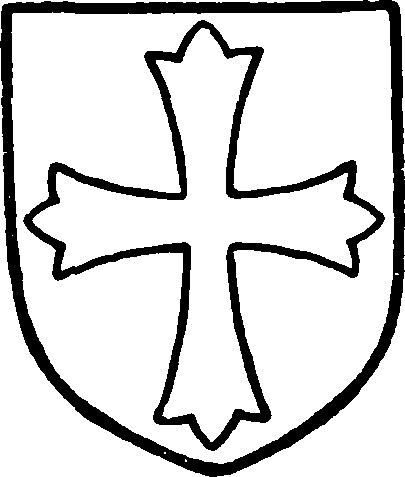
These Stanhopes and their descendants continued to bear the arms of Colville, viz. a cross, until the 15th.Century, when the present modification was adopted.
Footnote.
1. Robert d’ Armentières, held Whatton of Gilbert de Gand. 1.1. William de Whatton, m. … de Newmarch. 1.1.1. Adam de Newmarch. It is claimed (CP ix. 543, citing Yorkshire Archæological Journal, vol. iv, p. 143, and Blythe cartulary, fo. 106) that Adam de Newmarch was the son of William de Watton, an unnamed son of his inheriting land from William de Newmarch, his uncle: Pipe Roll 31 Hen I (1129/30), Northumberland, p. 36., records ‘Wills de Waddona’ accounting for ‘fil suus’ having succeeded to the land of ‘Willi de Novo Mercato avunculi sui’ in Northumberland. Adam de Newmarch witnessed the foundation of Roche Abbey in 1147. (E.Y.C., viii., 142).
A sense of the association of the Newmarch family to Womersley is given in The Yorkshire Archaeological Journal, vol. 13, pp. 149-150, 1873:
‘The parish of Womersley comprises the townships of Little Smeaton, Stubbs Walden, Womersley, and part of Cridling Stubbs. The name is spelt Wlmeresleia in the Record, but appears in the Domesday Recapitulation later on (which so frequently presents an amended orthography), Wilmereslege. It reported as having been in the pre. Norman times owned by Wege, who might indeed have been the Wiga of Whitley, the bordering township. … In the time of the Survey it had fallen to Ilbert de Lascy, who had 3 carucates in denesne, while 14 villanes and 4 borders had 8 carucates … Ilbert Lascy had Womersley still in his own hands at the time of the foundation of St. Clernent’s Chapel, and made a grant from the tithes to the endowment; which he could not have done had not the manor been in his own domain’.
‘Fines. 48 H. 3. (1264). The King comtted to Richard Foliot the Mannrs of Adam Newmarch of Wylmersley, Campsall, Thorp, Bentleye, Archesey, in ye County of Yorke. Out of John Roman’s Register, fo. 13., vol. 28. 16 Ed. 1. (1287). Adam de Newmarch p’sents to ye Church of Wilmersley, Fines 34 Ed. 1 (1306). Between Gilbert de Stapleton, compt, & John de Novo mercato & Avicia his wife, disturber, of one messuage with ye Appurtnances in Wilmersley. To ye right heires of John & Avicia. Chartæ 11 Ed. 2 (1317). The King granted to Roger Newmarch free warren in all his demeasne Lands of Wilmersley, Rissingthorp, Askern & Scoulthorp in ye County of Yorke. Chartæ 20 Ed. 3 (1346). Roger de Novo mercato had a market & a faire at Wilmersley in ye County of Yorke’.
Robert de Armentières was probably the son off Gilbert Crispin II., br. of William Crispin 1., father of William Crispin II., alias William de Colville, who was a tenant of William de Percy, who had been given the lands confiscated from William Mallet, uncle of William Crispin II. A very noted antiquarian had adduced the synonomous nature of these relationships in 1857; the consequent ignorance of them does not beggar belief, but, rather, understands it in terms that define the poverty of modern-day ‘research’.
Manor of Wetherby. Wiber had two carucates of land to be taxed, and there may be two ploughs there. William (de Colville), a Knight of William de Percy’s, now has it, himself one plough there, and three villanes and one bordar with one plough. Value in King Edward’s time 20s., the same now. In this same village is one carucate of land to be taxed, the soke belongs to Chenarsburg ; William has it now; there may be half a plough there. There are two carucates of land to be taxed in the soke of Knaresborough. There is land to one plough. Ernegis (Erneis de Burun) has there one sokeman and four villanes, with two ploughs. Wood pasture half a mile.
copyright m stanhope 2021


 Walter FitzGilbert de Hamilton