
England is small. Somerset is a small part of England. The part of Somerset from which came many settlers of early Virginia comprised of a number of villages through which all roads went to Bristol; a magnet of opportunity, especially through the tobacco trade with Virginia. Both yeoman farmers and the lesser sons of the gentry sought wealth through this trade.
Their villages were small, perhaps consisting of 200 households. The roads linking them winded around the marshy lands of the Bristol estuary. Everyone knew everyone. Their families had intermarried for centuries, so, when, in Virginia, some links between close neighbours are not evident, it is usually the case of not digging deep enough; usually because of not knowing where to dig.
They were kin, sometimes distant by modern measurement, but not by theirs; their connections being reinforced through every generation by intermarriages into the same families.
They all gravitated toward the most powerful family at the centre of their kinship group. In the case of the Harris, this was the Bennetts. The aim was to intermarry with them, as did a branch of the (Wiveliscombe) Harris, which, in turn, became the focus of others to intermarry with; a form of ‘next best’ achievement. It was considered a natural occurrence for other branches of this Harris family to share in the good fortune of their kin, thus producing many familial associations they held in common. Arranging marriages to procure advantage to your family (as security and wealth) was a consuming obligation. They survived through kinship; communal enterprise.
This preamble is necessary to this account as it sets the context in which the possible origins (and possible descendants) of Sergeant John Harris of Virginia can be understood. This context is totally different from that which has previously been proposed. Much Harris research of the 1990’s commenced with a blank canvass which needed to be filled. This was done by assuming a close connection between Sir Thomas Smith, Treasurer of the Virginia Company, and the Harris family of Crixse, Essex, which were documented by such as Burke. This link was highly tenuous, but it lead to a vast amount of dilligent research into this family, but to no avail, as they were a wrong assumption.
Other assumptions were pinned to Sergeant John Harris: He had a son named Thomas who was born ca. 1615 in England (who did not accompany his two younger siblings to Virginia in 1624), who was he who died in Virginia in 1677, and was the father of such and such, claimed as ancestors. There is no proof of any of this, as most dilligent Harris researchers of old know.
In more recent times, a link between the Harris family of Wiveliscombe, Somerset, and a Harris family of Virginia has been proposed, which I suggest is of a very firm nature. However, discerning between they and their Harris kinsfolk is difficult, due to the aforementioned ‘familial associations they held in common’. In the case of the Thomas Harris who died in 1729/30, it is possible to show a consistent link to the family of Thomas Harris (of Wiveliscombe) who died in 1672. Yet, this would be expected in any case, the Harris family of Wiveliscombe being a focus of attraction to their Harris kin. It may be the case that the origin of Sergeant John Harris of Virginia is blinded by a closeness to his cousins.
Before commencing an account of the possible origins and descendants of Sergeant John Harris of Virginia, the following geographical associations can be considered:
Blagdon to Long Ashton – 10 mls.
Blagdon to Cheddar – 5 mls.
Blagdon to Stoke Rodney – 4 mls.
Blagdon to Bristol – 12 mls.
Blagdon to West Pennard – 18 mls.
West Pennard to Taunton – 18 mls.
Taunton to Pitminster 4 mls.
Pitminster to Wiveliscombe 12 mls.
It is usually possible to track a family’s transit from a place of 16th century origin through parish registers. If there is a large concentration of a surname in one parish between 1540 and 1570, with a growing number of of the same surname appearing in nearby parishes thereafter, the earlier entries point to the place of most recent origin. By this token, the Kitchen/Kinchen family of Stoke Rodney were of West Pennard, and both were of the same family as Abel Kitchen of Bristol. It was associations to the merchant class of Bristol that greatly fascilitated emigration/sponsorship to Virginia. In the case of the Kitchens, an association to the family of Barker (with such associations being almost invariably familial) would seem of prime importance to later associations in Virginia.
The following associations may lead to Sergeant John Harris:
1. … Kitchen.
2. “Franncis Kytchin”, bur. April 16, 1591, in West Pennard.
3. Joan, Kitchen, m. Thomas Pearce, Nov. 24, 1586, in West Pennard.
3. William Kitchen, m. Isabell Farr, Nov. 26, 1576, probable sister of Mary Farr, who m. Edmund Wheeler, June 20, 1580.
4. John Kitchen (namesake d. inf).
5. John Kitchen, m. Grace Cade, Aug. 10, 1635. (I have documented the association between these families in Virginia).
6. William Kitchen, d. 1685 m. Martha …
7. William (it is assumed) (sic) Kinchen, m. Elizabeth Joyner, dau. of Bridgman Joyner, guardian of an orphan of Thomas Harris, d. 1688.
2. Robert Kitchen Sr.; Will of 1594, bequeathed the rents of property in the New Market and Broad Street, as a charitable trust, to poor apprentices.
3. Abel Kitchen. In his Will, the rents of these properties were devised for the uses expressed by his father. (Bristol Arch., BCC/F/Ch/9). Abel Kitchen was a partner of John Barker, mariner and merchant: Co’part Bargain and Sale. Richard Cole, Alderman; Ralph Hurte, grocer; William Colston, gent.; John and Thomas Pepwall, gent. Lewys the younger; William Davis, inholder; John Henrie; William Philpott; and Thomas Callowhill the younger; to John Barker; Mathewe Haveland; Abell Kitchen; and John Rowberowe; merchants: in cons. of a sum of money paid. The two tens. in Broad Street. Endorsed: Mr John Barker, Mr Mathewe Haviland, Mr. Abell Kittchine, Mr John Rowberowe. 1598. (Bristol Arch. P/AS/D/BS B 21).
3. Robert Kitchen. Covenant to levy a fine between John Carpenter and wife Elizabeth, Thomas Iles and wife Dorothy and Sarah Kitchen, spinster (daughters of Robert Kitchen descd and co-heirs of Mary, dau. of Abel Kitchen descd) to Samuel Franckome, Richard Davis al. Taylor and Thomas Tucker: messuage called the Splotts, situated under Toghill at Doynton, with lands. 1654. (Bristol Arch., HA/D/295).
Mr. John Barker was almost certainly closely related to this William Barker. Bond of Francis Derrick [the younger], of Bristol, and William Barker, of Ratcliffe, Middlesex (but of the Bristol family of Barkers, mariners, sometimes recorded as Baker – M.S) to the King, in 1,0002. conditioned for the appearance of Derrick before the Council, to answer an accusation of piracy pretended to have been committed by him upon a Spanish ship in a voyage to Virginia, about llth October 1636. (Calendar of State Papers, Domestic Series, of the Reign of Charles I, vol. 10).
William Barker, bapt. on May 7, 1592, in St. Werburgh’s, Bristol; merchant and mariner, who deposed his age to be 37 in 1629, and mate of the Hopewell, which sailed fom Virginia on New years Eve of that year for England, under Captain Richard Russell, in company with ‘the Gift’ of London, under Captain Samuel Crampton and Master Edward Beale. (See Coldham, P.W., English Adventurers and Emigrants, 1609-1660, p. 23, 1984).
‘Francis Derrick to Richard Johnson, bill of sale for 30 acres, October 14, 1638: ‘Whereas John Baker and Dorothy his wife, daughter of the late deceased Sergeant John Harris, have by order of court at Henrico on the 27th day of August last surrendered to mee Captain Francis Derrick all the right and title which they and claime unto the devident of land belonging to the late deceased George Cawcott which was given to the said Dorothy by the last will and testament’, p. 113. In the patois relevant to Somerset at this time, Cawcott is synonomous with Cockett: Silvester Thacker and Anthony Fulgham, 100 acs. Isle of Wight Co., Oct. 22, 1643, p. 937. Lying upon Pagan Point Bay, E. upon land of Mr. Thomas Davis & S. upon Mr. John Mahoone. Trans, of 2 pers: John Cockett & Sarah Robinson. A family of Cockett were established at North Petherton (10 mls fr. Pitminster, from whence the Fulghams), from whence a family of Hole (intermarried with the Fulghams); originally from Wedmore juxta Cheddar. (This legal dispute may be of relevance: Cockett v Barker, Mann, Cole. 1598. STAC 5/C31/32).
This Francis Derrick, b. 1607 in Long Ashton, Somerset, was the son of Francis Derick, bapt. May 6, 1576, d. 1637/8, who m. Katherine, in Long Ashton. Sir William Waller, knight, Abell Kitchen, John Gay, Richard Holworthy, Robert Kitchin (br. of Abel) v. Edward Balhashe, Francis Dirrick: Prisage upon wines brought into the port of Bristol from beyond seas from St. Mallowes (France) in the year 1626. What vintage, &c. 1626. (E 134/4Chas1/East17).
Francis Derrick Jr. was a cousin of James Derick, bapt. Feb. 14, 1620, in Blagdon, who m. Ann Ozen (bapt. June 19, 1625), on July 20, 1648. James Derick was almost certainly the stepson of Joan Harris, bapt. May I, 1603, in Blagdon, sister of John Harris, bapt 1589/90, in Blagdon, who, it may be suggested, was he rec. Jan. 16, 1637 as “servant” of Arthur Bayly, as William Barker, aforesaid. He was the probable father of John Barker, father of Joel Barker, John Barker Jr., and Jethroe Barker, and a dau. who m. John Harris. Their son, also John Harris, d. in 1697/1698; his estate administered by John Barker Jr. and Patrick Lashley, John Barker Jr’s son-in-law. Feb. 11, 1698; B. 5. p. 165. The latter John Harris was the likely brother of William Harris, whose relict’s estate was administered by her son, Henry Harris, of hin, anon, and witnessed by John Barker Jr. R. June 16, 1711. (B. 6, p. 52).
The following table is not an unreasonabe conjecture as to Sergeant John Harris of Virginia. if it is apt, he was of yeoman stock, adept with cattle and horse husbandry, who sought a different life through the tobacco trade, assisted by his merchant kin of Bristol.
1. John Harris, bapt 1589/90, in Blagdon, Somerset (d. bef. October 14, 1638, as Sergeant John Harris of Virginia?). He may have been rec. Jan. 16, 1637 as “servant” of Arthur Bayly, as William Barker. Baylie v Baylie. Plaintiffs: John Baylie. Defendants: Arthur Baylie. Subject: property in Allington, Somerset. (4 mls fr. Pitminster). 1654. (C 8/131/21). He was a merchant operating out of London, and probably of the same family as John Bayly, who m. Margaret Farr on May 7, 1593, in Pitminster, thus kin of the Kitchen/Kinchen family.
Sergeant John Harris, his wife, Dorothy, and two infants, are recorded as living in Shirley Hundred (Charles City County), Feb. 16, 1623. They are not listed in the muster of 1624/5. He represented Shirley Hundred Maine (mainland) in 1629/30 (Heming vol. 1, p. 138); which was about thirty-seven miles above James City (Virginia Historical Register, vol. 1, p. 110). “As early as 1618, the Governor and Council were instructed to divide the Colony into Counties (1st Hening, 115) but there is no record of their having done so, until 1634, when they divided it into eight shires (counties) of which Charles City and Henrico were two, the former covering the territory below the Appomattox down to Upper Chippoak’s Creek“. (Philip Slaughter, A History of Bristol Parish, Va).
Sergeant John Harris was a neighbour of the Feltons: “William Lea and Alice (Feltham), his wife, to William Heath, 150 acres … formerly Thomas Felton’s,* deceased, and lyeing and being in Southwarke Parish in the County of Surry in Virginia commonly called Upper Chippoakes in the woodes joyneing upon the lands which was John Harryes and neere unto the plantation which was formerly Robert Moseleys, adjoining to a great swamp (Ohoreek) which divides Surry Co. from Charles Cittie County”. (Surry Co. Court Records. R. Nov. 10, 1660). Charles City County Orders 1658 – 1661. Oct. 3, 1659 . Ordered that Wm. Lee pay unto Richard Taylor 350 lbs of good tobacco and cask due per a bill of his predecessor Thomas Felton
2. Dorothy Harris, infant in 1623/1624, sold land to Francis Derrick Jr., a kinsman, of Long Ashton (10 mls fr. Blagdon), and Bristol.
2. John Harris, infant in 1623/1624, m. a sister of John Barker Sr.; probable son of William Barker, partner of Francis Derrick Jr. A John Harris, on May 2, 1654, witnessed a bond of Robert Mosley to John Felton. (Crozier Misc. rec. vol. 6, p. 31, 2009). William Lea’s patent of Feb. 6, 1654 (for 500 acres), shows this land to be “on the South side of James river & on the west side of an Indian Swamp commonly called & known by the name of Ohoreek”. In 1663, William Heath transferred William Lea’s patent to William Simmons Sr. (per record of fine imposed on William Simmons Sr. after Bacon’s Rebellion).
Thomas Busby, father-in-law of John Barker Jr., sold 100 ac. at the head of Upper Chippoakes to Roger Potter, bounded by John Barker Jr. and the path to Mr. Stevens’ mill. This was “Mr. George Stevens”, whose mill descended to “Mr. John Brasseur”, who m. a dau. of Col. Robert Pitt, of Bristol, “and heir at law to the said Stevens”. April 20, 1682. (B. 6, p. 346).
Thomas Busby’s son and namesake m. Mary Simmons, dau. of William Simmons Sr., and sister of William Simmons Jr. Richard Taylor witnessed a patent of John Barker on July 4, 1685. (B.3, p. 31). On December 12, 1668, Edward Collier sold Richard Rogers 300 acres on Chippokes Creek called “Cabin Point” formerly patented by Mr. George Stephens and bought from him by John and Richard Taylor who sold to Collier. Richard Taylor was the br.-in-law of John Barker Sr. Thomas Busby was b. in 1632. He m. Sussanah Grey, dau. of Francis Grey, granted 750 ac. in Charles City Co. Nov. 24, 1653, p. 231. Francis Grey was the half br. of William Grey, father of a namesake; the latter two being witnesses of the Will of William Harris, dated May 1, 1720, in Surry.
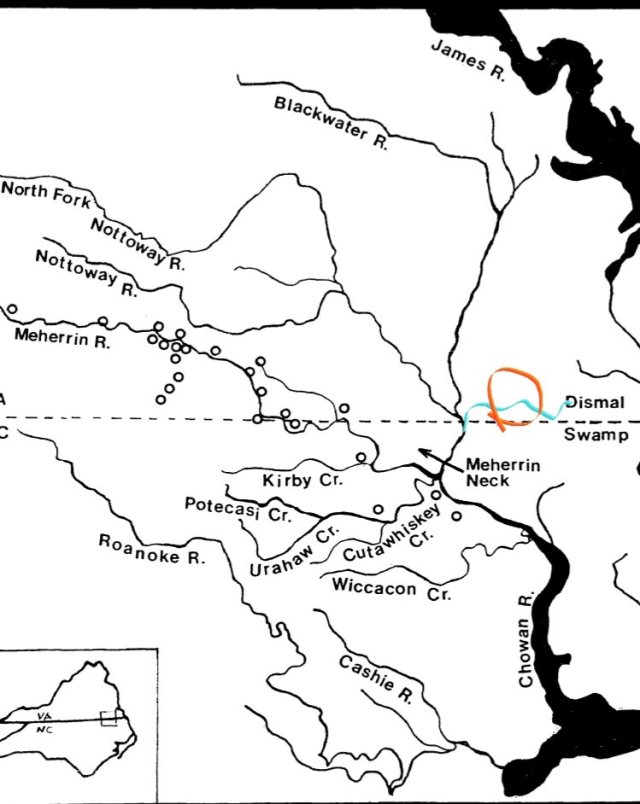
The farm of Thomas Harris who d. in 1729/30 was shown by his patent to have been adj. this latter “William Simmons line”, on March 24, 1725, and “adj. Herbert’s branch”, and on “both sides of the Meherrin river”. Its location is described here: A General Assembly, House of Delegates, report of 1828 gives indication of this: “That the petition of divers inhabitants of the county of Southampton, praying that all that part of the said county within the following bounds, to wit: by a line beginning at Taylor’s bridge on Meherrin river, including the said bridge; thence along the main road leading to Southampton (formerly IOW) courthouse, to the flat swamp; thence up the meanders of the said swamp to Harris’s old mill-pond; thence up the south fork of the said swamp known by the name of Herbert’s branch, to a black gum; thence along a line of marked trees, to a pine in Thorp’s old mill-run; thence down the said mill-run, to the Three creeks; thence up the said creek, to the Sussex line; thence along the said line, to Meherrin river; thence down the said river to the beginning, may be added to the county of Greensville, be rejected”.
Flat Swamp is Dismal Swamp, described in a geographical context by Edward Shulkcum, et al. Soil Survey of Isle of Wight County, Virginia 1941 p. 2. “This county lies wholly within the Virginia section of the Atlantic Coastal Plain, in the tidewater section of the State. It is mostly on the Wicomico marine terrace but also covers small remnants of the Chowan and Dismal Swamp terraces along the Blackwater River on the west and the James River on the north. The more level or flat areas occur on the Dismal Swamp terrace in the eastern part of the county”.
(Harris’s old mill-pond is recorded here: “The Meherrin River and Potecasi Creek basins contain most of the bottomlands. Most swamp lies along the Chowan and Wiccacon Rivers and the lower portion of the Meherrin River. The Harris and Taylor millponds (totaling about 140 acres), near Harrelsville and Winton, are the largest lakes”. (Land Potential Study, Hertford Co., NC., 2012).
The farm of Thomas Harris, d. 1729/30 was probably on Kirby Creek and Meherrin Neck, west of the swamp, and south of the James river; and adj. to Charles City County.
3. William Harris, Will dated May 1, 1720, in Surry, witnesses William Grey and William Grey Jr.
4. Mary Harris, m. Thomas Taylor. On April 27, 1748, he witnessed the Will of John Edwards, the executor being Henry Harris. This Thomas Taylor was a neighbour of Thomas Goodwin in Surry (br. of Theophilus Goodwin, as follows). Thomas Taylor’s son, also Thomas, m. Thomas Goodwin’s dau., Penelope. These Taylors were probably of the family of Richard Taylor, uncle of John Barker Jr.
5. Thomas Taylor, Will probated Nov. 14, 1754: wife Katherine, use of water mill and 49 ac. adjoining it; son Herman Taylor, plantation in Northampton County, north of Meherrin River.
3. John Harris, estate admon by John Barker Jr. (1698). Thomas Busby, 475 ac. Upper Chippoakes Cr. Sept. 22, 1682; trans. Robert Atkins, Elizabeth Bond; John Harris, Robert West, William West.
4. William Harris; his widow’s estate admon. by (eldest son) Henry Harris. R. June 16, 1711. Wit. John Barker Jr.
5. Henry Harris, 280 acs., Is. of Wight Co; on S. side of the Flatt Swamp; June 16, 1727, p. 77. Flat Swamp in Southampton (formerly Isle of Wight).
6. Benjamin Harris, d. 1774, m. Faith Smith, dau. of Lawrence Smith and Jane Regan.
7. Absolom Harris, m. Elizabeth Tarver, dau. of Andrew Tarver and Elizabeth Jordan, the sister of Priscilla Browne, who m. (2) Thomas Blunt, whose first wife was Mary Gilliam, by whom they had a dau. m. to Joel Barker, aforesaid, father of John Barker; b. Lawrenceville, Brunswick, d. Oct. 14, 1808, Pigeon Creek, Iredell, NC. He m. Elizabeth, dau. of Hinchea Gilliam and Faith, dau. of Samuel Briggs and Mary Bayley, granddau. of Arthur Bayley and Mary (dau, of Arthur Jordan), who m. (2) Christopher Foster, father of Christopher Foster Jr., father of John Foster, whose dau., Sarah, m. Walter Gilliam; their dau., Lydia, m. John Watkins, whose dau., Millie, m. Solomon Harris.
5. Thomas Harris, d. 1729/30.
6. Joshua Harris.
7. Thomas Harris, m. Sara Goodwin, dau. of Theophilus Goodwin and Elizabeth Wyche.
8. Solomon Harris, m. Millie Watkins, on March 11, 1778. The test results for a descendant (with Family Tree DNA) are a perfect match with Harris Group 4 males,
I do not know the ancestry of Sergeant John Harris of Virginia.
Neither does anyone else.
Yet, he just might have been blinded from us, like Icarus, orbitting too close to the (Bennett) sun.
The ongoing link is Kinchen.
copyright m stanhope 2020


 Walter FitzGilbert de Hamilton