
The fundamental fact about the Walter FitzGilbert who was given land in Scotland by Robert de Brus is that he was necessarily of a knightly class who were equipped by military training and a network of kin who could be called upon to defend the possessions of each other. Land held by the knightly class was always held on the prerequisit of miltary service to be given. It was by proof of such service that ownership of land was ascertained in courts of post mortem; the jury always seeking to establish by which pact land was subfeudated; the ‘quo pacto habuit’ burden of proof.
There was invariably a kinship connection between the feudal overlord (Robert de Brus), and his tenant, (Walter FitzGilbert), making them of the same social class. It was not the case that the defense of his newly claimed and disputed kingdom could possibly be entrusted to a person of vastly inferior rank, who had no ties of kinship and no means of providing military assistance. In this regard, the discredited notion that a Gilbert of low rank was the father of Walter, should not need repeating. The full deed of 1272 in which he appears shows him to sign as a witness after what in English terms would be a parish vicar. The ‘name is the same’ is one of the greatest pitfalls in genealogical enquiry, and can only be avoided by a knowledge of the social imperatives of the era under consideration.
One such imperative was the rules regarding the sequestration of land. Walter FitzGilbert was granted land forfeited by John Comyn; his son, David FitzWalter, was granted land forfeited by David de Strathbogie. Such grants were usually given to a kinsman of the disgraced magnate, and it is such links that should be central to any enquiry as to the origins of Walter FitzGilbert ‘s family.
The clear pathway between his family and those of Brus, Comyn, Strathbogie, and Umfraville should give any reader an overwhelming sense that Gilbert de Colville was the ancestor of the baronial family of Hamilton. That other families of this name appear in Scotland is nor relevant to this proposition.
1. William Crispin II., an Anglo-Norman lord who held land in Wheldrake, Goodmanham, Arnodestorp, Dunnington, Elvington, Fyling, Hinderwell, Kirkleatham, Nafferton, Pockthorpe, Sutton upon Derwent, and Warter (Domesday Book, folio 322v.) of William de Percy I., who had taken them over fom a Malet undertenant.
2. ‘Lord Thomas de Colvyle gave to God and the appertenances of the vill of Coxwold … to do there with whatsoever they would for ever’ (Excerpt from Foundations of Bylands Abbey, Gentleman’s Magazine, 1843). He m. Matilda d’Aubigny, probably a close relative of Roger (d’Aubigny) de Mowbray I., his overlord.
3. Philip de Colville, held land in Thimbleby and Sigston, Yorkshire; m. Engelisa, dau. and heir of Robert Ingram, a tenant of the Brus fee in Heslerton.
4. William de Colville (escheat 1230), m. Maud d’Albini (Brito). He was the br.-in-law of Robert de Gand. She was the cousin of William Albini I. (Brito), who m. Matilda, the dau. of Odonel de Umfraville (grandfather of Gilbert de Umfraville I), whose family armorial was gules, 3 cinquefoils or, as the Hamiltons: “A sensible proposition is that they were kin, or vassals of the Umfraville lords of Redesdale and the earls of Angus” (Bruce A. McAndrew, Scotland’s Historic Heraldry, p. 235, 200).
5. Thomas de Colville, m. Asceline, half-sister of Robert de Quincy, son of Saher de Quincy. Robert de Quincy’s son, Saher de Quincy, bore or, a fesse gules, the exact arms that the Colvilles assumed. The latter Saher de Quincey’s great-granddau, Hawise de Quincy, m. Baldwin Wake, d. 1282, the son of Hugh Wake, who m. Joane, dau. of Nicholas de Stuteville, Lord of Liddell (the half-brother of Beatrice de Stuteville, wife of William de Colville); grandparents of Margaret Wake, the wife of John Comyn, Lord of Badenoch (d. Bannockburn 1314), br. of Joan Comyn (d. bef. 1326), who m. David de Strathbogie, Earl of Atholl (d. 1326), whose sequestered estates were given to Sir Adam Gordon, whose dau. m. David FitzWalter.
5. William de Colville, m. Beatrice de Stuteville, sister of Alice de Stuteville, who m. Roger de Merlay, son of Ralph de Merlay, Lord of Morpeth.
6. Roger (not Robert) de Colville of Bytham Castle, Lincolnshire.
7. Walter de Colville (b. ca. 1225, d. 1276), m. Isabel, dau. of Odenel d’Albini, son of William d’Albini I. and Matilda, dau of Odonel de Umfraville.
8. Roger de Colville of Bytham Castle (b. 1251. d. 1287), m. Margaret, dau of Richard de Braose, of Stinton, Norfolk, and Alice de Ros, dau. of William de Ros, 2nd Baron Ros of Helmsley, and Margaret de Badlesmere, dau. of Bartholomew de Badlesmere, 1st Baron Badlesmere (who held Normanton and Hameldun/Hamilton; his tenants being the Colvilles in the former place, and probably in the latter; the overlordship at various times being the tenure of the Umfravilles), and Margaret (relict of Gilbert de Umfraville), dau. of Sir Thomas de Clare, lord of Thomond, second son of Richard de Clare, 6th Earl of Gloucester and Maud de Lacy. dau. of John de Lacy and Margaret de Quincey (niece of Thomas de Colville), dau. of Robert de Quincey, son of Saher, grandson of Saher de Quincy, who m. Matilda de Saint Liz, relict of Roger FitzGilbert de Clare, and mother of Matilda FitzRobert de Clare, wife of William d’ Albini II; their son m. Maud de Umframville; their granddau. being the wife of Walter de Colville.
On April 28, 1316, Bartholomew was one of four men who were authorised to grant safe conducts to Robert Brus and other Scots so that they could come to England to negotiate a truce.
William de Ros helped in negotiating a peace between the English and Robert de Brus, who had assumed the kingship of Scotland; and was the son of William de Ros (1st Baron Ros of Helmsley, claimant of the crown of Scotland in 1292, son of Robert de Ros and Isabel d’Albini* (dau. of William ‘the Lion’ d’Albini; son of William d’Albini and Margeret de Umfraville, dau of Odonel de Umfraville; aunt of Walter de Colville’s wife); and brother of Mary de Ros, who m. (as third wife) William de Braose, 1st Baron Braose, lord of Gower and Bramber, son of Sir John de Braose (Lord of Bramber and Gower), and Margred, dau. of Llewelyn, Prince of Gwynedd, and Joan Plantagenet, dau. of King John and a concubine. (Richardson, Magna Carta Ancestry, p 701). Mary de Ros and William de Braose had issue: Richard de Braose, of Stinton, Norfolk, father-in-law of Roger de Colville of Bytham Castle. William d’Albini and Margeret de Umfraville had issue: Alice d’Albini, who m. Gilbert de Gand; their dau., Juliana, m. Henry de Armenters (from whose general family stemmed the Wormleys).
William de Brus (br. of Sir Robert de Brus, 6th Lord of Annandale; father of Robert de Brus, King of Scotland, b. 1274, d. 1329, grantor to Walter FitzGilbert), was granted wardship on May 8, 1288 of the lands late of Roger de Coleville, son of Walter, as follows, tenant in chief of Bytham and other places in co. Lincoln, reserving to the King the marriage of the heirs during their minority (Calendar of the Patent Rolls, 1272-1281, p. 247)
*This marriage introduced a Scottish connection: Robert de Ros was related to Alexander III, King of Scotland, who employed him in Scotland in 1258 to protect the Crown from rebellion. In 1264, he joined the barons under Simon de Montfort, and, when the barons were later defeated, he was imprisoned in Hungerford Castle, being released by 1267. His son William de Ros succeeded to Belvoir on the death of his mother Isabelle in 1301. As the great-grandson of Isabel*, dau. of William I, ‘The Lion’, King of Scotland, he competed for the crown of Scotland in 1292. *Relict of Robert de Brus, and illegitimate dau. of William ‘the Lion’, King of Scotland, by a mistress, dau. of Richard Avenel.
8. Gilbert de Colville, b. ca. 1255. The Writs of Military Service show (1292) Gilbertus Coleville performing military service in Scotland due from Gilbertus de Neville, his kinsman, through the Merlays. Gilbert de Neville (elected a Knight of the co. of Lincoln in 1290) performing such service in 1277 due to Gilbert de Gand (br. of Juliana d’Armenters), son of Gilbert de Gand, Earl of Lincoln and Alice d’Albini); husband of Laura, dau. of Henry de Baliol and Lauretta de Valognes; parents of Nicola de Gand, wife of Piers de Mauley and Joan de Brus, dau. of Peter ll de Brus, of Skelton, and sister of Margaret de Brus, who m. Robert de Ros; br. of William de Ros (Roos), 1st Baron Ros of Helmsley.
‘The Colvilles in question then must be looked for among the undertenants of the Belvoir Barony, and as the major part of that Honour lay in S. Lincolnshire and Leicestershire, it is to the records connected with this part of England that our attention must be directed’ (Cambridge Antiquarian Soc., 1901, pp. 381-383). ‘As a matter of fact Colvilles are plentiful in this district. The first I have come across is Will. de Colville who attests a charter granted by the Earl of Lincoln in 1141 (Gilbert de Gand – MS) when he went to meet King Stephen at Stamford (see Round’s Geoffrey de Mandeville, p. 159). Twenty-five years later the Black Book of the Exchequer records the existence of another Will. de Colville as undertenant in 1166 of the D’Eyncourt’s at Somerby near Grantham, and of the Wakes at Creeton, a few miles west of Bourne’ (Lib. Rub. 379).
‘The same man is entered a few lines further down an holding Bytham and its soke of the Earl of Albermarle. Turning next to the Belvoir fees we again find Will. de Coleville (Testa 343) as undertenant at Auburn, south-west of Lincoln, while the Close Rolls of 1230 contain a writ addressed to the Sheriff of Lincoln stating that Will. de Coleville de Bytham was dead and ordering that his heir Roger de Coleville be put in seisin of his estates. The Testa has returns for 1242 as well as 1212, and turning to these we find Matilda de Coleville (p. 323) as tenant of Somerby, Walter de Colville of Bytham and … Creeton (p. 327), and finally Walter de Coleville as an undertenant of Roger de Coleville at Auburn (p. 326). The Testa has no Leicestershire returns for 1212 but it shows in 1242 a William de Coleville as undertenant of Walter de Coleville at Muston and Normanton near Belvoir’ (ibid.).
(Walter de Colville held in Creeton and Counthorpe of the heirs of Hugh Wake).
William Page, Victoria History of the Co. of Rutland, vol. 2, p. 22, 1908: ‘Normanton is not mentioned in Domesday Survey (1086), but it probably formed one of the berewicks of the king’s manor of ‘Hameldune Cherchesoch.’ It was acquired by the Umfravilles at an early date, and in 1183 the sheriff rendered account of 25s. 8d. from Normanton, the land of Odinell de Umfraville. (See Pipe R. 29 Hen. II, m. 4 d.).
‘It is sometimes spelled Hambleden, and Hamilton, but anciently ‘Hameldune’, perhaps meaning the hamlet on the hill. In Saxon times it was the property of Queen Editha, wife of Edward the Confessor, and at the Norman Survey was principally in the hands of the Conqueror himself, when it was certainly of much more consequence than at present (Britton, Beauties of England and Wales, vol. 12, p. 127, 1813).
‘Hamelyton near Normanton, in the road to Okeham, is in the maps and some descriptions spelt Hambleton, or Hamelden. In the R. of Edw. II. this manor bel. to Bartholomew Ld. Badlesmere, who obtained a Mt. here on M. and a Fair Aug. 23, 24, and 25′. (Stephen Whatley, England’s Gazetteer, 1751).
The tithes of Hamilton included revenue from Normanton: ‘Cujus quidem verus tenor sequitur et est talis. Ecclesia de Hamildon que est de Communa Ecclesie Lincolniensis omnia inferius contenta a prima sua fundatione percepit et percipit de villatis subscriptis, videlicet de Normanton’ (Journal of the Rutland Record Society, vols. 15-23). The feudal lord of one was often that of the other: Bartholomeo de Badlesmere et Margareta, uxore ejus, pro j. f. in Hameldon et Normanton’ (Inquisitions and Assessments Relating to Feudal Aids, 1284-1431, vol. 4).
NORMANTON PARK
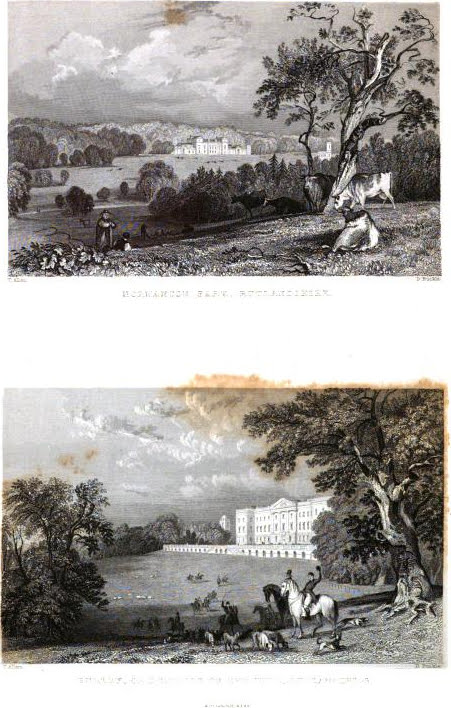
Mr. Page continued: ‘From this date the overlordship of Normanton followed the descent of Hambleton (q.v.) until the death of Sir Giles de Badlesmere in 1338, on whose death it was assigned to Giles’s sister and co-heir, Elizabeth, widow of Edmund Mortimer, then the wife of William de Bohun, Earl of Northampton. Normanton, after this date, is said to have been held of Hambleton manor. Early in the 13th century Normanton was subinfeudated (to) Robert d’Albini, son of William d’Albini. (Maud, dau. of Odinell de Umfraville (d. 1182), m. William d’Albini, and the d’Albinis may have obtained Normanton through her.) As given, William d’Albini was the cousin of William Colville’s wife. Robert d’Albini presented to the church in 1227, and he or his son Robert presented in 1234. (Rot. Hug. de Welles, Cant. and York Soc., ii, 180). Eustachia, probably the second wife of Robert, however, seems to have held Normanton in her own right. It may have been she who, as Eustachia, widow of Robert de Sancto Albano, claimed a third of 20 virgates and 5 acres of land in Normanton against Gilbert de Umfraville in 1237′ (Cal. Close R. 1234–7, p. 517).
The Colvilles held other property in Rutland and elsewhere. In the 12th century the family of Barrow or Berc is found in Rutland. In 1197, Hugh de Berc acknowledged that he had given to Roger de Colville all his lands in Barrow (Berc) which he held of William Colville of the Wake barony: Temp. Henry I., Hugh le Wake, m. Emma, dau. of Baldwin FitzGilbert, uncle of Gilbert de Gand, 1st Earl of Lincoln. He d. in 1172, and was s. by his son, Baldwin Wake, who was s. by his son, Baldwin Wake. He was s. by his son and namesake, who m. Isabel, dau. of William de Briwere, and dying ca. 1213, was s. by his son, Hugh Wake, who m. Joane, dau. of Nicholas de Stuteville (half-br. of Beatrice wife of William de Colville), Lord of Liddell. who m. Gunnor d’Albini Brito.
9. Walter FitzGilbert. Robert de Brus (nephew of the guardian of Roger de Colville’s children), granted to Walter FitzGilbert the whole tenement of Machan which belonged to John Comyn in 1320. It was a medieval ‘norm’ to give forfeited lands to a member of the ‘disgraced’ family. John Comyn was the cousin of his namesake, husband of Alice de Ros, kinswoman of Walter FitzGilbert. Walter’s descendants bore gules, 3 cinque foils or. The earliest representation of the Hamilton arms appears on the Bute Mazer were Gules, three cinquefoils ermine, presumably for Walter FitzGilbert and is accompanied by Gules, a chevron ermine between three cinquefoils for brother John. To repeat: ‘(A) sensible proposition is that they were kin, or vassals of the Umfraville lords of Redesdale and the earls of Angus’ (Bruce A. McAndrew, Scotland’s Historic Heraldry, p. 235, 2006). Gilbert de Umframville’s sister, Margery de Umframville, m. Roger de Merlay, son of Roger de Merlay and Alice de Stuteville, whose sister, Beatrice, m. William de Colville. Gilbert de Umframville II. was a cousin of John Stewart of Bonkyl, whose granddau., Elizabeth Stewart, m. John FitzWalter, son of Walter FitzGilbert.
10. David FitzWalter, m. Mary, dau. of Sir Adam Gordon, who received from Robert de Brus a grant of the forfeited estate of David de Strathbogie, Earl of Athole. To repeat, for it bears it: Temp. Henry I., Hugh le Wake, m. Emma, dau. of Baldwin Fitz-Gilbert, uncle of Gilbert de Gand, 1st Earl of Lincoln. He d. in 1172, and was s. by his son, Baldwin Wake, who was s. by his son, Baldwin Wake. He was s. by his son and namesake, who m. Isabel, dau. of William de Briwere, and dying about the year 1213, was s. by his son, Hugh Wake, who m. Joane, dau. of Nicholas de Stuteville, Lord of Liddell (the half-brother of Beatrice de Stuteville, wife of William de Colville, as given). Sir Hugh Wake was the father of Baldwin Wake, who m. Hawise de Quincy, dau. of Robert de Quincy, dvp. (son of Saher de Quincey). This Baldwin Wake was the father of John Wake, 1st Baron Wake of Liddel; the father of Margaret Wake, the wife of John Comyn, Lord of Badenoch (d. Bannockburn 1314), br. of Joan Comyn (d. bef. 1326), who m. David de Strathbogie, Earl of Atholl (d. 1326), whose dau., Isabel, was the mistress of Edward Brus, Earl of Carrick, br. of Robert Brus.
10. John FitzWalter.
The branch of the Colville family that settled in Scotland at an early period maintained close links with their kin, this leading to their association with the Hamiltons as Colvilles.
2. Philip de Colleville, from whom descended the Lords Colville of Scotland (E. A. Freeman, The Norman People, pp. 405-406, 1874).
3. Philip de Colleville’s son, Philip de Colville, accepted an invitation of King Malcolm IV. to settle in Scotland, and founded the baronies of Culross and Ochiltree. He was witness to a general confirmation by King Malcolm of all donations made by his predecessors to the monastery of Dunfermline before 1159. He was one of the hostages for the release of King William the Lion from captivity in 1174. The first possessions he obtained in Scotland were Heton and Oxenhame, in the county of Roxburgh.
4. Philip de Coleville, of Heton and Oxenhame, in the county of Roxburgh, Scotland. ‘Philippus de Colvill’ donated ‘terre in Hetoun ex dono Galfridi de Percy et Henrici patris sui’ to Dryburgh monastery’ (Cart. de Dryburgh). ‘Henry de Percy has granted to Whitby Abbey in perpetual alms those donations by which Alan de Percy II., his brother, gave two ploughgates of land, one in Oxnam and the other in Heiton , and that donation of one ploughgate of land in Oxnam which Geoffrey, his brother, gave to the same church in perpetual alms ‘ (Whitby Cart., no. 60, May 24, 1153). These were grandsons of William de Percy I., by his son, Adam de Percy I. and Emma de Gand, dau. of Gilbert de Gand.
5. Thomas de Colville (cognomento ‘the Scot’), obit. 1219, Constable of Dumfries Castle. ‘Thomas de Colville, the constable of Dumfries Castle, gave land in Galloway to Vaudey Abbey, to pray for the souls of dead Scottish Kings.The fact that a Lincolnshire Abbey received land in Galloway for the souls of Scottish Kings is only explicable because of the existence of an aristocratic family with members in both kingdoms’ (G. Barrow, The Anglo-Norman Era in Scottish History, 1980). The network of relations was vitally important, providing support in times of need, and promotion when influence permitted. The family of de Colville, although geographically dispersed, was a powerful political entity.
6. John de Colville, of Oxnam. His parentage is confirmed by the attestation (1316) of his granddaughter, ‘domine Eustachie Lachene’, relating to ‘ecclesie de Oucheltrye’ (Melrose Liber, t. ii., 400, p. 363).
7. William de Colville, of Spindlestone, Northumberland. The aforementioned attestation of ‘domine Eustachie Lachene’, states that ‘avus suus dominus Johannes de Coluille’ was succeeded by ‘filius suus legitimus Willelmus’, who married ‘filiam domini Johanis de Normanville’.
8. Thomas de Colville, ob. ante 1280 (Melrose Liber, t. ii., 400, p. 363).
9. Robert de Colville, d. bef. Apr. 2, 1341, m. Katerina (The Scots Peerage, Vol. II, edited by Sir James Balfour Paul, p. 539).
10. Robert de Colville, obit. c. 1397.
11. Thomas de Colville, ob. ante February 4, 1403, born in Formartine, Aberdeenshire, m. Margaret Lindsay, dau. of James de Lindsay and Margaret Keith, dau. of Sir William Keith and Margaret Fraser. Margaret Keith’s sister, Janet Keith, m. David Hamilton of Cadzow, lord of Cadzow, son of David FitzWalter (FitzGilbert) of Cadzow. David Hamilton was the first of the family recorded as formally using the surname Hamilton, appearing in a writ of 1375 as ‘David de Hamylton, son and heir of David FitzWalter’.
copyright m stanhope 2019


 Walter FitzGilbert de Hamilton