
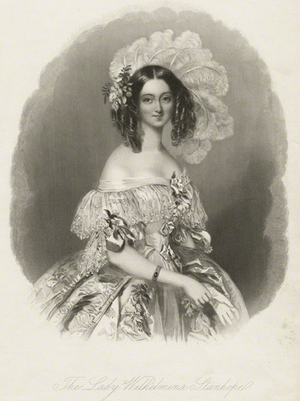
Lady Wilhelmina Stanhope
When considering Wace as a historian it is necessary to ask how much accuracy was contained within his rhymes. A general consensus is perhaps expressed by Elisabeth M. C. Van Houts (2004), who suggested: ‘As a historian, Wace was dedicated to the truth and willing to undertake personal research in order to verify the accuracy of his statements’. Having been born c. 1110, he relied on orally transmitted material to inform of the ‘battle companions’ of William the Conqueror, so this must be considered as a caveat. An intriguing feature of his work is associating various individuals into groups, or ‘minature war bands’, which may have simply been the result of their names rhyming, which would inform nothing of any vassalage or familial connection; a case of how much history in the poetry? In this regard, perhaps a fair amount of history. Many of his ‘companions’ have close geographical and/or connections of vassalage.
Del viez Molei* e de Monceals, **
Cil ki ert sire de Pacie,
E li seneschals de Corcie,
Et un chevalier de Lacie,
Ensemle o els cils de Gascie,
E cil d’Oillie h de Sacie,
E li sire de Vaacie,
Del Torneor e de Praeres,
Et Willame de Columbieres,
E Gilbert li viel d’Asnieres,
De Chahignes e de Tornieres,
Li viel Luce de Bolebec.
*Milo de Molay. Milo Moli. ‘Probably to be distinguished from Miles Crispin, who would otherwise seem most naturally to occur at this point in Domesday, since a de Molay family occurs in the Honour of Wallingford during the twelfth century. Possibly named from Le Molay, Calvados, cant. Balleroy‘. (Keats-Rohan, p. 298).
**Monceaux, near Bayeux. Drogon de Monceaux (Dreux de Monci), the second husband of Edith, widow of Gerard de Gourney, or his son, of the same name, signed the foundation charter of the abbey of Dunstable, in Bedfordshire, temp. Hen. I.
There the Chief who held Pacy (1) on Eure, too, was found,
With de Courcy (2), the seneschal, taking his ground.
De Lacy’s (3) good Knight, with de Gace (4) did ride,
De Sacy (c. Monceaux) and D’Oily (5), were close at their side.
Sires de Vescy (6), Le Torneur, and the Sire de Praeres, (Richard de Praeres, Presles, arr. Vire). Among the gifts of his vassals to his father’s monastery of Saint Werberga, Chester, Earl Richard fitz Hugh of Chester confirmed that of Richard de Presles and his sons William and Adam.
Were banded with William de Columbieres (7).
The aged Lord Gilbert, who was Sire of Asnieres (8),
Had for Comrades, de Cahagnes (9), and de Tornieres.*
(1) Pacy, at the conquest, belonged to William Fitz-Osbern. But there was a William de Pacy in 1080, who possibly held under him. Ord. Vit. 527,576. Pacy-sur-Eure, arrondissement of Evreux. ‘William Crispin I was the possessor of a large amount of property in Pacy which is made evident by his many donations to the abbey of Bec before 1070. William Crispin I gave to the abbey of Bec before 1070 one-sixth of the mills at Pacy, one half of the forest there belonging to it, and l00 solidi of the customs of that citadel. ] When he was appointed hereditary viscount of the Norman Vexin by duke William, about 1045, the castle of Pacy came under his command, it being one of the border fortresses in this district. The seigniory of Pacy was in possession of William Fitz Osberne at the time of the conquest, consequently there could not have been another sire de Pacy then, as affirmed by Wace (l. 13655), unless he meant to chronicle William de Breteuil, eldest son of William Fitz Osborne, who succeeded to this seigniory at the death of his father in 1074. If this assumption is incorrect, then he referred to someone who held under Fitz Osberne, though probably not entitled to be designated “sire de Pacy.” There was at that time a William de Pacy (Willelmus de Paceio) apparently of considerable importance, who with his mother Hadwis gave lands to the abbey of Bec c. 1070. He would appear to be the same William de Pacy, possibly castellan of Pacy, who was among the witnesses of a charter in favour of St-Evroult, by Raoul de Toeni II. between 1087 and 1099.’ (Lady Wilhelmina Stanhope, Battle Abbey Roll). I have previously outlined the cousinship relationship between the Crispins and FitzOsberns.
(2) From this family were the seneschals, Robert, under the empress Matilda, and William, under Hen. II.
(3) Ilbert de Lacie, tenant of the Bishop of Bayeux. (D.B. 87d). Lassy, arrondissement of Vire. Walter de Lacy was the conqueror’s attendant, and Ilbert de Lacy is also said to have been present.
(4) Gace, arrondissement of Argentan. Robert de Gace, grandson of archbishop Robert, and son of Ralf, who was concerned in the murder of Gilbert count of Brionne, died without issue before the Conquest, Orderic. Vit. 488, 681. Who held Gace afterwards does not appear.
(5) According to M. Le Prevost, from Ouilly-le-Basset, arrondissement of Falaise. Robert D’Oily was the one at the conquest. His daughter Maud married Milo Crespin, who had with her Wallingford castle. Introd. Domesday, i. 458; ii. 361. Yet, it should be considered that Ouilly-le-Ribauld was held by Ribald Crespin, of the baronnie de Tillières.
(6) Robert and Ivo de Vassy/Vesci were in William’s expedition. Vassy is a small village three leagues from Vire.
(7) (8) Columbieres and Asnieres are in the arrondissement of Bayeux. The lords of both are found in a charter of 1082, in favour of the Abbaye-aux-dames, of Caen. The lord of Asnieres (Canton d’Isigny) was then Ralf,* who possibly had succeeded ” Gilbert le viel”. Ralf de Columbels, or Columbers (canton Troarn), in Domesday, held lands in Kent. Columber, from Colombieres, on which seventeen knight’s fees were dependent. (Des Bois). William de Columbieres” is one of the knights mentioned by Wace at Hastings, who Mr. Round made father of the said Ralf, with what proof is not known.
Van Houts (Roman de Rou, 2004, p. 53), states: William of Colombieres had interest in lands at Asnieres given by Radulf of Asnieres [q.v.] to Sainte-Trinite at Caen (Musset, AC, nos 8, 22); also link with William of Semilly [q.v.]. William of C. gave land to abbey of Troarn in 1068 (Sauvage, no. ii, pp. 348-51).
‘Guillelmus de Columbers, filius Goisfridi, vendidit Sancte Trinitati emptam quoque Sancto Martino eternali conditione edificandum episcopi ipsius auctoritate obtulit. Saltus vero confinitate antea deserta erat, Gosscelinus denique … Guillermus etiam de Columbiers, filius Goiffredi, dedit in elemosiet Sancto Martino et Petro monacho totam decimam de terra Goisfridi’ (Marie Fauroux, Lucien Musset, Recueil des actes des ducs de Normandie de 911 à 1066, p. 412, 1961). (See ad.).
James Robinson Planché, The Conqueror and His Companions, vol. ii, p. 251, 1874: ‘Little is known of this personage mentioned by Wace (Rom. de Rou, 1. 13,462) beyond the fact of the occurrence of his name in a charter in favour of the Abbey aux Dames at Caen in 1032. (Not necessarilly the same William – M.S). He was probably deceased before the compilation of Domesday, in which a Rannulph de Columbel is returned as the holder of sundry manors in Kent, the reward of the services rendered to the Conqueror cither by Ranuulph himself or the William of Wace, whom he might have succeeded. Colombieres is in the arrondissement of Bayeux, and it is worthy of note that in the charter above mentioned a Raoul d’Asnieres is found in company with the Lord de Columbieres. Asnieres being in the same arrondissement, and “Gilbert le viel d’Asnieres” coupled with “Willame de Columbieres ” in the ” Roman de Rou,” it is fairly presumable that they were near connections as well as near neighbours.
(9) Arrondissement of Vire. The lords of Cahagnes are among the benefactors of Grestein and Lewes. he Lords of Cahagnes, and Tournières came, the former from the arrondissement of Vire, the latter from the arrondissement of Bayeux. The former figure among the benefactors of the abbey of Lewes, in Sussex, and the latter, styled Richard de Turneriis, is mentioned in thefoundation charter of the priory of Kenilworth, in the reign of Henry the First.
(10) Richard de Torneriis *Tournieres (Calvados, cant. Balleroy).
Domesday Kent:
Canterbury Archeological Society, 1959: ‘Domesday Book states that there is a Ranulf “de Columbers” in control, under Odo, of Shelling (in Woodnesborough), close to the port of Sandwich, while the same man is found holding of the abbot of St. Augustine’s one yoke of ground at Northbourne, near Dover, worth 50d. per annum. A man with the quasi-surname “Columbers” might be associated with Colombieres’. (Calvados, arrond. Bayeux, canton Trevieres; juxta Colleville-sur-Mer, canton de Trevieres).
‘Stephen of Stratton and Anna’ his wife claim against Ralph de Colville and Idonea his wife half of nine acres of land and twelve penceworth of rent with appurtenances in Clopton, and against William de Spina half of two acres of land with appurtenances in the same vill, and against the said Ralph and Idonea a third part of two and a half acres of land and eight penceworth of rent with appurtenances in the same vill’.
‘Of the house which Ralph Colville (Ranulf de Columbel) occupies, heretofore the property of an exile or outlaw, it is agreed that one half of it belongs to the king, and the other to Eanulf. Hunfrid has I house, one half of it belongs to the king. Roger of Easterham erected a certain house upon the king’s water, and has hitherto observed the king’s customs. There was no house there in the time of king Edward. And all these depend on the bishop of Bayeux as their protector and donor’.
Canterbury: ‘The burgesses had xlv houses beyond the precincts of the city, from which they received rent and customary payments; but the king had Sac and Soc therefore. The burgesses also had xxx in acres of land from the king for their guild. These houses and this land Ralph Colville holds; besides these, he has lxxx acres of allotted land, which the burgesses held from the monarch. He has v other acres, which rightly belong to a church. For all these, Ranulf appeals to the bishop of Bayeux for protection‘.
‘Stanbope, or de Colville, a baronial family. William de Colleville, who came to England 1066, had issue: William, who t. Henry 1. was Lord of Colleville, Normandy (MSAN, viii. 430). It was held from Ranulph the Viscount and from the Church of Bayeux’.
1. “Rannulfo filio Anschitilli”, Vicomte du Bessin (Bayeux), m Alix, illegitimate dau. of Richard III.
1.1. Ranulph “le Meschin”, Vicomte du Bessin, m. Maud d’Avranches, dau. of Richard le Goz, Vicomte d’Avranches, sister of Hugh d’Avranches, Earl of Chester, father of Robert FitzHugh, aforesaid.
copyright m stanhope 2018
Ad.
Charte de dotation du prieuré de Saint-Martin-du-Bosc relevé de ses ruines par les moines Pierre et Deodatus venus de Fécamp, souscrite par Guillaume, duc de Normandie. c. 1066.
Tempore Guillelmi Normanni? potentissimi marchionis, Rotberti venerabilissimi filii, quidam cenobit? Petrus et Deodatus qui, dum seculari habitu potirentur intra ejus curiam fuerant obversati …
Guillelmus de Columbers, filius Goisfridi, vendidit Sancti Trinitati et Sancto Martino, et Petro monacho totam decimam de terra Goisfridi, filii Rainfridi in Langrone et decimam de terra Gonoera et de filiis suis, et de terra Alberadis cum suo filio perpetualiter sine fine; et pro hoc dedit ei Petrus et Deodatus decem libras, et decem solidos, et unum equum centum solidos appreciatum, et orationes loci, et uxori tres solidos pro concessione. Testibus Genscelino, Tangredo, Richardo, Rogerio filio Harderet. Rogerius Malreguart vendidit Sancti Trinitati et Sancto Martino Petro monacho tria jugera terre et dimidium agrum in Langrone, concedente Goisfrido filio Rainfridi domino suo; et pro hoc dedit et Petrus et uxori ejus tres libras, et IIII solidos. Serlo, filius Turstini, vendidit Sancti Trinitati, Sanctoque Martino III agros in Langrone de terra, pro quo dedit ei Petrus et Deodatus XXX solidos; testibus Tanchredo et Rogerio, filio Hardere. Quidam vero Guillelmus de Corcella dimidiam partem piscationis in aqua Tolce et integrum agrum unum de prato suo obtulit et septem sextarios annon ob redemptionemanima sui]: teste Genscelino, Malgerio et Herberto, filio Odberti. Uxor vero Berengerii, pro anima viri sui, annuente domino suo Herluino, in presentia comitis obtulit Sancto Martino et tribuit unum agrum prati, et ideo dedit ei Petrus et Deodatus novem solidos. Testibus: Genscelino et Ansfredo Polein, aliisque multis croix. Gausfredus de Lamara (de la Mare – M.S) vendidit Sancti Trinitati et Sancto Martino duas partes decima de Butvillae terra et medietatem omnium qu’cumque offeruntur altari, cum medietate decimarum et sepulturarum, et unum integrum colonum de]terra que fuit Wuatscelino, et alium dimidium ospidem de illa terra qu? fuit Peregrino cuidam; et ex alia parte novem jugera terre, et decimam piscium de Lamara, et Odonem sacerdotem cum monasterio et totam terram quam tenebat; et pro hoc dederunt Petrus et Deodatus supradicto Goisfrido precium centum solidorum, annuente uxore et filiis ejus et concessu Rogerii de Belmunt domini sui, et uxoris ejus et filiorum: testibus Richardo de Sancto Medardo, Genscelino, Haralt, Radulfo, et filio suo Rogerio; qua de re dederunt Petrus et Deodatus predicto Goisfrido inter omnia viginti sex libras et decem solidos et Rogerio Belmuntensi uxorique Adeline unam unciam auri et XX solidos. Richardus vero, filius Garini, dedit Sancti Trinitati et Sancto Martino omnem decimam quam tenebat in Butvilla et unum agrum terre; et pro hoc dederunt ei Petrus et Deodatus XXX solidos et Goisfrido, domino ejus, dederunt sex solidos pro concessu. Teste: Genscelino et Richardo de Sancto Medardo et Goisfrido Broc filio Aszoris. Hoc omnia concessit Goisfridus Sancti Trinitati Sanctoque Martino atque Petro et Deodato et propter istam pecuniam, et salutem anima sui. Quando Genscelinus dedit fundum de Dalbuet Sancto Martino, habebat pro sua paupertate quorundam hominum servitium invadiatum, usque ad summam pecuni centum et decem solidorum. Quapropter dederunt monachi Radulfo Benevent quindecim solidos et suo filio Radulfo octo solidos et Richardo dispensatori centum solidos, quibus servitium erat invadiatum, et ita disvadiaverunt, et Sancti Martini possessionem perpetuam. Herfredus frater Genscelini dedit partem terre quam habebat in eadem villa Sancto Martino jure hereditario, post mortem suam, si heredem non haberet. Serlo de Lamara concessit Sancti Trinitati et Sancti Martino decimas de tota terra sua quam tenet in Butvilla pro salute anima, et patris atque matris et uxoris et filiorum, et unum agrum terre in eadem villa, et hoc jure perpetuo. Signum Wuillelmi comitis Normannorum (croix). Signum Mathildis comitiss (croix). Signum Rotberti filii sui [croix]. Signum Richardi de Abrincas filii sui (croix). Testes: Rogerius de Montegomerico, et Rogerius de Belmunte, et Ricardus vicedominus et Herluinus vicecomes de Conta Villa.
DOVER. in the time of King Edward, rendered eighteen pounds, of which sum, Edward had two portions, and Earl Godwin a third. Besides this, the Canons of St. Martin had another moiety. The Burgesses provided twenty ships for the Monarch once each year for fifteen days, and in each ship Were twenty-one men. Fines and Suit of Court; they had their own Guildhall — and William Fitz-geoffrey was the Mayor — Willielmus Filius Goisfrid; habet tres Domos in quibus erat Gihalla Burgensium. (Domesday; Or, An Actual Survey of South-Britain, edited by Samuel Henshall, John Wilkinson, 1799).


 Walter FitzGilbert de Hamilton