
Genealogy is a great begetter of romance. The origins of the Macleods of Lewis are woven in a deceptive thread, its design to give the impression that they stemmed from Leod (pronounced ‘lodge’ in Scottish Gaelic); the eldest son of King Olave the Black, brother of Magnus, the last king of Man; this honour being shared by two brothers, Tormod, the progenitor of the Macleods of Harris, and Torquil, of those of Lewis.
This thread is so thin that it would snap in a breeze, and is wholly typical of the ‘pedigree building’ so beloved by the Victorians. Even (the otherwise laudible) historian of Scotland, William Anderson, after admitting “there is no authority whatever for such a descent”, quoting learned authorities, carried on to allow it on the basis that these clan founders both had Norwegian names!
The earliest reference to the Macleods of Lewis is contained in a royal charter dated to circa 1343, when King David II. granted to Torkyll M’Cloyd the four davochlands of Assynt. A Pictish davach was a rough measure of land for both fiscal and military purposes. Its holders were expected to do service in the Scottish army for six weeks a year, but in the western fiords of Scotland this servive could be exchanged for naval service.
The Macleods held Assynt as vassals of the Macdonalds of Islay. In time, their lands stretched from the islands of Lewis, Raasay, the district of Waternish on Skye, and, on the mainland, as well as Assynt, Coigach and Gairloch.
The granting of these lands seem to be a confirmation of a grant by David’s father, Robert, and can be seen in the context of his Irsh Campaign, conducted between 1315 and 1318, and his need to increase naval power to counter English control of the North Channel. The Macleods of Lewis were, thus, mercenaries of the Scottish Crown.
To redeem Mr. Anderson, his account (in ‘The Scottish Nation’, 1863) of the Machivellian nature of Anglo-Scottish politics of these times aptly places the role of the Macleods of Lewis in context: “It is historically known that in 1369, the year before his death, that monarch (David II.) proceeded in person, at the head of a formidable expedition, against the rebellious lord of the Isles (John MacDonald/Eòin Mac Dòmhnuill), and compelled him and his vassal chiefs, at Inverness, to submit to his authority. One of the means employed by him on this occasion to effect that purpose, and to keep the rude northern chiefs to the obedience of the laws, was the promise of rewards and the bestowal of lands, on some of the principal of them. It is even said, (Fordm a Goodal, vol. ii. p. 380,) that he used artifice to divide them and induce them to slay or capture one another. Certain it is, that it was in this reign that the practice of bonds of manrent or friendship among the chiefs and nobles began”.
Monroe (in his ‘Description of the Western Isles’,1549), gives accounts of lands held by the Macleods of Lewis:
“At the shore of Watternesse lyes ane ile callit Isa, ane faire laiche maine ile, inhabit and manurit, verey fertill and fruitfull for corne and gerssing, ane myle lange and haffe myle braid, having beside it ane uther laiche ile full of sheepe. This ile is guid for fishing, quhilk perteins to M’Cloyd of the Lewis”.
“On the eist shore of Watternesse lyes ane ile callit Elian Askerin (the Ascrib Isles) abounding in gressing and pasture, maire usit for sheilling and pasture than for corne land, guid for fishing and slaughter of selchies, pertaining to M’Cloyd of Lewis”.
The lands of Assynt were held Torkyll Macleod of Lewis, who was described as a “fugityve fra the lawis” in 1502, and had his lands conficated, and Malcolm Macleod, who, in 1511, was granted all that had been possessed by his family, and additionally included the castle of Stornochway, i.e. Stornaway (Gregory, pp. 72, 73. 14 Reg. Sec. Sig., vol. xv. fol. 77). Their relationship to the grantee of 1343 is unknown.
The fall of this clan and the loss of the Isle of Lewis was a result of feuds with other clans. What is dressed in a fiction, that only such as Robert Louis Stevenson may have imagined – a chieftain divorcing his adulterous wife; his ensuing battle with her bastard son; his imprisonment by him, monstrous treacheries – hides the fact of a successorship struggle to land and power, wherein patricide and fratricide were common accompaniments.
William Buchanan (in his Historical and Genealogical Essay, pp. 73-5, 1820), also gives a romantic account of the Macleod’s later struggles, which is also free of the bloody undertones of reality:
“In the reign of king James VI. (1566-1625) that (Roderick) MacLeod of Lewis had the misfortune of falling into some disloyal practices, for which he was forfeited. King James having a design of civilizing and improving that large and fertile island, thought that a fit opportunity of falling on that project, and in order thereto, gave a grant of the Lewis to certain gentlemen of the shire of Fife, for payment of a small sum of fen-duty, and some other casualties.
MacLeod of Lewis dying, these gentlemen thought to get their design with all facility accomplished, but were very far disappointed; for notwithstanding that they built pretty good houses near one another, in the form of a village, for their mutual defence, yet Murdo MacLeod, bastard son to MacLeod of Lewis, with some of his father’s tenants and dependants, assaulted the Fife lairds in their village, and having fired their houses, obliged them all to become his prisoners, and for preservation of their lives, to swear, that with the utmost diligence they would abandon the island, and never return, which was punctually performed. The king finding this method would not do, gave in a short time thereafter a grant of Lewis to the Earl of Seaforth”.
In reality, the (Mackenzie) Earl of Seaforth conquered Lewis as a Crown agent, the background to this being that the crown-rents of Lewis were unpaid, and an act of parliament was passed, in June 1598, to confiscate Macleod lands.
Niel Macleod took (his brother) Murdo Macleod prisoner, and delivered him to the authorities; Murdo being subsequently hanged at St Andrews. In return, Niel obtained a pardon at Edinburgh, and was promised a portion of his father’s lands by the chief of the Mackenzies, which did not transpire. Niel Macleod and his partisans rose in rebellion; attacking the settlements of the invaders, and killing most of them. The rebellion eventually failed; Niel Macleod was captured (possibly with the collusion of relatives), and executed in Edinburgh in April 1613.
The relationship between these Macleods and the following MacLeods (if any) can not be known. These latter Macleods are mentioned in depositions of 1805, concerning the boundaries between Lewis and Harris.
1. “Duncan McInnes, tenant at Kirkibost of Lewis, depones that he is eighty years of age … that he has for these last sixty-eight years lived in the farm of Kirkibost … that he does not remember how long he has held lands from the family of Seaforth, but that he has done so since the death of his father”.
2. “John McKay, residenter at Gisla, aged sixty-seven years, depones that he is the identical John McKay who was servant upwards of forty years ago to Murdo McLeod at Kenresort … depones that he saw a particular stone that stood erect at the top of Eeuntom-na-laig Aird … depones that Donald Macleod, son of Murdo Macleod at Kenresort, was the person that took it out of its place and brought it to Kenresort … depones that Murdo Macleod, his master, and Donald Macleod before mentioned, attended by the deponent, carried the stone to Stornoway,and produced the same to George McKenzie, then chamberlain of Lewis, and Dr McKenzie at Stornoway, who after inspecting it, ordered it to be carried back and placed at Eeuntom-na-laig Aird”.
3. “Donald M’Aulay, at Bunavonedder, in the forrest of Harris … aged eighty years depones that he saw a stone … of an oblong form, light blue; which according to general report, had been placed as a march-stone at a remote period … depones that it was surrounded by heath and moss, and one end of it inserted in the earth: that it was an uncommon stone, with four regular sides, but broader than thick … depones that he saw and was present when Malcolm Campbell deprived Murdo M’Leod of his dog and gun … his reason for doing so was that Murdo M’Leod had been guilty of poaching on the Harris side of the march on former occasions … that Murdo M’Leod, who succeeded his father as sub-forester of Harris, informed the deponent that was the line of march … that Murdo M’Leod informed him of this about 40 years ago”.
4. “John Mackay, born c. 1738, lived at Kinresort, where he worked for Murdo Macleod, forester at Uig, until c. 1765. He relocated to Linshader where he spent thirty years until returning to Kinresort for seven years before moving again to live in Gisla”.
5. “Angus M’Leod, tenant at Brenish, aged sixty years, depones that he was born in the parish of Uig, and has resided there ever since … depones that his father Ewen M’Leod is now living at Brenish, and is aged eighty-nine years, and has resided in the parish of Uig, either on the farm of Brenish or Mialasta all the days of his life. Depones, That his father told him that the march betwixt Lewis and Harris commenced at the mouth of the water of Resort, and proceeded by the water of Chlairbeg to Braidhanfhiachlachan”.
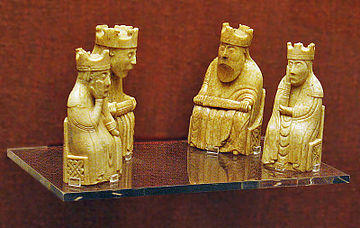
(The Uig chessmen, named after the bay where they were found, are a group of 12th century Viking chess pieces, carved in walrus ivory).
On first consideration, these Macleods were of a fixed and distinct geographical location, centred around Uig, but this was not so. From the 1790s, the Seaforth-owned Parish of Uig was rented out as sheep farms. In the early 1820s, evicted Seaforth tenants were moved to waste land at Aird Tong. In the following year, Alexander Craig, a Seaforth Estate manager visited Aird Tong and was appalled by what he saw:
“Until I saw the actual situation of the new cottars at Aird Tong I had no idea of the great hardships and deprivation that the poor people had to endure. The situation of the new cottars at Aird Tong at this moment beggars all description. It is even worse than anything I ever saw in Donegal, where I always considered human wretchedness to have reached the very acme.There were no tracks, far less roads, to the new settlement and its occupants had literally to step to their knees in mud once they stepped outside their thresholds”.
It can not be known if the Macleods of Tong were of the same flock as those of Uig.
(Those of the latter place are now of note for their connection to Mary Anne Macleod, the mother of President Trump. Her immediate ancestry is briefly given thus:
1. Keneth Macleod, b. 1776, & Catherine MacIver.
1.1. William MacLeod, crofter/fisherman, 1806-1869.
1.1.1. Alexander MacLeod, crofter/fisherman, died in Tong in 1900.
1.1.1.1. Malcolm MacLeod, crofter/fisherman & Mary Smith, married 1891.
1.1.1.1.1. Mary Anne Macleod, b. 10th May 1912 at Tong, 3-4 miles from Stornoway, and 1 coatal mile from Aird of Tong.
1.2. Murdo Macleod, b. 1810, & Mary Murray).
What is certain is that Mary Anne Macleod’s ancestors would have been spellbound by the trial of Malcolm Macloud, of Knock (in) Uig; conducted in 1838 before Judge Lord Cockburn, in Stornoway; as reported by Archibald Campbell Swinton, in Reports of Cases Before the High Court and Circuit Courts of Justicary in Scotland, vol. 2., 1842:
The charge: “In so far as on the 27th January 1838, within or near to the house situated at Clete, on the lands of Bayble … in the parish of Knock (in) Uig … (he) did wickedly and feloniously attack and assault the now deceased Henrietta M’Leod, his wife, and did seize her by the face, and did, with his hand … violently compress her mouth and nostrils, so as to prevent her from breathing, and did throw her down upon the ground … and did press forcibly with his knee upon her back … and did thereby break three of her ribs, and did continue to compress her mouth and nostrils.
(Malcolm M’leod) stated that he was thirty-four years of age, and that he married the deceased, Henrietta M’Leod, in the month of May or June 1829, by whom he had three children, boys. After their marriage they lived very happily together, but within the last three years they did not live so happily, which arose in consequence of a coolness on her part, from time to time, towards him — she not appearing to be so much attached to him as formerly — in which she was encouraged by some of her relations who lived near them. He stated further, that she had expressed to him that she wished him dead, and was indifferent though he should leave her altogether. On one occasion … his wife was cutting potatoes in the house, while he was giving a lesson to some of his neighbour’s children in Gaelic: she ordered him to go out and work at the labouring of the land, or she would stab him; upon which he went and called in two elders, to be evidence against his wife for threatening him. One night also, whilst he was in bed with his wife, he found her pressing him upon his breast with her elbow, by which he was awakened out of his sleep, in consequence of the pain, which he felt for some time afterwards. He told her she meant to take away his life, which she denied. She went to her father’s house, taking with her the infant child, and did not return to her own house for four or five days.
There came some blood from his wife’s mouth and nose, before he took his hands off her face. He stated that he thought he was only about five or six minutes, in accomplishing the act of putting an end to his wife’s existence. On finding life was extinct, he lifted her into the bed in which he and she usually lay, and laid her down upon her back therein, and washed her face, which was dirty from the dust of the floor, upon which she fell, when he had seized her, as before described. He washed her face from water that was in a metal pot, and took a towel or rubber to dry her face with. As he was just done, he heard his mother-in-law rapping at the door, upon which he put the pot and towel below the bed on which his wife’s corpse lay, and went and opened the door. Previous to committing the act, he had secured the door, by putting up a spade or stick as a prop; his children were out at the time, but he did not put them out. It was about sunset when he committed the deed; and it was not just dark, but nearly so, when his mother-in-law came to the door.
In his second Declaration (he) stated that he adhered to what he had previously said, except that he regretted having said so much against his wife for her treatment of him, because she has departed this life, and cannot now answer for herself. He stated further, that the deceased had a red worsted shawl upon her at the time he took away her life, which he tightened round her neck, the sooner to hasten her death. All that she was able to say, after he commenced taking away her life was,—” Let me alone.” For sometime previous to his committing the act, he knew that she was with child to him; but at the moment he did the deed that circumstance did not occur to him“.
Catherine M’Donald, wife of Malcolm M’Donald, fisherman, “I knew the deceased Henrietta M’Leod, who lived next door to me. (Malcolm M’leod) was reckoned a religious man; be was once a schoolmaster. The deceased was of a mild temper”.
Isabella M’aulay (see deposition of 1805, no. 3, heretofore) or M’leod, residing at Clete: “I am the mother of the deceased. We lived very near each other. I last saw my daughter in life on a Saturday, about breakfast time. This was the same day she died. I went in the afternoon, and found the door fastened. I knocked at the door, but could not get entrance, and I went back, believing my daughter to be praying. I went again shortly after, ind the door was still fastened. 1 knocked with some force … after (Malcolm M’leod) came to the door. He did not say a word until we came to the inner room, when he said, “Henrietta has nothing to say now — she cannot speak.” I looked for my daughter, and saw her laying across the bed, and put my hand on her Person and ascertained she was dead. I then called out to (Malcolm M’leod), “Henrietta is dead”. The brother and sister of the deceased then came to the house. The brother, Roderick M’leod, said to (Malcolm M’leod), “As sure as Henrietta is dead you will die also.” (Malcolm M’leod) then came to me, and, patting me on the shoulder, said, “Don’t you know that I was good to her?”
Gordon (representing Malcolm M’leod), proposed to ask the witness, whether she knew a son of (Malcolm M’leod’s) uncle who was insane at times. Some discussion took place as to the competency of the question, in the course of which Lord Cockburn observed, that it had been decided, in the House of Lords, that it was incompetent, in a civil cause, to lead evidence that the alleged insanity was hereditary. The witness did not know (Malcolm M’leod’s) uncle or his family.
Roderick M’leod, tenant of Totteranach: “l am the brother of the deceased. I heard the deceased complain that (he) did not work for his family; he did not fish with his neighbours, though he was under an engagement to do so all the season. She said he had lost his character in consequence. I saw my sister on the bed dead; (he) was standing by, and said it would be a great loss to him to want her. The body was warm about the breast at this time … About an hour afterwards I saw some marks on the face of the deceased — some scratches about the mouth and cheek. There was some blood about the teeth. I have known (Malcolm M’leod) for twelve years … and never considered him to be of unsound mind. He was unkind and uncharitable towards his wife (having) feelings of jealousy, which were unfounded. (He) made a curious piece of workmanship of wood, in the parish of Uig; it was like a cart-wheel, and was said to be intended for private prayer. This was all his wife said about it. He prayed inside the circle of the wheel; the sharp ends of the nails were up, as the deceased told me, and I myself saw afterwards the places where they had been. This was about five years ago. I heard that he got up in church one Sunday, and spoke to the minister; the deceased said so; this happened six or seven years ago. The words he used were, “I am tired of you, you devil!” meaning the minister … The deceased was very sorry for this, as it would injure her husband’s character. (He) told her that he was discovering the perpetual motion, and that if he had got the materials he would have made the discovery; he wanted loadstone. (He) also said he was engaged in some plan for propelling vessels without wind or tide. This plan was tried on a small boat last winter, (he) having made machinery for it. He wrote a great deal about the perpetual motion. As a religious man, (he) thought himself better than other people. He left the church, and some people called on him privately to receive instruction from him”.
George Stewart, tenant in Big Park: “I am second cousin of the deceased. On the night when the deceased was lying dead on the bed, (he) was wringing his hands, and said he was an object that night. Some people asked him how she got to the bed; he answered that she got to the bed herself. There were some scratches on her face, and something like blood on her teeth. I have known (him) for four or five years. I never thought him wrong in his mind, except one day. That was about four years ago, on a Sabbath in the harvest time, when 1 saw him going to the river with a bed-cover about him. He spread the cover on the water twice, and then wrapt it about his person. I did not speak to him. He and I have frequently lived together. We fished together for twenty days last year, and he conducted himself like the first of the crew”.
Roderick Adam, mason, in Stornaway: “I acted as assistant to the constable in the apprehension of (him). There is no jail in Stornoway, and I assisted to keep him in a house. He spoke about the crime, and confessed that it was himself did it. He said he took his wife by the mouth and nose with his hand, that she fell forward towards the fire, and he gave her two or three chops with his knee on the back. He said she did not live above four or five minutes, that he next got some water to wash away the ashes and blood off her face, that he might conceal it. He said she did not get time to speak — five minutes was the longest time the whole took. He made no remark as to the cause of his murdering his wife”.
The following letter, written by Malcolm Macleod to his brother, after his apprehension, was then proved, and read to the Jury. “February 5, 1838. My Dear Brother,I must leave you under the law of the kingdom for my great sins against heaven and earth, which cannot be suffered without punishment, whatever the Lord in mercy do to my sinful soul through eternity. My great black and scarlet sin is before him. What can I say to you, but I have a low eye and trembling heart, and a low hope that the Lord have mercy on me a cursed poor man. Because that every man may ask his own possession, I must tell you, so far as I can, few things was between me and merchants in Stornoway. I hope that you will do a duty, and pay them with the things which I left. You will be so good as speak to Mr. John Mackenzie, the merchant, Stornoway”. Malcolm Macleod. Addressed — Mr. Angus Macleod, Port Vallon, parish of Uige or Knock, Stornoway.
The following translation of a letter written by Malcolm M’leod in Gaelic to his brother-in-law, was also proved and read:
“February 6th, 1838. Dear Friend, I am now bound with the good laws of the kingdom, for my heinous sins, in the presence of God and of men. I now cnnfess with sorrow and shame the thing for which I am deserving of being in chains of darkness till the great day of judgment. Death and eternity are now before me; my burden is too heavy, my hands are red and corrupted with blood, and my fingers with iniquity. I am now under the curse; my sins were great before, but now much greater. Little is my confession worth, unless Jesus Christ will have great mercy on me in these short minutes. My eye is towards God through Christ, this day, that he may have mercy on me a lost sinner, even the chief of the blackest of sinners. Oh, it would be honourable to me this day, that she had been living, and I dead: not that I should live these few short days under great disgrace. My eye is towards the Lord this day. I pray thee, from the brink of Jordan, that you nor any other will not impute my sins to my poor children; but that you will shew them mercy for the sake of the Lord, and that you will set a godly example before them in the days of their youth. Sorrowful I am; but although you should not remember me to them, remember the Redeemer to them; wheresoever they go, they are under his care”. Malcolm Macleod. Addressed — Mr. Roderick Macleod, Tenant at Bayble.
Catherine M’leod, residing at Clete: “I am Malcolm Macleod’s sister. He sometimes spoke of his wife in a violent manner, but I never heard him say he was jealous of her. The deceased, however, said that her husband was jealous of her, and told me a story of her husband having sworn her on the Bible. She said he had made her go down on her knees, and swear on a Bible that she never had connection with any other man. The deceased was much grieved at this conduct; she was a circumspect and virtuous wife. I never saw the wheel which he had made, but I saw something of the pulpit he had. The deceased used often to speak of the pulpit, and said it was a verv curious idea”.
Rev. Mr. M’kenzie, Knockbain: “I had a school in Stornoway some years since. (He) attended the school for about half a year in 1824 or 1825. He was learning a little English, to qualify himself for being a Gaelic teacher. He was of a mild and gentle disposition; he did not manifest any particular quickness or slowness at school. When he left the school, (he) wrote a letter to me, which appeared to have been written in blood. He called on me in the spring of 1833 or 1834, and intimated that he had discovered the perpetual motion. 1 was a little astonished, but I knew that (he) had fanciful and peculiar ideas on religious subjects. In the same year he wished me to apply to the member for the county, to procure for him fourteen or twenty-eight pounds weight of loadstone, which was to be the moving power in the machine for the perpetual motion. The member for the county was his landlord”.
Dr. Chisholm, Inverness: “I am aware that insanity is generally divided into four sections — moral insanity, mania, monomania, and dementia, A person may have a delusion on one subject, and be perfectly sane on all others. The intellect may be so constituted, that a man may be impelled, by partial derangement, to do an act of violence, or commit a crime, though conscious at the time that he is doing wrong. There may be moral insanity, and yet no particular delusion”.
Gordon, for Macleod: “(He) was evidently deranged at the time when he committed the crime. The various kinds of insanity have been divided into,— 1. Idiocy, where the mental faculties have been wanting from birth; 2. Dementia, where the faculty of judgment is entirely lost; 3. Mania, where the understanding is generally deranged; 4. Monomania, where the understanding is partially diseased, under the influence of some particular illusion, referring to one subject, while the intellectual powers are, on other subjects, in a great measure unimpaired; 5. Moral Insanity, where there is no insane illusion or defect of the intellect, but a morbid perversion of the feelings, temper, and natural impulses. (Pritchard’s Treatise on Insanity; Watson’s Medical Jurisprudence, p. 322). The present case partakes of the character of the two last. (See case of Doux. Beck’s Medical Jurisprudence, 5th Edition, p. 410.) In cases of monomania, if the crime can be traced as directly flowing from the prevailing delusion in the mind of the criminal, he is not responsible. (Speech of Lord Erskine in the case of Hadfield, State Trials, vol. xxvii. p. 1307; Alison, vol. i. p. 645.) That (he) was not of sound mind, generally, is proved by a variety of circumstances, such as his writing the letter to Mr. M’Kenzie in blood, his strange religious notions, the inexplicable story with regard to the wheel, studded with nails, upon which he prayed, the pulpit,the story of the blanket, which he put into the river, and then threw around his shoulders, which made the witness who saw it think him mad, —his fancy that he had discovered perpetual motion; and, above all, his wild and extraordinary exclamation in church, which, of itself, was sufficient to point out a diseased mind, and proved that he was a person who acted upon incontrollable impulses. But the prevailing illusion of his intellect, which seems to have influenced his whole conduct, and constituted the peculiar monomania of his mind, was jealousy of his wife, and a belief that his life was threatened by her. See the case of Clark v. Pritchard, 1825, p. 376″.
“Lord Cockburn charged the Jury, directing their attention to the legal authorities on the subject (Hume, vol. i. pp. 37, 38. Alison, vol. i. pp. 644, 645), and expressing a decided opinion that the general result of the evidence was, not merely that the defence of insanity was not made out, but that it was disproved.
The Jury unanimously found Macleod guilty.
In respect of which verdict of Assize, he was sentenced to be executed at Inverness on the 11th of May.
In consequence of an application to the Secretary of State, two successive respites were obtained, for the purpose of staying the execution of MacLeod, until additional evidence could be obtained regarding his alleged insanity. A proof was accordingly taken at Stornoway. Several of MacLeod’s neighbours deponed that for the last three years, they had considered him subject to temporary fits of insanity; but the general character which he received was that of a remarkably sober and religious man, of a very mild and easy disposition, but of a visionary and abstracted turn of mind. He had been remarkable since his schoolboy days for his patient endurance of injuries, and a temper quite the reverse of irritable. Various instances of his eccentric conduct were detailed; such as on one occasion, working in the open air in a state of almost entire nudity, his rolling himself up in a blanket which he had previously steeped In a river, and which he wore by way of doing penance for the sins of his neighbours, and his constructing a large wheel, studded with ten long iron spikes, within which he was in the habit of praying, and the object of which he explained to be that each spike represented one of the ten commandments, and if he fell asleep while engaged in prayer, he would be pierced by those spikes which represented the particular commandments which he was most deficient in observing. His deceased wife had once informed a neighbour that he did not at times know what he said or did; and on the occasion of his calling out in church, as described in the evidence on the trial, he stated himself that he did not believe he was in his sound mind. The circumstance of his supposing, that if he had proper materials, he could discover the perpetual motion, was fully established”.
He was eventually found to be insane, and sent to Broadmoor.
The trial reads as a treatise of a state of mind shaped by feelings of insecurity, developed in a remote and harsh environment, leading to a grandiose state of delusion (the then ‘monomania’), given expression by a very ideosyncratic interpretation of religious doctrine. As such, it has an ongoing relevance to psychiatry.
Of the Macleods of Lewis, generally. In the Darwinian sense, they sought to survive and prosper as a clan, a “species”, within which individuals worked together for the mutual good of all; but which fell apart through internal fractures caused by individual greed and lust for power: the most enduring of stories.
The Macleods of Lewis played others in a brutal game of chess, and lost.
copyright m stanhope 2017


 Walter FitzGilbert de Hamilton
I have been to the Isle of Lewis, many years ago. It was a place set apart from the rest of Britain; only reached after driving for hours through Scotland’s grandest mountains and moorlands, and then a three-hour sea crossing on the ferry from Ullapool.
We heard Gaelic spoken in the streets of Stornaway – a place where strict Sunday observance as a day of peace, quiet and rest, after the morning service, would have truly justified Tony Hancock’s Half Hour sketch about a boring Sunday afternoon in 1950s/60s’ England with nowhere open and nothing to do. On Lewis, nobody would mow the lawn or even hang out their washing on the Sabbath day. We saw one little family out for an evening walk, the parents reminding their boisterous children to go quietly, so as not to disturb anybody as they passed their houses. I don’t suppose it has changed much.
Out of the only town, I remember Lewis being largely an uncultivated moorland, peppered with mounds of cut peat drying out in the Atlantic wind to be burnt for fuel. Bleak, but beautiful in its own way, with a chain of fine, totally empty beaches down the sparsely-peopled western coast.
Set in a wild and lonely place, as John Laurie would have said, the mysterious Callanish standing stones beat Stonehenge hands down for atmosphere.
There was nobody else there when we visited them, and no visitor centre had yet been built to tame the sweeping remoteness of their isolated panorama. Windswept clouds scudded dramatically across a broad, open sky over this prehistoric setting.
The Callanish stones must have been ancient and enigmatic, standing there silently in all weathers, for thousands of years before the Macleods gained power on Lewis.
But the landscape has probably changed little and it wasn’t difficult to use one’s imagination to picture the people who erected them. Exactly when and why they did so is still being studied.
If anybody would like to know more about the Callanish stone circle and see photos, this link leads to several interesting websites:
https://www.google.co.uk/webhp?gws_rd=ssl#q=The+Callanish+stones
Nick.
LikeLike