
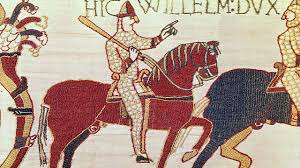
Then, who was he who bore the famed title, “Turstinus filius Rollonis vexillum Normanorum portavit?”. Wise men of old debated this question in pre-revolutionary France, and would often comment on the ascertion made in Le Mercure Galant (1709) that the bearer of the Norman battle standard at Hastings was “Guillaume Toustain” (William Crispin), which was based on a false understanding of the locational origin of Turstin, confounding Bec-Cauchois with Bec-Crespin.
The “wise ones” also speculated on the origins of Rollo/Raoul/Rolf de Bec, taking into account that he must have been related to Duke William, and would probably have associations with the ducal domain of Fecamp. A concensus was beginning to form by 1780 that he was probably an illigitimate son of Duke Robert II. (“bâtard du Duc Richard petit“), and Turstin (Toustain) his son was a possible cousin of William the Conqueror.
1. Raoul, Rolf.
1.1. William, – December 17, 942. William Longsword (Guillaume Longue-Épée, Willermus Longa Spata, Vilhjálmr Langaspjót), m. Luitgarde, daughter of Count Herbert II. of Vermandois, whose dowry gave him the lands of Longueville. Herbert was a descendant of Charlmagne (see Bradbury, The Capetians: Kings of France, 987-1328, p. 36, 2007).
1.1.1. Richard, b. 28 August, 933 in Fécamp; d. November 20, 996 in Fécamp, m. Gunnora.
1.1.1.1. Richard, August 23, 963 – August 28, 1026.
1.1.1.1.1. Robert, “le Magnifique”, June 22, 1000 – July 1035.
1.1.1.1.1.1. William “the Conqueror”, c. 1028 – 1087.
1.1.1.2. Emma, 985 – March 14, 1052, bur. Winchester Cathedral, m., firstly, Æthelred II., King of England, son of Edgar “the Peacable”, King of England, and his second wife, Ælfthryth.
1.1.1.2.1. Edward “the Confessor”. Emma m. secondly Canute, King of England.
1.1.1.1.2. Raoul, Rolf, “bâtard du Duc Richard petit“. The Anglo-Saxon Chronicle names “bishop Rudolf” as Edward the Confessor’s kinsman when recording his installation by King Edward as bishop of Abingdon, in 1051, a year before his death. He was likely of Danish extraction (see David Knowles, ‘The Monastic Order in England’, p. 68, 1963); one of the “episcopus ab Anglia multos adduxit in Daniam” charged with spreading the Gospel in Scandinavia after the succession of Canute as King of England; who, by this construction, was his uncle, with Edward the Confessor being his cousin. He was not necessarilly a monk, perhaps more an embassador of religion. Rudolf/Rolf accompanied Bishop Sigurd on his visit, in 1030 or 1031, to the Bremen Archbishop, Liawizo. The entry in the Chronicle reads: “Then at mid-Lent [1051] King Edward had a council-meeting in London, and set Robert as archbishop for Canterbury and Abbot Sparrowhawk bishop for London, and gave Bishop Rudolph, his relative, that abbacy in Abingdon“.
1.1.1.1.2.1. “Turstinus filius Rollonis vexillum Normanorum portavit“, of Bec Cauchois; a league and east-south-east of Fecamp, not Bec-Crespin, near Montivilliers, a distance of more than five leagues from Fecamp. By this construction, he was William the Conqueror’s cousin.
1.1.1.1.2.2. Walter de Bec-aux-Cauchois. Tenant of Walter Giffard II. (Domesday). Donated lands in Gueuteville (Amfreville-Gueuteville; Yvetot), with Turstin de Bec, to Boscherville in c. 1050 (R.A.D.N. 197). He expanded his territory from Buckinghamshire into Norfolk, where he married a daughter of Hugh de Grandcourt.
1.1.1.1.2.2.1. Robert de Bec-aux-Cauchois. Held of the Peverels (Stapleford, 2 carucates, six bovates), and Henry Ferrers in Derbyshire, and Herissiere, Haye-Pesnel, of the Peverels, under Hugh d’Avranches, in Avranches. “Le Sieur de Heriz a construit le château Hérissière (Société d’archéologie, ‘Revue de l’Avranchin’, p. 388, 1934). Another patron of Robert’s in 1080 was Walter Giffard II. (Neustria Pia, p. 402). His father, Walter Giffard I., contributed 60 ships towards the invasion of 1066, and received 107 lordships (48 in Buckinghamshire) as a reward. Walter was one of two who, having been offered the privilege of carrying William’s standard in the battle, respectfully refused; the honour going to “Turstinus filius Rollonis vexillum Normanorum portavit”. Walter was (on chronilogical grounds) a grandson of Osborne de Bolbec, Lord of Longueville and Avelina, sister of Gunnora, Duchess of Normandy. As such he was a cousin of William the Conqueror.
1.1.1.1.2.2.1.1. Robert de Heriz I., ob. ante. 1128, who held Stapleford, Tibshelf, Wingfield, and Oxcroft, was mesne tenant of William Peverel. Robert was Sheriff of Nottingham, 1110-1122 (Judith A. Green, The Government of England under Henry I., p. 221, 1989). He was a King’s Commissioner who witnessed charters of Robert de Ferrers, 1st. Earl Derbys. He was “probably son of the Domesday tenant” (“Robert”), who held Tibshelf and Stapleford (Notts.) under William Peverel (G. Turbutt, A history of Ogston, p. 226, 1975). The Robert of Domesday was also styled “Robert de Dun”, noted as donator in the foundation charter of Tutbury Priory (founded by Henry Ferrers), and in subsequent charters of that house. A part of the Norman honour of the Ferrers was near St-Aubin-sur-Mer, Seine-Inf., arr. Yvetot, cant. Fontaine-de-Dun (Le Prevost, Mem. et Notes … de Eure, ii. 100). Bourg-Dun is 2 miles south-east of St. Aubin. It is probable that “Robert de Dun” was Henry de Ferrer’s tenant in Normandy.
1.1.1.1.2.2.1.2.Geoffrey de Heriz is recorded in Avranches with ‘les hommes de Guillaume Peverel sont du diocèse d’Avranches’ (Société d’archéologie et d’histoire de la Manche, 1992, Identification des notables de l’Avranchin et du Cotentin cités dans le livre noir de l’abbaye de la Lucerne, 1143-1309, p. 56). The Heris name is a contraction of (Héris)sière, and their armorial of three hedgehogs was a pun of Hérissière, a fort with defensively angled wooden spikes that resembled the spines of a hedgehog; hérisson being an hedgehog. Hérissiere was also called La Rochelle-le-Hériciere (D.N., v. xi., p. 379, 1776), and another common spelling of Heris/z was Herice, a contraction of Hériciere.
1.1.1.1.2.2.2. Walter de Bec. “Walterus de Beco” appears in Pipe Roll, 31 Hen. 1. (Bucks); according to Lib. Nig. 221, he was a tenant (” Walterus del Bec”) of Earl Ferrers.
Wise men of old may not have frowned.
copyright m stanhope 2016


 Walter FitzGilbert de Hamilton