
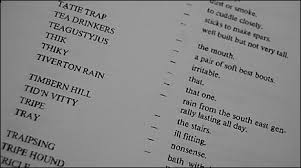
James Jennings (Observations on some of the dialects in the west of England, 1827) made the point that the spoken English of Chaucer treated syllables in the same way as occured in the Somerset dialect north east of the River Parret, which made “two syllables of words which are monosyllables in our polished dialect. And thus the words air, both, fair, fire, stairs, sure, &c. become ayer, booath, feyer, vier, stayers, shower, &c. And thus, 1 have no doubt, they were formerly very generally pronounced, as Chaucer gives many of them as dissyllables”.
He also drew other parallels: “There is also as strong a tendency to pleonasm in some instances, as to contraction and elision in others. Thus we have alost for lost, agone for gone, abought for bought, abrought for brought, &c. Exemplifications of these prefixes will be found in abundance in Chaucer; but he very often uses the y instead of a, as ylost”.
He defended this Somerset dialect agaist charges of inferiority: “Notwithstanding there is an impression very generally entertained, I believe, that this dialect of the west is a very rough and inharmonious one; except in the frequent and unpleasant use of Z for S and V for F, I do not think it will be found so deficient in agreeable sounds as it has been commonly supposed”.
Importantly, he was a student of pronounciation, and “conveyed in letters the nearest to the sound of the words” several poems written in this dialect. He explained his method: “Where I have used the circumflex over the letter a it is to be understood that the sound of the letter is to be exactly like the a in father. I might have adopted the same plan with respect to the vowel o, for the long sound of it, as heard in the words no, gold, &c.; which is, for the most part, like aw in the word awful, but, as it is very easy to convey this sound by an additional letter, I have preferred the latter mode”.
That listening was central to his methodology is evidenced in his comments about book-driven lexicography: “Too many of our lexicographers have fallen, in compiling a dictionary from a living language. They have depended too much upon books, and too little upon the use and accepted meaning of words as they are current in the every-day transactions of life. Hence it sometimes happens, that the meaning in a dictionary is at variance with the use of the word in society; and it has happened, too, that many words are current in society, which no lexicographer has arrested, but which are nevertheless useful words. Books are not, in fact, the only sources whence information of this kind should be derived”. He further commented: conjectural etymologies are, in too many instances, calculated to mislead”.
He makes a point that can be expanded: “It is remarkable that few, if any, dictionaries of our language are to be obtained which were published from the invention of the art of printing in the middle of the fifteenth century and during the whole of the sixteenth, a period of about one hundred and fifty years. These dictionaries would, no doubt, throw considerable light on our early literature and provincial words. It is true some scarce copies of such works are to be found, I understand, in the cabinets of the curious, but they are not accessible to the general reader”.
Dictionaries, plays, and Classical literature were freely available to the university educated, “which were published from the invention of the art of printing in the middle of the fifteenth century and during the whole of the sixteenth”. The salient point being that such publications as replications aided the standardisation of Elizabethan English among the social/intellectual elite.
When historians refer to the English people of this time as an homogenous entity, united in a common opposition to Spain, or enjoying the plays of Shakespeare, they but refer to a ruling elite. The dispossed Catholic half of the country prayed for a Spanish invasion; the vast majority of people would not have understood much spoken by Queen Elizabeth (rallying a homogenous English army!), or, for that matter, anything spoken in a play of Shakespeare; for the general public did not have access to or understanding of the written word, and were thus excluded from the process of the harmonisation of the English language. They lived in idiosyncratic and remote islands of dialect, and, when migrating to London, tended to live in single-dialect communities, much the same as in modern cities.
Idiosincracy was a key key element in distinguishing the English of the elite from that of the masses, for not only were the sounds of various English dialects almost alien to each other, these dialects also contained words which were not shared: Dialects differed in substance as well as form, with area-specific words reflecting ancient colonisations by different ethnic groups.
It is one thing in the luxury of time to reflect on the common origin of words, and another to suppose in the instance of their delivery that they would be understood by all.
Mr. Jennings entreats: “To a person, therefore, acquainted with this dialect, who has leisure, and who should feel disposed to go through a course of study amongst our old writers, and who has an opportunity of examining our old MSS., an abundant harvest offers, from which an amusing book might be made, illustrative of many of our provincial words and of our ancient manners. But such leisure, whatever may be my disposition, does not fall to my share; the compilation of such a work must be left to some more fortunate individual than myself. I must be contented with having thus far elucidated the language of my native county”.
He provides a valuable glossary of words (extracts of which are given), which can be compared and contrasted with Chaucer, and those of other regional dialects:
GLOSSARY OF WORDS COMMONLY USED IN THE COUNTY OF SOMERSET; BUT WHICH ARE NOT ACCEPTED AS LEGITIMATE WORDS OF THE ENGLISH LANGUAGE;OR WORDS WHICH, ALTHOUGH ONCE USED GENERALLY, ABE NOW BECOME PROVINCIAL.
A. adv. Yes. A is also frequently used instead of the pronoun he: as a zed a’d do it; he said he’d do it.
Abrood’. adv. When a hen is sitting on her eggs she is said to be abrood.
Agoo’. I Ago; agoo, Chaucer; from the verb to goo, i. e. to go; he is up and agoo; he is up and gone.
Aller. s. The alder tree.
Anby’. adv. Some time hence; in the evening.
Apast’. part. and prep. Past; apast, Chaucer.
To Ar’gufy. v. n. To hold an argument; to argue.
Assu’e. adj. When a cow is let up in order that she may calve, she is said to be assue — having no milk.
To Ballirag. v. a. To abuse with foul words; to scold.
To Bane. v. a. To afflict with a mortal disease: applied to sheep.
Barrow-pig. s. A gelt pig.
Be’edy. s. A chick.
Befbr’n. prep. Before.
Begrum’pled. part. Soured; offended.
To Belg. v. n. To cry aloud; to bellow.
To Belsh. v. a. To cut off dung, &c. from the tails of sheep.
To Bethink’. v. a. To grudge.
Bettermost. adj. The best of the better; not quite amounting to the best.
To Biv’er. v. n. To quiver; to shake.
Blanker. s. A spark of fire.
Bleachy. adj. Brackish; saltish: applied to water.
Booath. pron. Both. “Boo’ath o’ ye;” both of you.
Brock. s. An irregular piece of peat dried for fuel.
Bullen, adj. Wanting the bull.
To Bunt. v. a. To separate flour from the bran.
Bur’cot. s. A load.
Buss. s. half-grown calf.
Chaity. adj. Careful; nice; delicate.
To Cham. v. a. To chew.
Chamer. s. A chamber,
Change. s. A shift; the garment worn by females.
Chit’terlins. s. pi. The frills around the bosom of a shirt.
Choor. A job; any dirty household work.
To Claps. v. a. To clasp.
Clavy. s. A mantel-piece.
Clinker-bell. s. An icicle.
Clint. v. a. To clench; to finish; to complete.
Clear-and-sheer. adv. Completely; totally.
Cock-lawt. A garret; cock-loft.
Cock-and-Mwile. s. A jail.
Colley. s. A blackbird.
Cow-baby. s. A coward; a timid person.
Creem. s. Sudden shivering.
Croom. A crumb; a small bit.
Crow’sty. adj. Crusty, snappish, surly.
Cutty. adj. Small; diminutive.
To Daver. v. n. To fade; to fall down; to droop.
Dibs. pl. Money.
To Dout. v. a. To extinguish; to put out.
To Downarg. v. a. To contradict; to contend with.
Drang. s. A narrow path. To Drash. v. a. To thresh.
To Drean. v. n. To drawl in reading or speaking. (A feature of this Somerset dialect).
Drode. part. Thrown.
To Drool. v. n. To drivel.
Drove. s. A road leading to fields, and sometimes from one village to another.
To Druck. v. a. To thrust down; to cram.
Drubbin. s. A beating.
To Dud’der. v. a. To deafen with noise; to render the head confused.
Duds. s. Dirty cloaths.
Emmet-batch, s. An ant-hill.
En. pron. Him; a zid en; he saw him.
Few. adj. More commonly pronounced veo.
Fil’try. s. Filth; nastiness; rubbish.
Flap-jack. A fried cake made of batter, apples, &c.; a fritter.
To Frump, v. a. To trump up.
To Fur. v. a. To throw.
Fur’cum. s. The bottom; the whole.
To G’auf. v. n. To go off.
To G’ auver. v. n. To go over.
To G’ in. v. n. To go in.
To G’ on. v.n. To go on.
To G’ out. v. n. To go out.
To G’ under. v. n.. To go under.
To G’ up. v. n. To go up.
Ginnin. Beginning.
G’lore. adv. In plenty.
Graint’ed. adj. Fixed in the grain; difficult to be removed.
Grammer. s. Grandmother.
Grithle. s. A young apple-tree raised from seed.
To Gud’dle. v. n. To drink much and greedily.
To Hain. v. a. To exclude cattle from a field in order that the grass may grow, so that it may be mowed.
Ham. s. A pasture generally rich, and also unsheltered.
Hard. adj. Full grown. Hard people, adults.
To Have. v. n. To behave.
Hay’ty-tayty. Interj. What’s here!
Heft. s. Weight.
To Hell. v. a. To pour. To hell in, to pour in;
Herence, adv. From this place; hence.
Hereright, adv. Directly; in this place.
Het, pron. It.
Het o’nt, it will not.
To Hick. v. n. To hop on one leg.
To Hike off. v. n. To go away; to go off.
Hollardy-day. Holy-rood day; the third of May.
Huck’muck. s. A strainer placed before the faucet in the mashing-tub.
Hum’drum. s. A small low three-wheeled cart, drawn usually by one horse; used occasionally in agriculture.
To Jee. v. n. To go on well together.
Jod. s. The letter J.
Keffel. s. A bad and worn out horse.
To Kern. v. n. To turn from blossom to fruit.
Kexies. As dry. as a kexy is a common simile.
Knot’tlins. s. pi. The guts of a pig or calf prepared for food by being tied in knots and afterwards boiled.
Lai’ter. s. The thing laid; the whole quantity of eggs which a hen lays successively.
Lam’iger. adj. Lame; crippled; laid up.
Larks-leers. s. pi. Arable land not in use; such is much frequented by larks; any land which is poor and bare of grass.
Lat’itat. s. A noise; a scolding.
Leathern-mouse. A bat.
Leer. adj. Empty.
Leer. s. The flank.
Lighting-stock. s. A horse-block; a graduated place of wood or stone, made to ascend and descend from a horse.
To Line. v. n. To lean; to incline towards or against something.
Lin’ny. An open shed, attached to bams, outhouses, &c.
Lock. s. A small quantity; as a lock of hay, a lock of straw.
Lockyzee! interj. Look, behold! Look you, see.
Lug. s. A heavy pole; a pole, a long rod.
Mang-hangle. adj. Mixed in a wild and confused manner.
To Meech. v. n. To play truant; to absent from school.
Messin. The act of serving cattle with hay.
Min. A low word, implying contempt, addressed to the person to whom we speak, instead of Sir. I’ll do it, min.
Mom’met. s. A scarecrow; something dressed.
To Moot. v. a. To root up.
Nan. interjec. Used in reply, in conversation or address, the same as Sir, in polite company, when you do not understand.
Nap. s. A small rising; a hillock.
Nawl-cut. s. A piece cut out at the navel: a term used by butchers.
Nestle Tripe. s. The weakest and poorest bird in the nest; applied, also, to the last-born, and usually the weakest child of a family;any young, weak, and puny child, or bird.
Nora’tion. Rumour; clamour.
Nor’thering. adj. Wild, incoherent, foolish.
Not-sheep. s. A sheep without horns.
Num’met. A short meal between breakfast and dinner
Nuncle. s. An uncle.
To Nuncle. v. a. To cheat.
Nuth’er. adv. Neither.
To Onlight. v. n. To alight; to get off a horse.
Ont. Will not. This expression is used in almost all the persons, as ont, he ont, we ont.
Oten. adv. Often.
Ourn. pron. Ours.
To Overget. v. a. To overtake.
To Overlook. v. a. To bewitch.
Overs. s. pi. The perpendicular edge, usually covered with grass, on the sides of salt-water rivers, is called overs.
Parfitly. adv. Perfectly.
Par’rick. s. A paddock.
To Payze. v. a. To force, or raise up, with a lever.
To Peach. v. a. To inform against; to impeach.
Peel. s. A pillow, or bolster.
To Peer. v. n. To appear.
Pigs-looze. s. A pigsty.
Pill-coal. v. A kind of peat, dug most commonly out of rivers: peat obtained at a great depth, beneath a stratum of clay.
To Pitch. v. a. To lay unhewn and unshaped stones together, so as to make a road or way.
To Pixy. crop is taken in; to glean, applied to an orchard only.
Pla’zen. s. pi. Places.
Plough. The cattle or horses used for ploughing; also a waggon and horses, or waggon and oxen.
To Pray. v. a. To drive all the cattle into one herd in a moor; to pray the moor, to search for lost cattle.
Pud. s. The hand; the fist.
Pulk. s. A small, shallow-place, containing water.
Put. s. A two-wheeled cart used in husbandry, and so constructed as to be turned up at the axle to discharge the load.
Pux’ie. s. A place on which you cannot tread without danger of sinking into it: applied most commonly to places in roads or fields where springs break out.
Pwint. s. Point.
Pwine-end. The sharp-pointed end of a house.
To Quar. v. a. To raise stones from a quarry.
Quar-man. A man who works in a quarry.
Quine. s. Coin, money.
To Quine. v. a. To coin.
Quine. A corner.
Rames. s. pl. The dead stalks of potatoes.
Ram’ping. part. Distracted, obstreperous: ramping mad, outrageously mad.
Raught. part.
To Rawn. v. a. To devour greedily.
Re’balling. s. The catching of eels with earthworms attached to a ball of lead, suspended by a string from a pole.
Remlet. s. A remnant.
Rev’el. s. A wake.
Rud’derish. adj. Hasty, rude, without care.
Rum’pus. s. A great noise.
The sound of S is very often converted into the sound of Z.
Sand-tot. A sandhill.
To Sar. v. a. To serve.
Seed-lip. s. A vessel of a particular construction in which the sower carries the seed.
Sel’times. adv. Not often; seldom.
Shatt’n. Shalt not.
Shil’lith. A shilling’s worth.
Shord. A sherd; a gap in a hedge. A stop.
To Shroud; to cut off wood from trees generally.
To Sim. v. n. To seem, to appear. This verb is used with almost all the persons.
To Skag. To give an accidental blow, so as to tear either the cloaths or the flesh; to wound slightly.
To Skeer. v. a. To mow lightly over: applied to pastures which have been summer-eaten, never to meadows.
Skeer’ings. s. pl. Hay made from pasture land.
Skent’in. adj. When cattle, although well fed, do not become fat, they are called skentin.
Skiff-handed. adj. Left-handed, awkward. Chaucer, Second Merchant’s Tale. Skram-handed.
Slait. An accustomed run for sheep; hence the place to which a person is accustomed.
Slipper-slopper. adj. Having shoes or slippers down at the heel; loose.
To Slitter. v. n. To slide.
To Slock. v. a. To obtain clandestinely.
To Slock’ster. v. a. To waste.
Slom’aking. adj. Untidy; slatternly: applied to females.
Snead. s. The crooked handle of a mowing scythe.
Snock. s. A knock; a smart blow.
Snowl. s. The head.
Squot. A bruise, by some blow or compression; a squeeze.
Stake-Hang. s. Sometimes called only a hang. A kind of circular hedge made of stakes, forced into the sea-shore, and standing about 6 feet above it, for the purpose of catching salmon, and other fish.
Stang. A long pole.
Stefinin. A ford made with stones at the bottom of a river.
Stitch. s. Ten sheaves of corn set up on end in the field after it is cut; a shock of corn.
To Stive. v. a. To keep close and warm.
To Stiv’er. v. n. To stand up in a wild manner like hair; to tremble.
Stomachy. adj. Obstinate, proud; haughty.
Su’ent. adj. Even, smooth, plain.
To Sulsh. v. a. To soil; to dirty.
Sweetortin. Courtship.
Ta’e’ty. A potatoe.
To Tang. v. a. To tie.
Tee’ry. adj. Faint, weak.
Than. adv. Then.
Thauf. conj. Though, although.
The’rence. adv. From that place.
Thic. pron. That. Thilk, Chaucer.
To Tine. v. a. To shut, to close; as, tine the door; shut the door. To inclose; to tine in the moor, is to divide it into several allotments.
Tite, s. Weight. The tite of a pin, the weight of a pin.
Touse. s. A blow on some part of the head.
Towards. prep. is, in Somersetshire, invariably pronounced as a dissyllable, with the accent on the last: to-ward’s. Our polite pronunciation, tordz, is clearly a corruption.
Tut-work. Work done by the piece or contract; not work by the day.
To Twick. v. a. To twist or jerk suddenly.
Twily. adj. Restless; wearisome.
Unk’et. adj. Dreary, dismal, lonely.
To Unray’. v. a. To undress
Up’pin-stock. s. A horse-block.
Utch’y. pron. I. This word is not used in the Western or Eastern, but only in the Southern parts of the County of Somerset. It is, manifestly, a corrupt pronunciation of Ich, or Iche, pronounced as two syllables, the Anglo Saxon word for I. What shall utchy do?
I think Chaucer sometimes uses iche as a dissyllable; vide his Poems passim. Ch’am, is I am, that is, ich am; ch’ill, is I will, ich will. See Shakespeare’s King Lear, Act. IV. Scene VI. What is very remarkable, and which confirms me greatly in the opinion which I here state, upon examining the first folio edition of Shakespeare, at the London Institution, I find that ch is printed, in one instance, with a mark of elision before it thus, ‘ch, a proof that the i in iche was sometimes dropped in a common and rapid pronunciation. In short, this mark of elision ought always so to have been printed, which would, most probably, have prevented the conjectures which have been hazarded upon the origin of the meaning of such words as chud, chill, and cham. It is singular enough that Shakespeare has the ch for iche I, and Ise for I, within the distance of a few lines in the passage above alluded to, in King Lear. But, perhaps, not more singular than that in Somersetshire may, at the present time, be heard for the pronoun I, Itchy, or iche, and Ise. In the Western parts of Somersetshire, as well as in Devonshire, Ise is now used very generally for I. … which is the sound we give to frozen water, ice.
To Vang. v. a. To receive; to earn.
Vare. s. A species of weasel.
To Vare. v. n. To bring forth young: applied to pigs and some other animals.
Var’mint. s. A vermin.
Vell. s. The salted stomach of a calf used for making cheese.
Vier. s. Fire. Some of our old writers make this word two syllables: “Fy-er.”
Vin’ned. adj. Mouldy; humoursome; affected.
Vit’ty. adv. Properly, aptly.
Vollier. s. Something which follows; a follower.
Vooath. adv. Forth; out. To goo vooath, is to go out.
To Vooase. v. a. To force.
To Wam’mel. v. n. To move to and fro in an irregular and awkward manner.
Weepy, adj. Abounding with springs; moist.
Well-apaid. adj. Appeased; satisfied.
Wetshod. adj. Wet in the feet.Wev’et. A spider’s web.
Whatsomiver. pron. Whatsoever!
Wimmin-dust. Chaff.
Win’dor. s. A window.
With’er. pron. Other.
With’erguess. adj. Different.
Yalhouse. s. An ale-house.
Yarm. s. Arm.
Yarth. s. Earth.
Yel. An eel.
Z. See the observations which precede the letter S, relative to the change of that letter to Z.
Zam’zodden. Time in a low heat so as to be in part spoiled, is said to be zamzodden.
Zel. pron. Self.
Zog. s. Soft, boggy land; moist land.
Zull. s. The instrument used for ploughing land; a plough.
Zunz. adv. Since.
THE MAN OF MORK.
Awa wi’ all yer tales o’ grief
An dismal storry writin
A ma-be zumthin I ma zing
Ool be as much delightin.
Zumtime agoo, bevaur tha moors war tin’d in
lived at Mork one Jerry Nutty.
Iz vather in a little cot liv’d, auver-right tha moor
An thaw a kipt a vlock o’ geese
A war a thoughted poor.
A niver teach’d tha cris-cross-lain
Ta any of his bways
An Jerry, mangst the rest o’m did
Not much appruv his ways.
Vor Jerry zumtimes went ta church
Ta hire tha Pason preach
An thawt what pity that ta read
Izzel a cood’n teach.
Vor than, a zunday aternoon
Tha Bible, or good book
Would be companion vit vor’m all
Who choos’d therein ta look.
Bit Jerry than tha naise o’ geese
Bit little moor could hire
An daly goose-aggs ta pick up
Droo-out tha moor did tire.
A dten look’d upon tha hills
An stickle mountains roun
An wish’d izzel upon ther taps
What zights a ood be boun!
Bit what did mooast iz fancy strick
War Glassenberry Torr
A always zeed it when tha zun
Gleam’d wi’ tha mornin stor.
O’ Well’s grate church a oten hired
Iz fancy war awake
An zaw a thawt that zoon a ood
A journey to it make.
An Glassenberry’s Torr, an Thorn
The hawly blowth of which
A hired vrom one and tother too
Tha like war niver jitch!
Bit moor o’ this I need not za
Vor off went Jerry Nutty
In hiz right hon a wakin stick
An in hiz qut a tutty.
Now, lock-y-zee! in whimly dress
Trudg’d chearful Jerry on
Bit on tha moor not vur a went
A made a zudden ston.
Which wa ta goo a cood not thenk
Vor there war many a wa
A put upright iz walking stick
A vall’d ta tha zon o’ da.
Ta tha suthard than iz wa a took
Athert tha turfy moors
An zoon o’ blissom Cuzziton
A pass’d tha cottage doors.
Tha maidens o’ tha cottages
Not us’d strange vawk to zee
Com’d vooath and stood avaur tha door
Jer wonder’d what cood be.
Zum smil’d, zum whecker’d, zum o’m blish’d
“Od dang it! Jerry zed
What do tha thenk that I be like?”
An nodded to’m iz head.
“Which is tha wa to Glassenberry?
I’ve hired tha hawly thorn
War zet there by zum hawly hons
Zoon ater Christ war born”.
“An how can you, a seely man
Jitch seely journey make?
What! dwont ye knaw that now about
It is the midst o’ June?
Tha hawly thorn at Kirsmas blaws —
You be zix months too zoon”.
“Goo whim again, yea gawky! goo!
Zaw zed a damsel vair
As dewy mornin late in Ma
An Jerry wide did stare.”
“Lord Miss!” zed he, I niver thawt
O’ Kirsmas! — while I’ve shoes
To goo back now I be zet out
Is what I sholl not choose.”
“Ih zee the Torr an hawly thorn
An Glassenberry too
An, nif you’ll put me in tha wa
I’ll gee grate thanks ta you.”
“Goo droo thic veel an up thic lane
An take tha lift hon path
Than droo Miss Crossman’s backzid strait
Ool bring ye up ta Wrath.”
Now mine, whaur you da turn again
At vanner Veal’s long yacker
Clooase whaur Jan Lide, tha cobler lives
Who makes tha best o’ tacker.”
“You mist turn short behine tha house
An goo right droo tha shord
An than you’ll pass a zummer lodge
A builded by tha lord.”
“Tha turnpick than is jist belaw
An Cock-hill strait avaur ye.”
Za Jerry doff’d his hat an bow’d,
An thank’d to vor er storry.
Bit moor o’ this I need not za,
Vor off went Jerry Nutty;
In hiz right hon-a waktn stick
An in hiz qut a tutty.
Compare this with the “clipped” Yorkshire dialect, and ask whether those of different regions and not party to a university education had any chance of understanding each others’ words in the instance of their delivery. Apart from stark differences in pronounciation, no one outside Somerset would know what was meant by emmet-batch, etc.
COLONIAL SETTLERS OF VIRGINIA LIVED IN COMMUNITIES OF THE KINSHIP OF THE LIKE-TONGUED. (Utch’y zay).
“ON ILKLA MOOAR BAHT ‘AT”.
Wheear ‘ast tha bin sin’ ah saw thee, ah saw thee?
On Ilkla Mooar baht ‘at
Wheear ‘ast tha bin sin’ ah saw thee, ah saw thee?
Wheear ‘ast tha bin sin’ ah saw thee?
On Ilkla Mooar baht ‘at
On Ilkla Mooar baht ‘at
On Ilkla Mooar baht ‘at
Tha’s been a cooartin’ Mary Jane
Tha’s bahn’ to catch thy deeath o’ cowd
Then us’ll ha’ to bury thee
Then t’worms’ll come an’ eyt thee up
Then t’ducks’ll come an’ eyt up t’worms
Then us’ll go an’ eyt up t’ducks
Then us’ll all ha’ etten thee
That’s wheear we get us ooan back
Where have you been since I saw you, I saw you?
On Ilkley Moor without a hat
Where have you been since I saw you, I saw you?
Where have you been since I saw you?
On Ilkley Moor without a hat
On Ilkley Moor without a hat
On Ilkley Moor without a hat
You’ve been courting Mary Jane
You’re going to catch your death of cold
Then we will have to bury you
Then the worms will come and eat you up
Then the ducks will come and eat up the worms
Then we will go and eat up the ducks
Then we will all have eaten you
That’s where we get our own back
copyright m stanhope 2016


 Walter FitzGilbert de Hamilton