
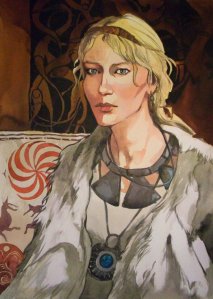
1. Sigfrid – alias Sigurd, the nephew of Godefrid, King of the Danes, or, perhaps more accurately, as ruler in Hedeby, a modern spelling of the runic Heiðabý(r), which was an important trading settlement in the Danish-German borderland, located towards the southern end of the Jutland Peninsula.
1.1. Reginheri – alias Ragnar Lodbrok, the leader of the Viking attack on Paris in 845. The first recorded instance of the names being so used [Ragnar + Lodbrok] is Ari Þorgilsson’s reference to Ívarr Ragnarssonr loðbrókar in his Íslendingabók, written between 1120 and 1133 (McTurk, 1991a, Studies in Ragnars saga loðbrókar and its major Scandinavian analogues. Medium Ævum monographs, new series, 15. Oxford: The Society for the Study of Mediæval Languages and Literature).
1.1.1. Ivar – alias Ivarr Ragnarssonr loðbrókar, with many variations, including Inguar/Hinguar/Ingar, which seem to be variants of the Norse name Ingharr, literally meaning the chieftain’s army, from the adjective element ing, meaning the first one/ahead of all others. His nickname, ‘beinlauss’, is wrongly interpreted as ‘boneless’, reflecting a misunderstanding of the written source of exosus (cruel), which was abbreviated to exos (boneless), hence stories invented to explain this strange epithet. Exosus accords well with Adam of Bremen’s description of Ivarr as crudelissimusis. (See J. de Vries, ‘Die westnordische Tradition der Sage von Ragnar Lodbrok’. Zeitschrift für deutsche Philologie 53, 257-302, 1928). Traditionally, Ivar has been assigned two sons, viz. Sitric (Sigtryggr); and Godfrey (so called in Cod. Clarendon, tom. 47), alias Guthfrith. Sitric I. is not known to have left any descendants; thus Guthfrith is assumed to have had had four sons, Anlaf, Guthfrith; Ragnal alias Ragenold, and Sitric II. I would consider it more reasonable that, as a son was rarely named after his father in this period, Sitric I. was the father of Guthfrith II., and Guthfrith I. was father of Sitric II.
1.1.1.1. Sitric 1 (Sigtryggr).
1.1.1.1.1. Guthfrith, Gofraid ua Ímair, king of York in 927; died 934. The first report of Guthfrith is in 918, when he accompanied Ragnall’s expedition to Northumbria.
1.1.1.1.1.1. Olaf Guthfrithson/Óláfr Guðfriðarson/Ánláf King of Dublin from 934 to 941, the year of his death. He married the daughter of king Constantine II. of Scotland. In 939, he invaded York, forcing Athelstan’s successor, Edmund, into a treaty which ceded Northumbria and part of Mercia TO Olaf. His battle troop carried the raven emblem.
1.1.1.1.1.1.1. Amlaíb mac Guthfrithson, joint ruler of York in 941.
1.1.1.1.1.2. Ragnall Guthfrithson (Old Norse: Røgnvaldr Guðrøðsson; Old Irish: Ragnall mac Gofraid), also known as Ragnall ua Ímair. ‘The identity between the Ragnall of the Irish Sea and Ragnald of northern Britain is no longer in doubt’ (Downham, Viking Kings, p. 94, 2007). I equate him with this Ragnall: The annalist Flodoard mentioned a Viking named Ragenold, like Rollo, called princeps Nortmannorum, leader of the Loire Vikings, who were regarded as a menace, especially to Brittany. He is noted as being a man of Rollo, who attended the coronation of Rollo’s son, William Longsword, in 931, and was probably of Rollo’s family. (A. Hugo, France Historique, p. 416, 1837). ‘In 924 Ragenold, although he had accepted a grant of lands within the borders of France, laid waste the country of Duke Hugh’ (Reginald Lane Poole, The English Historical Review, p. 16, 1911). Later that year, Ragenold was party to a treaty with Hugues le Grand, in which he relinquished lands he had siezed in Maine. (Bulletin de la Société d’agriculture, sciences et arts de la Sarthe, xiii., 1858). Although Ragenold was not Rollo, with whom he has been confounded, he places Rollo within the Hiberno-Norse kinship network of the ui Imhair.
1.1.1.1.1.3. Albann, killed in battle against Muirchertach mac Néill in 926. (Downham, p. 29).
1.1.1.1.1.4. Blácaire, ruler of Dublin in 939.
1.1.1.2. Guthfrith Ivarsson – alias Guthfrith, ‘Duke of Frisia’ and ruler in Dublin in 883. The Danish Viking leader who had probably been with the Great Heathen Army (led by Sigifridus, 882-6), which descended on the Continent. He became a vassal of the Emperor Charles III., after that ruler sued for peace, giving Godfrey most of Frisia to rule. Charles also gave him Gisela (865-908), illegitimate daughter of King Lothair II. (839-869), as his wife.
1.1.1.2.1. Sitric II. He commanded Viking forces in the Battle of Confey. the Annals of Ulster records the arrival of two viking fleets in Ireland in 917, one led by Ragnall ua Ímair and the other by Sitric, both of the House of Ivar. Sitric ruled Northumbria until his death in 927. The Anglo-Saxon Chronicle records his marriage to King Æthelstan’s sister at Tamworth on 30 January 926. William of Malmesbury claimed she was Æthelstan’s full sister, daughter of Edward the Elder and his first wife, Ecgwynn. This was an example of a peace-weaving alliance.
1.1.1.2.1.1. Harald: ‘Aralt great-grandson of Ivar and son of Sitric lord of the foreigners of Limerick’ (Four M.). Harald was also known as Harald ua Imair. He died in 940.
1.1.1.2.1.2. Gofraid, Old Norse Guðrøðr Sigtryggsson, also known as Gothfrith, Guthfrith, and Godfrey, ruler of Dublin after the death of his cousin Blácaire mac Gofrithson in a battle against Congalach mac Máel Mithig, the High King of Ireland, in 948. he died in 951.
1.1.1.2.1.3. Amlaíb mac Sitric, Old Norse Óláfr Sigtryggsson. He became co-ruler of York in 941, following the death of his kinsman, Amlaíb mac Guthfrithson. He was probably born c. 910. Among his wives were Dúnlaith, daughter of Muirchertach mac Néill, and Gormflaith, daughter of Murchad mac Finn, King of Leinster. Muirchertach was the son of Niall Glúndub and Gormlaith, thus his father and both of his grandfathers had been High King of Ireland.
1.1.1.2.2.3.1. Harald/Aralt, proposed as synonomous with Harald of Bayeux, noted ally of Rollo’s family, who came to hold land between Bayeux and Coutances, possibly connected to the family of the Duchess Gunnor, and the person called on for assistance by Bernard the Dane when the Scandinavian colonists came under attack by Hugh the Great, duke of the Franks, in conjunction with King Louis IV. d’Outremer. Professor Eleanor Searle (‘Facts and Patterns in heroic poetry’, 1984), wrote of the besieged colonists being reinforced by a new wave of Norsemen in the 960’s, and Richard (‘dux pyratorum’) took as a wife Gunnor, the daughter of one of their leaders, in a ‘peace-weaving’ marriage. The Normans pressed for the marriage of Richard and Gunnor, ‘so that from a Danish father and a Danish mother may be bore the heir of this land, and will be its defender and advocate’ (Dudo, 4.125). Accepting Searle’s hypothesis, and on chronological grounds, it is possible that Óláfr Sigtryggsson, by any of his wives/concubines, was also the father of:
1.1.1.2.2.3.2. Herfast.
1.1.1.2.2.3.3. Gunnor.
1.1.1.2.2.3.4. Duvelina .
1.1.1.2.2.3.5. Wevia.
They were most likely to have been half-siblings.
‘Whereas Gunnor and her brother Herfast have recognisable Scandinavian names, their sisters Sainsfrida, Wevia and Duvelina (or Dunelina) have Germanic names. In my discussion of Robert’s genealogies I suggested that the three sisters discarded their Scandinavian names upon marriage to Frankish men and in accordance with a well established practice accepted Frankish ones instead. Gunnor herself had done so, for she can occasionally be encountered under her adopted Frankish name of Albereda’. (Elizabeth Van Houts, Collegium Medievale, p. 9, 1999).


 Walter FitzGilbert de Hamilton