
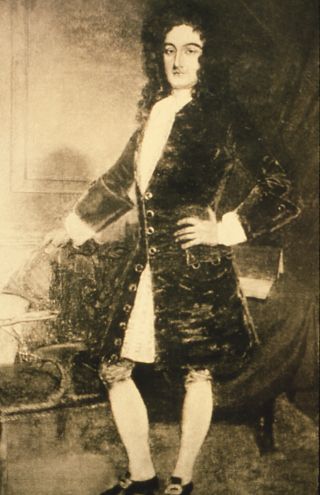
 William Byrd II
Mr. Collins, the somewhat verbose genealogist, who never wasted an opportunity to lavish praise on those of the higher order of English society, and who I suggest was the source of many characters in Jane Austen’s work, and, on whom, I also suggest, she may have modelled the clergyman suitor of Elizabeth Bennett, gave account, in 1799, of the family of Leonard Barrett, Lord Dacre:
‘This family, which long held rank amongst those of the first note in Kent, were resident at Chevening, in that county, at least as early as the reign of Henry VI. when we find George Lennard, then living there, and that by Matilda, his wife, he had issue John Lennard, born about the 37 Henry VI. who married Anne, daughter and heir of Thomas Bird, of Middlesex, who bore quarterly Argent and Sable; in the first a spread Eagle of the second; (another branch; of which family, their arms being exactly the fame, were settled in Essex, in the beginning of Henry the Eighth’s reign; for several of whom, there are memorials in the churches of Littlebury, and Saffron-Walden; and hereof was, Sir William Bird, Knt. Dean of the Arches, and Judge of the Prerogative Court of Canterbury, in the reign of James I,) by which Anne he had issue … William, ancestor of the Lennards, sometime of Heathfield, in Sussex’.
Mr. Collins has John Leonard being born circa 1459; it may be assumed Ann Byrd was born circa 1460-1470, and her father between 1430-1440, contemporaneous with (1) ‘John Byrd of Walden, co. Essex,’chapman,’ for not appearing before John Prysot and his fellows, justices of the Bench of the late king, to answer Robert Barley of London, mercer, touching a debt of 40s. London’ (Cal Pat. Rolls, mem. 22, 1470). (2) William Byrd: ‘William Byrd, late of London, ‘chapman,’ for not appearing to answer John Wheler, late citizen and girdler of London, touching a debt of 40s, Middlesex’ (ibid., mem. 21).
Of the same family would appear to be this William Byrd:
24 March. 1514. Letters and Papers, Foreign and Domestic, of the Reign of Henry VIII. For Katharine Semar, late of Cheping Walden, widow, p. s. Thomas Strachy, James Bodley, William Birr and Nicholas Rutland, all of Walden aforesaid. Licence to found a guild in honor of the Trinity, in the church of St. Mary, Walden, to consist of one treasurer, two chamberlains, brethen and sisters, of the parishioners of Walden; with mortmain licence to acquire lands to the annual value of 20 marks, for a chaplain to pray daily for the King and Queen Katharine, foR Katharine Semar, Thomas Wulcy, late almoner to the King, Joan Bradbury, widow, John Leche, vicar of the said church, the said Thomas [Strachy] and Joan his wife, James Bodley and Joan his wife, William Bird and Anabella his wife, and Nicholas Rutland, and Clemence his wife; and for the souls of Thomas Bodley, William Lawnaelyn and Alice his wife, Walter Cook and Katharine his wife, Roger Pyrk and Joan his wife, Thomas Semar and Margery his wife, Nicholas, Thomas and Katharine, children of the said Katharine Semar, George Thoorne and Florence his wife, John Strachy and Alice his wife, Thomas Thoorne and Joan his wife’. Del. Westm.
It is obvious that these Byrds were also established in Suffolk, as noted here: ‘Protection to John Byrd, of Lavenham, Suffolk, in the retinue of Thomas Fyndern, knight. July 22, 1450. (See East Anglian, Or, Notes and Queries on Subjects Connected with the Counties of Suffolk, Cambridge, Essex and Norfolk, ed. S. Timms, p. 108, 1910). The executor of the Will of Joan Cogman of Lavenham, probated September 24, 1452, was John Byrd the elder; his Will proved Feb. 1471 (SROB, Baldwyne 488, 2., no. 552). His son or grandson would seem to be noted here: Will of John Byrde, Clothmaker of Lavenham, Suffolk. PROB 11/21/409. August 25, 1524. As will be shown, the Byrds of Walden, Essex, held land in Lavenham.
Of the Walden Byrds:
1. William Bird and Anabella his wife. Holt v Byrd. Plaintiffs: Thomas Holt. Defendants: William Byrd and Alexander Thomesone. Subject: Mortgage of land in Walden. Essex. C 1/322/42. 1504-1515
1.1. Thomas Byrd: Danbury v Byrd. Plaintiffs: John Danbury. Defendants: Thomas Byrd and Thomas Boyton of Walden, mercers, executors of William Byrd of Debden, mercer. Subject: Debt for pease. Essex. C 1/977/5. 1538-1544.
1.1.1. William Byrd, Gent, d. 1568, m. Mary Woodhall, da. of James Woodhall, of Walden, Co. Essex, yeoman, in his will dated 21 Feb., 1588, pr. 30 June, 1601 (P. C. C. Woodhall 1), bequested: ‘Land near William Shelford, land near Thomas Howard, bought of William Bowling. To William Bird and George Bird, sons of my daughter Mary’.
1.1.1.1. William Byrd, bur. September 5, 1624: ‘Sir William Bird, of All Souls College, was admitted D. C. L. in 1587. He was son of William Bird, of Walden in Essex, and was Principal, Official, and Dean of the Arches, a Knight, and Judge of the Prerogative Court of Canterbury. He died s. p. in 1624, and was buried in Christ Church, London. Quarterly Argent and Sable, in the first an Eagle display’d of the Second, is born by the Name of Bird, and was confirm’d or granted by William Camden in March 1606, to William Bird Doctor of the Civil Law, Son of William Bird and Mary Daughter and Heir of James Woodhall of Walden, the Son of Thomas Bird and Beatrix Daughter of John Worlich of Cowlidge in Suffolk; which Thomas was the Son of William Bird, by Annabel Daughter and Heir of John Thinley, by his Wife the Sister and Heir of Rohert Dauncy, Son and Heir of Robert Dauncy of Walden‘(‘John Guillim’, A Display of Heraldry, p. 383, 1722). ‘He married, after 1613, Jane (bur. 1 Mar. 1645), da. and coh. of John Johnson, Merchant Taylor, of London, wid. of Richard Trafford of Low Leyton, Essex. Byrd, a younger son of a modest gentry family, proved himself a precocious scholar at Oxford, where he proceeded to the rank of doctor of Civil Law and advocate. He received a grant of arms in 1606. His stepfather, William Woodhall, was registrar of the Prerogative Court of Canterbury and the ‘loving cousin’ of Sir Daniel Dunne, and it was probably via this connection that Byrd was returned for Oxford University at a by-election to succeed the deceased Sir Thomas Crompton as Dunne’s colleague in the first Jacobean Parliament In his funeral sermon it was observed that he had seldom employed deputies, ‘saying, I will do what I may possible by myself; I (and not they) must answer if wrong be done. And when I shall be upon my deathbed, clamours will trouble me if any be injured’.28 He died of a burning fever, ‘the disease of the time’, making a nuncupative will without preamble on 27 Aug. 1624, by which he left the lease of his London house to his wife, with whom he had no children. He was buried on 5 Sept. 1624 at Christ Church, Newgate’ (Hist. Parl. Trust, ed. Andrew Thrush and John P. Ferris, 2010). His widow Jane married Sir William Acton, Bt., Sheriff of London in 1628/29; Lord Mayor of London between 1640 and October 6, 1640; discharged by the House of Commons on account of favouring the King. By his first wife, Anne Bill, Sir William Acton was the father of Elizabeth, wife of Sir Thomas Whitmore, of Apley, Salop.
1.1.1.2. George Byrd.
1.1.1.3. Elizabeth Byrd, m. Edmund Grindall, Bishop of London 1551, Archbishop of York 1570, Canterbury 1576-83, who bore Quarterly arg. and az. a cross quarterly erm. and or betw. four doves counterchanged; granted 1559; Harl. MS. 1441 fo. 62 b. These are totally distinct from any arms bore by any family of Grandon/Grendon, which were typically ar. three chev. gu. There is no English record of the names Grendon and Grindall being synonomous; that particular claim belonging to the contortions inherent in ‘genealogies’ of Virginia. In 1624, Edward Grindal of colonial Virginia, held land next to ‘Richard Tree of James Citty Carpenter whoe came over into this Country wth Master Abraham Percye Cape Merchant in the George as a freeman’, and Richard Craven. A Thomas Grindall is noted as a transportee of Edward Oliver in a grant of 450 acs. James city Co. dated April 16, 1639. The Grindall’s very probably descended from a family settled in Bridlington, in the East Riding of Yorkshire, of which there is a pedigree in Harl. M.S. 1154.
John Woodhall, ‘Surgeon of London’, is noted in Jamestown in 1624, and John and Thomas Woodall are noted in that place in 1636.
1.1.2. Samuel Byrd.
1.1.2.1. Josias Byrd.
1.1.2.1.1. Josias Byrd, M.A. from Corpus Christi, 1571, of Walden gentleman, Will proved May 24, 1586.
1.1.2.1.2. Samuel Byrd, M.A. from Corpus Christi 1573, schoolmaster, Lavenham, Suffolk, 1583, Minister of St Peter’s, Ipswich, 1580-1604, his year of death. Author of religious works. Mentioned in Will of br., Josias. Bird v Lines. Plaintiffs: Thomas Bird gent, of Lawshall, Suffolk. Defendants: Henry Lines, John Tweed gent and Nicholas Lynes. Subject: Following the plaintiff’s seizure of the defendant Henry’s goods and cattle for arrears of rent, the three defendants drove the seized cattle away from the plaintiff one night: property in Lavenham, Suffolk and Preston St Mary, Suffolk. C 6/387/31. 1697.
1.1.2.1.2.1. Samuel Byrd, M.A. at Emmanuel, Oxf., 1603. Prebend of Canterbury, 1618-1624.
1.1.2.1.2.2. Josias Byrd, mentioned in Will of his uncle Josias.
1.1.2.1.3. Cowper Byrd, sister of Josias, given malt in his Will.
1.1.2.1.4. Dorothy Byrd, sister of Josias, given malt in his Will.
1.1.2.2. Philip Byrd, of Debden, Essex.
1.1.2.2.1. William Byrd, eldest son, received land in the Will of his br., Thomas.
1.1.2.2.1.1. William Byrd, recorded here: Byrd v Killingworthe. Plaintiffs: Elizabeth Byrd. Defendants: John Killingworthe, William Byrd and George Byrd. Subject: jointure of messuage and farm in Saffron Walden, Essex. C 2/JasI/B1/70. 1603-1625.
1.1.2.2.1.1.1. William Byrd: Byrd v Phillips. Plaintiffs: William Byrd. Defendants: Henry Phillips and John Phillips. Place or subject: property in Walden, Essex. C 7/460/7. 1663.
1.1.2.2.1.1.2. Thomas Byrd: Feoffment in consideration of £29 (i) Thomas Byrd of Saffron Walden, gent; (ii) Deborah Shelford of North End, Saffron Walden, spinster. Three acres of arable land at the bottom of Windmill Hill, Saffron Walden Deed: Feoffment in consideration of £29 (i) Thomas Byrd of Saffron Walden, gent; (ii) Deborah Shelford of North End, Saffron Walden, spinster. Three acres of arable land at the bottom of Windmill Hill, Saffron Walden. D/B 2/TDS5/2. Feb. 27, 1671.
1.1.2.2.2. Edward Byrd, b. 1547; admit. Inner Temple, Oct. 10, 1580; d. Walden, 1613. Bird v Bird. Plaintiffs: Alice Bird (widow of William Bird). Defendants: William, Bird, Edward Bird and Christopher Bird (executors etc). Subject: claims under the will of William Bird to lands and tenements in Walden and Littlebury, Essex. C 2/JasI/B12/32. 1603-1613.
1.1.2.2.3. Thomas Byrd, gifted his books to br. Edward, in his Will of 1595.
1.1.2.3. Andrew Byrd, executor of the will of his br., Josias.
1.1.2.3.1. Philip Byrd.
1.1.2.4. Christopher Byrd, matric. Christ’s, Oxf., 1553.
It is not improbable ‘that the Birds mentioned in the abstracts of the wills of the Woodhalls were of the same lineage of William Byrd of Westover, James River, Va., whose parents were John and Grace (Stegge) Byrd, of London’ (Waters, Henry F. Genealogical Gleanings in England. Vol. 1. pp. 52-3, 1885).
Davis, Surry County Deeds, 1652-1684, lists William Byrd as a creditor in the settlement of the estate of John Westhope, merchant of London, whose Will of 1656 records that Walter Cowper was then living on the Maine, west of Jamestown Island, and had a son named Thomas. Walter Cooper (Cowper, Couper) came to Virginia on the Jonathan in 1619. By Feb. 1625, he was listed as a 33 year old servant in the household of Captain Samuel Mathews, who had m. the widow of Abraham Peirsey, aforesaid. ‘It was ruled that in 1622, Samuel Matthews had two cows belonging to John Woodall, and that the increase of the cows to the time of the inquiry might number fifty. Accordingly, fifty head of Mathew’s cattle were transferred to (John) Woodall’ (The Virginia Magazine of History and Biography vol. 11, no. 2 (Oct., 1903), pp. 169-182).
Given that these Byrds were cousins of a family of Cowper, it is It certainly not improbable that the erudite Byrds mentioned in the abstracts of the wills of the Woodhalls were of the same lineage of William Byrd of Westover, and that ancestral roots all too easily extracted from English genealogical tomes are as light as a feather.
copyright m stanhope 2016


 Walter FitzGilbert de Hamilton