
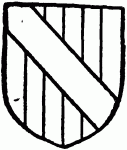
The family of Langford (of Derbyshire, Nottinghamshire, and Shropshire), bore for arms paly of six, or and gu. over all a bend ar., differenced by the bend from the arms of Goushill, a family to which they were kin: Ralph de Gousle, son of Robert, had a son called Sir Walter de Goushill, who married Matilda, one of the two coheirs of Matthew de Hathersege, the other sister, Cecilia, was the wife of Nigel de Langford, and mother of Nigellus, father of Oliver (Oliver FitzNigel), father of John, father of Nicolas de Langford, who lived 4 E. 3. (See Quo. War. 4 E. 3. rot. 2. Derbys.).
‘Longford lies about nine miles from Derby. In its church are several ancient monuments of the Longford/Langford family; one of these is an altar-tomb, under a richly ornamented arch at the east end of the south aisle, on which is the figure of a knight in plate armour, mail gorget, and pointed helmet, with a collar of SS round his neck, and his hands joined in a supplicatory form; under his head is a large helmet with the Longford crest, which here much resembles three mushrooms’* (Bateman’s ‘Vestiges of the Antiquities of Derbyshire’, 1848). * More accurately, three rounded plumes of feathers.
Within Longford was the manor of Hollington, held by the Meynells in the reign of Edward I. (Hieron’s Collections).
The families associated with this manner are given thus:
1. Gilbert de Meynel, m. a dau. of Ralph FitzHubert.
2. Robert de Meynel held 5 fees of Barlborough, Whitewell, Clune, Stretton, Egstow, and Hanley (1162), m. Isabella, dau. of Nigel of Rampton (Blyth Priory Cartulary, no. 149). Robert paid 100s relief for one knight’s fee of the Honour of Peverel in 1186.
2. Emma de Meynel, m. Matthew de Hathersage (Yeatman, p. 339). Matthew de Haverseg occurs in 1193. His wife’s name is given as Emma. He was possibly the son of William, son of Wulfric of Withington; yet it may be bore in mind that Yeatman, supra, thought that he was ‘probably a Brito, of Walton‘, whose father had married a sister of Ankerus Freschville. In this regard the following deed may be pertinent: 1234. Hugh (Brito) of Walton acknowledged to have received from William de Thornaco, Dean of Lincoln, six acres of land in Newbold which Matthew de Hathersage (qv. Brito) gave to the Church of Chesterfield (see Frank’s Muniments). Ralf Brito del Hertwyc to Jocelyn de Haremere, Grant of land at Hertwyc called Hympcroft, and land near Walter Seldene’s land at Ravenscroft, land near Dalhec, and other land of Robert (Brito of Walton) brother of the said Ralf, Witnesses: Dno Willo de Heriz, Dno Robert de Harest, Robert de Wincon, Hugo (Brito) de Walton, Peter fil Simon de Brumington, Robert (Brito) de Oggeston, Robert de Heriz, in Sutton-on-Dale, Rado de Sydenhall, Willo fil Willi fil Thomae, in Sutton, Willo de Plesslie, in Sutton, Roger de Summerville, Ralf Cleric de Walton. Walkelin, the father of William, of Steinsby, was a younger son of William de Ferrers, Earl of Derby, and his sister Cecilia married Robert Brito, of Walton, who was father of Robert, of Walton, and Ralf, of Hardwick, both of whom attested William fitz Walkelin’s Charter to Arnold de Hertstoft (John Pym Yeatman, Records of the Borough of Chesterfield).
3. Matthew de Haversage, m. Annora Mark, dau. of Philip Mark.
4. Mathilda de Haversage, m. Walter Goushill.
4. Isabel de Haversage, m. 1. ‘Sewal fil Henry 50 pounds for having the daughters of Robert de Maisnil and their lands’ (Pipe no 40 r, 6 Ric I, 1195), 2. John de Neville, ‘700m for his passage, and for having to wife Isabella, the widow of Sewell fil Henry, with her whole inheritance and dower (Pipe No 56 r, 12 John, 1210); 3. Ralph Musard,’15m for having the land which was Walter de Godardsvill’s and Johanna,his wife, sister of Isabelle, wife of the said Ralph, and of whom Isabel was next heir when the king took the homage of the said Ralph, and conceded by the fine that he should have seizin of the said land, by the pledge of Wm de Meinel 3m, Hy de Cubbele 3m, Roger fil Propositus 3m, Roger Parmenter 2m, Wm fil Hugh 2m and John de Bosco (Pipe No 70 r, 10 Henry III, 1225).
4. Joan de Haversage, m. Sewal de Munjoy (Pipe no 45 r, 1 John, 1199).
4. Cecilia de Haversage, m. Nigel de Longford.
5. Nigel de Longford. In 1260 there was a partition of estates between Sir Nigel de Longford and Dame Maud de Gousill; Hibbert-Ware, Manch. Foundations, iii, 125.
6. Oliver de Longford; acknowledges the service of one serjeancy, to be performed with one horse price five shillings, a sack, and a broche, and makes fine for the same.— Expedition against the Welch.— Muster at Rhuddlan, on Sunday the Morrow of St. Peter ad Vincula, 2 Aug. 10 Ed. I.
7. John de Longford. Johannes de Langeford; returned from the Counties of Nottingham and Derby as holding lands or rents to the amount of £20 yearly value and upwards, either in Capite or otherwise, and as such summoned under the general writ to perform Military Service in person, with horses and arms, &c. in Scotland. —Muster at Nottingham, on Sunday next after the Octaves of St. John the Baptist, 7 July. 25 Ed. I.;summoned from the Counties of Nottingham and Derby to perform Military Service in person against the Scots.— Muster at Berwick-upon-Tweed, on the Nativity of St. John the Baptist, 24 June. 29 Ed. I; appointed to superintend and hasten the collection, in the Counties of Hereford, Salop, and Stafford, of the Fifteenth granted in the Parliament at Lincoln, in Eight Days of St. Hilary, 20 Jan. 29 Ed. I. John de Longford held the knight’s fee in Withington in 1302; Lancs. Inq. and Extents, i, 313. Sir John de Longford and Dame Joan, probably his widow, had inclosed part of Burnage before 1320; Mamecestre, ii, 283–4. Another of Matthew de Haversage’s sisters married a Gousill; Thoroton, Notts. iii, 147.
8. Sir Nicholas de Longford, m. Alice Butler, dau. of William Boteler (d. September 14, 1335, in Wem, Shropshire), and Ela, dau. of Roger de Herdeburgh; dau. of Sir Roger de Herdeburgh II, and Ida de Clinton; dau. of William de Oddingseles, and Ela FitzWalter de Longespee. Alice was the sister of Ankeret, who m. John le Strange, of Blackmere. William Boteler gained renown in the Scottish wars of the period, and was summoned to parliament as a baron from 10 March, 1308, to 10 October, 1325. Sir Nicholas, the son of John, was in possession of the Langford estates by 1317, as appears by a Trafford deed. He was was knighted at the siege of Calais in 1347; Shaw, Knights, i, 6. He was probably the Nicholas de Longford returned in 1346–55 as holding the fee in Withington which Matthew de Haversage had formerly held; Feud. Aids, iii, 89. He in 1362 made a feoffment of his manor of Withington, and died in 1373, leaving a son and heir Nicholas, twenty-two years of age.
(1. Robert FitzRichard de Clare, d. 1134, steward to King Henry I (desc. of Gilbert de Brionne, son of Geoffrey de Brionne, Count of Eu, an illegitimate child of Richard the Fearless, Duke of Normandy, from 942 to 996), m. Matilda de St. Liz. 2. Walter FitzRobert of Woodham Walter, Maldon, Essex, Baron of Little Dunmow, m. 2. Maud de Lucy, dau. of Richard de Lucy of Diss. 3. Robert FitzWalter of Woodham Walter and Dunmow Castle, a Magna carta Surety (d Damietta 1234), m. 1. Gunnora de Valoniis, dau. of Robert de Valoniis of Bennington. 4. Sir Walter FitzRobert of Woodham Walter (b. c. 1220, d. bef. April 10, 1258), m. 2. Ida de Longespee Plantagenet. Walter FitzRobert came of age in 1240; William Longespee II came of age in 1233; it is therefore very probable that Ida was the sister, not daughter, of William Longespee II, due to this chronological consideration; and a daughter of William de Longespee Plantagenet, illegitimate son of the first Plantagenet king, Henry II, and Ida de Tosny. King Henry II acknowledged William as his son and in 1188, and granted him the honour of Appleby in Lincolnshire. 5. Ela FitzWalter m. William d’Odingsells of Maxstoke Castle. Ela’s and Williams’s grandsons include William de Clinton and John de Grey). Walter and his wife, Ida, appear together in an Essex fine dated 1256/7 regarding a messuage and land in Little Maldon, Essex (Feet of Fines for Essex, 1:221-222]. The IPM of their grandson, Sir Robert FitzWalter, dated 1328 shows that at his death, he possessed a half a knight’s fee in Maldon, Essex (Cal. IPM, 7 (1909): 126-129).
9. Sir Nicholas de Longford m. Alice Deyncourt, dau. of Sir Roger Deyncourt. In 1376 Nicholas de Longford was plaintiff and Oliver de Barton and Alice his wife deforciants in a fine respecting the manor of Withington; the right of Nicholas was acknowledged (Feet of F. Divers Counties, Mich. 50 Edw. III, no. 136).
10. Sir Nicholas de Longford. Sir Nicholas de Longford, son of Sir Nicholas, died in Sept. 1415, leaving a son Ralph, fifteen years of age, and a widow Alice, who married William Chanterell.
11. Ralph de Langford. Sir Ralph de Longford (Feud. Aids, iii, 96) died in 1431, having made a settlement of his manor of Withington and other lands in Lancashire in 1429; he left a son and heir Nicholas, aged thirteen; Lancs. Inq. p.m. (Chet. Soc.), ii, 29. Ralph seems to have been made a knight in 1426 for his conduct at the battle of Verneuil; Metcalfe, Bk. of Knights, 1.
11a. Sir Nicholas de Longford of Withington. This Sir Nicholas, the heir, is named as lord of Withington in 1449, and again (probably) in 1473, when 9s. was due from him to the lord of Manchester (sake-fee) and 10s. for castle ward; Lancs. Rec. Inq. p.m. no. 36, 37a; Mamecestre, iii, 481. He was knighted after Tewkesbury; Shaw, Knights, ii, 15.
11b. Ralph de Langford. Longford v The Bishop of Chester. Plaintiffs: Ralph Longford, esquire, brother and heir of Sir Nicholas Longford, knight. Defendants: John, bishop of Chester. Subject: Manors, lands, etc. Lancashire, Staffordshire, Derbyshire, Warwickshire, Lincolnshire, Shropshire. 1465-1471, or perhaps 1480-1483. Shrop. Arch. C 1/36/27.
Of this generation, and bearing the same arms of Ralph de Langford –
11c. John de Langford (‘de comitat Derb.’, Har. 1396, fol. 219b), b. c. 1420, m. dau. of John Bord (Berde), i.e. John de Berde, of Derby.
12c. William Langford.
13c. William Langford.
14c. Richard Langford, m. Anna, dau. of Walter Rogers.
15c. Thomas Langford.
16c. Jane Langford, bapt. Oct. 10, 1567, m. (Sept. 14, 1595) Rowland Harris of Ludlow, d. 1605.
17c. John Harris, bapt. March 5, 1604.
18c. Major William Harris, bapt. January 13, 1627/8.
That John de Langford was of this family is evidenced by him marrying within their kinship group. Philip Mark, aforementioned, had an estate at Locko, which was rated at one-half a knight’s fee. His holding there was sub-divided into three equal one-sixth knight’s fees each of 63 acres as follows: (a) Land in Locko held by the Master of Burton Lazars of the heirs of Philip Mark. (b) Land in Locko held by John Birde of the heir of Philip Mark. Land in Locko held by William de Chaddesden senior of the heirs of Philip Mark. Henry de Berde was a juror for the Borough of Derby in the Eyre of 1281 (Hopkinson, 2000, p.195), and a John Bird was MP for Derby in 1366 and 1377 (Simpson, 1826, Vol.2, p.758). His son and namesake is evidenced here: Grant by John de Berde, of Derby, to Richard de Stathum and Richard de Denton, of a messuage with buildings in Derby, opposite the bridge across the Odbroke called ‘St. Peter’s Bridge.’ Witnesses:- John del Hay and William Payn, bailiffs of Derby, and others (named). Derby. 20 February. 14 Henry IV. 1412/13. It seems very likely that his daughter married John de Langford, ancestor of Major William Harris.
Who were the Longfords? A question addressed by Charles J. Cox, Notes on the Churches of Derbyshire. Vol. 3, pp. 184-5, 1875: There is no manor of the name of Longford mentioned in the Domesday Survey, but those of Alkmonton, Hungry Bentley, Hollington, and Rodsley (all in this parish), are enumerated as part of the vast estates of Henry de Ferrers. Mention is also made of the manor of Bubedene, which we believe to have been then synonymous with Longford. It was divided into two parts, one being held by Elfin under Henry de Ferrers, and the other pertaining to the bishopric of Chester. This is the entry relating to the latter in the Domesday Book: ‘In Bubedene and its appendages are five carucates and two oxgangs of land for geld. Land for five ploughs. The Bishop of Chester has one plough there, and twelve villains, and three bordars, having seven ploughs. A priest is here and a church, and one mill of ten shillings, and sixty acres of meadow. In the time of King Edward it was worth seven pounds; now four pounds’. It has hitherto been supposed that Bubedene or Bubden, was in the hundred of Morleston, near Sawley, where the other possessions of the Bishop were situated; but there can be no doubt that this episcopal manor was really Longford, for we find that that manor was held in fee-tail of the Bishop of Chester by the de Longfords for at least two centuries after the drawing up of the Survey. One part of the parish of Longford, consisting of a farmhouse and a cottage, is still called Bupton, and it may have been here, and not on the present site, that the first church was erected.
It is difficult to ascertain the precise origin of the family of Longford, or when the manor took the name of the owners, as the different accounts are so contradictory; but this much is certain, from the charters pertaining to Kenilworth Priory, viz., that about the year 1145, Nicholas de Gresley (son of Nigel de Stafford, afterwards termed Gresley, brother of William, founder of Gresley priory and progenitor of the Gresley family), and Margaret his wife, gave the advowson of the church of Longford to the above-named priory, the said church being part of the dowry of his wife. From other charters we learn that Margaret was the daughter and heiress of Nigel de Longford, that her husband Nicholas was subsequently termed de Longford, and that their son Nigel was styled Nigel de Longford, and occasionally Nigel de Bubden, a title that confirms us in accepting Bubden as the ancient name for Longford.
About the year 1170, Hugo de Puisac, bishop of Durham, and Simon, abbot of Beauvale, were appointed commissioners by the Pope to settle a dispute that had arisen between the priory of Kenilworth and Nigel de Bubden (alias Longford), with respect to the patronage of the church of Longford. The terms of their decision are not stated, but it seems to have been favourable to the priory, and the decision obtained the official sanction of Kichard Peche, bishop of Coventry and Lichfield, who held the See from 1161 to 1183. The church was also confirmed to the priory by Alexander Stavenby, bishop of the same diocese from 1224 to 1240′.
1. Roger ‘the Spaniard’ de Toeni, m. 3. Godeheut Borrell.
1.1. Robert de Stafford, Governor of Stafford Castle. Held 131 manors in Warwickshire and Lincolnshire, m. Avice de Clare.
1.1.1. Nicholas de Stafford, Sheriff of Staffordshire, temp. King Henry I.
1.1.2. Nigel de Stafford.
1.1.2.1. Nicholas de Gresley, m. Margaret, dau. of Nigel de Longford.
1.1.2.1.1. Nigel de Longford.
1.1.2.1.1.1. Nigel de Longford of Longford, m. Cecilia de Hathersage.
copyright m stanhope 2016


 Walter FitzGilbert de Hamilton