
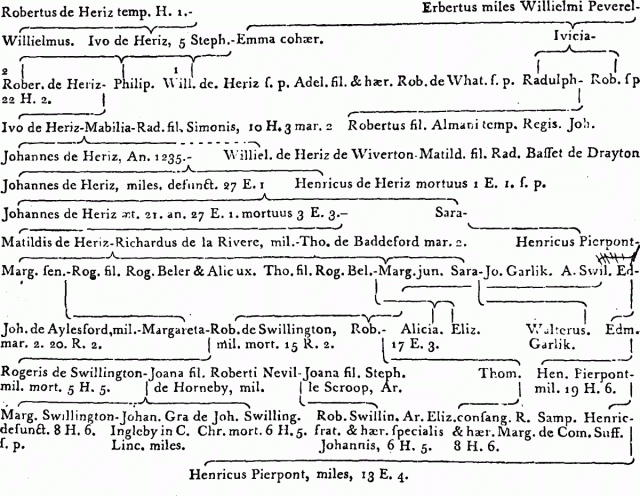
The armigerous nature of the following family of Essex may suggest a more direct connection to their namesakes of Devon.
1. Robert I de Heriz, ob. by 1128, of Tibshelf, Stapleford, and Oxcroft, held of William Peverel 1., benefactor of Lenten priory, Sheriff of Notts. and Derbys., 1110-1114.
1.1. Ivo I. de Heriz, Sheriff of Notts. and Derbys., 1128-30.
1.1.1. Robert II. de Heriz, ob. 1198, who paid relief, in 1181, to obtain the lands of his brother.
1.1.1.1. Ivo II. de Heriz, ob. 1225, m. Hawise Briwiere, probable sister of William Briwiere.
1.1.1.1.1. William de Heriz, ob. 1242, of Wiverton, Justice Itinerant of Notts., m. Maud Basset.
1.1.1.1.1.1. Richard de Heriz (Hoblyn MS.).
1.1.1.1.1.1.1. ‘John Heris’, m. Joan Vyvian, dau. of Richard Vyvian and Constance Peverel, descendant of William Peverel I.
1.1.1.1.1.1.1.1. John Harris, 1st at Radford, m. Alice le Abbetot.
1.1.1.1.1.1.1.1.1. John Harris, 2nd at Radford.
1.1.1.1.1.1.1.1.1.1. Sir John Harris, 3rd at Radford, ob. ante 1430.
1.1.1.1.1.1.1.1.1.1.1.John Harris, 4th at Radford, ob. ante October 16, 1485.
1.1.1.1.1.1.1.1.1.1.1.1. Francis Harris. (Sir Thomas Arundel of Lanherne, b. 1452, m. (1473), Katherine Dinham (1453-September 25, 1501),of Nutwell, Devon. Their son, Sir John Arundel, b. 1474, in Lanherne, ob. February 8, 1545, in Roscarrock, Cornwall, m. (1507) Katherine Grenville, 1487-ob. ante April 25, 1545.
Katherine was the sister of Philippa Grenville, born 1489, who m. (1) (1509) Francis Harris, son of John Harris, 4th of Radford, (2) (1512) Humphrey Arundel, fl. 1523, br. of the said Sir John Arundel.
Sir John Arundel was the father of:
(1) John Arundel (1500 – November 7, 1557), who m. Mary (Belknap) Dannet; whose niece, Elizabeth Belknap, m. Sir Philip Cooke, whose sister, Beatrix Cooke, m. Sir Nicholas Rawson of Aveley, Essex. Their dau., Anne Rawson, m. Michael Stanhope, who was beheaded on Tower Hill in 1552, as was his brother-in-law, Edward Seymour, the Protector Somerset.
Elizabeth Belknap and Sir Philip Cooke had issue: John Cooke, whose first wife was Alice Saunders (d. 1510), the dau. of William Saunders of Banbury, Oxfordshire. John Cooke’s Will states: ‘I make and ordain mine executors Gerard Danett, William Shelley and Richard Cooke, my brother, and I bequeath to every of them £6 13s 4d for their labour and all their costs; Item, I will that they that be seised of and in my lands in Southwark (London) shall after my father’will performed be seised to th’ use of the performance of my will’ (TNA PROB 11/18/537). His dau., Joanna Cooke, m. ‘William Harris, b. by 1502, prob. 1st s. of John Harris of Prittlewell Essex by w. Joan. educ. L. Inn, adm. 16 Feb. 1520. m. (1) by 1527, Joan, da. and h. of John Smith of Essex, 4s. inc. Vincent† 4da.; (2) Joan Cooke of Bocking, Essex, 1s.; (3) by Oct. 1540, Agnes, da. of William Rutter of Southwark, Surr. 2s. 2da. suc. fa. 1520′ (Bindoff, Hist. Parl. Trust, 1982).
(2) Katherine Arundel, who m. Thomas Tregian, whose mother was the heiress of Wolvedon: ‘There flourished for a long series of years a family of the same name, the last of which John Wolveden, esq. had only two daughters and coheirs, of whom the eldest having married Tregian, esq., brought to her husband this and several other fair estates. The other sister, Catherine, m. Nicholas Carminow, esq., of Trenowth in this parish. Their son married an Arundell of Lanhearne’ (Joseph Polsue, A Complete Parochial History of the County of Cornwall, vol. 4, p. 92, 1872). The Wolvedon Arms were: — Arg. a chevron between three wolves’ heads erased, sable.
The East Anglian: Or, Notes and Queries, ed. Samuel Tymms, pp. 140, 172, 1866, Church of All Saints, Maldon: ‘Besides some of the arms which I have already noted as still extant, the following monuments and arms are recorded in Harl MS. 4944, which have been since destroyed. Robert Darcy, and Alice his wife. Arg. 3 cinquefoils Gu. impaling a fess between 8 (six) leaves Gu. William Harris, son of William Harris and Jane his wife, which William died 14th May, 1559. Per pale on a chevron engrailed between 3 wolves heads, a lozenge between 2 fish respecting. Sir Thomas Harris, and Cordelia his wife, on the wall. Quarterly; 1 and 4, on a bend Az. 3 cinquefoils of the first. 2 and 3, Arg. gutté de Sang, impaling, on a chevron Arg. 3 mullets of the field, on a canton Or, a lion rampant Gu. Crest, a talbot sejant. Motto, modera durant. (Vyvian: Trelowren-Park, Cornwall, ar. a lion, rampant, gu. armed sa. Vyvian (Cornwall) ar. a lion, rampant, gu. on a mount, in base, vert. – M.S).
Upon the south wall a mural monument of the 15th century, despoiled of its brass efiigies and inscription. From the arms and style of workmanship, I have little hesitation in apporpriating it to Thomas D’Arcy, Esq., who died 25 Sept, 1485. These arms remain : D’Arcy and Fits Langley quarterly: 1 and 4, three quartrefoils; 2 and 3, a fess between six oak leaves. 2, Darcy, impaling quarterly; 1, a goat salient, Bardwell. 2, Quarterly, in the first quarter an eagle with two heads displayed. 3, a chief and a chevron. 4, a fess Erm., cottised, Harlston. Surtout an inescocheon (blank). 3, Darcy alone.
A slab for one of the family of Herris; only a small portion of the inscription, with the date 1658, can be read, and the arms are partly concealed. I think they may be correctly supplied. Quarterly 1 and 4, on a bend 3 cinquefoils, Harris; 2 and 3 gutté.
Muilman, writing in 1770, says, “There are in a window of Darcy’s chapel, the arms of Peverell, impaling Assigny, and in the north window of the north chapel, the remains of those of King Edward the Confessor, of Norman princes and nobles, with some descriptions in old French, for whom they were’.
Sir Thomas Arundel of Lanherne and Katherine Dinham also had issue:
(1) Thomasine Arundel, who m. Henry Marney, having issue Catherine Marney, wife of Sir Thomas Bonham, Sheriff of Essex & Hertfordshire in 1520 & 1526; their dau. being Elizabeth Bonham, who m. John Barington (Visitation; Essex, 1634, Bonham; Berry’s Essex Pedigrees); their son was Thomas Barington, who m. Alice, d. o. Sir Henry Brooke. Their dau., Elizabeth Barington, m. Edward Harris, second son of William Harris of Southminster by his third wife, Anne Rutter, of Southwark London. Their son, Christopher Harris of Shenfield, m. Mary, d. 0. James Gedge of Shenfield; their son, Sir William Harris of Shenfield, m. Frances Astley, d. o. Thomas Astley of Shaxtons; her sister, Elizabeth Astley, m. Edward Darcy (son of Sir Arthur Darcy of Brumham and Mary Carew, d. o. Sir Nicholas Carew of Beddington); their grandson, Edward Darcy of Dartford (Kent) & Newhall (Derbyshire) m. 2. Elizabeth Stanhope, d. o. Philip Stanhope, Earl of Chesterfield, great-grandson of Sir Michael Stanhope.
(2) Anne Arundel, who m. Sir James Tyrel, son of William Tyrrell of Gipping, and Margaret Darcy, the d. o. Sir Robert Darcy, who bore: Arg. 3 cinquefoils Gu.
William Harris’s father made his will in 1508; it shows him as a landowner in Hadleigh, Prittlewell and Rochford, Essex, and on Foulness island, although far less extensively than his son, who was to add to this inheritance from his legal practice, the profits of agriculture, the exploiting of salt marshes and fisheries, and perhaps good marriages. In 1523 and 1524 Harris paid £120 for land in Essex, and after parting with £100 worth in 1527 he maintained an unbroken record of purchases and died one of the richest men in the county. He focused his attention on the coastal area east of a line from Maldon to Leigh-on-Sea. Between 1539 and his death he purchased, by fine in the common pleas, land in Essex valued at over £3,000, more than two thirds of it from the crown by way of Sir Thomas Darcy, Lord Darcy of Chiche, b. 4 Dec. 1506, o.s. of Roger Darcy of Danbury by Elizabeth, da. of Sir Henry Wentworth of Nettlestead, Suff. m. (1) by Sept. 1521, Audrey, da. of Sir John Raynsford of Bradfield, Essex, s.p.; (2) by 1532, Elizabeth, da. of John de Vere, 15th Earl of Oxford, 3s. at least 1 da. suc. fa. 3 Sept. 1508. Kntd. 1 Nov. 1532, KG nom. 18 Sept., inst. 6 Oct. 1551. cr. Baron Darcy of Chiche 5 Apr. 1551. His relationship with the 16th Earl took on a new significance with the advent to power of Edward Seymour, Duke of Somerset.* Somerset, who was a cousin of Darcy, planned to marry his heir to Oxford’s daughter and heir presumptive’ (Bindoff, ibid.). *As stated, br.-in-law of Sir Michael Stanhope. Sir Thomas Darcy was a nephew of Sir Robert Darcy, who bore: Arg. 3 cinquefoils Gu.
Sir Thomas Harris, and Cordelia his wife bearing 1 and 4, on a bend Az. 3 cinquefoils of the first probably reflects the Harris intermarriage with the family of Gedge (1 and 4, a Bend charg’d with 3 cinquefoils), and of both these family’s association with the Darcys.
1.1.1.1.1.1.1.1.1.1.2. John Harris, half-brother of John Harris 4th at Radford, m. ‘a dau. and heiress of Stone of Liston’.
1.1.1.1.1.1.1.1.1.1.2.1. William Harris, m. Thomasine, d. o.Walter Hayne, of Hayne. (Their issue: 1. John Harris of Hayne, ob. 1551, Ottery St. Mary, m. Elizabeth Kelly, fl. 1551. 1.1. William Harris of Hayne, m. 1. Mary Greville, d. o. Sir Fulk Greville of Beauchamp’s Court. 1.1.1. Arthur Harris of Hayne & Kenegie (ob. 1628), m. Margaret Davils, d. o. John Davils of Totely. 1.1.1.1. John Harris of Hayne & Kenegie m. (1) Florence Windham, d. o. Sir John Windham; m 2. Cordelia Mohun, d. o. Sir John Mohun of Boconnoc, 1st Lord of Oakhampton. 1.1.1.1.1. Sir Arthur Harris of Hayne & Kenegie, Bart, m. (1673) Theophila Turner, d. o. John Turner. 1.1.1.2. Arthur Harris. 1.1.1.2.1. Christopher Harris of Hayne & Kenegie, m. Elizabeth Martin, d. o. William Martin of Linderidge. 1.1.1.2.1.1. William Harris of Hayne, Sheriff of Devon, ob. 1709. 1.1.1.2.1.2. Joseph Harris. 1.1.1.2.1.2.1. Major John Harris, of Saint Stephen’s Parish, Northumberland County, Virginia, Will proved 1713. 1.1.1.3. Thomas Harris of St. Hilary, sp. Joan Harte.
1.1.1.1.1.1.1.1.1.2.2. Jane Harris, sister or half-sister of John Harris who m. the heiress of Stone, m. Thomas Killigrew. They leased land in Dunmow, Essex, to ‘John Harryes’. It may not be insignificant that William Harris of Southminster (son of John Harris of Prittlewell), received interest from the Dunmow estate. William Harris was paid 32 shillings by the Royal Commissioners from monies owed to him by the estates tenants, which they had recovered (E. Oxley, The Reformation of Essex, 1965, p. 112).
1.1.1.1.1.1.1.1.1.2.3. ‘John Harryes’, John Harris of Prittlewell?
This seems almost certain to be the case.
John Dynham being an executor of the Will of Thomas Darcy links these families to those of Harris of Prittlewell, Essex, and Radford, Devon. A précis of the ‘Darcy section’ (in Transactions of the Essex Archaeological Society, vol. 4, 1869), gives detail of these links, as well as to those of the family of Clopton.
The Will of John Harris of Prittlewell contains the instruction: ‘I make, constitute, and ordain John Heron of Danbury (where the Darcys were lords – M.S) my true and legal attorney and executor of this my last will and testament, and I bequeath to the aforesaid John Heron for his labour in executing this my last will and testament, £10′. Terminology such as ‘my true’, ‘friend’, ‘loving friend’, and ‘next friend’, were archaic expressions of the period, and usually referred to a kinsman. John Heron is evidenced here in association with Thomas Clopton: ‘Release by Thomas Clopton of Sydmyster, ‘gentilman’ to John Heron, citizen and mercer of London, of all actions. Essex. E 210/787. November 23, 1491. It is difficult to place Thomas Clopton into the Clopton family as given hereinafter, but he seem certain to be of it.
‘The Essex D’Arcys deduced their descent from a common ancestor with the Barons D’Arcy and the Earls of Holdernesse, namely, from Norman de Areci, or D’Arcy, who lived at the time of the Conquest.‘ The D’Arcis of Essex, says Morant, sprang immediately from orman D’Arcy, Baron D’Arcy, to whom King Edw. I. granted the marriage of . . . D’Amory, of Little Maldon; and had by her Henry D’Arcy, Sheriff of London in 1327, and Mayor in 1337, the first of the family that had lands in Essex—namely, the Manor of Great Yeldham. His descendants, in after times, founded four notable families, seated respectively at Maldon, Danbury, Tolleshunt D’Arcy, and St. Osyth, where they had great possessions.‘
The once magnificent Church of All Saints, Maldon, ‘dives pictai vestis et auri’, the pious gifts of the D’Arcys, was their chief place of sepulture; and in the spacious chapel which they there founded and adorned, and in which their remains rested, three ‘priests sung daily and said daily orisons for the souls of the departed D’Arcys and all Christian souls’. Thither the wills of the D’Arcys lead us, to find, however, but a solitary and defaced memorial left of all the costly monuments which once enshrined their relics or preserved their names. This monument may, with perfect certainty, be appropriated to Thomas D’Arcy, who died in 1485, and whose will I shall present to the reader. It is a beautifully executed mural monument, on the south side of the chapel, consisting of a canopied niche formed by a wide ogee arch, with crockets and finial, and having buttresses on each side terminating in pinnacles, all delicately wrought and enriched. It was originally inlaid with brasses. In the niche were the effigies of a man and his wife, with scrolls issuing from their mouths. Between them is a small square indent, probably for some religious device. Beneath is the matrix of the inscription plate. Over each efiigy was an escocheon, and between the two shields is another small plate for some religious emblem. In the head of the canopy is an escocheon still bearing the arms of D’Arcy and Fitz Langley quarterly. In the dexter spandrel another of D’Arcy, impaling four coats quarterly, with an inescocheon, blank; and in the sinister spandrel, D’Arcyalone.
We have here a striking exemplification of the value of heraldic insignia, as upon this evidence alone, which is all that remains, I have no hesitation in appropriating this monument to Thomas D’Arcy, whose epitaph is preserved by Weever. He was the eldest son of Robert D’Arcy of Maldon and Danbury by Elizabeth his wife, daughter of Sir Thomas Tyrell of Heron. On the death of her husband she re-married to Richard Hawte.
Thomas D’Arcy would be entitled to quarter the coat of Fitz Langley, which appears at the top of this monument, his grandfather, Robert D’Arcy, having married Alice, daughter and heir of Robert FitzLangley, and widow of John Yngoe
He married Margaret, daughter and co-heir of John Harlston, of Suffolk, by Mary Bardwell, and would therefore impale, as the general usage then was, the arms of Harleston (for they were rarely borne in pretence), and would be the first and only D’Arcy who could impale them. His successor would quarter them. Now upon this monument D’Arcy does impale the Harlston‘arms, though Bardwell is marshalled in the first quarter and Harlston in the fourth, which must certainly be an error of the engraver or in the design, for Harlston should occupy the first quarter. But as no other D’Arcy could impale Harlston and Bardwell, and the style of the monument appears to accord with the date of Thomas D’Arcy’s death, We may safely appropriate it to him, and the following inscription to it :——
Orate pro anima Thome Darcy Ar. corporis Regum Edwardi quarti et Henrici sexti, et nuer unius Justiciar. ad pacem in Com. Essex, ac filii et heredis Roberti Darcy, nec non pro anima Margarete consortis sue unius filiarum et heredis Johannis Harleton in com. Sufl‘olk Ar.
I insert here a few notes from his Will, in modern English, with some excerpts in the orthography of the Register.
THE WILL OF THOMAS D’ARCY, ESQ., DATED MARCH 5, 1484. PROVED JUNE 16, 1486.
(My) body to be buried if, it may be … where the bodies of my graundfader and my said fader lyen buried, in the p’ysh chirch of alhalowes of Maldon … Item. I will that my executors of my best cheyn of fyne gold, weying abowte xxx unc. of troy weight, and of cupp of gold that sumtyme was my seid faders, do to be made another cupp of gold w‘ a cov’ing of gold w‘ the armes of me and my wif’ and my auncesteres that my livelod came by most be graven in the botom and cov’yng of the same cupp, an that cupp w‘ the cov’ing so to be made to be delyv’ed unto myn heire male of my body (when 21) & his heiress … Remainder to Robert Darcy my brother; remainder to my uncle John Darcy and his heirs. In default, to be sold, and the mono to go in masses for my soul, finding scholars to Oxford an Cambridge, the marriage of poor honest people in Essex, mending foul and noyous ways and bridges, and in other works of piety an charity.
A few brief notes from the remainder of this Will will suffice:
Appoints executors, Sir Nicholas Sexton, Sir John Sholdewell, Sir Robert Broke, Clerks, and Henry Tey, Esq. Overseers … my right especial good lords Thomas, Bishop of London, and John Lord Denham,* Sir James Tyrell Kn’… my (step) father Richard Hawte, and my uncle John Clopton Esq** … (executors) … My wife Margaret to enjoy my manor, lands and tenements in Maldon, my lands and tenements called Salyhous lying beside Maldon, and my manors of Pudsey and North Pitts for life. She to have charge of my children, &c. Mentions son and heir aparent and daughter, but without naming them. Proved by Henry Tey, one of the executors named; power reserved to others.
(*John Dynham, summoned to Parliament from February 28, 1446, to January 16, 1497, as ‘Johanni Dinham do Clare Dinham, Chl’r, K.G., Lord Treasurer’, ob. circ. 1509, when the Barony is presumed to have become extinct. His estates descended to the heirs of his four surviving sisters; two being: Elizabeth Dinham (d. October 19, 1516), second sister, who married firstly Fulk Bourchier, 10th Baron FitzWarin (d. September 18, 1479), feudal baron of Bampton in Devon; Katherine Dinham, fourth sister, who m. Sir Thomas Arundell (d. February 8, 1485) of Lanherne, St. Mawgan-in-Pyder, Cornwall, father of Sir John Arundell, heretofore mentioned – M.S).
(**Sir John Clopton and Alice Darcy had issue: Sir William Clopton, d. Feb. 20, 1531, of Kentwell, in Long Melford, Suffolk. He m. (1) Joan Morrow, dau. of William Morrow and Margaret Rich, having issue: Elizabeth, wife of Sir Geoffrey Gates; John Clopton of Kentwell (d. October 21, 1541), who m. Elizabeth Roydon (d. 1564), dau of John Roydon of Ramsey; having issue: William Clopton of Kentwell (d. November 17, 1562), who m. 2. Mary Peryent, dau. of George Peryent of Digswell, having issue: Thomas Clopton of Long Melford (d. 1597), who m. Mary Waldegrave (d. December 19, 1599), dau of Sir William Waldegrave of Smallbridge – M.S).
THE WILL OF DAME MARGARET D’ARCY, DATED JULY 19, 1489. PROVED JANUARY 1489.
(She was the widow of the last mentioned Thomas D’Arcy, by whom, according to Morant, she had three sons, Roger, John, Robert, who died April 28,, 1514, without issue, and a daughter Margaret. Roger D’Arcy, of Danbury, Esq., the eldest son, was Sheriff of Essex and Herts in 1506).
IN DEI NOMINE IHU AMEN, the ix day of July the yere of our lord god MccccLxxxIx. I dame Margarete Darcy, wydowe, late wyfe of Thomas Darcy Esquier, being at Bardwell in the Dioc’ of Norwich, hoole in mynde and of good Remembrance bein, make my testament under the forme followyng, first I bequeith my sowle to allmighty god, to our lady seint Mary and to the seints of hevyn, and my body to be buried in the church of alhalow at Maldon by the body of my seid husbond; and I will that I be caried hens and that a dirige and a masse be done for me here in the church so that the vicary may have his of’erin as he should have if I had be buried here … It’m I bequeith to the freres of Norwich to soy for me a trentall … To Dorothie Calthorp my goddaughter viij”, and to ev’y other godchild v” a piece … Also I bequeith to Thomas my son my tablett wt the flower wt the safir, (if he die, to Roger). I will that Elizabeth my doughter have my fiowre for her nek, and ij gilt gyrdels. It’m, I will that my doughter have when she comyth to thage of xiiij yers my tothe ike of gold wt my litle cheyne (if she die, to her sister Elizabeth) … Appoints executors, John Clopton, Esq., Robert Crane, Thomas Ffoxm’ Esqrs, and Edward Clopton.
THE WILL OF ELIZABETH D’ARCY, WIDOW. PROVED JANUARY 29, 1508.
This lady was ‘the Wife of Roger D’Arcy, whose sepulchral inscription in the Church of All Saints, Maldon, has been preserved by Weever as follows :— Hic jacet Rogerus Darcy Ar. filius et heres Tho. Darcy Ar. pro corpore illustrissimi Principis Henrici septimi Regis Anglia, et Elizabetha uxor ejus, filia Henrici Wentworth, militis, qui obijt ultimo die Septemb. 1508. Morant says that she was the daughter of Sir Henry Wentworth of Nettlested, and had been previously married to John Bourchier,* Earl of Bath, and to Thomas Windham. *Eldest son and heir of Fulk Bourchier, 10th Baron FitzWarin (September 18, 1479), by his wife Elizabeth Dynham, 2nd daughter and co-heiress of John Dynham, 6th Baron Dynham. He was the brother of Elizabeth Bourchier, who, by her third husband, Sir Edward Stanhope, she was the mother of Anne Stanhope, wife of the Protector Somerset, and half-sister of Sir Michael Stanhope.
IN NOMINE IHU AMEN. I Dame Elizabeth Darcy widow being in god mynde make my testament and last will in maner and four me following with godds grace to be truly kepyd … first I biqueth my soule to almighti God my savyour ihu crist, and to our ladi his blessid mother, and to all the blessid company of hevyn, an my body to be buried at Maldon win the tumbe where mayster Darcy lyth according to that god hath left me as my power and will streche … also for my tythis and of’eringes according not doyn by my thowhtfulnesse, to make amendys for my soule helth, I biqueth to the high aulter vj” viijd; also I biqueth to alhalow church, ther to be payed for, a cope and a vestiment, with more and it myght be, of blak velvet and th’ orferys a purpill cloth of gold. also I biqueth to my chapell and chauntrys at Maldon a vestment of blak Saten, that to remayne alway to the chauntry at Maldon … Item, I biqueth to my doughter Barbe a payre of fyne shets of iij brodes and a table cloth of crownes and floure deluces … It’m to my doughter Gaynssford a payer of shets of bradys, and a table cloth of diaper of biesey’n, and a bed of blew say embrawdid with fiowres and sy’kfoyles, and to my doughter Bakyr a payre of shetys of iiij brodys … if god give me life then I after trust to do other wise in every thing, but this in eny wise that my dettys be first payde, which be them that followe, first to my brother Humfrey … Sir Thomas Tyrell may have 111′ and eche of the other xx’.
THE WILL OF SIR ROBERT DARCY, KNIGHT, DATED OCTOBER 5, 1469. PROVED 1470.
Robert Darcy, Knight, made this Testament the 5 of October Anno Domini 1469, his body he willed to be buried in all Hallowes Church of Maldon, before the Altar, in the Isle where his father lieth in a Tombe of marble. Also he willed l markes to be disposed for two thousand masses for him to be said, within sixe weekes next after his deceyse, for every masse; and that they be charged for to prey for his soule, his wife soul, his fathers and his mothers, and for all his sisters soules (n.b. – M.S); and for all their husbands soules, and for all the soules that he is bound to prey for … And he made his executors Elizabeth his wife, John Clopton, Esquire, Nicholas Saxton, and Richard Ashley, Clerkes. And the supervison of this his Testament, ‘my Lord of Essex, my Lord Dinham, Thomas Mountgomery, and Thomas Tirrill, Knights’; lowly beseeching the said Lord of Essex, the Lord Dinham, Sir Thomas Mountgomery, and Sir Thomas Tirrill to helpe his son Thomas and all his children. Also he willed that my Lord of Essex and the Lord Dinham should each of them have 8 but of Malmesy, and that Sir Thomas Mountgomery and Sir Thomas Tirrill should each of them have a pipe of red wine. Also he willed that his brother John Clopton, one of his Executors should have for his labour xxl. Also he willed mistresse Anne Darcy his brothers wife to have xx markes’.
The Harris pedigree given in the ‘Visitations’ is likely to be more an ‘elaboration’ than a complete fiction.
1. Henry ‘Hotspur’ Percy, m. Elizabeth Mortimer, dau. of Edmund Mortimer, 3rd Earl of March.
1.1. Elizabeth Percy, m. John Clifford, 7th Lord Clifford.
1.1.1. Mary Clifford, m. Sir Philip Wentworth, beheaded May 18, 1464, after the Battle of Hexham.
1.1.1.1. Sir Henry Wentworth of Goxhill, Lincolnshire, and Nettlestead, Suffolk, Will, dated August 17, 1499 and proved February 27, 1501, m. Anne Say, the dau. of Sir John Say, Speaker of the House of Commons, by his first wife, Elizabeth Cheney, dau. of Lawrence Cheney, esquire.
1.1.1.1.1. Sir Richard Wentworth, d. October 17, 1528, m. Anne Tyrrell, the dau. of Sir James Tyrrell (d. May 6, 1502) of Gipping, and Anne Arundel, the dau. of Sir John Arundel of Lanherne, Cornwall.
1.1.1.1.2. Elizabeth Wentworth, m. (1) Sir Roger Darcy, d. September 30, 1508, (2) Sir Thomas Wyndham, d.1522, (3) John Bourchier.
1.1.1.1.2.1. Thomas Darcy, born in 1506, the only son and heir of Roger Darcy, and Elizabeth Wentworth, dau. of Sir Henry Wentworth. He m. Elizabeth, dau. of John de Vere, 15th Earl of Oxford and Elizabeth Trussell. Their children included John, who succeeded as 2nd Baron Darcy of Chiche. He m. Frances, dau. of Richard Rich, 1st Baron Rich, and they had issue, including Thomas, 3rd Baron and 1st Earl Rivers.
1.1.1.1.3. Margery Wentworth, who m. Sir John Seymour, by whom she was the mother of Queen Jane Seymour, and Edward Seymour, the Protector Somerset, br.-in-law of Sir Michael Stanhope.
1.1.1.1.4. Jane Wentworth. (f. 158v) ‘In the name of God, Amen. The 17 day of August the year of Our Lord God 1499 and the 14th year of the reign of King Henry the 7th, I, Sir Henry Wentworth, knight,being of whole and perfect mind, make, ordain and dispose this my last will and testament in form following … First I bequeath my soul to Almighty God and to his Blessed Mother, Our Lady Saint Mary, and to all the blessed company of heaven, my body to be buried at the pleasure of Almighty God; also I bequeath to Jane, my daughter, 400 mark to her marriage … Also I will that the residue of all my goods and chattels not afore bequeathed nor disposed shall be in the disposition of Elizabeth, Lady Scrope, my wife, Henry Tey, knight, and Robert Crane, esquire, whom I make mine executors, they to perform and execute this my last will and testament, taking every of them for their labour and businessof the same 10 marks of lawful money of England’.
1.1.2. Thomas Clifford, 8th Baron de Clifford, Baron and High Sheriff of Westmorland, Earl of Cumberland, and Earl of Skipton who m. Joan Dacre, dau. of Thomas Dacre, 6th Baron Dacre, by Philippa de Neville (d. o. Ralph Neville, 1st Earl of Westmorland, and Margaret Stafford), son of Sir John de Neville and Maude de Percy, 1st d. o. Henry de Percy, 2nd Baron Percy, and Ideonia de Clifford. Sir Ralph de Neville, by his second wife, Joan Beaufort, d. o. Sir John of Gaunt, Duke of Lancaster, and Katherine Swynford, was the father of Katherine Neville, who m. Sir John de Mowbray, 2nd Duke of Norfolk, lord of Prittlewell. IPM, Prittlewell, Jan. 13, 1400: Thomas Mowbray held jointly with his wife Elizabeth the manor of Prittlewell by the grant of Richard Earl of Arundel, father of Elizabeth. It is held of the king of the honour of Rayleigh, by knight service. By his marriage he also acquired Wing (Bucks.); estates that remained in the Mowbray family untill the extinction of the male line in 1477. Ralph de Neville and Margaret Stafford also had issue: Sir Ralph Neville, ob. 1458, who m. Mary Ferrers, d. o. Sir Robert Ferrers; Anne Neville, who m. Sir Gilbert Umfraville.
1.1.2.1. Sir Robert Clifford (d. March 15, 1508), m. Elizabeth (née Barley), relict of Sir Ralph Jocelyn (d. October 25, 1478), Lord Mayor of London, and dau. of William Barley of Aspenden, Hertfordshire, and Elizabeth Darcy, dau. of Sir Robert Darcy, of Danbury, Essex (younger br. of Thomas Darcy, b. c. 1459, who m. Margaret Harleston, see TNA PROB 11/7/329), who held ‘Crixheth, Crixseth, Criksea’ manor: ‘Distant from Maldon nine miles, and from London, forty-two. In 1498, Thomasine Hopton held it of Thomas Darcy, esq., and Robert Darcy died possessed of it in 1516. The Harrys or Harris family had a large brick mansion here, pleasantly situated and enclosed in a park, well stored with timber. Some remains of the outer court, and the site of the building, and of fish-ponds, are yet to be seen’ (Hist. Essex, Cricksea Hall). Elizabeth Barley was the sister of William Barley, who m. (3) Anne (née Jerningham), dau. of Sir Edward Jerningham (d. January 6, 1515) of Somerleyton, Suffolk, by Margaret Bedingfield, d. March 24, 1504. For the Barley pedigree see Tymms, Samuel, ed. (July 1862). ‘Notes on the Parish of Wicken Bonant, Essex’, The East Anglian (London: Whittaker and Co.), Vol. I, pp. 220–9).
1.1.2.1.1. Jane Clifford?, m. John Harris of Prittlewell? By this suggestion, the wife of John Harris was the great-granddaughter of Robert Darcy, holder of Crixheth manor (Darcy and Harris armorials carried three cinquefoils), and the great-grandaughter of Henry ‘Hotspur’ Percy. She would also had strong connections to the Jocelyn and Jernegan families, which probably added to the ‘elaboration’ of the Harris pedigree in the ‘Visitations’, so as to ‘stengthen’ existing kinship connections.
Sir Robert Clifford and Elizabeth Barley certainly had issue, as suggested by Bindoff: ‘It is virtually certain that a Clifford sitting in Parliament for Appleby was a kinsman of the Earl of Cumberland.* Although no George Clifford has been found among the immediate family at this time, the 2nd Earl had a distant cousin so named. On 11 Feb. 1555 Cumberland had licence to grant his estates to feoffees who included the brothers Thomas Clifford of Aspenden, Hertfordshire, and George Clifford, and in his will he placed these two after his own illegitimate brother in the entail of his estates. They were the grandsons of Sir Robert Clifford, himself a younger son of Thomas, 8th Lord Clifford. Sir Robert had acquired Aspenden on his marriage to Elizabeth Barley or Barkley, widow of Sir Ralph Jocelyn, and although his son appears to have disposed of his interest there the family continued to be described as of Aspenden’ (The History of Parliament: the House of Commons 1509-1558, ed. S.T. Bindoff, 1982). This connection to the Earls of Northumberland can be given thus:
1. Thomas Clifford, 8º B. Clifford.
1.1. John Clifford, 9º B. Clifford, m. Margaret Visci, d. April 12, 1493.
1.1.1. Henry Clifford, 10º B. Clifford, m. 1. Anne St. John, of Skipton.
1.1.1.1. Henry Clifford, 1º E. Cumberland, 1493 – April 22, 1542, m. 2. Margaret Percy, dau. of Henry Algernon Percy, 5º E. Northumberland.
1.1.1.1.1. *Henry Clifford, 2° E. Cumberland, m. 2. Anne Dacre, of Kirk Oswald.
The sheer ‘density’ of the interelationships of this kinship group are indicated by Sir William Parker’s account, 1872, of Long Melford Church: There are portraits of Elizabeth and both her husbands in the stained glass windows of Holy Trinity church, Long Melford, Suffolk, (as there are of) Sir William Clopton, John, Lord Dynham; ‘Lady Hungerford, Lady Ann Percy, dau. of that Earl of Northumberland who was killed at the battle of St Albans, 1455. North Side from the West. In the upper part, three women in their coats of arms, having the following inscription, viz.: ‘Pray for the soul of Dame Annes Frey, and specially for Dame Margaret Leynam, and for the good state of Elysabeth Walgrave’. In the lower parts are two Cloptons, and the wife of one of them, Joane Marrow. Dame Annes Fray’s portrait, together with those of her daughters, Leynham and Waldegrave. The second daughter, Elizabeth, married Sir Thomas Waldegrave, who was knighted by King Edward IV. at the battle of Towton. Lady Fray married, secondly, John, Lord Wenlock, who was slain at the battle of Tewkesbury, 1471. Her third husband was Sir John Say, Knight. By her will, of which John Clopton is one of the executors, she directs that a ‘priest shall sing for the souls of my Lord Wenlock, Sir John Fray, and Sir John Say, my husbands’. Of the two Cloptons in the lower part, one is Sir William Clopton, of Kentwell, Knight, who married twice, his first wife being Joane, daughter of William Marrow, of Stepney, in the county of Middlesex, citizen and alderman of London, and Lord Mayor 1455. The large monumental slab, with one shield remaining, bearing the arms of Clopton impaling Marrow, used to be in the floor of the chancel, in front of the tomb of his father, John Clopton. Sir William Clopton’s second wife was Thomasine, eldest daughter of Thomas Knevet, and sister and heiress to Edward Knevet, of Stanwey, Essex. Window North Side from West. In the upper parts Ralph Justin in his Lord Mayor’s habit, with Clifford and his wife in their coat armour, and under them is written, ‘Pray for the soul of Rolf Justin, twice Mayor of London: and for the good estate of Robert Clifford and Dame Elizabeth his wife’. Ralph Joslin was Lord Mayor of London in the year 1462 or 1464, and again in 1476. He married Elizabeth Barley, who afterwards remarried Sir Robert Clifford. She and Ralph Joslin are now in the north-west window. Sir Robert Clifford is in the East window. Window North Side from the West. In the upper parts Montgomery and Darcy, and the effigies of two females in their coat armour; viz. Tyrell, Argent two chrevrons azure within a border engrailed, impaling Darcy. Lower part three effigies; John Harliston and Alice his wife, and a Clopton. The shields of Montgomery and Darcy and Tyrell and Darcy are now in the East window. Dame Margaret Tyrell was a daughter of Robert Darcy, and Dame Elinore Tyrell was her sister. They married uncle and nephew. They were sisters of John Clopton’s wife, Alice Darcy. Margaret’s name only is written under the figure of Elinor, now in the north-west window, in the lower part. Alice Harleston was daughter of Sir William Clopton and Margery Drury, and was probably born About 1410. From the inscription under them, it appears likely that the third person with them is wrongly described u a Clopton, but was intended for the son, John Harleston, junior’.
Those that were remembered together had lived together. These (probable) early Harris associations were the basis of future ones.
copyright m stanhope 2016


 Walter FitzGilbert de Hamilton