
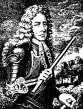
Sir John Owen, Royalist Commander
There are two ‘associational’ suggestions which might point to the parentage of Bartholomew owen; the first of these being a close association to Perry, Lane & Co., the mecantile house much involved with English/Virginia trade, and the transportation of emigrants, and to the family of William Pace.
The Pace association can be traced through William Corker:
Jane (Browne) Spencer m. (2) Thomas Jordan, neph. of Col. George Jordan, having issue: Mary, wife of Francis Sowersby. Thomas Jordan m. (2) Lucy Corker, dau. of the William Corker, who claimed a Richard Pace as headright; the said Richard being listed with Francis Sowersby as a tithable in 1678-80, and in various court records until 1682. In 1678, Ben Pace was listed with Samuel Watkins as a tithable. Watkin’s plantation was located about a mile northeast of Sowersby’s.
Richard Pace described himself as of Lawne’s Creek Parish, which was described by Anglican Church Historians as being a small parish north of the Blackwater River bounded by Lawne’s Creek, the James River, and Lower Chippoakes Creek. This area takes up what was then known as Hog Island in the James, and the peninsula that leads to it. This Richard Pace seems of some connection to this namesake: In 1611, Captain William Perry arrived in Virginia on the ‘Starr’, and m. Isabella, widow of Richard Pace, and came to live at ‘Pace’s Paines’. In Feb. 1631, he was Burgess for the territory ‘from Captain Perry’s to Hog Island’.
B. 6, p. 452: Bartolomew Owen, 648 acs., Surry Co., 14 May 1673. On S.W. side of John Chewakins Sw., & upon Mr. Corker. Granted to John Vincent, deserted, & now granted by order, &c., 20 Sept. 1671. Trans. of 13 pers: Robt. Prouse, Mary Ransome, William Taylor, Robert Greene, Tho. Wilkins, Tho. Taylor, Ann Stock, Elinor Edwards, Sym. Corlile; ‘for Importation of himself’.
In a deposition in James City, of August 19, 1660, Roger Rawlins, aged 26, said that he heard Owen ‘disparrage’ Captain Jordan and the Court, threatening him ‘publicky’ in company, saying ‘he longed to kick that man’s arse’. In September 1660, Mrs. Fortune Mills, a relative of Captain George Jordan, ‘deposeth’ that Bartholomew Owen of Surrey County, hath several times, in her hearing, spoken ‘dispairaging and scandalous’ words against the Commissioners and wholly against Captain Jordan saying ‘he never had justice done him in that Court’. The court found Bartholomew guilty of scandalous and defamatory language and appointed Captain George Jordan to sue and prosecute the said Owen at the next Quarter Court with full power and authority to use all lawful means, for their consideration. Robert Stanton, the court clerk recorded this judgement, on Sept. 10, 1660.
Richard Perry, of London, was the founder of the mercantile house, Perry, Lane & Co., and came to own the Mayflower: ‘Accounts for sugar, muscadet and whites consigned to Richard Perry in the Mayflower of London, master William Badiloe’ (HCA 30/840/74, f. 182, Oct. 8, 1636).
Richard Perry afors. was closely related to William Perry (who witnessed the Will of Richard’s brother, John), the second husb. of Isabella Smythe, whose first m. Richard Pace, and had issue: George Pace, recorded in a land patent dated Sept. 1, 1628, which reads: ‘Unto Georg Pace sonn and heire apparent to Richard Pace deceased … Four Hundred acres of land scituated and being within the Corporation of James Cities on the southward side of the river at the plantation called Paces Paines and formerly granted unto Richard Pace his father deceased by Patent from George Yardley, then Governor and Captt. General of Virginia, bearing date the fifth day of December Anno Domini One Thousand Six Hundred and Twentie. The said four hundred acres abutting westerly on the land of his mother Isabella Perry and easterly on the land of Francis Chapman now in the tenure of William Perry, Gent., his father-in-law'(stepfather). Isabella Smythe m. 1. Richard Pace, 2. William Perry, 2., 3. George Menifee. As I have recorded elsewhere, George Yardley was of Southwark, London, and transp. Thomas Harris of that place in 1621, whose likely son, Thomas Harris, d. 1668, who was transp. by Stephen Hamlin, Oct. 26, 1650, and res. at Paces Paines.
Richard Perry’s son, Henry Perry, was the son-in-law of George Menifee.
Micajah Perry, grandson of Richard, had a partner, Thomas Lane, who m. Mary Puckle. Edward Bathurst was m. to Mary’s sis., Susanna. Lane’s Will, pr. Nov. 10, 1710, states: ‘If my wife marry again, I give her sister Susanna Bathurst and her daughter Susanna L200 apiece’. ‘Thomas Lane of St. Catherine, Coleman, London bachelor, 40, and Mary Puckle of St. Catherine Creechurch, London, spinster 20, her parents dead and she at the disposal of her uncle Gray, of same, who consents … At St. Swithin, or St. Stephen, Walbrook, London. (Wm. & Mary Col. Quar. xviii., pp. 104-105). ‘Edward Bathurst of St. Catherine Creechurch, London, bachelor and Susannah Puckle of St. Dunstan, Stepney, Middlesex, spinster 22, her parents dead at St. Mary, Islington, Middlesex, 15 Sept. 1690’ (ibid., p. 95). This Edward Bathurst was the nephew of Lancelot Bathurst, as hereinafter follows, and was an agent for Micajah Perry in Maryland, in 1704. (Am. Col. 1st Ser.59).
MicaJah Perry m. Ann Owen. Micajah Perry of the parish of Mary-le-Bow, London, ‘haberdasher’, received a license on Oct. 20, 1663 to marry ‘Ann Owen of the parish of St Swithin, London, spinster’; her father being Dr. Richard Owen, a distinguished clergyman, son of Cadwaladr Owen. Richard Owen was ‘Fellow of Oriel College, Oxford, 1627; V. Eltham, Kent, 1635; R. St. Swithin, London, 1638. Deprived by the Parliamentary Committee. Restored. V. St. Mary’s Cray, and Preb. St. Paul’s. He published two Sermons, and translated into English the Satires of Juvenal'(Richard Thomas, Esgobaeth Llanelwy. A history of the diocese of St. Asaph). (Rev. Cadwaladr Owen was Rector of Llanfechain, co. Montgom., 1601-1617. Dr. Owen was a friend of Evelyn, the diarist, baptising his son, John. He m. twice: his first wife Anne d. March 12, 1652, giving birth to her tenth child; his second wife was Amy Kidwell, widow, of Eltham (their articles of marriage being recorded Feb 4, 1653), by who he had ‘with other issue’ Amy and Thomas Owen.
Dr. Owen had a numerous family. Five of his nine sons and three daus. were buried in Eltham Church, and are commemorated on a marble monument erected by Owen in 1679. His first wife, Anne, the mother of ten of his children, died in March 1652-3; and on Jan. 6, 1654-5 he m. Amy Kidwell, by whom he had at least two sons. She lived till March 1694. An amusing letter from her to John Evelyn in 1680, on the subjet of her ‘trading for tulips,’ is printed, with Evelyn’s answer, in the ‘Diary and Correspondence,’ 1859 (i. 41-2).
Inscription written by Dr. Owen. M. C., ‘In the middle of this chancel doe rest, waiting for the last trumpet, Ann the virtuous dear wife of Dr. Richard Owen, who died in childbed of their 10th, March 12, 1652-3; Richard, their eldest son, a year old, buried Mar. 24, 1641-2; Charles, their third, carried from the womb to the tomb, July 5, 1648; Edward, their fourth, who lived 27 years, grew to be a learned man, Master of Arts, Fellow of Magdalen College, in Oxford, took holy orders, a solid preacher, died of a consumption, and was buried July 15, 1678; James, their fifth, the mother’s sorrow, buried, six months old, Sep. 27, 1653; Mary, their second daughter, buried in her 31st year, Oct. 7, 1675; Jane, their fourth, taken off in her prime, aged 20, buried Mar. 11, 1663-4, Blainch, their fifth, buried in the third year of her age, Nov. 8, 1649; Thomas, his third son by his second wife, Amy, now living, (George, the elder by her, being lost at sea in the year 1674,) the great hope, joy, and grief of the parents, beloved of all, aged 23, buried April 26, 1679’.
Dr. Owen was buried in the chancell of Eltham Church on Jan 22, 1682. He is named in the Chirk Castle Accounts, 1666-1753: ‘paid Mr. Ambrose Sparrow the cheese factor, to be returned to Mr. Chalmondeley of London, to pay Dr. Owens in part for the lands bought of him at Llanvechan and Merionethshire cxviii’ – a messuage and tenement in the township of Bodynfol, par. Llanfechain, which had been rented at £20 per anum.
Lancelot Bathurst’s dau. m. Francis Merriwether, son of Nicholas Merriwether, whose estate was admin. by Bartholomew Owen.
Given that Lancelot Bathurst had common associations with Edward Meriwether, Nicholas may be this Edward’s son: Lancelot Bathurst. Sus/A/YO606, May 14, 1666: Indenture Articles of Agreement for Inclosure between the freeholders of Hothorpe co. Northants, viz. (1) Launcelott Bathurst Esq (6) Edward Marston and Mary Marston his mother. Sus/A/U908/T35/8, 1657: Edward Meriwether, plaintiff, Edward Marston, gent. and Mary, his wife, Thomas Burton and Elizabeth, his wife and Robert Wickenden otherwise Wiggenden, deforciants. Edward Meriwether (b. 1598) was the son of Ursula Shrubsole and Edward Meriwether (m. October 15, 1593); he m. Dorothy Thompson, whose mother was a dau. of Thomas Swanne of Wye. Ursula Shrubsole was the dau. of Richard Shrubsole; her aunt, thus , being Anne Shrubsole, who m. Thomas Barham. Her will beq, to Anthony Barham ‘now of Virginia’ Thomas Barham’s first wife was Elizabeth Meriwether, whose nephew, John, m. Alice , dau. of Sir William Crafford, and sister of Anne Crafford, who m. John Warren of Ripple. It was by an intermarriage with this Warren family that that the intermarried families of Harris, Newsome, Sheperd, and Spencer, of Southwark, London, shared ‘common ground’ in Virginia.
Laurence Bathurst settled on ‘S side Chickahomin’.
1. Robert Bathurst, m. (1) dau. of Wm. Saunders, and had issue: 1.1. John Bathurst, m. Mary, dau. of Edward Dodge. 1.1.1. Robert Bathurst, m. (2) Eliza, dau. and heir of Ralph Waller, and relict of Sir John Lawrence, Lord Mayor of London. 1.1.1.1. Sir Edward Bathurst and his second wife, Susan Rich (who m. 3. Richard Jordan, Sept. 18, 1674), had issue: 1.1.1.1.1. Lancelot Bathurst, had issue: Mary, m. Francis Meriwether, son of Nicholas Meriwether; Lawrence, who d. c. 1705, without issue; Elizabeth, m. (1) William Tomlin, (2) in 1709, William Daingerfield; Susanna m. Drury Stith. Lancelot Bathurst came to New Kent Co. with Edmund and Peter Toney as transportee of Henry Wyatt, Oct. 1, 1679; ‘Henry Wyatt 900 acres Henrico co S side Chickahomin … trans. of 18 persons: Laur. Bathurst, Edmd Tony, Peter Tony’ (B. 7, p. 259). 1.1.1.1.2. Robert Bathurst. 1.1.1.1.2.1. Edward Bathurst, br.in-law of Thomas Lane, Micajah Perry’s partner.
A deposition that Nicholas Meriwether gave established his birth date as c. 1631. On Oct. 8, 1677, Bartholomew Owen was granted Power of Attorney to Nicholas Meriwether, and, on Jan. 31, 1677, Jone Owen was granted administration of the estate of Bartholomew Owen, deceased …Richard Jordan purchased land which was part of Bartholomew Owen’s 1673 patent of 648 acres on Johnchecochunk Swamp … Deed, Nov. 13, 1679: Richard Jordan Sr. to Joseph Woory, 363 acres formerly granted by Gov. Chichely at northwest side of the head of Lower Bay Creek and mouth of Cypress Creek… to corner tree of Richard Reynolds, Jr… Witness: Wm. Crawford, Jno. Combe (B. 1, p. 414) … June 1686, Surry tithables, list of Samuel Swann for Southwarke parish: Rich. Jordan Junr. & his son Richd … Jul. 10, 1687: Elizabeth Jordan and Mary Swann witness to apprenticeship of Samuel Reade, orphan of William Reade, to William Edwards (ibid. p. 91) … Apr. 9, 1689: A deed from Robert (Owen, s/o Bartholomew) and Katherine (Proctor) Owen (his wife) to Nathaniel Roberts for 100 acres of a 648 acre patent to Bartholomew Owen, of May 14, 1681, on Johnchecohunk Swamp, is described as bounded by Richard Jordan and Roger Potter (ibid., p. 104) … Deed, Mar. 1, 1691: Nathaniel Roberts and wife Elizabeth Roberts to Robert House Jr., both of Southwarke parish, 250 acres on the east side of Johnokocan Swamp … Robert Owen’s old line … corner of Richard Jordan Sr… Jordan’s line … (ibid., p. 255). Roberts is selling the land that he bought from Bartholomew Owen’s adjacent Richard Jordan to Jordan’s son-in-law Robert House Jr.
This describes one of the ‘associational’ suggestions of the parentage of Bartholomew Owen. He may have been related to Dr. Richard Owen.
The second such suggestion, which I have described elsewhere, makes him a grandson of Edward Owen of Shrewsbury, who m. a 4th cousin of Lancelot Bathurst. Having read the wills of Edward Owen, and those of his sons and grandsons, and the deeds of Edward’s younger sons, Nathaniel and Leighton, and finding no mention of a Bartholomew Owen, I conclude he may not have been of this family, but of another substantial family, one with familial connections to Micajah Perry, and well equiped, therefore, to be able to speak as bluntly as he pleased, for many were in the pocket of Micajah Perry. Unfortunately, this potentially places Bartholomew Owen in a very large pond of Owens, which a net may never catch.
ADDENDA.
Richard Owen (1606–1683), royalist divine, was son of Cadwallader Owen (1562–1617), by Blanche, dau. of John Roberts, younger br. to Lewis Anwyl of Park, Merionethshire (Dwnn, Visitations of Wales, ii. 215). This is clearly wrong, and Blanche was most likely the aunt of John Roberts and Lewis Anwyl. Cadwallader, who was also of Merioneth, matriculated at Jesus College, Oxford, Nov. 24, 1581; graduated B.A. in 1583, M.A. in 1588, and B.D. in 1603; and was elected fellow of Oriel College in 1585. In 1597 he was acting as Sir Robert Harley’s tutor at Oriel College. He was appointed to the rectory of Llanfechain in Montgomeryshire in 1601, made vicar of Llanbrynmair in the same county in 1608, and sinecure rector of the same place in 1610. He was buried at Llanfechain on 6 April 1617 (Parish Register). He is said to have been a great disputant, and to have gone by the name of ‘Sic doces.’ Wood says that he had ‘heard he was a writer,’ but knew nothing of his works.
Lewis Anwyl’s dau. Catherine, m. William Owen (1624-1677), son of ‘Sir John Owen (1600- 1666), royalist commander, who was the eldest son of John Owen of Bodsilin , Walsingham ‘s secretary, and of Elin (later lady Eure ), granddaughter of Sir William Maurice. He was b. in 1600 at Clenennau, near Dolbenmaen, Caerns., his mother’s home; m. Janet, daughter of Griffith Vaughan of Cors-y-gedol, Mer. , and had some military experience before succeeding to Clenennau on his mother’s death in 1626 ( N.L.W. Brogyntyn 3/46 ). He was sheriff of Caernarvonshire in 1630-31 and of Merioneth next year … After the successful invasion of Wales by Sir Thomas Myddelton, he was summoned to Oxford , where the king made him governor of what became the ‘ffrontiere garrison’ of Conway’ (10 Dec. 1644) … After the royalist defeat … ‘Owen was committed to Denbigh castle, then brought to London for trial on charges of treason to parliament … After a spirited defence without the aid of counsel, he was condemned to death, but next day submitted a petition for reprieve (of which numerous drafts exist), with a success … By July he was free to entertain John Evelyn in London with a Welsh harpist , and he was home in Sept. An attempt to wring out of his estate, already decimated ( 27 May 1647 ) by a fine of £771, sums which had been earmarked in advance ( 10 Feb. 1646 ) for repaying loans contracted for Myddelton ‘s campaign … and Myddelton seems to have behaved considerately over the work of sequestration’ (Dict. of Welsh Biography).
Sir John Owen’s br., William Owen (1607-1670), inherited Porkington (now Brogyntyn ), Salop.
The Brogyntyn estate was situated in the parish of Selatyn near Oswestry. The earliest settlement on the site was a motte, supposedly associated with Owain Brogyntyn. By the mid-sixteenth century the owner was John Lacon, whose estate included Constable’s Hall at Porkington and Llanddyn near Llangollen in Denbighshire. His daughter, Margaret, was married in 1556 to William Maurice (1542-1622) of Clenennau in Penyfed, Caernarfonshire, eldest son of Moris ap Eliza and Ellen Puleston. Since 1501, when Moris ap John ap Meredudd received a gift of land in Clenennau from his foster-father, Rhys ap Ieuan ap Dicws Foel, the Moris family had accumulated property in Penyfed, Penmorfa, Trefan, Pennant, Clenennau and parts of Merionethshire. William Maurice continued this trend over the next five decades by the further acquisition of lands in Shropshire, Denbighshire and Merionethshire, by leases from the Corporation of Harlech and enclosures in Harlech Marsh. He was widowed in 1572, but remarried twice, in 1576 to Ellen Lewis, widow of John Lewis of Chwaen Wen, Anglesey, and in 1605 to Jane Johnes (nee Puleston), widow of Sir Thomas Johnes of Abermarlais, Carmarthenshire. From 1581 he held several important public offices in the county administration of Caernarfonshire and Merionethshire, and he was knighted upon the accession of James I in 1603. Sir William’s eldest son, William Wynn Maurice (1559-c.1598) had predeceased him, leaving two daughters, Ellen and Margaret, as coheiresses upon their grandfather’s death in 1622. Ellen Maurice (1578-1626), was married to John Owen of Bodsilin and Fernhill, secretary to Sir Francis Walsingham, and eight children were born prior to his death in 1611. She remarried in 1616, to Sir Francis Eure, Chief Justice of North Wales, by whom she had one son, Compton. By then she was living at Constable’s Hall, Porkington, where she had the house rebuilt in 1617. Ellen died in 1626, leaving her eldest son, John Owen (1600-1666), as heir to the Clenennau estate, and his brother William (1607-1670), to inherit Porkington’ (ibid.).
‘Owens, of Cefny Van, now called EstymCegid. Owen Gwynedd, Prince of North-Wales, and Sovereign of all Wales, for the Princes of South-Wales, and Powys, were but Tributarys to the Prince of North-Wales; Owen Gwynedd, bore vert three Eagles displayed in Fess. Or, Descendants from Owen Gwynedd, are Lloyds, of Rhiwedog; Wynns, of Clenenny; Owens, of Cefny Van, now called EstymCegid; Wynns, of Gwudun, Sir John Wynn, of Wynn Stay, Baronet; Wynns, of Maelmochnant; of Berthddu, and Bods Gallon; Gyfarch, Bodveddan and Conway; Lloyds, of Havod Lwyfog; Anwyls, of Park; Hughs, of Chwaen’ (John Reynolds (of Oswestry). A display of herauldry of the particular coat armours now in use, p. 2, 1739).
Richard Owen was born on 3 Oct. 1606 at Llanfechain, and baptised there on 7 Oct. following (par. reg.). He matriculated at Oxford on 28 June 1622, entering Oriel College as a servitor. On 30 March he was elected Dudley exhibitioner, and held the exhibition till 25 Oct. 1626. He was Bible clerk from 25 Oct. 1624 till 2 Feb. 1627, graduated B.A. on 19 Feb. 1624–5, was elected fellow of his college on 21 March 1627–8, and proceeded M.A. on 22 June 1630, and B.D. on 4 Dec. 1638. He became rector of Llanfechain in 1634, was instituted to the vicarage of Eltham in Kent on 10 Feb. 1636, and to the rectory of St. Swithin, London Stone, on 2 Sept. 1639. He resigned his fellowship at Oriel in 1638. In 1643 he was ejected from his livings on account of his adherence to the royalist cause. During his sequestration he resided at Eltham. He was on intimate terms with John Evelyn, at whose house (Sayes Court) he occasionally preached and administered the sacrament. On 13 Nov. 1656 he petitioned the council for liberty to preach; on 16 Dec. Dr. John Owen, vice-chancellor of Oxford, and Joseph Caryl certified his fitness, and referred his case to the committee for the approbation of public preachers, and he was approved on 30 Dec. In the same year he was made a minister of North Cray in Kent, and he resigned Eltham in 1658. At the Restoration he retained North Cray, and by act of parliament was allowed to choose which of his former livings should be restored to him. He chose St. Swithin. He was created D.D. of Oxford on 1 Aug. 1660, and received the prebend of Reculverland at St. Paul’s on 16 Aug. He died in January 1682-3, and was buried at Eltham on 27 Jan. He never wavered in his orthodoxy or his loyalty.
Owen is held by some to be responsible for the free transation and amplification in Latin of the ‘Royal Apologie’ (1648) by George Bate, entitled ‘Elenchus Motuum nuperorum in Anglia aimul ac juris regii ac parliamentarii brevis narratio,’ London, 1650. By others the ‘Royal Apologie’ and he ‘Elenchus’ are both assigned to Bate himself. Owen is also stated to have translated into English many, if not all, of Juvenal’s satires. but none seems to have been published. He published ‘Paulus, Multiformis concio ad clerum,’ London, 1666, a Latin sermon delivered at St. Alphege, London, on 8 May of the same year.
(Thomas’s Diocese of St. Asaph, p. 757; Foster’s Alumni Oxon. 1500-1714; Shadwell’s Reg. Orielense, pp. 173-4, 319; Wood’s Athenæ (Bliss), iv. cols. 84-5; Wood’s Fasti (Bliss), i. cols. 414, 455, 502, ii. col. 240; Hasted’s Hist. of Kent, i. 64, 159; Drake’s Hundred pf Blackheath, pp. 202, 203, 209, 211, 212; Newcourt’s Repertorium, i. 205, 543; Evelyn’s Diary, 1859, i. 258, 289, 297, 299, 300, 321-2, 346, iv. 41-3; Cal. State Papers, Dom. Ser. 1656-7 pp. 158, 199, 1660-1 p. 405; Le Neve’s Fasti (Hardy), ii. 431; Walker’s Sufferings of the Clergy, pt. ii. pp. 53, 173; Bluxam’s reg. of Magdalen coll. v. 285; Will in Somerset House P.C.C. 24 Drax; Welch’s Alumni Westmon.’ Llanfechain Parish Register per the Rev. David Jones).
1. Richard Perry, of St Antholins, d. 1649, served his apprenticeship at Buckland Manachorum. He rec. a small land grant in the Colony. He was a partner of James carter, a London shipmaster, with whom he exported woollen goods to Virginia. Carter d. in 1626 and left goods to his ‘kinsmen’ (the brs.) Richard and John Perry. John Perry took over the Carter estate, and d. in Virginia in 1628; his Will was dat. June 26, at Perrys Point, near James City, with William Perry being witness.
1.1. Richard Perry. He was described as ‘Richard Perry of Glascow in Scotl(an)d gent’, and was a collector of customs and exise. He moved to Ireland in 1657, becoming a merchant in Clonmell.
1.1. Micajah Perry was apprenticed in 1656 to Robert Carter,’citisen and Haberdasher of london’, son of John Carter of Middlewich, Cheshire. His apprenticeship terminated in 1663, the year he m. Ann Owen (he was actually 22 years old). Ann could not have had a large dowry as her father had suffered privation under Cromwell, but she rec. some property because Micajah used it to aquire land in ireland. Micajah helped his br. Peter become a merchant in York co. Virginia,as partner in the firm Hill, Perry, and Randolph (William Randolph). Micajah d. aged 80.
1 Hwfa ap Cynddelw, of Presaddfed, d. aft. 1169, Lord of Llifion, m. Ceinfryd Verch Ednowain Bendew.
2 Methusalem ap Hwfa, of Llanfaethlu, Anglesey (3rd son), m. Agnes verch Gryffydd ap Conan.
3 Meredydd ap Methusalem, m. Angharad verch Llowarch Hwllbwrch.
4 lorwerth ap Meredydd, m. Gwenhyfer verch Jevah.
5 Gruffydd ap lorwerth, m. Gwenllian verch Rhirid Flaid.
6 Iorwerth ap Gruffudd, m. Gwladys verch Howel.
7 Iorwerth Ddu ap Iorwerth, m. Gwenllian, dau of Howel Goeg ap Iorwerth ap Cadwgan.
8 Hywel ap Iorwerth Ddu, m. Angharad Verch Howel Ap Cynwrig Vychan (of Tre Brys & Hiraethog) ap Cynwrig ap Llowarch ap Heilyn Goch, of Carwed Fynydd.
9 Hwlcyn ap Hwyel, killed fighting with Owen Glyndwr against Henry IV., m. Eurddyled verch Ierwerth ap Dafydd Llwyd.
10 Llewellyn ap Hwlcyn, m. Mali, dau. of Ifan Llwyd of Bodsilin ap Griffith ap Grono ap Howell ap Cunfig ap Jorwerth ap Yarthur ap Cynddulodigi, King of Wales.
11 Meurig ap LLewellyn, m. Margaret verch Ieuan Vychen ap Evan ap Adda ap Iorwerth Ddu, of Pengwern, Denbigh.
12 Owen ap Meurig, d. 1530, m. Eleanor verch Robert ap Meredith ap Hwleyn Lloyd, of Glynllifon.
12 John ap Meurig, m. Angharad verch Gruffydd ap Howell ap David ap Meredith or Angharad verch Gruffydd ap Howel ap Madog ap Ieuan ap Einion, of Lleyn
13 Robert ap John, m. Gwenhwyvar verch William ap Meredith ap Rys.
14 Owen ap Robert, of Bodsilin, m. Angharad verch Dafydd ap William ap Griffith ap Robyn.
15 Robert Owen, of Bodsilin, co. Carnarvon, d. aft. 1588, m. (1) Anne Wynne, dau. of John Wynne of Hirdrefaig, (2) Lowry Coetmor, dau. of William Coetmor. ‘Robert, son and heir of Owen ap Robert, was descended from Hwfa ap Cynddelw, founder of one of the noble tribes of N. Wales. Robert’s great-great-grandfather, Meurig, was son of Mali (Mary), heiress of Bodsilin. A window in Llangadwaladr Church contains memorials of him and his father, Llewelin, with Meurig’s armorial bearings, gu., a chevron, bet. three lions rampant, or. Underneath is this linguistic curiosity,— “Orate pro animabu: Meyrick ap Llewelyn ap Hulkin, and Marggaretae uxoris, and Odueni Meyrick and Ellene, ferch Roberti Meredith de Glynlleon, Armigeri, uxoris suae, qui hanc fenestram fieri facierunt”. Robert of Bodsilin signed his name in 1588 “ Robert Owen”. His arms were, the coat of Hwfa ap Cynddelu, gules, a chevron, bet. three lions rampant, or; (2) those of Cochwillan; (3) those of Jarddur’ (Thomas Nicholas, Annals and Antiquities of the Counties and County Families of Wales, p. 27, 1872).
16 John Owen b: c. 1560, d. March 17, 1611. m. Ellin Maurice (Morris) b. 1578, d. 1626, dau. of William Wynne Maurice of Clenneney, son of Sir William Maurice of Clenenney, Sheriff of Cardiganshire, and Margaret, dau of John Wynn Lacon of Llanddyn, son of Maurice of Clenenney, d. 1575, and Elin Puleston, d 1577, dau of Sir John Puleston of Bersham.
John Owen is noted as having three brothers. In that Cadwalladr Owen was born at Maentwrog (see Bertha Porter, ‘Cadwallader Owen (c.1562–1617)’, Oxford Dictionary of National Biography, 2004), and this was owned by the Wynn family of Glyn, Merioneth, an heiress of which m. John Owen’s great-grandson, as follows, whose mother was Katherine Anwyl, cousin of Cadwallader Owen’s wife, there is a high probability of the said Cadwalladr being a br. of John Owen.
‘The road T0 Maentwrog lies up an arduous path, on the side of a craggy mountain, in a N. direction, over a trackless plain, known to guides by Meini-hirion, and concentric circles of stone. A tumulus and carnedd, larger than the others, is styled King Ingo’s Tomb. The place is also called Bon-llef-hr’r, or. ‘the Loud Shout to Battle’. A columnar stone is reared here of an unusual size, probably in memory of a chief who fell in battle. A road leads hence to Glyn, a seat of Robert Godolphin Owen, Esq., situated in a romantic well-wooded bottom, it formerly belonged to the ancient family of Wynne, whence it passed, by marriage, to Sir Robert Owen’ (Nicholson’s Cambrian Traveller’s Guide, p.. 280, 1840).
Eight children were born prior to John Owen’s death in 1611 (Brogyntyn Estate records,S.A. GB 0210 Brotyn), and it may reasonably be summised that Bartholomew Owen was a son of one of three brothers, John, William, or Maurice, and b. c. 1630.
17 Sir John Owen, b. 1600, Clenennau, Dolbenmaen, Caernarvonshire, his mother’s home, d. 1666, m. Janet Gruffydd.
18 William Owen, d. 1678. m. Katherine Anwyl, d. bef. 1685.
19 Robert Owen, d. 1698, m. Margaret Wynn, b. June 7, 1663, at Glyn, Merioneth.
Thus:
1. Robert Owen, of Bodsilin, m. Anne Wynne. 1.1. John Owen, m. Ellin Morris. 1.1.1. Sir John Owen, Royalist commander. 1.1.1.1. William Owen, m. Katherine Anwyl, dau. of Lewis Anwyl, whose aunt (I suggest) was the wife of Cadwalladr Owen. 1.2. Cadwalladr Owen. 1.2.1. Dr. Richard Owen. 1.2.1.1. Amy Owen , m. Micajah Perry, partner of Thomas Lane, who m. a dau. of Lancelot Bathursts nephew, who worked for Micajah Perry in Maryland, in 1704.. Lancelot Barhurst’s dau. m. Nicholas Meriwether, whom Bartholomew Owen was Power of Attorney. Micajah Perry was closely related to william Perry, who m. Isabella, widow of Richard Pace, whose descendant was a headright of William Corker, Bartholomew Owen’s neighbour. 1.1.2. … Owen. 1.1.2.1. Bartholomew Owen. He is noted in Virginia in the mid 1650’s, coinciding with the Royalist defeat in the English Civil War, and the harsh treatment of such as Sir John Owen. He transported Mary Ransome. Robert Ransome was the capatain of the ‘Planters Adventure betw. 1677 and 1681, bound from London to Virginia. He also served as first officer on the ‘Culpepper’, a Perry and Lane ship, which Micajah Perry used on his cross-Atlantic voyages. HCA 26/1/57: ‘Commander: John Wynn. Ship: Culpepper…of London. Burden: 460 tons. Crew: 40. Chief mate: Robert Ransome. December 17, 1689’.
Thus, perhaps a reasonable suggestion?
copyright m stanhope 2015


 Walter FitzGilbert de Hamilton