
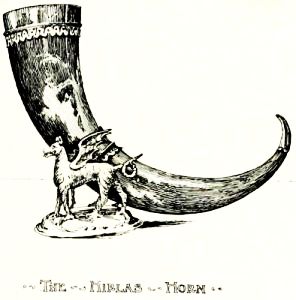
Owen Cyveilioc
Hirlas Horn (The Long Blue Horne)
Sharon Turner. The History of the Anglo-Saxons. vol iii., p. 333, 1840:
Another princely Bard was Owen Cyveilioc. He flourished between 1150 and 1197. He was the prince of Powys. He was engaged in some intestine conflicts with Howel; he fought with our Henry, and at last excited against himself Owen of Gwynedd, the hero of the poetry of Gwalchmai and Cynddelu. This hero defeated and expelled Owen Cyveilioc in 1166 from Powys, to which, however, he was re-admitted.
The prince was a turbulent warrior, generally fighting with some of his neighbours. His Hirlas, however, shows that he possessed a strong poetic genius, and applied it to celebrate the warriors who accompanied him in his quarrels. The plan of the poem is ingenious and picturesque. He fancies himself surrounded by his chiefs at the festive table, rejoicing in their victory; and he orders his cupbearer to pour out the generous beverage to those whom he intends to celebrate, and whom he selects and describes successively. Two of his accustomed companions,and favourite warriors,were Moreiddig and Tudyr, who had just perished in a preceding battle. In the ardour of his festivity and panegyric, he forgot that they were no more. Therefore, after directing the horn of mead to be sent to his warriors, and after addressing each of them with appropriate praise,he proceeds to send it to Moreiddig and Tudyr. He recites their merit— he turns to greet them — but their place is vacant — he beholds them not— he hears their dying groan — he recollects their fate — his triumphant strains cease—his hilarity flies, and the broken tones of mournful exclamation suddenly burst out. Shall I be pardoned if I disgress awhile to insert the passage in a close translation?
“Fill, cupbearer, seek not death-
Fill the horn of honour at our banquets,
The long blue horn, of high privilege, of ancient silver,
That covers it not sparingly;
Bear to Tudyr, eagle of slaughter,
A prime beverage of florid wine.
Thy head shall be the forfeit if there come not in
The most delicious mead
To the hand of Moreiddig, encourager of songs;
May they become old in fame before they leave us!
Ye blameless brothers of aspiring souls,
Of dauntless ardour that would grasp ev’n fire;
Heroes, what services ye have achieved for me!
Not old disgustingly, but old in skill;
Unwearied, rushing wolves of battle;
First in the crimsoned rank of bleeding pikes,
Brave leaders of the Mochnantians, from Powys,
The prompt ones, in every need,
Who rescue their borders from violence,
Praise is your meed, most amiable pair:
Ha! — the cry of death — And do I miss them —
O Christ!— how I mourn their catastrophe —
O lost Moreiddig — how greatly shall I need thee!“


 Walter FitzGilbert de Hamilton